TEL:+86 132 6656 7067




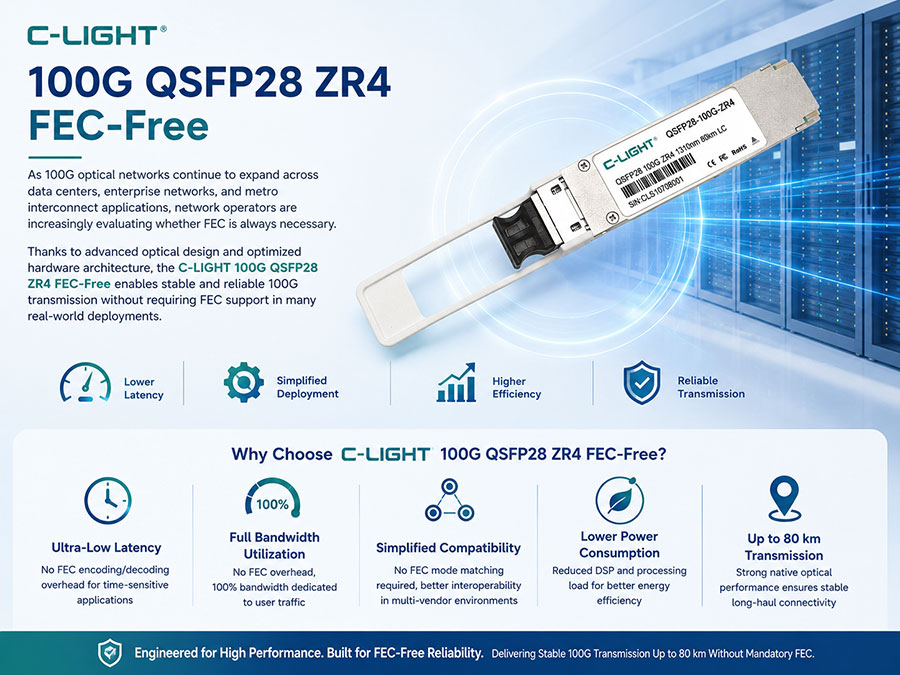
As 100G optical networks continue to expand across data centers, enterprise networks, and metro interconnect applications, network operators are increasingly evaluating whether Forward Error Correction (FEC) is always necessary.
While FEC can improve error tolerance in challenging optical environments, it also introduces additional processing overhead, latency, and configuration complexity. Thanks to advanced optical design and optimized hardware architecture, the C-LIGHT 100G QSFP28 ZR4 FEC-Free enables stable and reliable 100G transmission without requiring FEC support in many real-world deployments.
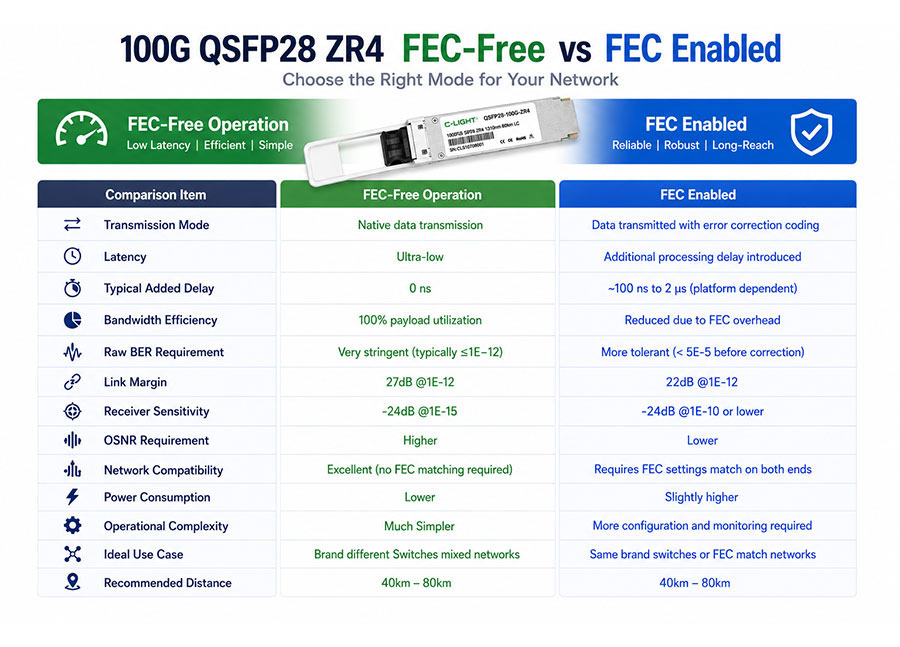
What Is the Difference Between FEC-Free and FEC Enabled?
FEC (Forward Error Correction) adds redundant coding to transmitted data, allowing the receiver to detect and correct certain transmission errors. This improves tolerance to degraded optical signals but requires additional encoding and decoding processes.
By contrast, FEC-Free operation transmits native Ethernet traffic directly, eliminating FEC overhead and reducing system latency.
100G QSFP28 ZR4 FEC-Free vs FEC Enabled
Why Choose the C-LIGHT 100G QSFP28 ZR4 FEC-Free?
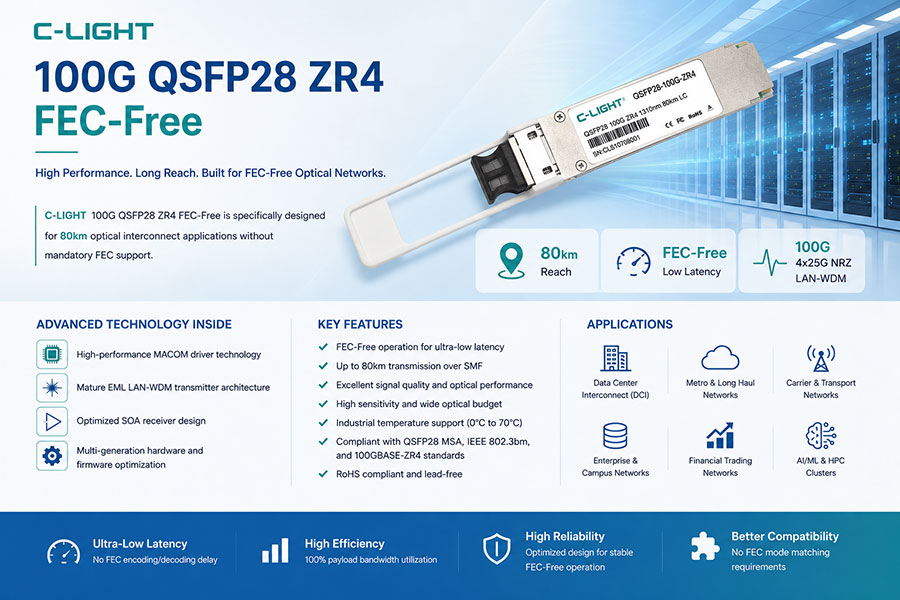
The C-LIGHT 100G QSFP28 ZR4 FEC-Free is specifically designed for 40 km, 60 km, and 80 km optical interconnect applications without mandatory FEC support.
Built with:
High-performance MACOM driver technology
Mature EML LAN-WDM transmitter architecture
Optimized SOA receiver design
Multi-generation hardware and firmware optimization
the module delivers excellent signal quality and optical performance while maintaining stable operation in FEC-disabled environments.
Key Features
QSFP28 Form Factor
100Gbps (4 × 25.78G NRZ)
LAN-WDM 1295–1309 nm
Duplex LC Interface
Up to 80 km Transmission Reach
Up to 27 dB Optical Link Margin
Receiver Sensitivity up to -24 dBm
Low Power Consumption
Carrier-Grade Reliability
Advantages of FEC-Free Operation
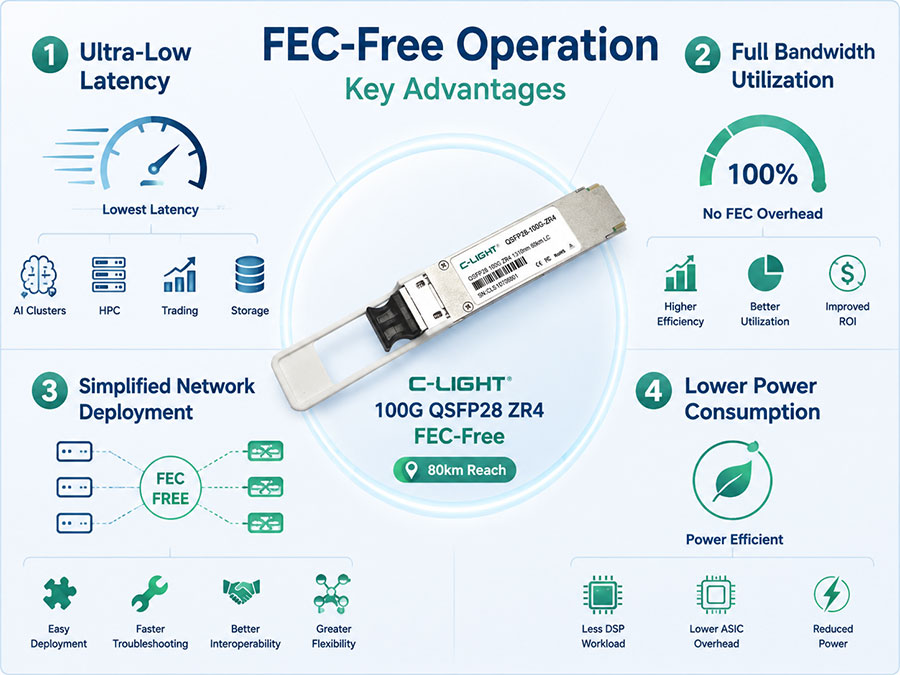
1. Ultra-Low Latency
FEC encoding and decoding introduce additional processing delays. Although typically measured in nanoseconds or microseconds, these delays can become critical in latency-sensitive environments.
C-LIGHT FEC-Free technology allows:
Faster packet forwarding
Reduced network latency
Improved real-time application performance
Ideal for:
AI Clusters
High-Performance Computing (HPC)
Financial Trading Networks
Storage Replication Systems
2. Full Bandwidth Utilization
With no FEC overhead, all available bandwidth is dedicated to user traffic.
Benefits include:
Higher transmission efficiency
Better network resource utilization
Improved ROI on infrastructure investments
3. Simplified Network Deployment
One common issue in multi-vendor environments is FEC incompatibility.
Different switch vendors may implement:
RS-FEC
KP4-FEC
Proprietary FEC configurations
FEC-Free operation eliminates these concerns by removing FEC dependency entirely.
Advantages include:
Easier deployment
Faster troubleshooting
Improved interoperability
Greater flexibility in mixed-brand networks
4. Lower Power Consumption
Without FEC processing requirements, network equipment can reduce:
DSP workload
ASIC processing overhead
Overall system power consumption
This contributes to improved operational efficiency in large-scale deployments.
Proven Optical Performance
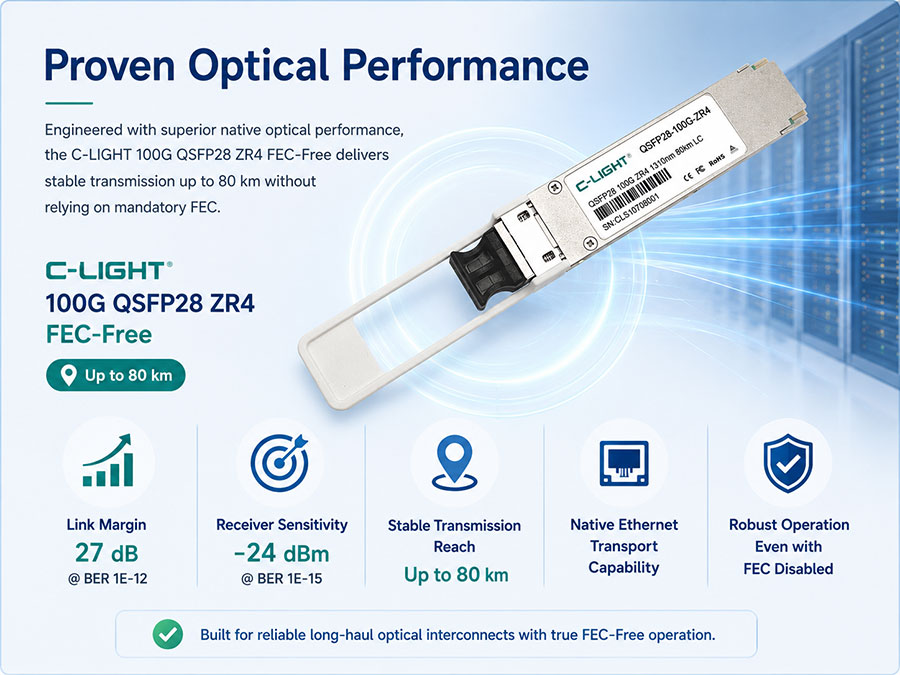
Unlike conventional solutions that rely heavily on FEC to compensate for limited optical margin, the C-LIGHT 100G QSFP28 ZR4 FEC-Free is engineered with sufficient native optical performance to support stable transmission without mandatory error correction.
Key optical indicators include:
Link Margin: 27 dB @ BER 1E-12
Receiver Sensitivity: -24 dBm @ BER 1E-15
Stable Transmission Reach: Up to 80 km
Native Ethernet Transport Capability
These characteristics enable robust operation even when FEC is disabled.
Conclusion
Both FEC-Free and FEC Enabled deployments have their place in modern optical networks. FEC remains beneficial for challenging optical environments and long-haul applications, while FEC-Free operation offers significant advantages in latency, efficiency, compatibility, and simplicity.
For organizations seeking reliable 100G transmission without the overhead and complexity of FEC, the C-LIGHT 100G QSFP28 ZR4 FEC-Free provides an optimized solution that combines:
✔ Ultra-Low Latency
✔ Full Bandwidth Efficiency
✔ Excellent Multi-Vendor Compatibility
✔ Simplified Deployment
✔ Carrier-Grade Optical Performance
✔ Stable 40 km–80 km Transmission
10. Frequently Asked Questions (FAQ)
Q1. What is the difference between 100G QSFP28 ZR4 FEC-Free and FEC Enabled optical transceivers?
Answer: The main difference between 100G QSFP28 ZR4 FEC-Free and FEC Enabled optical transceivers is whether Forward Error Correction (FEC) is required during data transmission. FEC Enabled solutions use additional error correction coding to improve signal tolerance, while FEC-Free solutions transmit native Ethernet traffic directly, reducing processing overhead, latency, and configuration complexity.
Q2. What is a 100G QSFP28 ZR4 optical transceiver used for?
Answer: A 100G QSFP28 ZR4 optical transceiver is designed for long-distance 100GbE transmission over single-mode fiber. It is commonly used in Data Center Interconnect (DCI), metropolitan networks, telecom infrastructure, and enterprise backbone connections requiring reliable transmission distances from 40km to 80km.
Q3. Why choose a FEC-Free 100G ZR4 optical module?
Answer: A FEC-Free 100G ZR4 optical module provides lower latency, simplified network deployment, and improved bandwidth efficiency by eliminating FEC encoding and decoding processes. It is suitable for applications requiring fast response, efficient bandwidth utilization, and easy interoperability across different network platforms.
Q4. Does a 100G ZR4 optical module need FEC for 80km transmission?
Answer: Not always. A properly designed 100G QSFP28 ZR4 optical module with sufficient optical performance and link margin can support stable transmission without mandatory FEC in suitable network conditions. Factors such as fiber quality, link loss, optical budget, and system compatibility determine whether FEC is required.
Q5. What are the advantages of FEC-Free operation in 100G optical networks?
Answer: FEC-Free operation provides several advantages, including lower transmission latency, reduced processing overhead, lower power consumption, and simpler network configuration. It is especially beneficial for latency-sensitive applications such as AI clusters, HPC systems, storage replication, and high-performance data center networks.
Q6. When should I choose FEC Enabled instead of FEC-Free 100G ZR4?
Answer: FEC Enabled 100G ZR4 is recommended for challenging optical environments where additional error correction capability is required. Networks with higher fiber loss, longer link margins, or strict error performance requirements may benefit from FEC support to improve transmission reliability.
Q7. What are the main applications of 100G QSFP28 ZR4 FEC-Free optical modules?
Answer: 100G QSFP28 ZR4 FEC-Free optical modules are mainly used in Data Center Interconnect (DCI) networks, metro optical links, cloud data centers, telecom networks, and enterprise backbone systems. They are suitable for scenarios requiring long-distance 100G connectivity with low latency and simplified deployment.
Q8. How do I choose between FEC-Free and FEC Enabled 100G ZR4 optical transceivers?
Answer: The choice depends on network requirements, transmission distance, and system compatibility. FEC-Free ZR4 is ideal for networks prioritizing low latency, efficiency, and simplified deployment, while FEC Enabled ZR4 is better suited for environments requiring additional error correction capability and higher tolerance to optical impairments.
 >
>

 >
>
 >
>
 >
>
 >
>
 >
>
 >
>
 >
>