TEL:+86 132 6656 7067




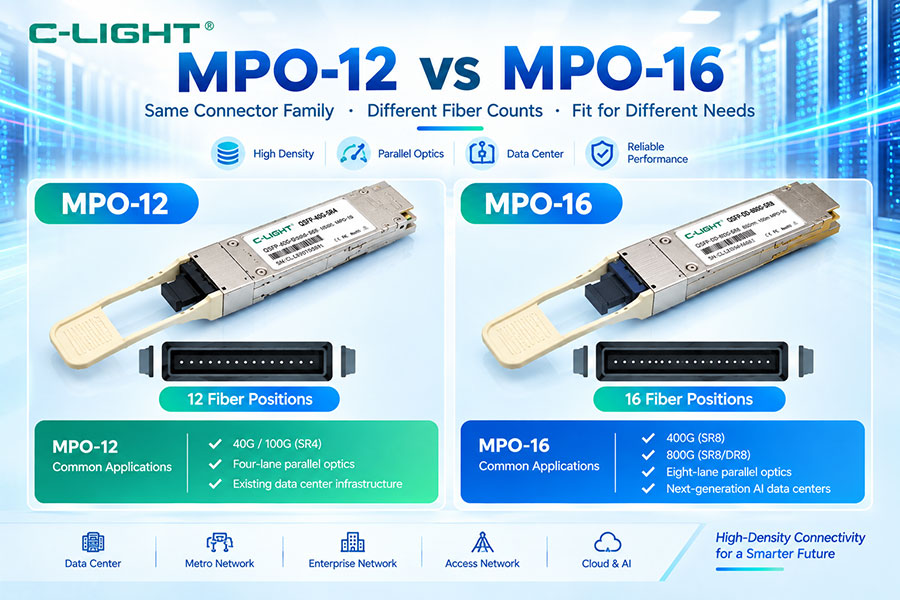
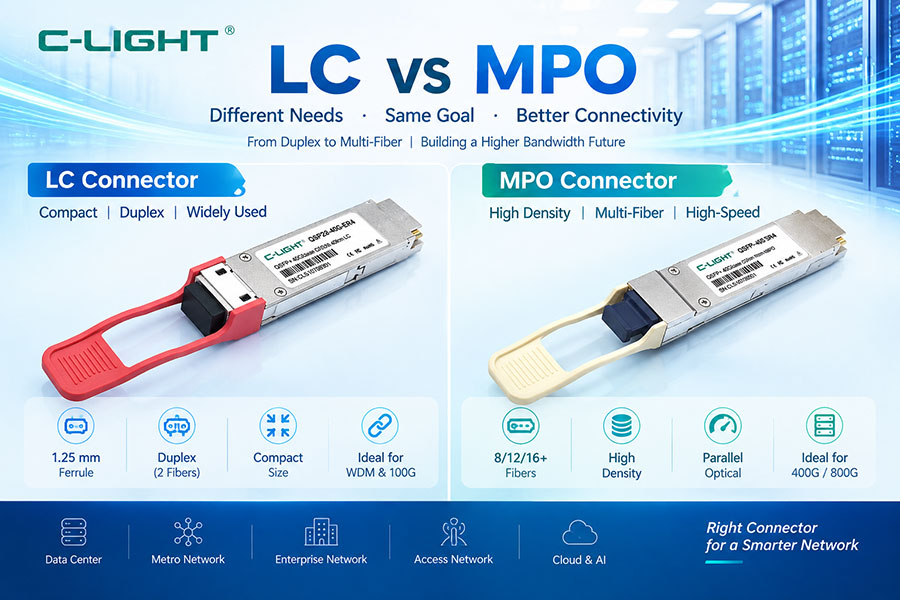
MPO-12 and MPO-16 are multi-fiber optical connectors used in high-density data center cabling. The main difference is the number of fiber positions: MPO-12 provides 12 fibers, while MPO-16 provides 16. This difference becomes especially important for 400G and 800G parallel optical systems, where lane count, fiber utilization, breakout design, and polarity must match the transceiver interface.
1. What Is MPO-12?
MPO-12 is a multi-fiber connector with 12 fiber positions arranged in a single row. It has been widely used in data center fiber infrastructure, especially for 40G and 100G parallel optical systems.
Because many four-lane optical architectures require eight active fibers, MPO-12 can provide the required connection while leaving some fiber positions unused.
2. What Is MPO-16?
MPO-16 is a multi-fiber connector with 16 fiber positions in a single row. It is particularly suitable for newer high-speed parallel optical architectures that use eight transmit fibers and eight receive fibers.
MPO-16 is therefore closely associated with 400G and 800G eight-lane optical systems.
3. MPO-12 vs MPO-16: Basic Difference
| Feature | MPO-12 | MPO-16 |
|---|---|---|
| Fiber positions | 12 | 16 |
| Fiber arrangement | Single row | Single row |
| Typical architecture | 4-lane parallel optics | 8-lane parallel optics |
| Common applications | 40G, 100G, some 400G | 400G SR8, 800G SR8/DR8 |
| Fiber utilization | May leave unused fibers | Can use all 16 fibers for 8 Tx + 8 Rx |
| High-density scalability | Good | Higher for 8-lane systems |
4. MPO-12 vs MPO-16 Fiber Count
The most important difference is straightforward: MPO-12 has 12 fiber positions and MPO-16 has 16.
For an eight-lane bidirectional optical link, eight fibers are needed for transmit and eight fibers are needed for receive, giving a total of 16 fibers. MPO-16 can therefore accommodate the complete fiber set in one connector.
5. Why Does Fiber Count Matter?
Modern parallel optical systems divide the total data rate across multiple optical lanes. The number of lanes determines how many optical fibers are required.
For example, a four-lane architecture normally requires four transmit fibers and four receive fibers, or eight active fibers. An eight-lane architecture requires 16 active fibers when transmit and receive use separate fibers.
6. MPO-12 for 40G and 100G
MPO-12 has been widely deployed with 40G SR4 and 100G SR4 systems. These architectures use four transmit and four receive fibers, requiring eight active fibers in total.
An MPO-12 connector therefore has additional fiber positions available in these applications. This helped make MPO-12 a practical solution for earlier generations of parallel data center optics.
7. MPO-12 for 400G
MPO-12 can still be used with certain 400G architectures, particularly four-lane designs such as DR4. An eight-fiber optical connection can use four fibers for transmit and four for receive.
In an MPO-12 implementation, some fiber positions may remain unused. The exact connector configuration must always follow the transceiver and cabling specifications.
8. MPO-16 for 400G SR8
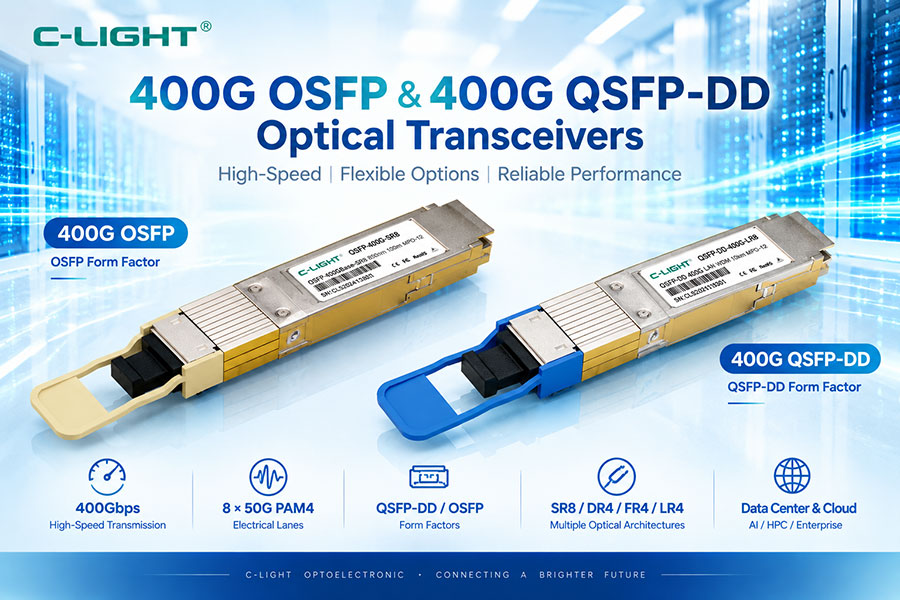
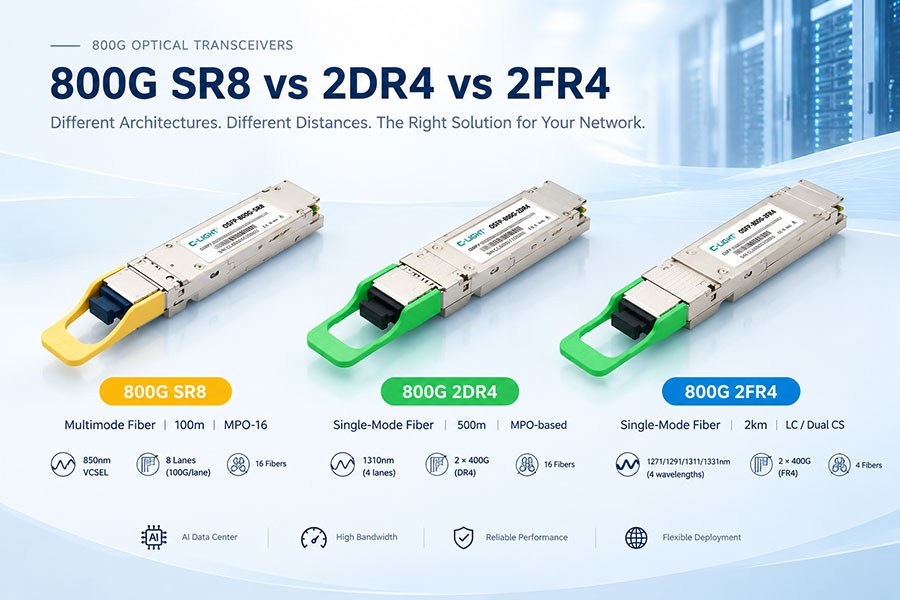
400G SR8 uses eight optical lanes. When each direction has eight fibers, the complete connection requires 16 fibers.
MPO-16 provides 16 fiber positions and is therefore a natural interface for 400G SR8 parallel optics.
9. MPO-16 for 800G
800G parallel optical systems can also use eight optical lanes. In an architecture with eight transmit and eight receive fibers, 16 fibers are required.
MPO-16 is therefore commonly associated with 800G SR8 and DR8 architectures that use a 16-fiber interface.
10. MPO-12 vs MPO-16 for 400G and 800G
| Optical System | Typical Lane Structure | Fiber Requirement | Typical Interface |
|---|---|---|---|
| 40G SR4 | 4 × 10G | 8 fibers | MPO-12 |
| 100G SR4 | 4 × 25G | 8 fibers | MPO-12 |
| 400G DR4 | 4 × 100G | 8 fibers | MPO-12 or architecture-dependent |
| 400G SR8 | 8 × 50G | 16 fibers | MPO-16 |
| 800G SR8 | 8 × 100G | 16 fibers | MPO-16 |
| 800G DR8 | 8 × 100G | 16 fibers | MPO-16 or architecture-dependent |
11. MPO-12 vs MPO-16 for Fiber Utilization
MPO-12 can provide excellent fiber density, but four-lane architectures may not use all 12 positions.
MPO-16 is more closely aligned with eight-lane systems because all 16 fiber positions can be assigned to eight transmit and eight receive lanes.
This makes MPO-16 attractive when the cabling system is designed specifically for high-speed parallel optics.
12. MPO-12 vs MPO-16 for Breakout Cabling
Breakout design is an important consideration when selecting between MPO-12 and MPO-16.
A four-lane 400G connection can be broken out into four lower-speed optical links using an appropriate MPO-to-LC or MPO-to-MPO configuration. Eight-lane systems require a fiber mapping capable of handling all eight optical lanes.
The breakout cable must match the transceiver fiber count, lane mapping, polarity, and connector configuration.
13. MPO-16 and 800G Breakout
An eight-lane 800G connection can be divided into multiple lower-speed connections when the optical architecture and transceiver support the required breakout configuration.
Because the native interface can contain 16 fibers, MPO-16 provides a convenient physical platform for managing the complete eight-lane connection.
14. MPO-12 vs MPO-16 Polarity
Both MPO-12 and MPO-16 require correct polarity management. Polarity determines how transmit fibers at one end connect to receive fibers at the opposite end.
MPO systems commonly use Type A, Type B, or Type C polarity methods. The selected method must be compatible with the transceiver, trunk cable, patch cable, cassette, and breakout configuration.
15. MPO-12 vs MPO-16 Keying
MPO-12 and MPO-16 interfaces are not simply interchangeable versions of the same connector. Their mechanical configuration and keying can differ, so an MPO-16 interface should not be assumed to mate directly with an MPO-12 interface.
The connector type specified by the optical module and cabling system should always be confirmed before deployment.
16. MPO-12 vs MPO-16 Fiber Type
The connector fiber count does not determine whether the cable is multimode or single-mode. Both MPO-12 and MPO-16 can be used with different fiber types depending on the application.
Short-reach SR systems commonly use multimode fiber, while DR systems generally use single-mode fiber. The fiber type must therefore be selected according to the optical transceiver rather than the MPO fiber count alone.
17. MPO-12 vs MPO-16 for AI Data Centers
AI data centers are increasing the use of high-speed parallel optical links because GPU clusters and high-radix switches require large numbers of high-bandwidth connections.
MPO-16 is particularly useful for eight-lane optical architectures because its 16 fiber positions directly correspond to the eight transmit and eight receive fibers required by many 400G and 800G designs.
18. MPO-12 vs MPO-16 for High-Density Cabling
Both connectors provide high-density connectivity compared with individual duplex connectors. The main difference is how efficiently their fiber count matches the optical architecture.
MPO-16 can reduce unused fiber positions in eight-lane systems, while MPO-12 remains practical for four-lane systems and installed infrastructure.
19. MPO-12 vs MPO-16 and Future Network Upgrades
Network upgrade planning should consider the lane architecture of future optical modules. A cabling system designed only around four-lane optics may require changes when the network moves to eight-lane 400G or 800G systems.
For new high-density AI data center deployments, the required fiber count, connector type, polarity, and breakout architecture should be considered together rather than selecting an MPO connector solely by current port speed.
20. MPO-12 vs MPO-16: Advantages
| MPO-12 Advantages | MPO-16 Advantages |
|---|---|
| Large installed base | 16 fibers in one connector |
| Well suited to four-lane optics | Well suited to eight-lane optics |
| Common for 40G and 100G | Strong fit for 400G SR8 and 800G |
| Useful for existing cabling infrastructure | Efficient fiber utilization for 8-lane links |
| Suitable for many breakout applications | High-density future-oriented cabling |
21. MPO-12 vs MPO-16: Which One Should You Choose?
| Requirement | Recommended Choice |
|---|---|
| Existing 40G/100G SR4 infrastructure | MPO-12 |
| Four-lane 400G architecture | MPO-12 or specified interface |
| 400G SR8 | MPO-16 |
| 800G SR8 | MPO-16 |
| Eight-lane parallel optics | MPO-16 |
| Legacy MPO-12 infrastructure reuse | MPO-12, if supported by the optical architecture |
| New high-density AI data center | MPO-16 when required by the selected optics |
22. MPO-12 vs MPO-16: Selection Considerations
Connector selection should not be based on fiber count alone. Before ordering an MPO cable or transceiver, verify the optical lane count, fiber type, connector gender, key orientation, polish type, polarity method, insertion loss, transmission distance, and breakout configuration.
23. MPO-12 vs MPO-16: Common Mistakes
One common mistake is assuming that all MPO connectors are interchangeable. MPO-12 and MPO-16 have different fiber counts and interface configurations.
Another mistake is selecting a cable based only on the nominal data rate. Two 400G transceivers can use different optical architectures and therefore require different connector and fiber configurations.
24. MPO-12 vs MPO-16: Summary
MPO-12 and MPO-16 are both important multi-fiber connector configurations, but they serve different optical architectures. MPO-12 is strongly associated with four-lane parallel optics and established 40G/100G infrastructure, while MPO-16 provides 16 fiber positions for eight-lane 400G and 800G parallel optical systems.
For a new deployment, the correct choice should be determined by the transceiver's lane architecture and cabling design. Fiber count, polarity, connector keying, fiber type, breakout configuration, and link budget should all be verified before deployment.
 >
>

 >
>
 >
>
 >
>
 >
>
 >
>
 >
>
 >
>