TEL:+86 132 6656 7067




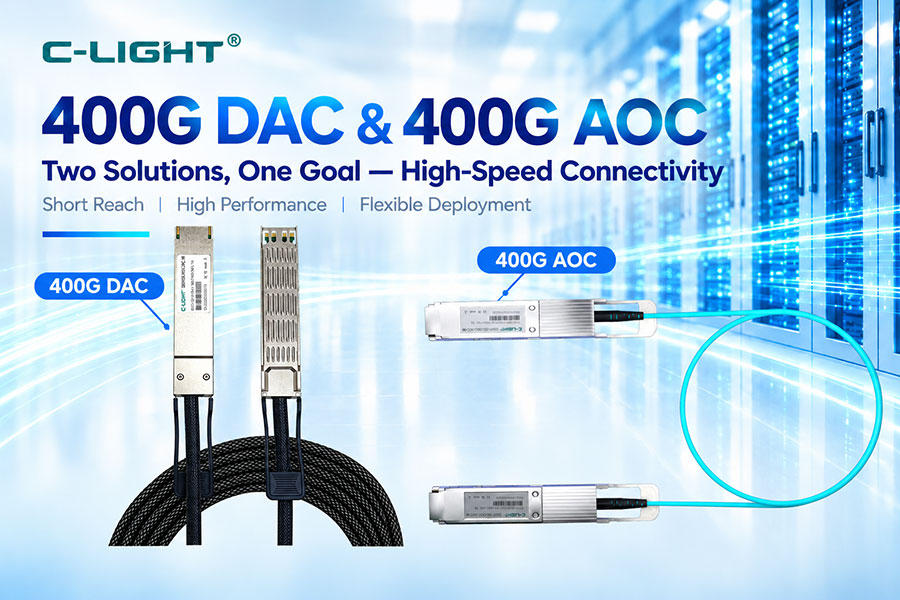
400G DAC and 400G AOC both provide high-speed 400Gbps connectivity, but they differ in transmission medium, reach, power consumption, cost, and deployment scenarios. DAC uses direct copper transmission for very short links, while AOC integrates optical transceivers with multimode fiber for longer short-reach connections.
1. What Is 400G DAC?
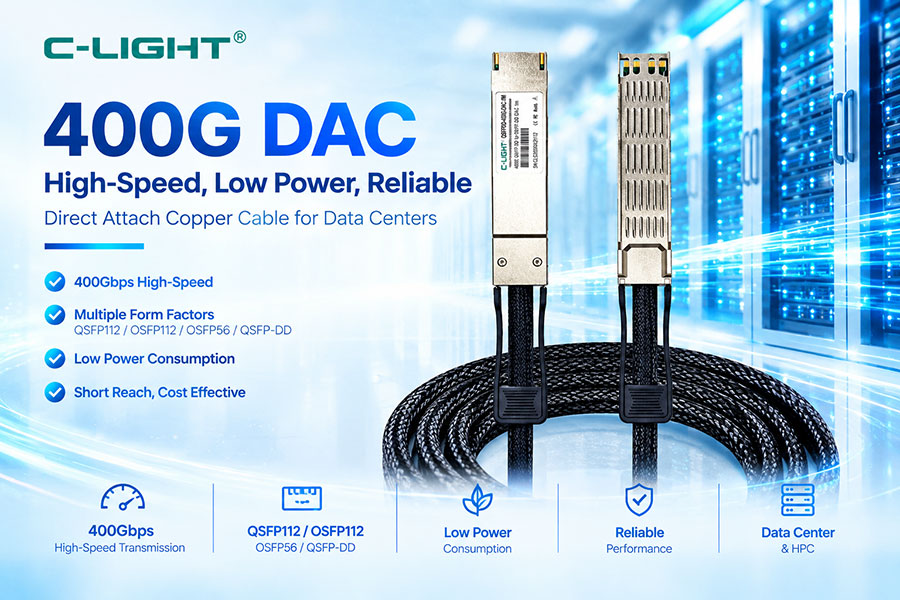
400G DAC (Direct Attach Copper) is a high-speed copper cable designed for short-distance 400Gbps connections. It directly connects compatible network ports without optical transmission components.
C-LIGHT 400G DAC configurations support QSFP112, OSFP112, OSFP56, and QSFP-DD interfaces, with cable lengths generally ranging from 0.5m to 3m.
2. What Is 400G AOC?
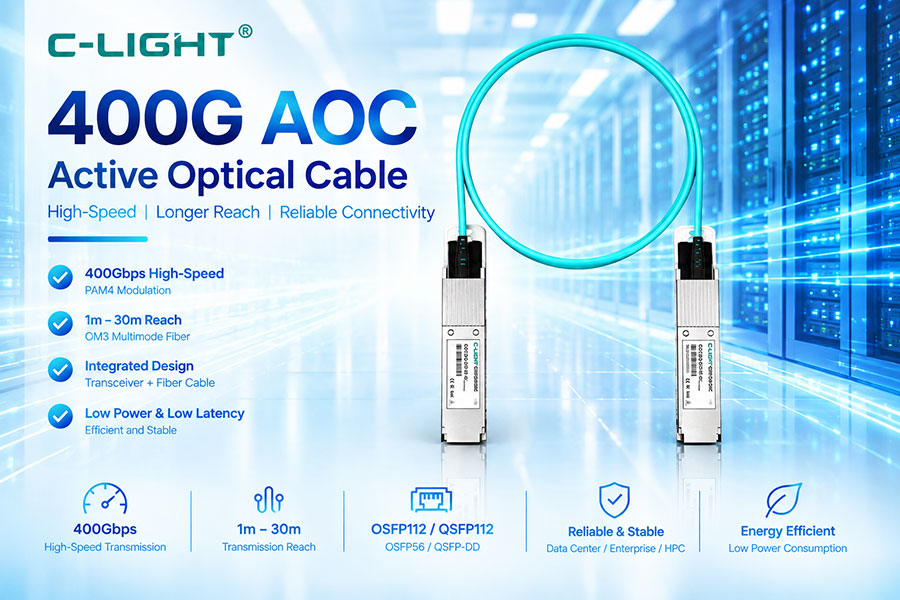
400G AOC (Active Optical Cable) integrates optical transceiver components and multimode fiber into one cable assembly. It provides 400Gbps connectivity while supporting longer short-reach links than copper DAC.
C-LIGHT 400G AOC configurations use 850nm multimode optical transmission over OM3 fiber, with available lengths from 1m to 30m.
3. 400G DAC vs 400G AOC: Basic Comparison
| Feature | 400G DAC | 400G AOC |
|---|---|---|
| Transmission Medium | Copper | Multimode Fiber |
| Data Rate | 400Gbps | 400Gbps |
| Typical Reach | 0.5m–3m | 1m–30m |
| Optical Components | No | Yes |
| Power Consumption | Very low | Higher than passive DAC |
| Latency | Very low | Low |
| Cost | Lower | Higher |
| EMI Resistance | Lower | Higher |
| Best Application | Very short connections | Longer short-reach connections |
4. Transmission Distance
Distance is one of the most important differences between 400G DAC and 400G AOC.
400G DAC is optimized for very short connections, with C-LIGHT configurations covering approximately 0.5m to 3m. It is suitable when servers, GPUs, and switches are installed close together.
400G AOC extends the connection range to 30m in the listed C-LIGHT configurations, making it more suitable for connections between racks or equipment with greater physical separation.
5. Copper vs Optical Transmission
400G DAC transmits electrical signals directly through copper conductors. This eliminates optical conversion components and keeps the cable architecture simple.
400G AOC converts electrical signals to optical signals inside the cable assemblies and transmits them through multimode fiber. This enables longer reach and better immunity to electromagnetic interference.
6. Power Consumption
Passive 400G DAC has very low power consumption because it does not require optical transmitters, receivers, or active signal-processing components in the cable.
C-LIGHT specifies a passive 400G DAC design with power consumption below 0.1W for the cable solution. AOC requires active optical components, so its power consumption is higher.
7. Cost Difference
400G DAC is generally more economical for very short connections because it uses copper conductors and does not require optical engines.
400G AOC has a higher component cost because it integrates optical transmitters, receivers, and multimode fiber. However, the additional cost provides greater reach and better flexibility for rack-to-rack connections.
8. Latency
Both solutions provide low-latency connectivity for high-speed data center networks.
DAC has a simple direct electrical transmission path and is particularly suitable for latency-sensitive AI and HPC connections. AOC also provides low latency, while its optical architecture allows longer short-reach connections.
9. Electromagnetic Interference
Copper cables can be affected by electromagnetic interference in environments with strong electrical noise.
Fiber-based AOC is inherently resistant to electromagnetic interference, making it advantageous in high-density data centers where many high-speed electrical connections operate close together.
10. 400G DAC Form Factors
C-LIGHT 400G DAC supports multiple 400G interface platforms, including QSFP112, OSFP112, OSFP56, and QSFP-DD.
Available architectures include native 400G connections as well as breakout configurations such as 400G to 2x200G, 400G to 4x100G, and 400G to 8x50G.
11. 400G AOC Form Factors
400G AOC is available in configurations including OSFP112, QSFP112, and QSFP-DD. Breakout configurations can connect a 400G interface to multiple lower-speed ports.
Examples include 400G to 4x100G and 400G to 2x200G configurations.
12. 400G DAC for AI Data Centers
AI data centers require high-bandwidth connections between GPUs, servers, and switches. When equipment is positioned within a short physical distance, 400G DAC provides a low-cost and low-power interconnect option.
It is particularly suitable for GPU-to-switch and intra-rack connections where the cable length remains within the copper transmission range.
13. 400G AOC for AI Data Centers
400G AOC is suitable for AI and HPC environments where the connection distance exceeds the practical range of copper DAC.
Its 1m–30m optical reach provides greater flexibility for connections between adjacent racks, leaf and spine switches, and other high-density network equipment.
14. 400G DAC vs AOC for Rack Connections
| Connection | Recommended Solution | Reason |
|---|---|---|
| GPU to switch within the same rack | 400G DAC | Short distance and low cost |
| Server to switch within the same rack | 400G DAC | Low power and low latency |
| Switch to switch within a short distance | DAC or AOC | Depends on distance |
| Adjacent rack connection | 400G AOC | Longer reach |
| High-EMI environment | 400G AOC | Optical transmission |
15. 400G DAC vs AOC: Bandwidth
Both 400G DAC and 400G AOC provide an aggregate data rate of 400Gbps. The main difference is not bandwidth but the physical transmission technology used to deliver that bandwidth.
16. 400G DAC vs AOC: PAM4
Modern 400G interconnects commonly use PAM4 signaling to achieve the required data rate across multiple high-speed lanes.
C-LIGHT 400G DAC uses PAM4 signaling across its high-speed electrical channels. AOC uses high-speed electrical interfaces together with optical transmission components to carry the 400G signal.
17. 400G DAC vs AOC: Installation
Both DAC and AOC are integrated cable assemblies, so installation is straightforward compared with separate transceiver and fiber patch-cord combinations.
DAC is particularly convenient for short rack connections. AOC provides more flexibility when the equipment is separated by several meters or when fiber transmission is preferred.
18. 400G DAC vs AOC: Scalability
DAC is highly effective for dense short-distance deployments, but copper cabling becomes less attractive as transmission distance increases.
AOC provides more physical deployment flexibility and is better suited to network layouts where high-speed links need to extend beyond the practical range of passive copper.
19. 400G DAC vs AOC: Cost, Power and Reach
| Category | 400G DAC | 400G AOC |
|---|---|---|
| Cost | Lower | Higher |
| Power | Very low | Higher |
| Reach | Up to about 3m | Up to 30m |
| Weight | Generally higher per long cable | Generally lighter for longer runs |
| EMI Immunity | Lower | Higher |
| Best Use | Intra-rack | Inter-rack and longer short reach |
20. Which Is Better: 400G DAC or 400G AOC?
Neither solution is universally better. The selection depends mainly on distance, power requirements, budget, cable routing, and network architecture.
For connections below approximately 3m where low cost and low power are priorities, 400G DAC is usually the more practical choice.
For connections requiring several meters of reach, optical isolation, or more flexible rack-to-rack deployment, 400G AOC is generally more suitable.
21. 400G DAC vs 400G AOC for Data Center Networks
400G DAC and AOC are complementary technologies rather than direct replacements. DAC is optimized for the shortest and most cost-sensitive links, while AOC extends 400G connectivity across a wider physical area.
In a large data center, both technologies can be deployed together according to the distance and topology of individual links.
22. 400G DAC vs 400G AOC for InfiniBand
Both technologies can be used in high-performance computing and InfiniBand environments when the selected interface and cable configuration are compatible with the network equipment.
DAC is attractive for short GPU-to-switch connections, while AOC can provide additional reach for cluster connections where copper cabling is not practical.
23. 400G DAC vs 400G AOC for Ethernet
400G DAC and AOC can both support high-speed Ethernet environments with compatible equipment. QSFP-DD-based configurations are particularly relevant to 400GbE data center deployments.
24. How to Choose Between 400G DAC and 400G AOC?
Consider the following factors before selecting a cable:
Transmission distance
Switch and server interface type
Power budget
Cable cost
Rack architecture
Electromagnetic environment
AI or HPC workload requirements
Breakout requirements
Future network expansion
25. C-LIGHT 400G DAC and AOC Solutions
C-LIGHT provides 400G DAC and AOC solutions for data centers, AI computing clusters, InfiniBand networks, HPC environments, and high-speed Ethernet infrastructure.
The 400G DAC portfolio covers 0.5m–3m configurations across QSFP112, OSFP112, OSFP56, and QSFP-DD interfaces. The 400G AOC portfolio covers 1m–30m configurations using 850nm multimode optical transmission and OM3 fiber.
26. Conclusion
400G DAC and 400G AOC address different short-reach connectivity requirements. DAC offers lower cost, very low power consumption, and extremely short-distance connectivity, while AOC provides longer reach and the advantages of optical transmission.
For short intra-rack connections, 400G DAC is usually the preferred option. For longer short-reach links between racks or network devices, 400G AOC provides greater flexibility.
 >
>

 >
>
 >
>
 >
>
 >
>
 >
>
 >
>
 >
>