TEL:+86 132 6656 7067




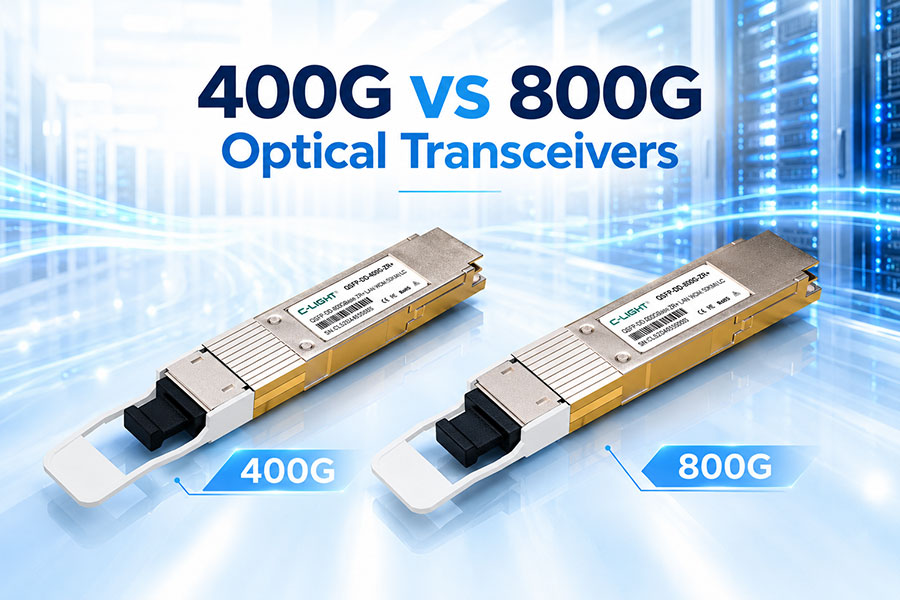
400G and 800G optical transceivers are widely used for high-speed data center networking, AI infrastructure, cloud computing, and HPC applications. The main differences include bandwidth, electrical lane architecture, optical interface, power consumption, reach, form factor, and deployment scenarios.
1. What Are 400G and 800G Optical Transceivers?
A 400G optical transceiver provides up to 400Gbps of aggregate data transmission, while an 800G optical transceiver doubles the total bandwidth to 800Gbps.
Both technologies convert electrical signals into optical signals for transmission over fiber and convert received optical signals back into electrical signals. They are commonly deployed between switches, servers, routers, and AI computing systems.
2. 400G Optical Transceiver Overview
400G optical transceivers are designed for 400Gbps Ethernet and high-performance data center networks. Depending on the product architecture, 400G modules can use different electrical lane configurations, including 4×100G or 8×50G PAM4.
Common 400G form factors include QSFP-DD and OSFP, with different optical configurations available for short-, medium-, and longer-reach applications.
3. 800G Optical Transceiver Overview
800G optical transceivers provide twice the aggregate bandwidth of 400G modules. Modern 800G solutions commonly use 8×100G PAM4 electrical lanes and are designed for high-density switches, AI clusters, GPU networks, and hyperscale data centers.
OSFP and QSFP-DD-based architectures are used for different 800G networking platforms, while optical configurations such as SR8, DR8, 2×FR4, and other variants address different reach requirements.
4. 400G vs 800G: Bandwidth
| Feature | 400G | 800G |
|---|---|---|
| Aggregate bandwidth | 400Gbps | 800Gbps |
| Typical PAM4 architecture | 4×100G or 8×50G | 8×100G |
| Data center density | High | Very high |
| Typical applications | Data centers, cloud, HPC | AI clusters, hyperscale, HPC |
5. PAM4 Technology in 400G and 800G
PAM4 is an important signaling technology used in modern high-speed optical transceivers. Unlike NRZ, which uses two signal levels, PAM4 uses four signal levels and carries two bits per symbol.
400G and 800G modules use PAM4-based electrical and optical architectures to achieve higher data rates without simply doubling the number of physical lanes.
6. Electrical Lane Architecture
Lane architecture is one of the key differences between generations of optical transceivers. Many 400G modules use 8×50G or 4×100G architectures, depending on the design and host interface.
800G modules commonly use 8×100G PAM4 lanes. Each lane operates at approximately 100Gbps, providing an aggregate 800Gbps data rate.
7. Optical Lanes and Fiber Connectivity
400G and 800G transceivers can use different numbers of optical lanes depending on the optical design. For example, SR8 modules use parallel multimode fiber connections, while DR4, FR4, DR8, and other architectures use different combinations of optical lanes and wavelengths.
The optical connector can also vary by product. MPO/MTP connectors are common for parallel-fiber solutions, while duplex LC connectors are often used for wavelength-multiplexed architectures.
8. 400G Optical Transceiver Reach
400G transceivers are available for different distances, ranging from short-reach multimode fiber connections to longer single-mode fiber links.
Typical product families include SR4/SR8-style short-reach solutions, DR4 for several hundred meters, and FR4 or other WDM-based solutions for kilometer-level transmission.
9. 800G Optical Transceiver Reach
800G transceivers also cover multiple reach categories. For example, 800G SR8 can support short-reach multimode fiber connections, while 800G DR8 can provide longer single-mode fiber connectivity. 2×FR4 architectures can support kilometer-scale links using duplex fiber connections.
The actual maximum distance depends on the optical design, fiber type, connector, transceiver specification, and network conditions.
10. 400G vs 800G Form Factors
400G modules are commonly available in QSFP-DD and OSFP form factors. 800G modules are also available in OSFP and QSFP-DD-related architectures, although OSFP is widely used for high-density 800G switching and AI networking platforms.
Form factor selection depends on the switch platform, port density, thermal design, electrical interface, and manufacturer requirements.
11. Power Consumption and Thermal Management
Higher bandwidth generally increases the power and thermal requirements of optical transceivers. 800G modules typically require more advanced thermal management than earlier 400G generations.
This is particularly important in AI data centers, where hundreds or thousands of high-speed optical ports can operate inside high-density GPU clusters. Heatsink design, airflow, liquid cooling, and rack-level thermal management can therefore influence 800G deployment.
12. 400G vs 800G for AI Data Centers
AI workloads require high-bandwidth connections between GPUs, servers, and switches. As GPU clusters become larger, network bandwidth can become an important factor in overall system performance.
400G remains suitable for many data center and AI networking applications, while 800G provides greater bandwidth per port and can reduce the number of ports required for equivalent aggregate capacity.
13. 400G vs 800G Network Density
An 800G port provides twice the bandwidth of a 400G port. This allows network operators to increase aggregate switch capacity without increasing port counts at the same rate.
For high-density AI fabrics, this can simplify network scaling and help support large numbers of high-speed connections between GPU servers and network switches.
14. 400G vs 800G Compatibility
400G and 800G transceivers are not automatically interchangeable. Compatibility depends on the switch port, electrical interface, module form factor, firmware, optical specification, and host platform.
For example, an 800G module cannot simply be installed in every 400G port. Breakout configurations can provide another migration path by dividing a higher-speed port into multiple lower-speed connections when supported by the switch and transceiver.
15. 400G vs 800G DAC, AOC, and Optical Transceivers
Optical transceivers are not the only connectivity option for 400G and 800G networks. DAC, AOC, and AEC solutions are also used for short-reach connections.
| Solution | Main Advantage | Typical Application |
|---|---|---|
| DAC | Low cost and low power | Short rack connections |
| AOC | Longer reach than DAC | Server-to-switch and switch-to-switch |
| AEC | Active signal conditioning | Higher-performance short-reach links |
| Optical Transceiver | Longer reach and flexible fiber connectivity | Data center and inter-rack networking |
16. When to Choose 400G
400G optical transceivers are a practical choice when existing network infrastructure supports 400G, the required bandwidth does not justify an 800G upgrade, or the deployment is based on a mature 400G switch architecture.
They can be used for data center switching, cloud infrastructure, HPC, enterprise networks, and selected AI networking applications.
17. When to Choose 800G
800G is better suited to high-density networks where bandwidth per port and network scalability are major priorities. It is particularly relevant to hyperscale data centers, AI GPU clusters, HPC systems, and next-generation Ethernet or InfiniBand networks.
For new infrastructure projects with high bandwidth requirements, 800G can provide a more scalable path than deploying additional 400G ports.
18. 400G vs 800G: Key Differences
| Category | 400G Optical Transceiver | 800G Optical Transceiver |
|---|---|---|
| Bandwidth | 400Gbps | 800Gbps |
| Common lane architecture | 4×100G / 8×50G | 8×100G |
| Signaling | PAM4 | PAM4 |
| Form factors | QSFP-DD / OSFP | OSFP / QSFP-DD architectures |
| Deployment | Data centers, cloud, HPC | AI, hyperscale, HPC, high-density networks |
| Port density | High | Higher |
| Thermal requirements | Moderate to high | Higher |
| Upgrade direction | Mature 400G infrastructure | Next-generation high-bandwidth infrastructure |
19. C-LIGHT 400G and 800G Optical Connectivity
C-LIGHT provides 400G and 800G optical transceivers for data center, AI, HPC, and high-speed networking applications. The portfolio covers different optical reaches and form factors for short-, medium-, and longer-distance connections.
C-LIGHT also provides 400G and 800G DAC, AOC, and AEC solutions for short-reach server-to-switch, switch-to-switch, and GPU-to-switch connectivity, allowing network designers to select the appropriate interconnect according to distance, bandwidth, power, and deployment requirements.
20. Conclusion
400G and 800G optical transceivers serve different stages of high-speed network deployment. 400G remains an important solution for established data center and cloud infrastructure, while 800G provides higher bandwidth per port and is increasingly suited to high-density AI and hyperscale networks.
The right choice depends on switch compatibility, network architecture, transmission distance, optical interface, power and thermal requirements, and future bandwidth needs. For new AI data center deployments, 800G provides a strong foundation for scaling high-speed network capacity, while 400G remains an effective option for existing infrastructure and many short- and medium-term applications.
 >
>

 >
>
 >
>
 >
>
 >
>
 >
>
 >
>
 >
>