TEL:+86 132 6656 7067




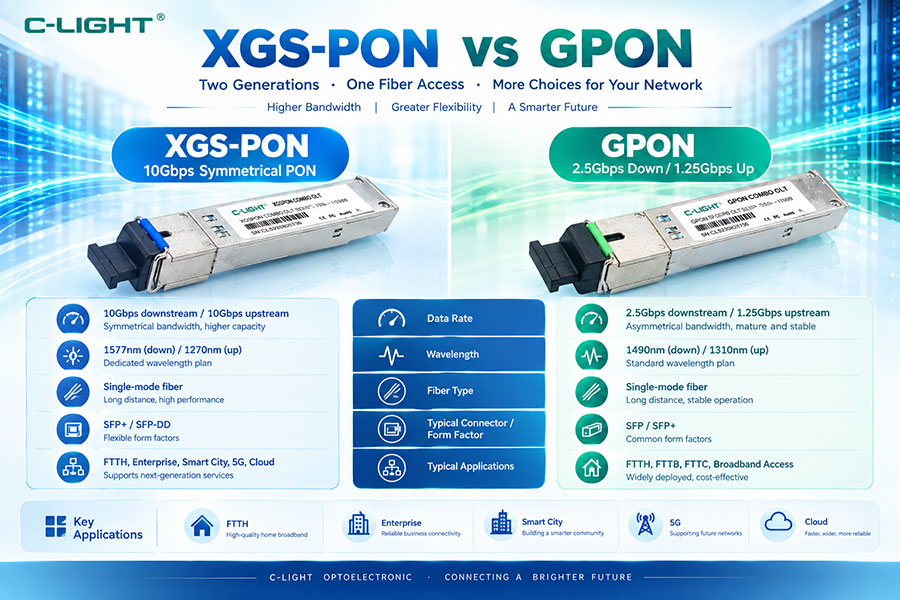
XGS-PON and GPON are two generations of passive optical network technology used for fiber access. GPON is widely deployed for residential broadband, enterprise access, and FTTx networks, while XGS-PON provides a major bandwidth upgrade with symmetrical 10Gbps transmission. The choice between them depends on bandwidth requirements, network upgrade plans, optical budget, subscriber density, and equipment compatibility.
1. What Is GPON?
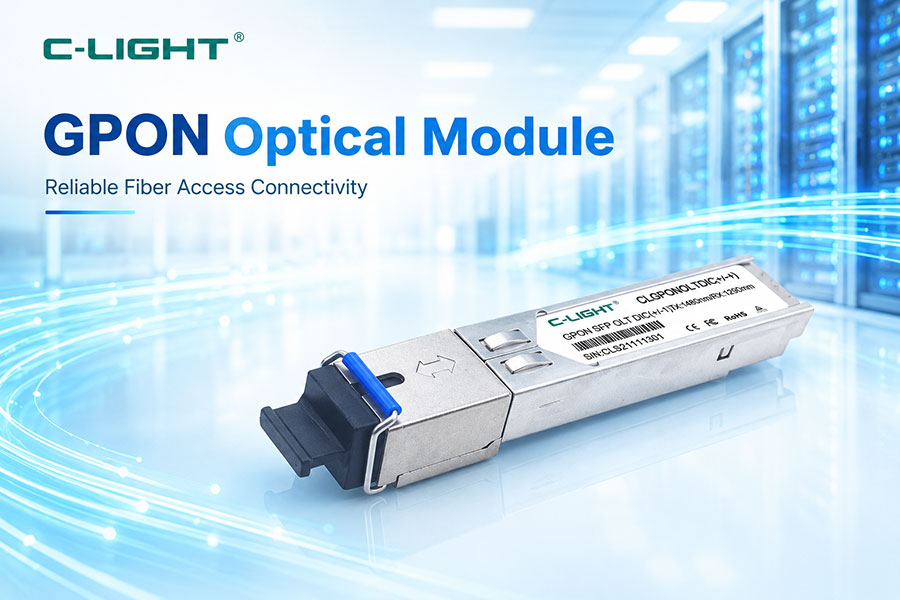
GPON, or Gigabit Passive Optical Network, is a mature PON technology designed for fiber access networks. It uses a single optical fiber to connect an OLT with multiple ONUs or ONTs through passive optical splitters.
In a typical GPON system, the downstream rate is 2.5Gbps and the upstream rate is 1.25Gbps. GPON is widely used for FTTH, FTTB, FTTC, enterprise access, and broadband deployment.
2. What Is XGS-PON?
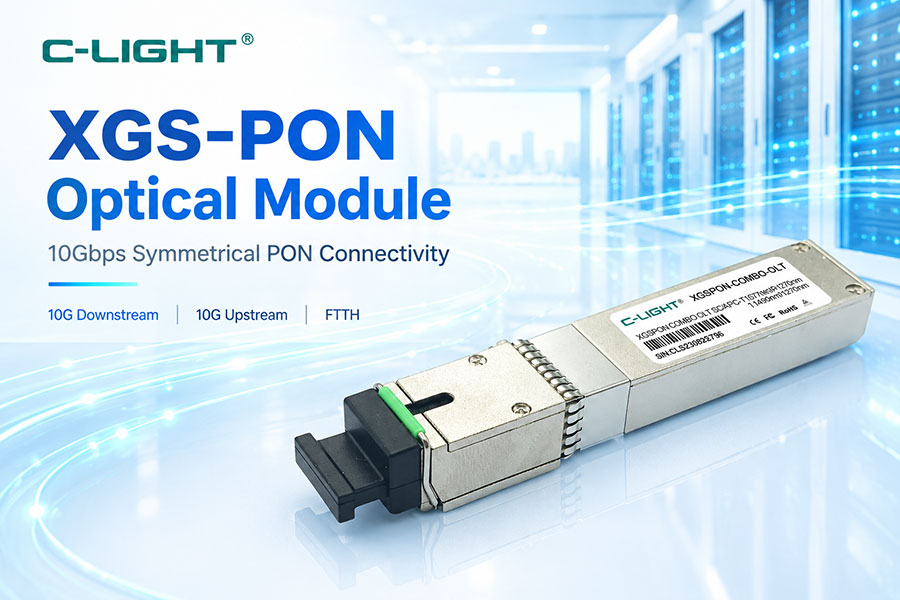
XGS-PON is a 10Gbps-class symmetrical passive optical network technology. It provides approximately 10Gbps downstream and 10Gbps upstream transmission and is designed for higher-bandwidth access networks.
XGS-PON is suitable for high-end residential broadband, enterprise services, smart cities, cloud access, and future network evolution.
3. XGS-PON vs GPON: Basic Difference
| Feature | GPON | XGS-PON |
|---|---|---|
| Downstream rate | 2.5Gbps | 10Gbps |
| Upstream rate | 1.25Gbps | 10Gbps |
| Bandwidth mode | Asymmetric | Symmetrical |
| Typical wavelength | 1490nm down / 1310nm up | 1577nm down / 1270nm up |
| Fiber type | Single-mode fiber | Single-mode fiber |
| Typical connector | Simplex SC or LC depending on module | Simplex SC |
| Typical applications | FTTH, FTTx, broadband access | 10G access, enterprise, smart city, high-end broadband |
4. XGS-PON vs GPON Speed
The most obvious difference is bandwidth. GPON provides 2.5Gbps downstream and 1.25Gbps upstream, while XGS-PON supports 10Gbps downstream and 10Gbps upstream.
This makes XGS-PON particularly attractive when users require higher upload bandwidth, higher aggregate capacity, or more consistent symmetrical service performance.
5. XGS-PON vs GPON Upstream Bandwidth
GPON is asymmetric, with significantly lower upstream capacity than downstream capacity. This design is adequate for many conventional broadband services where downloading dominates traffic.
XGS-PON provides 10Gbps upstream as well as 10Gbps downstream. The symmetrical architecture is better suited to cloud applications, enterprise connectivity, high-resolution content creation, large file transfers, and other upstream-intensive services.
6. XGS-PON vs GPON Wavelengths
GPON commonly uses 1490nm for downstream transmission and 1310nm for upstream transmission.
XGS-PON uses a different wavelength plan, with 1577nm downstream and 1270nm upstream commonly used for XGS-PON optical modules.
The different wavelength ranges allow XGS-PON and GPON services to coexist on the same physical fiber in appropriate combo-PON architectures.
7. Can XGS-PON and GPON Coexist?
Yes. XGS-PON and GPON can coexist on the same optical distribution network when the OLT, optical modules, splitters, and wavelength plan are designed for coexistence.
This enables operators to upgrade access capacity while continuing to support existing GPON subscribers. Combo OLT solutions can integrate GPON and XGS-PON services at the access platform.
8. XGS-PON/GPON Combo OLT
A combo OLT can support both GPON and XGS-PON services, making it useful for gradual network migration.
C-LIGHT offers XGS-PON/GPON combo OLT optical modules in SFP+ and SFP-DD form factors. Current configurations support 10G/10G XGS-PON operation together with 2.5G/1.25G GPON operation on a single-fiber interface.
9. XGS-PON vs GPON Optical Modules
GPON optical modules are available for both OLT and ONU applications. Typical GPON OLT modules use 1490nm downstream and 1310nm upstream wavelengths, while GPON ONU modules use the reverse direction.
XGS-PON OLT modules commonly use 1577nm downstream and 1270nm upstream wavelengths, while XGS-PON ONU modules use the opposite direction.
The selected optical module must match the OLT or ONU architecture, optical budget, wavelength plan, connector, temperature range, and transmission distance.
10. XGS-PON vs GPON Transmission Distance
Transmission distance depends on the optical class, launch power, receiver sensitivity, splitter loss, fiber attenuation, connector loss, and overall link budget.
C-LIGHT GPON OLT/ONU products include 20km configurations and selected 40km OLT options. C-LIGHT XGS-PON OLT/ONU products include 20km and 30km configurations.
The nominal distance of a module should therefore be evaluated together with the complete PON optical budget rather than treated as an independent specification.
11. XGS-PON vs GPON Optical Budget
The optical budget determines whether the PON link can operate reliably through fiber, connectors, splitters, and other passive components.
A higher-power OLT module can support greater optical loss in appropriate designs, while higher splitter ratios increase total loss. When selecting XGS-PON or GPON optics, the required optical class and receiver sensitivity should be checked against the actual network architecture.
12. XGS-PON vs GPON Split Ratio
Both technologies can use passive optical splitters to connect one OLT interface to multiple subscribers. However, the practical split ratio depends on the optical budget, fiber distance, service requirements, and network design.
Higher split ratios increase the number of subscribers served from one PON port but also introduce greater splitter loss. Optical budget must therefore remain within the allowable range.
13. XGS-PON vs GPON for FTTH
GPON remains a practical choice for many residential FTTH deployments because its bandwidth is sufficient for a broad range of broadband services and its ecosystem is mature.
XGS-PON is more suitable when operators need higher aggregate capacity, symmetrical 10Gbps access, or a migration path toward higher-speed broadband services.
14. XGS-PON vs GPON for Enterprise Networks
Enterprise users increasingly require higher upstream capacity for cloud applications, remote collaboration, backup, virtualization, and large-scale data transfer.
GPON can support smaller enterprise access requirements, while XGS-PON provides a larger bandwidth envelope for high-capacity enterprise services and dedicated access.
15. XGS-PON vs GPON for Smart Cities
Smart city networks can connect large numbers of cameras, IoT devices, public services, and edge applications. The required bandwidth varies considerably between applications.
GPON can support many conventional access scenarios, while XGS-PON offers additional capacity for bandwidth-intensive services and future network growth.
16. XGS-PON vs GPON for High-End Broadband
As residential bandwidth demand increases, multi-gigabit services place greater pressure on access network capacity.
GPON provides a 2.5Gbps downstream capacity at the PON interface, while XGS-PON raises the interface rate to 10Gbps in both directions. XGS-PON therefore provides significantly more headroom for multi-gigabit access services.
17. XGS-PON vs GPON Latency
Bandwidth and latency are different performance parameters. XGS-PON provides much higher bandwidth than GPON, but actual end-to-end latency depends on the complete access architecture, scheduling, processing, traffic load, and upstream network.
A higher-rate PON system can improve available capacity, but it should not automatically be described as having a fixed latency advantage under every deployment condition.
18. XGS-PON vs GPON Power Consumption
Power consumption varies by optical module design, transmitter output power, form factor, temperature grade, and equipment architecture.
Higher-speed XGS-PON optics may require different optical and electrical components than GPON modules. The overall system power should therefore be evaluated at both the module and OLT platform levels.
19. XGS-PON vs GPON Deployment Cost
GPON generally benefits from a mature and widely deployed ecosystem, which can make it attractive for cost-sensitive broadband networks.
XGS-PON requires higher-performance optical and electronic components, but its greater capacity can reduce the need for frequent access network upgrades as bandwidth demand increases.
20. XGS-PON vs GPON Network Upgrade
The upgrade path is one of the strongest reasons to consider XGS-PON. Operators can maintain existing fiber infrastructure while introducing higher-speed optical access equipment, provided the optical distribution network and coexistence architecture support the upgrade.
Combo OLT platforms can simplify migration by supporting legacy GPON subscribers and XGS-PON subscribers from the same access platform.
21. XGS-PON vs GPON Compatibility
Compatibility includes more than connector type. The OLT, ONU, optical wavelengths, PON protocol, optical class, management functions, and network architecture must all be compatible.
C-LIGHT XGS-PON and GPON optical modules are available in multiple configurations and are designed for compatibility with mainstream OLT platforms. The exact part number should be selected according to the target platform and optical requirements.
22. XGS-PON vs GPON OLT Modules
GPON OLT SFP modules typically provide 2.5G downstream and 1.25G upstream operation using 1490nm and 1310nm wavelengths. C-LIGHT provides GPON OLT modules with different output-power levels and transmission distances.
XGS-PON OLT SFP+ and SFP-DD modules provide 10G downstream and 10G upstream operation, with common configurations using 1577nm downstream and 1270nm upstream wavelengths.
23. XGS-PON vs GPON ONU Modules
GPON ONU modules generally operate at 1.25Gbps upstream and 2.5Gbps downstream, while XGS-PON ONU modules support symmetrical 10Gbps operation.
ONU module selection should also consider connector type, optical class, transmission distance, temperature range, and host equipment compatibility.
24. XGS-PON vs GPON Connector
Both technologies can use single-fiber bidirectional connections. C-LIGHT product configurations include simplex SC interfaces, while selected GPON ONU modules are also available with LC/APC interfaces.
The connector should be matched to the OLT or ONU port, patch cord, adapter, and outside-plant cabling system.
25. XGS-PON vs GPON in C-LIGHT Products
C-LIGHT GPON OLT/ONU optical modules cover 20km and selected 40km configurations, with GPON OLT modules supporting 2.5G/1.25G transmission and ONU modules supporting 1.25G/2.5G transmission.
C-LIGHT XGS-PON products include OLT, ONU, and XGS-PON/GPON combo configurations. Current products include SFP+ and SFP-DD options, with 20km and 30km configurations available.
26. XGS-PON vs GPON: Comparison Table
| Network Requirement | GPON | XGS-PON |
|---|---|---|
| Basic residential broadband | Excellent | Suitable |
| Multi-gigabit access | Limited | Excellent |
| Symmetrical high-speed service | Limited | Excellent |
| Existing GPON infrastructure | Best fit | Suitable for upgrade |
| Enterprise high-bandwidth access | Suitable | Better suited |
| Future bandwidth expansion | Moderate | Strong |
| Legacy subscriber support | Excellent | Excellent with combo architecture |
27. When Should You Choose GPON?
GPON is a reasonable choice when the network primarily requires conventional broadband access, existing GPON infrastructure is already deployed, and the current bandwidth demand is within GPON capacity.
It can also be appropriate for cost-sensitive FTTH, FTTB, rural broadband, and smaller enterprise access networks.
28. When Should You Choose XGS-PON?
XGS-PON is a better fit when the network requires 10Gbps-class symmetrical access, higher aggregate capacity, enterprise-grade bandwidth, or a longer-term upgrade strategy.
It is particularly attractive for high-end FTTH, enterprise access, smart city infrastructure, and networks experiencing rapid traffic growth.
29. XGS-PON vs GPON for Future Networks
Access networks are moving toward higher bandwidth as cloud services, video, AI applications, remote work, and connected devices generate more traffic.
GPON remains important because of its large installed base, while XGS-PON provides a higher-capacity platform for network evolution. Combo architectures allow operators to protect existing investments while introducing higher-speed services.
30. XGS-PON vs GPON: Summary
GPON and XGS-PON are both important technologies for passive optical access networks, but they target different bandwidth requirements. GPON provides 2.5Gbps downstream and 1.25Gbps upstream, making it suitable for many established broadband and FTTx deployments. XGS-PON increases the interface capacity to 10Gbps in both directions, making it better suited to multi-gigabit broadband, enterprise access, and future network expansion.
The decision should consider bandwidth, upstream requirements, optical budget, transmission distance, existing infrastructure, OLT/ONU compatibility, and migration strategy. For networks that need higher capacity without replacing the entire fiber distribution infrastructure, an XGS-PON/GPON combo approach can provide a practical migration path.
 >
>

 >
>
 >
>
 >
>
 >
>
 >
>
 >
>
 >
>