TEL:+86 132 6656 7067




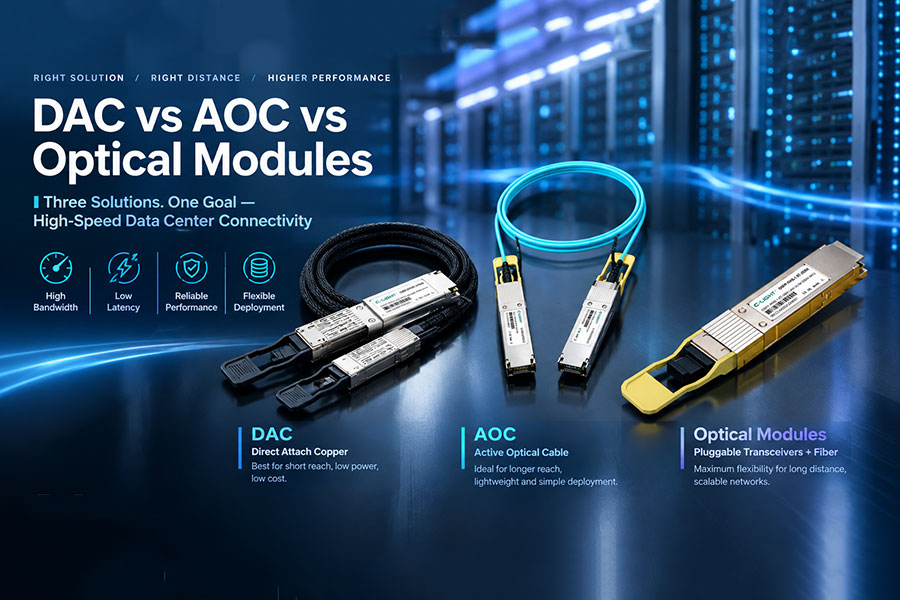
DAC, AOC, and optical modules are three common solutions for high-speed data center connectivity. Although all three can support high-bandwidth links, they differ significantly in transmission medium, reach, power consumption, flexibility, cost, and deployment scenarios. Choosing the right solution depends on link distance, port density, network architecture, and performance requirements.
1. What Are DAC, AOC, and Optical Modules?
DAC (Direct Attach Copper) uses copper conductors with transceiver connectors integrated at both ends. It is mainly designed for short-distance connections inside racks or between nearby network devices.
AOC (Active Optical Cable) combines optical fiber with permanently attached optical transceiver electronics. It provides longer reach and lower weight than copper cables while keeping the cable assembly simple to deploy.
Optical modules, also called optical transceivers, are pluggable devices installed separately at both ends of a fiber link. A separate fiber optic cable connects the two modules, providing greater flexibility for different distances, fiber types, and network architectures.
2. DAC: Direct Attach Copper
800G/400G/200G/100G/50G/40G/25G/10G DAC Cable丨C-LIGHT
DAC is a passive or active copper interconnect designed for short-reach, high-speed connectivity. Common configurations include 100G, 200G, 400G, and 800G DAC, with newer generations increasingly targeting AI and high-performance computing environments.
A typical DAC consists of copper cable assemblies and high-speed connectors. Passive DAC does not require optical conversion, which helps minimize power consumption and latency.
3. AOC: Active Optical Cable
800G/400G/200G/100G/50G/40G/25G/10G AOC丨C-LIGHT
AOC uses optical fiber as the transmission medium and integrates optical components into the connectors. Unlike a conventional fiber link with separate optical modules, the optical transceivers and fiber cable are supplied as one factory-terminated assembly.
AOC is particularly useful when copper DAC becomes impractical because of distance, cable weight, signal loss, or cable-management requirements.
4. Optical Modules and Fiber Links
Optical Transceivers & Fiber Optic Products丨C-LIGHT
An optical module is a pluggable transceiver that converts electrical signals into optical signals and optical signals back into electrical signals. The modules are connected using a separate fiber optic cable.
This architecture provides considerably more deployment flexibility than DAC or AOC. Engineers can select different module types and fiber assemblies according to reach, wavelength, connector, and network requirements.
5. DAC vs AOC vs Optical Modules: Basic Comparison
| Feature | DAC | AOC | Optical Modules |
|---|---|---|---|
| Transmission medium | Copper | Optical fiber | Optical fiber |
| Typical reach | Short | Short to medium | Short to long |
| Installation | Simple | Simple | More flexible |
| Power consumption | Very low for passive DAC | Higher than passive DAC | Depends on module type |
| Cable weight | Higher | Lower | Low |
| Flexibility | Low | Medium | High |
| Field replacement | Replace entire cable assembly | Replace entire cable assembly | Modules and fiber can be replaced separately |
| Long-distance connectivity | Not suitable | Limited | Excellent |
| Typical applications | Intra-rack and short links | Server and switch connections | Data center, campus, telecom, and long-reach networks |
6. Transmission Distance Comparison
Transmission distance is one of the most important factors when selecting between DAC, AOC, and optical modules.
DAC is optimized for very short connections. Typical applications include server-to-switch connections within the same rack and short switch-to-switch links. As cable length increases, copper attenuation, insertion loss, cable thickness, and signal integrity become increasingly important.
AOC can extend beyond the practical range of many copper connections because optical fiber has much lower transmission loss over distance. It is suitable for connections where a pre-assembled optical cable is preferred.
Optical modules provide the widest reach range. Depending on the module and optical technology, solutions can support connections from several meters to hundreds of meters, kilometers, or longer.
7. DAC vs AOC vs Optical Modules for Data Centers
Modern data centers often use all three technologies rather than selecting only one.
DAC is commonly used for short intra-rack connections where low cost, low power consumption, and simple installation are priorities.
AOC is useful for longer rack connections and high-density environments where copper cables become difficult to manage.
Optical modules are preferred when network designers need different transmission distances, fiber types, connector configurations, or upgrade paths.
8. DAC for AI Data Centers
AI data centers require large numbers of high-speed connections between GPUs, servers, switches, and network fabrics. DAC can be an effective solution for short-reach links within high-density racks.
400G and 800G DAC solutions can support high-bandwidth connections while avoiding optical conversion. Their low latency and low power characteristics make them attractive for short-distance GPU-to-switch and switch-to-server connections.
For extremely high-density AI clusters, however, cable size, thermal management, and physical routing must also be considered when deploying large numbers of copper connections.
9. AOC for AI and HPC Networks
AOC provides an intermediate solution between DAC and conventional optical module-based links. It uses fiber for transmission while maintaining a simple plug-and-play cable structure.
In AI and HPC environments, AOC can be used for connections where the required distance exceeds the practical range of copper but the network does not require the flexibility of individually replaceable optical modules and fiber cables.
10. Optical Modules for High-Speed Networks
Optical modules are widely used in high-speed Ethernet, InfiniBand, data center interconnect, telecom, and cloud networking.
Common data center speeds include 100G, 200G, 400G, 800G, and emerging 1.6T solutions. Different module architectures can support different reaches and optical interfaces.
For example, short-reach multimode modules can be used inside data centers, while single-mode solutions are more suitable for longer connections.
11. Power Consumption Comparison
Power consumption becomes increasingly important as network port speeds increase.
Passive DAC has a major advantage because it does not require optical conversion. Its power consumption is therefore extremely low compared with active optical solutions.
AOC requires active electronics at both ends of the cable, resulting in higher power consumption than passive DAC.
Optical modules also require electrical-to-optical and optical-to-electrical conversion. Their power consumption varies according to transmission speed, optical architecture, DSP requirements, and reach.
12. Cost Comparison
For short connections, DAC is generally the most economical option because it uses copper rather than optical components.
AOC typically costs more than passive DAC because it integrates active optical components into the cable assembly.
Optical module solutions can have a higher initial system cost because separate optical modules and fiber cables are required. However, their modular architecture can provide better flexibility and easier network expansion over the long term.
13. Installation and Cable Management
DAC, AOC, and optical modules have different cable-management characteristics.
DAC cables are relatively thick and heavier than fiber-based solutions. Large quantities of high-speed copper cables can increase rack congestion and make cable routing more difficult.
AOC is lighter and easier to route over longer distances. Because the optical cable and transceivers are integrated, installation is also relatively straightforward.
Optical module systems require separate fiber patch cables, but this modular architecture provides greater flexibility for structured cabling and future network changes.
14. Flexibility and Scalability
DAC has limited flexibility because the cable and connectors are normally supplied as one fixed assembly.
AOC provides similar simplicity, but the fixed cable length and integrated transceivers limit field configuration.
Optical modules provide the highest level of flexibility. A network operator can replace modules independently, change fiber assemblies, select different reaches, and adapt the link to different network architectures.
15. DAC vs AOC: When Should You Choose DAC?
DAC is a strong choice when the link is short and the primary requirements are low cost, low power consumption, low latency, and simple deployment.
Typical DAC applications include:
Server-to-ToR switch connections
GPU-to-switch connections
Intra-rack switch connections
Short switch-to-switch links
AI and HPC cluster interconnects
High-density short-reach data center connections
16. DAC vs AOC: When Should You Choose AOC?
AOC becomes attractive when the required distance is beyond the practical range of copper or when lower cable weight is important.
AOC is suitable for:
Longer server-to-switch connections
Rack-to-rack connectivity
High-density data center networks
AI and HPC environments
Applications where simplified optical cabling is preferred
17. When Should You Choose Optical Modules?
Optical modules are the preferred solution when flexibility, scalability, and transmission distance are more important than the simplicity of an integrated cable assembly.
They are particularly suitable for:
Longer data center links
Leaf-spine network architectures
Data center interconnects
Campus and enterprise networks
Telecommunications networks
Multi-distance optical networks
Networks requiring future upgrade flexibility
18. DAC vs AOC vs Optical Modules for 400G
At 400G, all three technologies have practical applications.
400G DAC is suitable for very short connections and provides low power consumption and low latency.
400G AOC extends the usable distance while maintaining an integrated cable structure.
400G optical modules provide the greatest reach and configuration flexibility, supporting different optical technologies and fiber infrastructures.
The appropriate choice depends primarily on link distance, rack architecture, cable density, and network requirements rather than bandwidth alone.
19. DAC vs AOC vs Optical Modules for 800G
At 800G, the differences become even more important because higher signaling speeds place greater demands on signal integrity, thermal management, power consumption, and physical infrastructure.
800G DAC is well suited to short high-bandwidth connections, particularly inside AI and HPC racks.
800G AOC provides an optical alternative for longer short-reach connections and can reduce cable weight compared with copper.
800G optical modules support a broader range of reach options, including short-reach multimode and longer-reach single-mode applications. They are therefore better suited to scalable optical network architectures.
20. DAC vs AOC vs Optical Modules for 1.6T Networks
As network speeds move toward 1.6T, interconnect selection becomes increasingly dependent on power, thermal density, physical space, and link architecture.
Short-reach copper solutions can remain useful for specific applications, but optical technologies become increasingly important as link distances and bandwidth requirements increase.
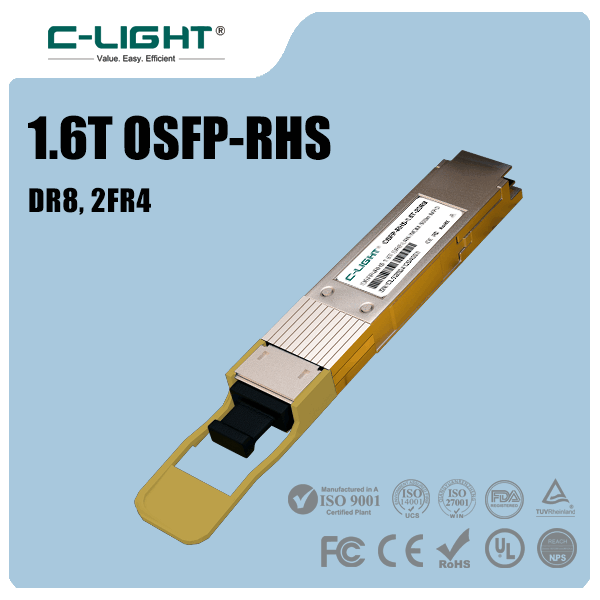
1.6T optical modules are designed for next-generation AI data centers, GPU clusters, and high-performance networking environments where extremely high bandwidth is required.
21. DAC vs AOC vs Optical Modules: Latency
DAC can provide extremely low latency because the electrical signal does not need to undergo optical conversion in a passive copper cable.
AOC and optical module links introduce optical conversion, but modern high-speed optical solutions are designed to maintain very low latency and are widely used in performance-sensitive data center networks.
In practical network design, total system latency also depends on switch ASICs, retimers, DSPs, FEC, connectors, and other components. Therefore, transmission medium alone should not be used to determine total network latency.
22. DAC vs AOC vs Optical Modules: Reliability
All three technologies can provide reliable connectivity when properly designed and tested.
DAC has a relatively simple structure, which can reduce the number of active components in passive configurations.
AOC integrates optical components into the cable assembly, reducing the number of field connections but requiring replacement of the complete assembly if a component fails.
Optical modules provide independent replacement of the transceiver and fiber cable. This can be advantageous in large networks where maintenance flexibility is important.
23. C-LIGHT DAC, AOC, and Optical Module Solutions
C-LIGHT provides high-speed interconnect solutions covering DAC, AOC, and optical transceiver technologies for modern data center networks.
C-LIGHT DAC solutions include 400G and 800G configurations for short-reach server-to-switch, switch-to-switch, GPU-to-switch, AI, HPC, and high-density data center applications.
C-LIGHT AOC solutions provide fiber-based connectivity for applications requiring longer reach than copper while maintaining an integrated cable design.
C-LIGHT optical modules cover multiple data rates, form factors, and transmission distances, supporting data center, AI, Ethernet, InfiniBand, and high-performance networking applications.
24. How to Choose Between DAC, AOC, and Optical Modules?
A practical selection process can be based on five main factors:
Link distance: Choose DAC for very short links, AOC for integrated fiber connections over longer short-reach distances, and optical modules for broader reach requirements.
Power budget: Passive DAC generally provides the lowest power consumption.
Cable density: Fiber-based AOC and optical module solutions can offer advantages in high-density environments.
Flexibility: Optical modules provide the greatest flexibility because modules and fiber cables can be selected independently.
Total cost: Consider not only transceiver cost but also cable management, power, maintenance, and future scalability.
25. DAC vs AOC vs Optical Modules: Final Comparison
DAC, AOC, and optical modules are not competing technologies in every application. They are complementary connectivity solutions designed for different network requirements.
DAC is best suited to short, low-power, cost-sensitive connections.
AOC is a practical choice when fiber is needed but a simple integrated cable assembly is preferred.
Optical modules provide the highest flexibility and are the strongest option for scalable networks covering different distances and architectures.
For modern AI data centers and high-speed Ethernet networks, a combination of DAC, AOC, and optical modules is often the most practical approach. Short intra-rack connections can use DAC, intermediate fiber links can use AOC, and longer or more flexible network connections can use pluggable optical modules.
 >
>

 >
>
 >
>
 >
>
 >
>
 >
>
 >
>
 >
>