TEL:+86 132 6656 7067




800G AOC cables provide high-bandwidth, low-latency optical connectivity for AI clusters, GPU servers, high-performance computing, and data center switching networks. By integrating optical transceivers and fiber into a factory-terminated active cable assembly, 800G AOCs simplify short-reach deployment while supporting the bandwidth, density, and signal integrity requirements of next-generation AI networks.
1. What Is an 800G AOC Cable?
An 800G AOC, or Active Optical Cable, is a high-speed optical interconnect with an optical transceiver integrated into each end of a fixed-length fiber cable. Unlike a passive DAC, which uses copper conductors, an AOC converts electrical signals into optical signals inside the cable ends and transmits data through optical fiber.
For an 800G AOC, the aggregate bandwidth is approximately 800Gbps per cable. Depending on the implementation, the cable can use multiple optical lanes based on 100G-class or higher-speed signaling. Modern 800G solutions commonly use PAM4 modulation and are designed for short-reach connections inside AI and data center environments.
The integrated construction eliminates the need to separately select transceivers and patch cables for many short-reach applications. The result is a compact, factory-tested interconnect that can be installed directly between compatible network ports.
2. Why 800G AOC Is Important for AI Networks
AI training and inference workloads generate extremely high volumes of east-west traffic. GPU servers continuously exchange parameters, gradients, model states, datasets, and synchronization information through the network. As GPU performance increases, the network must provide sufficient bandwidth to prevent communication from becoming a bottleneck.
Traditional 100G and 200G connections are increasingly insufficient for large-scale accelerator clusters. 400G became an important building block for modern AI fabrics, while 800G provides another step toward higher port bandwidth and greater aggregate network capacity.
800G AOCs are particularly relevant to short-reach links where the required distance is limited but bandwidth density is high. They can connect switches, GPU systems, storage platforms, and other network equipment without the additional components required by separate transceiver-and-fiber architectures.
3. How Does an 800G AOC Work?
The basic signal path of an 800G AOC is:
Network Port → Electrical Signal → Optical Transmitter → Fiber Cable → Optical Receiver → Electrical Signal → Network Port
At the transmitting end, the host switch or server generates high-speed electrical signals. The integrated optical engine converts these signals into optical signals. The optical signals travel through the fiber, and the receiving end converts them back into electrical signals for the destination device.
Because the optical conversion electronics are integrated into both cable ends, the AOC behaves from the network operator's perspective as a complete point-to-point cable assembly.
4. 800G AOC Lane Architecture
800G optical connectivity requires multiple high-speed lanes. A common architecture uses eight 100G-class lanes based on PAM4 signaling, although the exact electrical and optical lane configuration depends on the product and interface implementation.
PAM4 transmits two bits per symbol using four signal levels. Compared with conventional two-level NRZ signaling, PAM4 increases the amount of information transmitted per symbol, allowing higher aggregate bandwidth without simply doubling the signaling frequency.
However, PAM4 also introduces tighter signal margins. Noise, insertion loss, crosstalk, reflections, connector performance, temperature, and optical characteristics all become important when operating at 100G-class lane rates.
This is one reason why an 800G AOC is more than simply a fiber cable. The optical engines, drivers, receivers, DSP or related signal-processing functions, thermal design, cable assembly, and host interface must operate as a coordinated system.
5. 800G AOC Form Factors
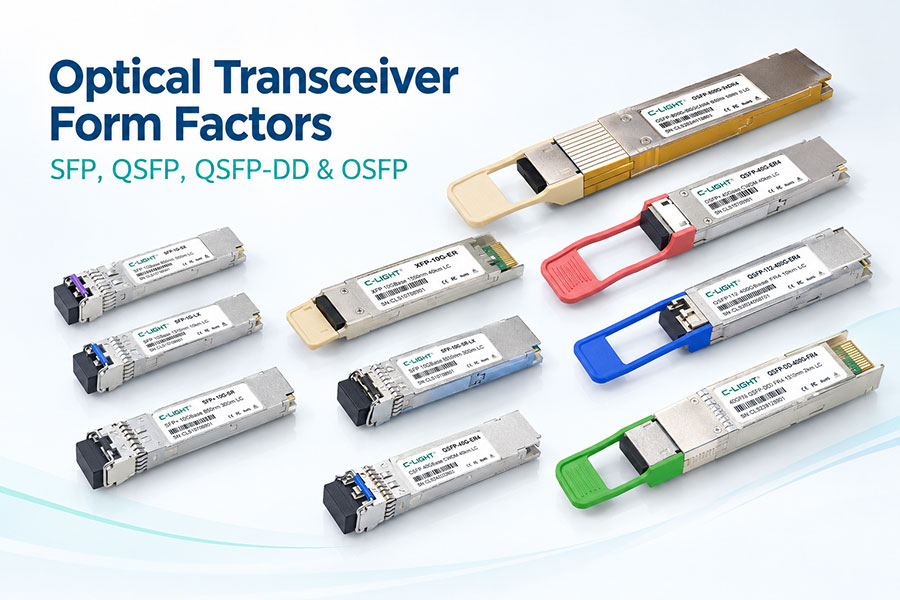
800G AOCs are available in different form-factor configurations according to the host platform. OSFP and QSFP-DD are two important form factors in high-speed data center networking.
5.1 800G OSFP AOC
OSFP provides a larger mechanical envelope than QSFP-DD and is widely associated with high-speed switching platforms. Its larger thermal envelope can be useful for high-bandwidth optical modules and dense AI networking equipment.
An 800G OSFP AOC can be used for short-reach switch-to-switch or switch-to-server connectivity when the network equipment provides compatible OSFP ports.
5.2 800G QSFP-DD AOC
QSFP-DD provides a compact, high-density interface designed for high-port-count networking systems. An 800G QSFP-DD AOC can support high-bandwidth connections while maintaining a relatively compact connector footprint.
The choice between OSFP and QSFP-DD is determined by the host switch or network platform. They should not be treated as interchangeable mechanical interfaces simply because both can support 800G-class networking.
6. 800G AOC vs DAC
DAC and AOC are both commonly used for short-reach connections, but they use fundamentally different transmission media.
| Feature | 800G AOC | 800G DAC |
|---|---|---|
| Transmission Medium | Optical Fiber | Copper |
| Signal Conversion | Electrical to Optical | Electrical |
| Weight | Generally lower | Generally higher |
| Cable Diameter | Typically smaller | Typically larger |
| EMI Sensitivity | Very low | Higher than optical fiber |
| Reach | Short to moderate reach depending on design | Very short reach |
| Flexibility for Dense Cabling | High | More limited at high cable counts |
| Power | Active optical electronics required | Generally lower active power |
DAC can be attractive for very short connections where cable cost and low power are primary considerations. AOC becomes more useful when cable length, weight, bendability, electromagnetic immunity, and high-density cabling become more important.
7. 800G AOC vs AEC
Active Electrical Cables, or AECs, use active electronics to improve the electrical signal over copper cabling. They occupy an intermediate position between passive copper and optical interconnects in some short-reach architectures.
An AEC can extend the practical reach of copper while maintaining a familiar electrical interface. However, copper remains subject to electrical transmission limitations, cable loss, crosstalk, electromagnetic considerations, and physical cable size.
An 800G AOC instead uses optical fiber as the transmission medium. For dense AI clusters containing large numbers of high-speed links, the lower weight and smaller cable profile of fiber can simplify cable management and airflow.
8. 800G AOC vs 800G Optical Transceivers
An 800G AOC integrates the optical modules and cable into one fixed assembly. A conventional 800G optical transceiver is installed separately and normally connects to a fiber patch cable, trunk, or structured cabling system.
| Architecture | 800G AOC | 800G Transceiver + Fiber |
|---|---|---|
| Installation | Plug-and-play cable assembly | Separate transceivers and fiber |
| Cable Length | Factory-defined | Flexible |
| Structured Cabling | Limited | Highly flexible |
| Component Count | Integrated assembly | Multiple components |
| Short-Reach Deployment | Well suited | Well suited |
| Longer-Reach Expansion | Limited by AOC design | More flexible |
AOCs are therefore particularly useful for predictable point-to-point connections, while separate transceivers and fiber provide greater flexibility for structured networks and links with varying distances.
9. Key Advantages of 800G AOC Cables
9.1 High Bandwidth
An 800G AOC provides an aggregate data rate of 800Gbps, making it suitable for high-bandwidth connections in AI clusters, high-performance computing, and data center switching environments.
9.2 Low Latency
Optical transmission supports high-speed point-to-point connectivity with low transmission delay. For AI workloads, reducing network communication overhead can help maintain efficient data exchange between compute nodes.
9.3 Lower Cable Weight
Large AI clusters can contain thousands of high-speed connections. Replacing large bundles of high-speed copper cables with optical AOCs can reduce cable weight and improve physical cable management.
9.4 Better Electromagnetic Immunity
Optical fiber is not affected by electromagnetic interference in the same way as copper conductors. This characteristic is useful in dense data center environments containing large numbers of servers, switches, power supplies, and cooling systems.
9.5 Factory-Terminated Design
An AOC is manufactured and tested as a complete assembly. This reduces the number of field-installed optical connections and simplifies deployment compared with building every link from independent transceivers and fiber assemblies.
9.6 High-Density Cabling
AI networks require a large number of high-speed connections in limited rack space. The smaller cable profile of optical interconnects can make high-density cable routing and airflow management easier.
10. 800G AOC for GPU-to-Switch Connectivity
GPU-to-switch connectivity is one of the important applications for 800G networking. In a scale-out AI architecture, multiple GPU servers connect to high-performance leaf or top-of-rack switches. The switches then connect to spine layers to provide communication across the cluster.
An 800G AOC can be used when the physical distance between the GPU system and switch falls within the cable's specified reach.
The main considerations include:
Host interface and form factor compatibility
Required bandwidth per port
Transmission distance
Optical lane architecture
Fiber type
Power consumption
Thermal environment
Cable routing and bend radius
Switch and GPU platform compatibility
11. 800G AOC in AI Leaf-Spine Networks
Large AI clusters commonly use multi-stage network architectures to connect thousands of compute endpoints. A leaf-spine design provides multiple paths between compute nodes and helps scale network capacity by adding switches and links.
Within this architecture, 800G AOCs can be deployed on short-reach connections between network devices. The fixed-length design is particularly useful when rack layouts and connection distances are standardized.
For longer connections between rows, rooms, or data halls, conventional 800G optical transceivers with separate fiber cabling may provide greater deployment flexibility.
12. Multimode Fiber and 800G AOC
Short-reach AOCs may use multimode optical technology depending on the product architecture. Multimode fiber is commonly associated with short-distance data center links because of its compatibility with short-reach optical engines and established data center cabling practices.
OM3, OM4, and OM5 are common multimode fiber categories used in data center environments. The actual supported distance of an 800G AOC depends on the complete optical design rather than the fiber category alone.
For example, an AOC specified for a particular distance should be evaluated using its complete product specification, including optical power, receiver sensitivity, insertion loss, BER performance, wavelength, and host interoperability.
13. PAM4 and 800G AOC Signal Integrity
PAM4 is a fundamental technology for many 800G optical interconnects. It uses four voltage or optical amplitude levels, allowing two bits to be represented by each symbol.
The higher information density comes with a smaller vertical eye opening than NRZ. As a result, 800G systems are more sensitive to signal degradation.
Important signal-integrity factors include:
Insertion loss
Return loss
Crosstalk
Jitter
Noise
Connector performance
Optical power stability
Receiver sensitivity
Temperature variation
For this reason, high-quality 800G AOCs require careful electrical and optical validation during manufacturing.
14. Power and Thermal Considerations
800G AOCs contain active optical electronics and therefore consume power. The actual power consumption depends on the optical engine, electrical architecture, DSP or signal-conditioning implementation, laser technology, driver, receiver, operating temperature, and cable design.
In a large AI cluster, the cumulative effect can be significant. Thousands of active optical connections can contribute substantial power and heat to the network environment.
Thermal design therefore needs to be considered at both the cable-end module and rack level. Adequate airflow around high-density switch ports helps maintain stable optical and electrical performance.
Power efficiency should also be considered on a per-bit basis. An 800G connection may consume more power than a lower-speed link, but it can deliver substantially greater bandwidth per port.
15. How to Select an 800G AOC
Selecting an 800G AOC should begin with the host platform rather than the cable alone.
15.1 Check the Form Factor
Confirm whether the switch, server, or accelerator platform uses OSFP, QSFP-DD, or another supported interface. Mechanical compatibility is essential.
15.2 Confirm the Required Reach
Choose the cable length according to the actual rack and equipment layout. Avoid excessive cable length because unnecessary slack can complicate cable management in high-density racks.
15.3 Check Optical Technology
Confirm the wavelength, fiber type, lane architecture, and supported transmission distance. Do not assume that every 800G AOC has the same optical configuration.
15.4 Verify Host Compatibility
Compatibility involves more than the physical connector. The host electrical interface, firmware, EEPROM information, optical specifications, and switch configuration can all affect interoperability.
15.5 Evaluate Power and Thermal Requirements
For high-density AI switches, compare AOC power consumption with the platform's port-level and system-level power budget. Thermal conditions should also be considered when many 800G ports operate simultaneously.
15.6 Consider Cable Management
High-speed AI networks can contain hundreds or thousands of cables. Cable diameter, flexibility, bend radius, connector orientation, and labeling can significantly affect installation and maintenance.
16. 800G AOC Deployment Scenarios
| Application | Typical Role | Key Requirement |
|---|---|---|
| AI GPU Cluster | GPU / Switch Interconnect | High Bandwidth and Low Latency |
| Data Center | Switch-to-Switch | High Port Density |
| HPC | Compute Interconnect | High Throughput |
| Storage Network | Server / Storage Connectivity | High Bandwidth |
| Cloud Data Center | Leaf / Spine Connectivity | Scalability |
| AI Training Cluster | East-West Traffic | High Aggregate Capacity |
17. 800G AOC Cable Management in Dense AI Racks
As port speeds increase, cable management becomes an important part of network design. An AI rack may contain a large number of 400G and 800G optical connections, creating substantial cable density around switch ports.
AOCs can simplify this environment because each assembly has fixed optical ends and a predefined cable length. Proper cable routing should maintain the specified bend radius and avoid excessive mechanical stress on the connectors.
Separating cable paths for different equipment groups can also make maintenance easier. In high-density environments, clear labeling and consistent cable lengths are particularly useful when troubleshooting a failed link.
18. Testing and Quality Control for 800G AOCs
High-speed AOCs require comprehensive testing because the cable is an integrated optical and electrical system.
Typical validation may include:
Optical output power
Receiver sensitivity
Optical extinction ratio
Wavelength verification
Bit error rate testing
Pre-FEC and post-FEC performance where applicable
Electrical signal integrity
Temperature testing
Power consumption
Host interoperability
EEPROM and management information
For PAM4-based 800G links, BER and signal-quality measurements are particularly important because small changes in electrical or optical performance can affect the available system margin.
19. Future Development of 800G AOC
800G AOC technology is closely connected with the continued development of AI networking. As accelerator performance increases, network bandwidth must scale accordingly.
Future high-speed interconnects will continue to focus on higher bandwidth per port, lower power per bit, improved thermal performance, greater port density, and easier deployment.
800G AOCs can serve as an important short-reach interconnect technology while higher-speed 1.6T optical connections become increasingly relevant. The same fundamental requirements remain: efficient optical transmission, reliable signal integrity, compact packaging, thermal control, and interoperability with the host network.
20. 800G AOC vs DAC, AEC and Optical Transceiver: When to Use Each
The appropriate interconnect depends on distance, bandwidth, power, cost, cable density, and network architecture.
DAC: Suitable for very short, cost-sensitive connections where copper cabling is practical.
AEC: Suitable for short-reach electrical connections where active signal conditioning can extend the practical capability of copper.
AOC: Suitable for high-bandwidth short-reach optical connections where low cable weight, electromagnetic immunity, and high-density cabling are important.
Optical Transceiver + Fiber: Suitable when the network requires flexible cable lengths, structured fiber cabling, patch panels, or longer transmission distances.
21. Conclusion
800G AOC cables provide a practical optical interconnect solution for high-density AI networks, GPU clusters, HPC systems, and modern data center switching environments. Their integrated optical ends and factory-terminated fiber simplify short-reach deployment while providing the bandwidth required by increasingly demanding network workloads.
The selection of an 800G AOC should consider form factor, host compatibility, optical architecture, transmission distance, fiber type, power consumption, thermal conditions, signal integrity, and cable management. For standardized short-reach connections, an AOC can reduce installation complexity while providing the optical performance required by high-speed AI infrastructure.
 >
>

 >
>
 >
>
 >
>
 >
>
 >
>
 >
>
 >
>