TEL:+86 132 6656 7067




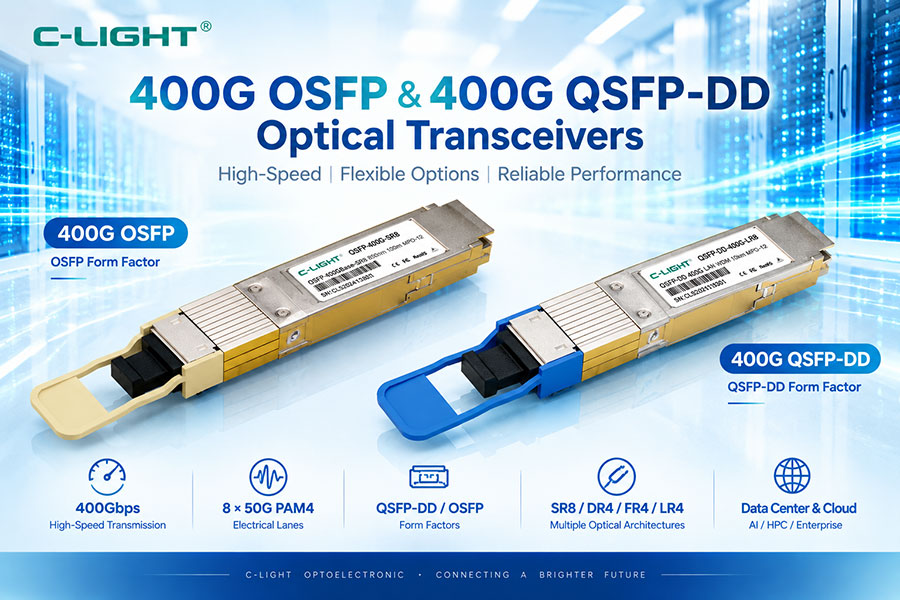
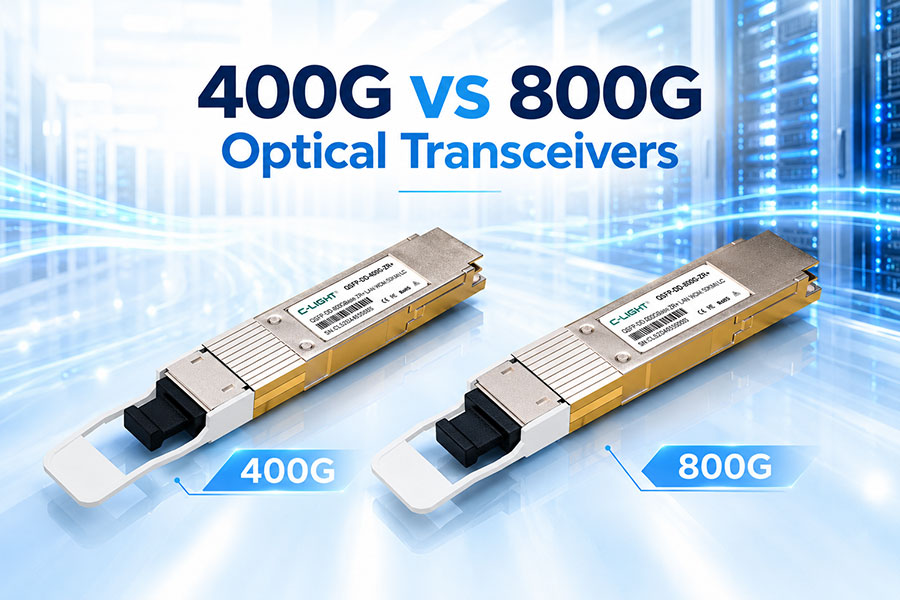
400G OSFP and QSFP-DD are two major pluggable form factors for 400G optical networking. Both support high-speed eight-lane electrical interfaces, but they differ in mechanical size, thermal design, port density, and ecosystem considerations. These differences make OSFP attractive for higher thermal headroom, while QSFP-DD offers a more compact form factor and strong compatibility with existing QSFP-based infrastructure.
1. What Is 400G OSFP?
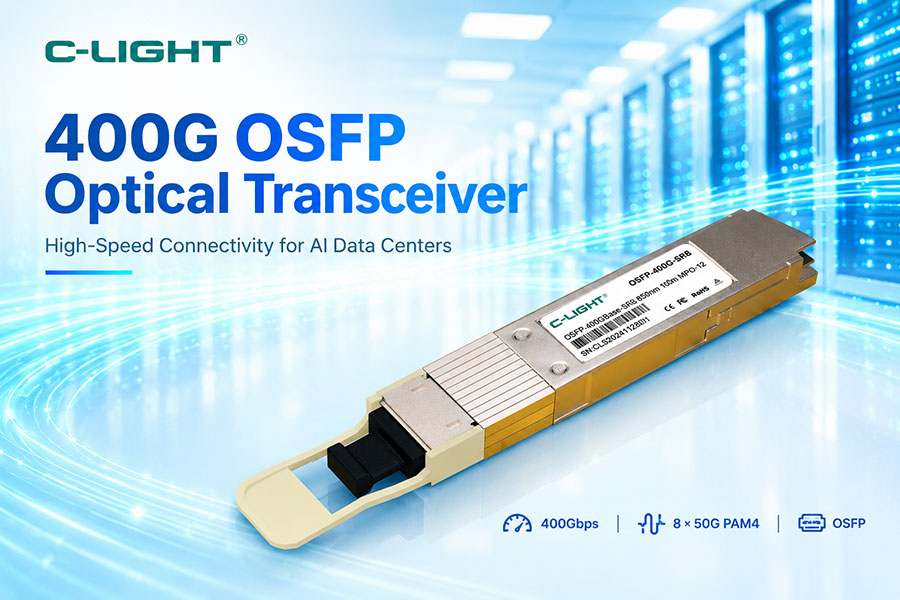
OSFP stands for Octal Small Form Factor Pluggable. The 400G OSFP form factor uses eight high-speed electrical lanes and was designed to support 400G and later higher-speed optical generations.
Its larger physical size and integrated thermal design provide additional space for heat dissipation, making OSFP well suited to high-power optical modules and high-performance data center applications.
2. What Is 400G QSFP-DD?
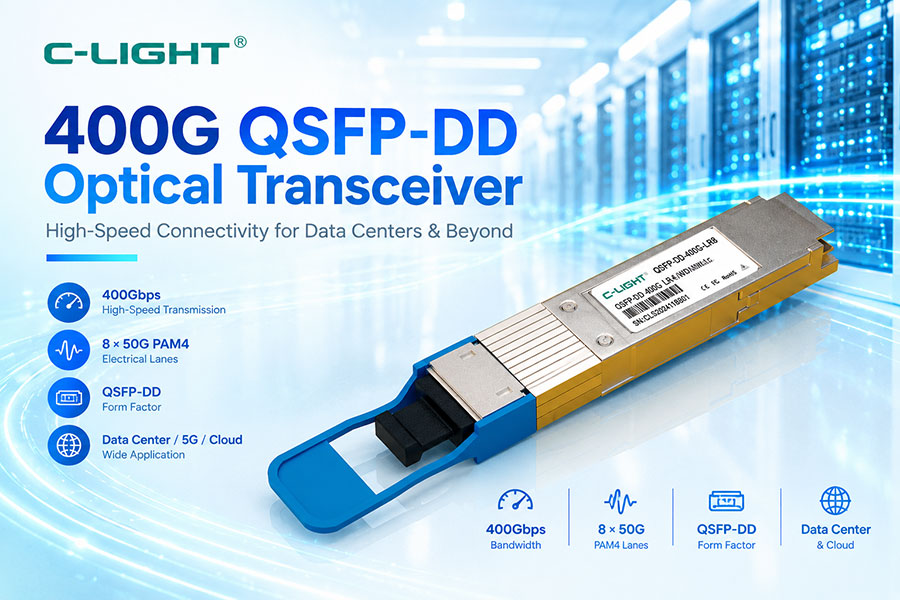
QSFP-DD stands for Quad Small Form Factor Pluggable Double Density. It extends the established QSFP form factor by providing eight high-speed electrical lanes.
400G QSFP-DD modules commonly use 8 × 50G PAM4 electrical lanes. The compact form factor helps maintain high switch port density while supporting the bandwidth required by modern data center networks.
3. 400G OSFP vs QSFP-DD: Basic Difference
| Feature | 400G OSFP | 400G QSFP-DD |
|---|---|---|
| Form factor | OSFP | QSFP-DD |
| High-speed electrical lanes | 8 | 8 |
| Typical 400G lane rate | 8 × 50G | 8 × 50G |
| Typical modulation | PAM4 | PAM4 |
| Physical size | Larger | More compact |
| Thermal capability | Higher thermal headroom | More compact thermal design |
| Port density | Lower than QSFP-DD in equivalent panel space | Higher |
| Common applications | High-performance data centers, AI/HPC | Data centers, Ethernet, high-density switching |
4. 400G OSFP vs QSFP-DD Architecture
Both form factors provide eight high-speed electrical lanes at the host interface. The difference is mainly in the mechanical and thermal implementation rather than the basic lane count.
For a 400G module, eight 50G PAM4 electrical lanes can provide an aggregate 400Gbps interface. The optical side may use parallel optics, WDM, or other architectures depending on the specific transceiver.
5. 400G OSFP Electrical Interface
400G OSFP supports eight high-speed electrical lanes. This provides a suitable electrical interface for 400G optical architectures and also gives the form factor a direct path toward higher data rates.
The OSFP MSA defines the mechanical module, cage, electrical interface, pinout, and related requirements.
6. 400G QSFP-DD Electrical Interface
QSFP-DD also provides eight high-speed electrical lanes. This double-density architecture increases the electrical lane count compared with traditional four-lane QSFP interfaces.
The QSFP-DD MSA covers the module, cage, connector, thermal characteristics, pinout, and management interface, while the actual optical implementation is determined by the relevant optical standard or product design.
7. 400G OSFP Thermal Performance
Thermal management is one of the major advantages of OSFP. The larger module body provides more physical space for heat dissipation, and standard OSFP designs commonly incorporate an integrated heatsink.
This makes OSFP attractive for 400G modules with relatively high power consumption and for future generations where thermal requirements become increasingly demanding.
8. 400G QSFP-DD Thermal Performance
QSFP-DD uses a more compact mechanical envelope, which helps increase switch front-panel density but places greater emphasis on thermal engineering.
Heat dissipation depends on the module design, heatsink, cage, airflow, host switch, and optical architecture. High-power QSFP-DD modules therefore require careful system-level thermal planning.
9. 400G OSFP vs QSFP-DD Port Density
QSFP-DD has a compact footprint and is designed to maximize switch front-panel density. This can be valuable when a switch must accommodate a large number of 400G ports within a limited rack-unit space.
OSFP is physically larger, so equivalent switch panels generally accommodate fewer ports. The trade-off is greater thermal and mechanical headroom.
10. 400G OSFP vs QSFP-DD Size
The OSFP module is larger than QSFP-DD. This difference is visible not only in the transceiver body but also in the corresponding cages and front-panel openings.
The larger OSFP package provides more room for thermal management, while QSFP-DD prioritizes compactness and backward ecosystem continuity.
11. 400G OSFP vs QSFP-DD Compatibility
OSFP and QSFP-DD are different form factors and are not mechanically interchangeable. An OSFP module must be installed in an OSFP port, while a QSFP-DD module requires a compatible QSFP-DD cage and connector.
Network operators should therefore verify the switch hardware before selecting the optical transceiver.
12. 400G OSFP vs QSFP-DD Breakout
Both form factors support breakout applications when the optical module and host platform provide the required lane mapping.
For example, a 400G port can be divided into multiple lower-speed connections such as 2 × 200G or 4 × 100G depending on the module, electrical architecture, connector, and switch configuration.
13. 400G OSFP Optical Architectures
400G OSFP can be implemented with different optical architectures, including SR8, DR4, FR4, DR4-based designs, and other variants.
Short-reach SR8 designs use parallel multimode fibers, while DR4 and FR4 architectures use single-mode fiber and provide longer transmission distances through parallel or wavelength-multiplexed optical channels.
14. 400G QSFP-DD Optical Architectures
400G QSFP-DD is also available in multiple optical configurations. C-LIGHT 400G QSFP-DD products include configurations such as SR8, DR4/DR4+, FR4, LR4, and longer-reach coherent variants.
This means that the form factor alone does not determine transmission distance. The optical architecture, wavelength, fiber type, and transmitter/receiver technology must also be considered.
15. 400G OSFP vs QSFP-DD Transmission Distance
Neither OSFP nor QSFP-DD has one fixed transmission distance. Both can support different optical reaches depending on the transceiver architecture.
| Architecture | Typical Fiber | Typical Reach |
|---|---|---|
| SR8 | MMF | Up to about 100m |
| DR4 | SMF | Up to about 500m |
| FR4 | SMF | Up to about 2km |
| LR4 or extended-reach design | SMF | Longer distance depending on design |
16. 400G OSFP vs QSFP-DD for 400G SR8
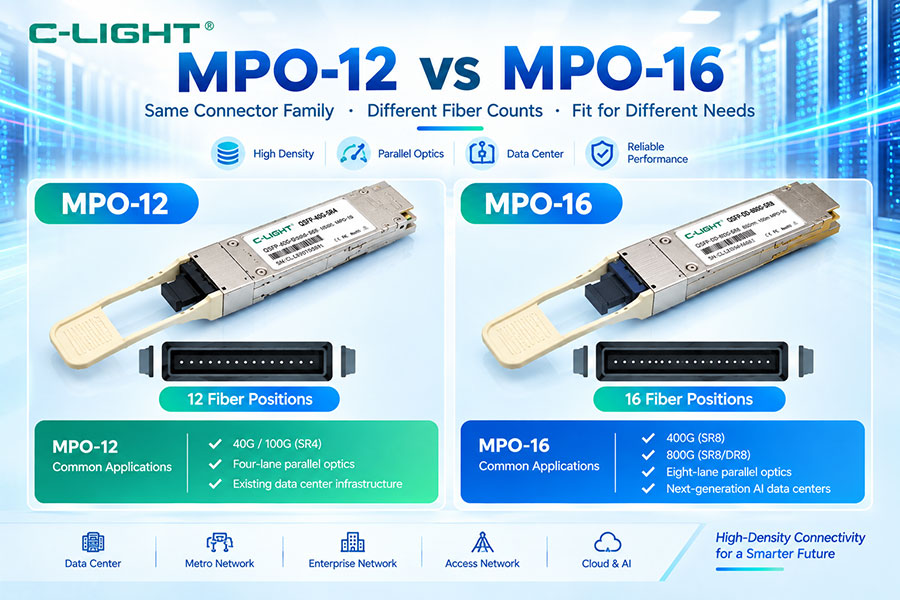
400G SR8 uses eight parallel optical lanes and is designed for short-reach multimode fiber connections.
Both OSFP and QSFP-DD can support 400G SR8 implementations. The appropriate choice depends primarily on the switch interface, cage type, module compatibility, and thermal requirements.
17. 400G OSFP vs QSFP-DD for 400G DR4
400G DR4 uses four optical lanes at 100G per lane and is normally designed for single-mode fiber links up to approximately 500m.
The optical architecture is independent of the module form factor, so DR4 can be implemented in either OSFP or QSFP-DD depending on the equipment platform.
18. 400G OSFP vs QSFP-DD for 400G FR4
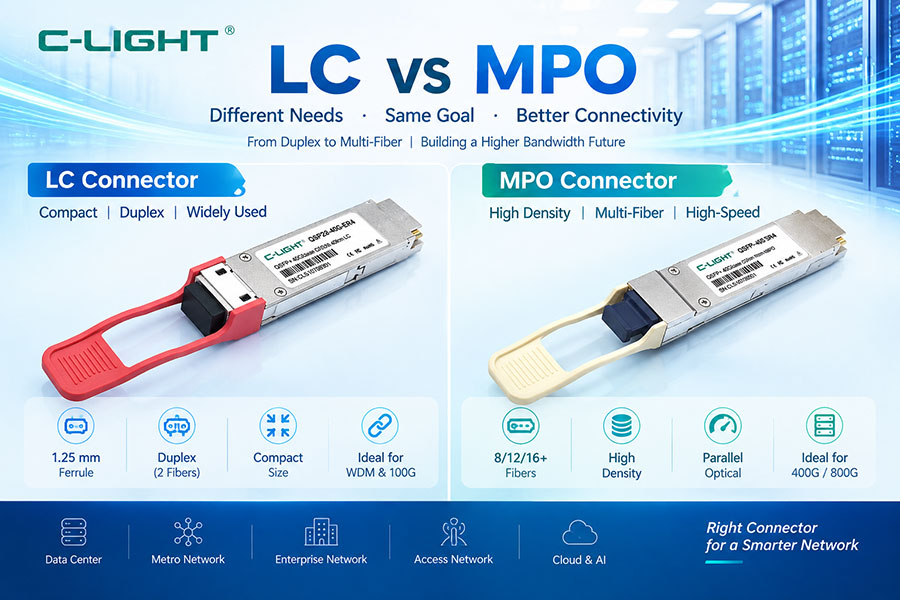
400G FR4 uses wavelength multiplexing to transmit 400G over single-mode fiber. A duplex LC interface is commonly used because multiple wavelengths share a fiber pair.
Both OSFP and QSFP-DD can host WDM-based 400G architectures such as FR4. C-LIGHT offers 400G QSFP-DD FR4 configurations for high-speed data center connectivity.
19. 400G OSFP vs QSFP-DD for AI Data Centers
AI data centers place strong demands on bandwidth, thermal management, port density, and power efficiency.
OSFP can be attractive for high-power optical modules because of its thermal headroom, while QSFP-DD can be attractive where port density and compact switch design are major priorities.
20. 400G OSFP vs QSFP-DD for HPC
High-performance computing networks require high-bandwidth, low-latency interconnects between servers, accelerators, and switches.
Both OSFP and QSFP-DD are suitable for 400G HPC networks. The choice depends on the host platform, optical reach, thermal environment, and required port density.
21. 400G OSFP vs QSFP-DD for Data Center Switches
QSFP-DD is attractive for switches that prioritize a compact front-panel design and high port density. OSFP is attractive when greater module thermal capacity is more important.
The switch's native cage design is a fundamental selection criterion because OSFP and QSFP-DD ports are mechanically different.
22. 400G OSFP vs QSFP-DD Ecosystem
QSFP-DD builds on the established QSFP ecosystem and is designed around a compact double-density architecture. This makes it attractive to equipment vendors seeking continuity with existing QSFP-based designs.
OSFP was developed specifically as a high-performance pluggable form factor with thermal capability suitable for 400G and beyond. Both ecosystems have broad industry support.
23. 400G OSFP vs QSFP-DD and Backward Compatibility
Backward compatibility is an important consideration during network evolution. QSFP-DD was designed around the QSFP family and supports lower-speed QSFP-based modules under appropriate host configurations.
OSFP uses a different mechanical form factor. Some systems can support lower-speed modules through appropriate adapters or platform-specific implementations, but this should not be assumed across all equipment.
24. 400G OSFP vs QSFP-DD Power Consumption
Power consumption is determined primarily by the optical technology, DSP, laser type, reach, operating temperature, and module architecture rather than the form factor alone.
However, OSFP's larger package provides greater thermal headroom, which can simplify the implementation of higher-power optical designs.
25. 400G OSFP vs QSFP-DD for Future 800G Networks
OSFP and QSFP-DD both have technology roadmaps extending beyond 400G. OSFP was designed around eight electrical lanes and supports 800G using 8 × 100G electrical lanes, while the QSFP-DD family has also expanded toward higher-speed generations.
For network planning, it is therefore useful to consider the full switch platform roadmap rather than selecting a 400G module solely on today's bandwidth requirement.
26. 400G OSFP vs QSFP-DD: Key Advantages
| 400G OSFP | 400G QSFP-DD |
|---|---|
| Greater thermal headroom | Compact physical size |
| Suitable for higher-power modules | High port density |
| Strong fit for AI/HPC platforms | Strong QSFP ecosystem |
| Designed for 400G and higher speeds | Flexible multi-generation platform |
| Large space for thermal management | Efficient front-panel utilization |
27. 400G OSFP vs QSFP-DD: Which One Should You Choose?
| Requirement | Preferred Form Factor |
|---|---|
| Maximum port density | QSFP-DD |
| Higher thermal headroom | OSFP |
| Compact switch design | QSFP-DD |
| High-power 400G optics | OSFP |
| Existing QSFP-based ecosystem | QSFP-DD |
| AI/HPC platform with demanding thermal requirements | OSFP |
28. 400G OSFP vs QSFP-DD for C-LIGHT Products
C-LIGHT provides 400G optical solutions in both OSFP and QSFP-DD form factors. The portfolio covers short-reach multimode connectivity, single-mode DR4 and FR4 links, and longer-distance optical solutions.
This allows the form factor to be selected according to the target switch platform while maintaining flexibility in transmission distance and optical architecture.
29. 400G OSFP vs QSFP-DD: Summary
400G OSFP and QSFP-DD both support high-speed eight-lane electrical architectures, but they are optimized around different design priorities. OSFP provides a larger physical envelope and greater thermal headroom, while QSFP-DD provides a compact package and high port density.
For high-power AI and HPC applications where thermal management is critical, OSFP can be an attractive choice. For dense Ethernet switches and installations where compact port architecture is important, QSFP-DD can be a better fit.
The final selection should be based on the switch port type, optical architecture, transmission distance, power budget, thermal environment, fiber interface, breakout requirements, and long-term network roadmap.
 >
>

 >
>
 >
>
 >
>
 >
>
 >
>
 >
>
 >
>