TEL:+86 132 6656 7067




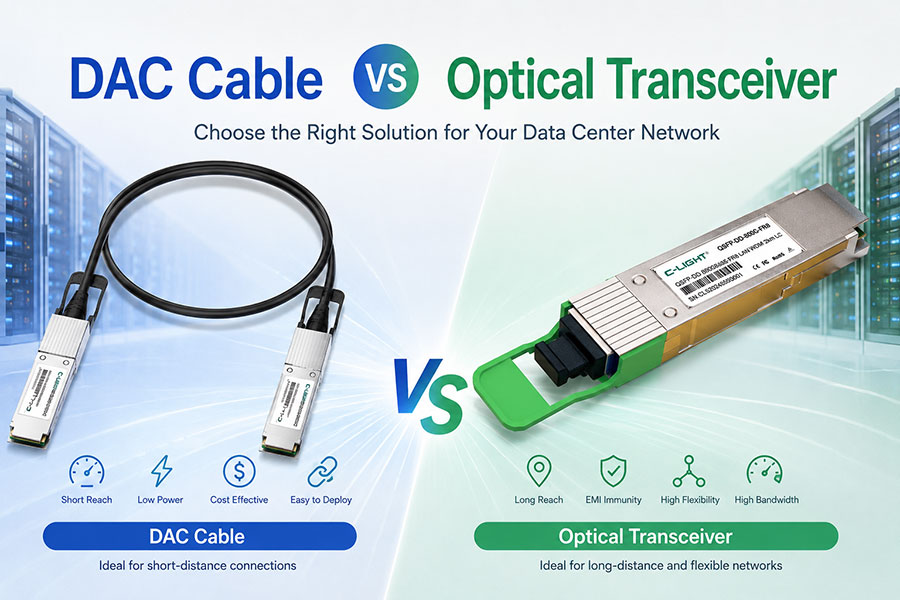
DAC cables and optical transceivers are both widely used for high-speed data center connectivity. As network speeds have evolved from 100G and 400G to 800G and beyond, choosing between copper-based direct attach solutions and optical connectivity has become increasingly important for network designers.
DAC, or Direct Attach Copper, integrates the electrical interfaces and copper cable into a single connectivity solution. An optical transceiver, in contrast, converts electrical signals into optical signals for transmission through optical fiber and converts them back into electrical signals at the receiving end.
The two technologies are not simply competing products. They are optimized for different distances, network architectures, power budgets, costs, and deployment environments.
This article compares DAC Cable vs Optical Transceiver in terms of transmission distance, bandwidth, power consumption, cost, installation, flexibility, and applications in modern data centers and AI networks.
1. What Is a DAC Cable?
A DAC cable, or Direct Attach Copper cable, is a high-speed interconnect solution that combines cable assemblies with electrical interfaces designed to connect directly to compatible switches, servers, storage systems, or other networking equipment.
Unlike an optical transceiver, a DAC cable does not use optical fiber for the transmission path. Electrical signals travel directly through copper conductors between the connected devices.
DAC solutions are particularly suitable for short-distance connections where low cost, low power consumption, and simple deployment are important.
Key Point: DAC cables are optimized for short-reach, high-bandwidth connections where copper transmission can meet the required distance and signal integrity requirements.
2. What Is an Optical Transceiver?
An optical transceiver is a network interface device that converts electrical signals into optical signals for transmission through fiber and converts incoming optical signals back into electrical signals.
Optical transceivers are available in a wide range of form factors, data rates, wavelengths, fiber types, connectors, and transmission distances.
They are commonly used for connections where copper cables cannot provide the required transmission distance, signal integrity, or network flexibility.
Modern optical transceivers support networking speeds including 100G, 200G, 400G, 800G, and 1.6T, depending on the application and network architecture.
3. DAC Cable vs Optical Transceiver: Key Differences
| Feature | DAC Cable | Optical Transceiver |
|---|---|---|
| Transmission Medium | Copper | Optical fiber |
| Typical Reach | Short distance | Short, medium, or long distance depending on module |
| Power Consumption | Generally low | Varies by module and architecture |
| Cost | Generally lower for short links | Generally higher |
| Installation | Simple | Requires transceivers and fiber connectivity |
| Transmission Distance | Limited by copper reach | Can support much longer distances |
| EMI Immunity | Lower than fiber | Excellent |
| Weight and Cable Size | Higher for longer copper assemblies | Fiber provides advantages for longer links |
| Network Flexibility | Best suited to fixed short links | Highly flexible |
| Typical Applications | Server-to-switch, rack-level connections | Data center, AI, DCI, campus, telecom |
4. Transmission Distance
Transmission distance is one of the most important differences between DAC cables and optical transceivers.
DAC cables are primarily designed for short-distance connections. Copper transmission becomes increasingly challenging as cable length and signaling speed increase because of insertion loss, attenuation, crosstalk, and signal integrity requirements.
Optical transceivers use fiber as the transmission medium and can support a much broader range of distances.
| Application | DAC | Optical Transceiver |
|---|---|---|
| Server to Top-of-Rack Switch | Excellent | Suitable |
| Same Rack | Excellent | Suitable |
| Adjacent Rack | Possible depending on distance and system | Excellent |
| Data Center Spine-Leaf | Limited | Excellent |
| Data Center Interconnect | Generally unsuitable | Excellent |
| Long-Distance Network | Generally unsuitable | Excellent |
For this reason, DAC is typically selected when the endpoints are physically close, while optical transceivers become increasingly attractive as the required distance increases.
5. Power Consumption
Power consumption is another important factor when designing high-density data center networks.
A passive DAC cable does not require optical conversion electronics along the transmission path, which can result in very low power consumption. Active copper solutions can include additional electronic components and therefore have different power characteristics.
Optical transceivers require electrical-to-optical and optical-to-electrical conversion. Their power consumption depends on the data rate, optical architecture, DSP implementation, laser technology, transmission distance, and module design.
As data rates increase to 800G and 1.6T, power efficiency becomes increasingly important.
Short reach + low power priority → DAC can be advantageous
Longer reach + high flexibility → Optical transceiver is generally preferred
6. Cost Comparison
For short-distance connections, DAC cables can provide a cost-effective networking solution because the cable and electrical interface are integrated into one assembly.
An optical connection typically requires optical transceivers at both ends together with optical fiber and potentially additional connectivity components.
This can increase the initial hardware cost compared with a short copper connection.
However, cost should not be evaluated only by the price of the individual cable or module. Network designers should consider the total cost of deployment, including rack layout, power consumption, cooling, cable management, maintenance, scalability, and future network upgrades.
7. Installation and Deployment
DAC cables are relatively simple to deploy. The cable assembly can be connected directly between compatible ports without separately installing optical transceivers and fiber patch cables.
Optical connectivity generally requires a transceiver at each endpoint and a compatible fiber connection between them.
This makes DAC particularly attractive for short server-to-switch connections where simplicity is important.
Optical transceivers provide greater flexibility when network infrastructure needs to cover different distances or support different fiber architectures.
8. Signal Integrity
Signal integrity becomes increasingly important as data rates increase.
High-speed copper links are affected by insertion loss, return loss, crosstalk, electromagnetic interference, and other electrical impairments.
Optical fiber does not experience electrical attenuation in the same way as copper and is immune to electromagnetic interference along the optical transmission path.
However, optical modules introduce their own design challenges, including optical power, receiver sensitivity, laser performance, TDECQ, dispersion, connector loss, and optical signal quality.
Both technologies therefore require careful validation at high data rates.
9. DAC Cable vs Optical Transceiver for 400G Networks
400G networks can use both DAC and optical transceiver solutions depending on the required transmission distance and network architecture.
DAC can be attractive for short server-to-switch connections within a rack or between closely positioned network devices.
Optical transceivers are more appropriate when the network requires greater reach, fiber connectivity, or connections between different areas of the data center.
The appropriate solution should be selected based on the complete link budget, host interface, cable length, power requirements, and network architecture.
10. DAC Cable vs Optical Transceiver for 800G Networks
The transition to 800G increases the importance of high-speed electrical and optical design.
800G DAC solutions are primarily targeted at short-reach applications where copper can satisfy the required electrical performance.
800G optical transceivers provide significantly greater flexibility for different transmission distances and fiber infrastructures.
| 800G Requirement | DAC | Optical Transceiver |
|---|---|---|
| Short server connection | Excellent | Suitable |
| Rack-level connectivity | Excellent | Excellent |
| Longer reach | Limited | Excellent |
| Fiber infrastructure | No | Yes |
| Low-cost short link | Strong advantage | Higher cost |
| Flexible network architecture | Limited | Strong advantage |
11. DAC Cable vs Optical Transceiver for AI Data Centers
AI data centers are driving rapid growth in high-speed connectivity. GPU servers, network switches, storage systems, and accelerator clusters require large numbers of high-bandwidth links.
The choice between DAC and optical transceivers depends heavily on the physical architecture of the AI cluster.
11.1 DAC for Short AI Connections
DAC can be an effective solution for short-distance connections where servers and switches are located within the same rack or within a short physical distance.
Its low power consumption, simple installation, and cost advantages make it attractive for these links.
11.2 Optical Transceivers for Longer AI Links
As GPU clusters expand across multiple racks and network layers, optical connectivity becomes increasingly important.
Optical transceivers can support longer distances and provide greater flexibility for connecting leaf, spine, and other network layers.
11.3 AI Network Architecture
A modern AI network may use different connectivity technologies simultaneously.
GPU Server → DAC → Top-of-Rack Switch
Switch → Optical Transceiver → Spine Network
Data Center → Optical Transceiver → DCI
This hybrid approach allows network designers to select the most appropriate interconnect technology for each link.
12. DAC vs Optical Transceiver: Advantages and Disadvantages
| Technology | Advantages | Limitations |
|---|---|---|
| DAC Cable | Low cost, low power, simple installation, excellent for short links | Limited reach, copper signal integrity challenges, less flexible for long-distance networks |
| Optical Transceiver | Longer reach, EMI immunity, high flexibility, broad application range | Higher cost, optical components required, more complex thermal and optical design |
13. When Should You Choose DAC Cable?
DAC is generally a strong option when the network has short physical links and the electrical interface can meet the required performance.
Short transmission distance: The endpoints are located close to each other.
Low power requirement: Minimizing interconnect power is important.
Cost-sensitive deployment: The network requires economical short-reach connectivity.
Simple installation: Integrated cable assemblies are preferred.
Rack-level connectivity: Servers and switches are positioned within the same rack or nearby.
14. When Should You Choose an Optical Transceiver?
Optical transceivers are generally preferred when distance, flexibility, fiber infrastructure, or network scalability is more important than the lowest initial link cost.
Longer transmission distance: The link exceeds the practical reach of copper.
Multiple network zones: Devices are distributed across racks or data center areas.
Fiber infrastructure: The network already uses optical fiber.
High-speed backbone: The connection is part of a spine-leaf or backbone network.
AI cluster expansion: The network must scale across multiple racks.
Future scalability: The infrastructure needs to support multiple transmission distances and future upgrades.
15. DAC Cable vs Optical Transceiver: Cost and Performance Trade-Off
The decision between DAC and optical transceivers should be based on the complete system rather than a single specification.
DAC
Best suited for short, cost-sensitive, low-power connections.
Optical Transceiver
Best suited for flexible, longer-distance, high-speed optical networks.
AI Networking
Both technologies can coexist in different parts of the network.
Network Scaling
Optical connectivity provides greater flexibility as physical distances increase.
16. DAC, AOC, and Optical Transceiver
DAC is sometimes compared with AOC and optical transceivers because all three can be used for high-speed data center connectivity. However, their architectures are different.
| Technology | Transmission Medium | Typical Strength |
|---|---|---|
| DAC | Copper | Short reach and low cost |
| AOC | Optical fiber with integrated optical ends | Simple optical short-reach connectivity |
| Optical Transceiver | Optical fiber | Flexible and scalable optical networking |
DAC and AOC are integrated cable solutions, while an optical transceiver is normally deployed with a separate fiber connection. This difference has a significant impact on installation flexibility and network architecture.
17. C-LIGHT DAC and Optical Transceiver Solutions
C-LIGHT provides high-speed interconnect and optical transceiver solutions for data centers, AI networks, cloud infrastructure, hyperscale computing, and high-performance networking.
The product portfolio covers different connectivity requirements across multiple bandwidth generations, including 400G, 800G, and 1.6T.
High-Speed Data Center Connectivity
DAC, AEC, and optical transceiver solutions designed for different network distances, bandwidth requirements, and system architectures.
For short-reach server and switch connections, DAC can provide a simple and power-efficient connectivity option. For longer links and network backbone applications, optical transceivers provide greater transmission distance and deployment flexibility.
C-LIGHT can provide solutions according to the target switch interface, transmission distance, bandwidth, connector, power budget, and application requirements.
18. Future Trends in Data Center Interconnect
The growth of AI infrastructure is pushing data center networking toward higher bandwidth and greater connection density.
The industry is moving from 400G to 800G and 1.6T, while higher-speed technologies are being developed for future network generations.
DAC will continue to play an important role in short-reach connectivity because of its cost and power advantages.
At the same time, optical transceivers will remain essential for longer-distance and high-capacity network connections.
New technologies such as AEC, LPO, silicon photonics, and CPO are also expanding the range of possible architectures for next-generation AI data centers.
Short Reach → DAC / AEC
Optical Short & Medium Reach → Optical Transceiver / AOC
Long Reach → Advanced Optical Transceiver
19. FAQ: DAC Cable vs Optical Transceiver
Q1: What is the main difference between DAC and an optical transceiver?
Answer: DAC uses copper conductors for electrical signal transmission, while an optical transceiver converts electrical signals into optical signals and transmits them through optical fiber.
Q2: Is DAC cheaper than an optical transceiver?
Answer: For short-distance connections, DAC is generally more cost-effective because it integrates the cable and electrical interfaces into one solution and does not require separate optical transceivers and fiber links.
Q3: Which has lower power consumption, DAC or optical transceiver?
Answer: Passive DAC generally has very low power consumption because it does not require optical conversion. Active copper solutions and optical transceivers have different power characteristics depending on their design.
Q4: Is DAC suitable for 800G networking?
Answer: Yes. 800G DAC solutions can be used for appropriate short-reach applications when the host interfaces, cable length, signal integrity, and system requirements are compatible.
Q5: Is optical connectivity better than DAC?
Answer: Neither technology is universally better. DAC is generally advantageous for short, low-cost, low-power links, while optical connectivity is better suited to longer distances and more flexible network architectures.
Q6: Can DAC and optical transceivers be used in the same data center?
Answer: Yes. Many data centers use different interconnect technologies for different network segments. DAC can serve short server-to-switch connections, while optical transceivers can connect switches, racks, network layers, and longer-distance links.
Q7: What should be considered when choosing DAC or optical transceivers?
Answer: Important factors include transmission distance, bandwidth, power consumption, cost, host interface, signal integrity, fiber infrastructure, thermal requirements, scalability, and the overall network architecture.
20. Summary
DAC cables and optical transceivers serve different but complementary roles in modern data center networks.
DAC is particularly suitable for short-distance, low-power, cost-sensitive connections. Its integrated design simplifies installation and makes it attractive for server-to-switch and rack-level connectivity.
Optical transceivers provide significantly greater flexibility in terms of transmission distance, network architecture, fiber connectivity, and scalability. They are essential for high-speed backbone, spine-leaf, AI cluster, hyperscale, and data center interconnect applications.
As data center bandwidth continues to evolve from 400G to 800G and 1.6T, both copper and optical technologies will remain important. The right choice depends on the physical distance, bandwidth, power budget, cost target, and architecture of each individual link.
C-LIGHT provides DAC, AEC, and optical transceiver solutions for high-speed data center and AI networking applications, supporting connectivity requirements across different bandwidth levels and network architectures.
 >
>

 >
>
 >
>
 >
>
 >
>
 >
>
 >
>
 >
>