TEL:+86 132 6656 7067




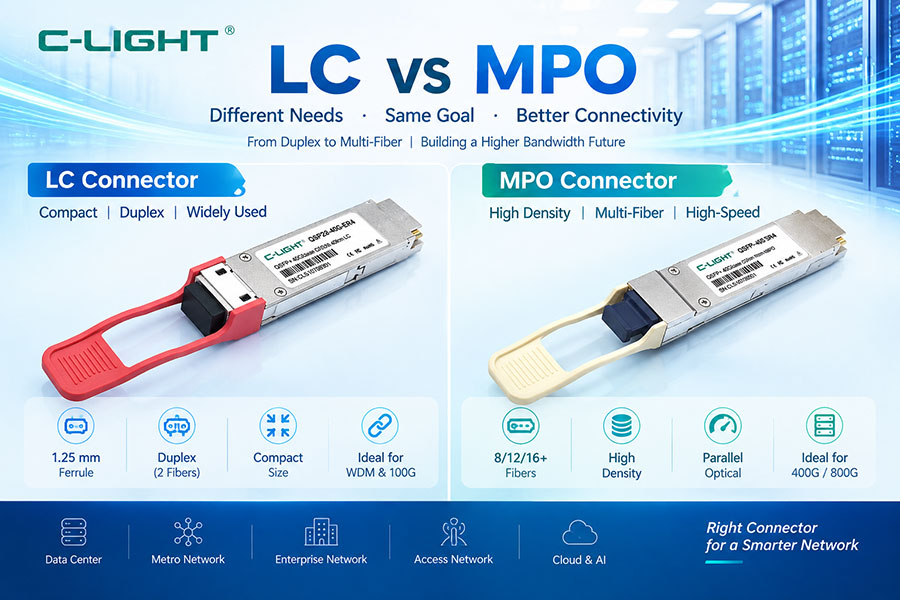
LC and MPO are two widely used fiber optic connector types in modern optical networks. LC is commonly used for duplex point-to-point connections because of its compact size and simple handling, while MPO provides multiple fiber connections through a single connector and is widely used for high-density data center cabling. Understanding the differences between LC and MPO is important when selecting fiber patch cables, optical transceivers, breakout cables, and structured cabling for 100G, 400G, and 800G networks.
1. What Is an LC Connector?
LC stands for Lucent Connector and is a small-form-factor fiber optic connector commonly used with single-mode and multimode fiber. LC connectors use a 1.25 mm ferrule and typically employ a push-pull latch mechanism.
LC is widely used in optical transceivers, fiber patch cords, patch panels, switches, and telecommunications equipment. Duplex LC normally uses two fibers, with one fiber carrying the transmit signal and the other carrying the receive signal.
2. What Is an MPO Connector?
MPO stands for Multi-fiber Push On connector. Unlike LC, which normally connects one fiber per ferrule, MPO can terminate multiple fibers in a single connector.
Common MPO configurations include 8-fiber, 12-fiber, and 16-fiber versions, while higher-fiber-count configurations are also available. MPO is particularly useful when high fiber density and parallel optical transmission are required.
3. LC vs MPO: Basic Difference
| Feature | LC | MPO |
|---|---|---|
| Connector type | Duplex or simplex | Multi-fiber |
| Typical fiber count | 1 or 2 fibers | 8, 12, 16 or more fibers |
| Ferrule | 1.25 mm | Multi-fiber ferrule |
| Density | High | Very high |
| Polarity management | Simple | More important |
| Typical application | Duplex optical links | Parallel and high-density links |
| Common high-speed use | 100G LR4/ER4 and WDM links | 40G/100G/400G/800G parallel optics |
4. LC vs MPO Fiber Count
The most obvious difference is the number of fibers supported by a connector.
A duplex LC connection normally contains two optical fibers. An MPO connector can contain multiple fibers within one connector body, allowing many optical channels to be organized in a much smaller physical space.
This difference becomes increasingly important as data center bandwidth increases and rack-level fiber density becomes a major design consideration.
5. LC Connector Structure
An LC connector uses a small 1.25 mm ferrule to align the optical fiber with the mating connector. Its compact housing makes LC suitable for high-density patch panels and optical transceiver interfaces.
Duplex LC connectors combine two LC interfaces into one assembly, normally representing a transmit and receive fiber pair.
6. MPO Connector Structure
An MPO connector uses a precision multi-fiber ferrule with multiple fiber positions arranged in a row. Guide pins and guide holes maintain fiber alignment between the two mating connectors.
Because several fibers are terminated together, MPO connectors require greater attention to fiber position, polarity, key orientation, and mating configuration than standard LC connections.
7. LC vs MPO Polarity
Polarity is relatively straightforward with a duplex LC connection because the two fibers can be arranged as transmit and receive.
MPO systems require more careful polarity management because multiple fibers must be mapped correctly between two endpoints. Type A, Type B, and Type C polarity methods are commonly used in structured MPO cabling.
Incorrect polarity can result in transmit and receive channels being connected incorrectly, preventing the optical link from operating normally.
8. LC vs MPO Insertion Loss
Insertion loss depends on connector quality, fiber alignment, cleanliness, mating condition, and the specific connector design. It should not be assumed that one connector type always has lower loss than the other.
For MPO systems, the overall loss of the multi-fiber connection and the number of mating interfaces should be considered when calculating the optical link budget.
9. LC vs MPO Return Loss
Return loss describes the amount of optical power reflected toward the transmitter. Connector end-face quality, alignment, polishing technology, contamination, and mating condition can all affect return loss.
For high-speed optical networks, connector specifications should be evaluated together with the requirements of the transceiver and optical link.
10. LC vs MPO Fiber Density
MPO has a major advantage in high-density environments because multiple fibers can be terminated within one connector.
For large data centers, this can significantly reduce the number of individual connector positions and simplify high-fiber-count backbone cabling. LC remains attractive where individual duplex connections and flexible patching are more important.
11. LC vs MPO for 100G Networks
Both LC and MPO can be used in 100G networks, but the appropriate connector depends on the optical architecture.
100G WDM transceivers such as 100G QSFP28 LR4 and ER4 commonly use duplex LC because multiple optical wavelengths are multiplexed onto a single fiber pair.
Parallel 100G architectures can use MPO connectors, where multiple optical fibers carry separate channels simultaneously.
12. LC vs MPO for 400G Networks
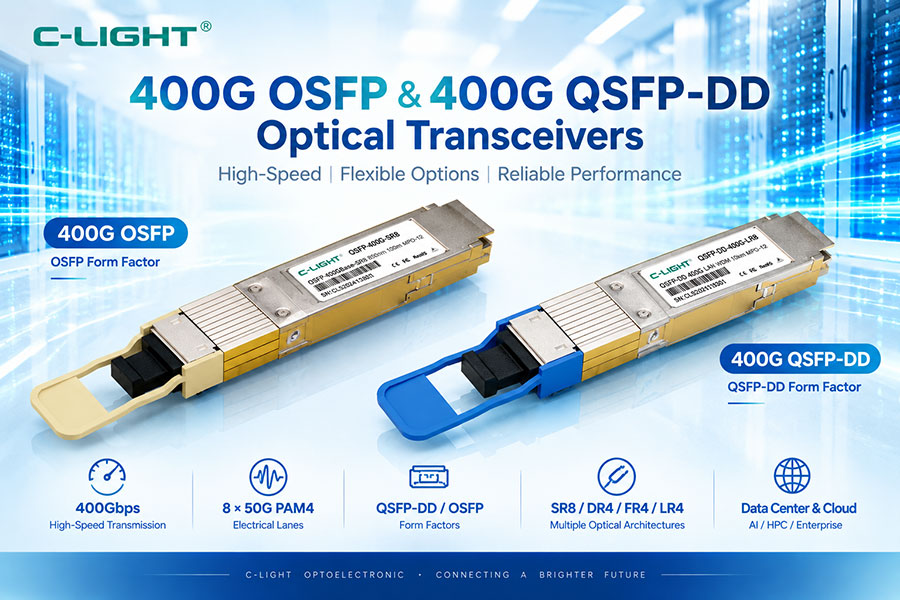
MPO becomes particularly important for 400G parallel optical systems. Depending on the transceiver architecture, 400G modules may use MPO-12, MPO-16, or other multi-fiber interfaces.
For example, an 8-lane 400G parallel optical architecture can use multiple fibers to carry individual optical lanes. The exact connector configuration depends on the module design and standard.
13. LC vs MPO for 800G Networks
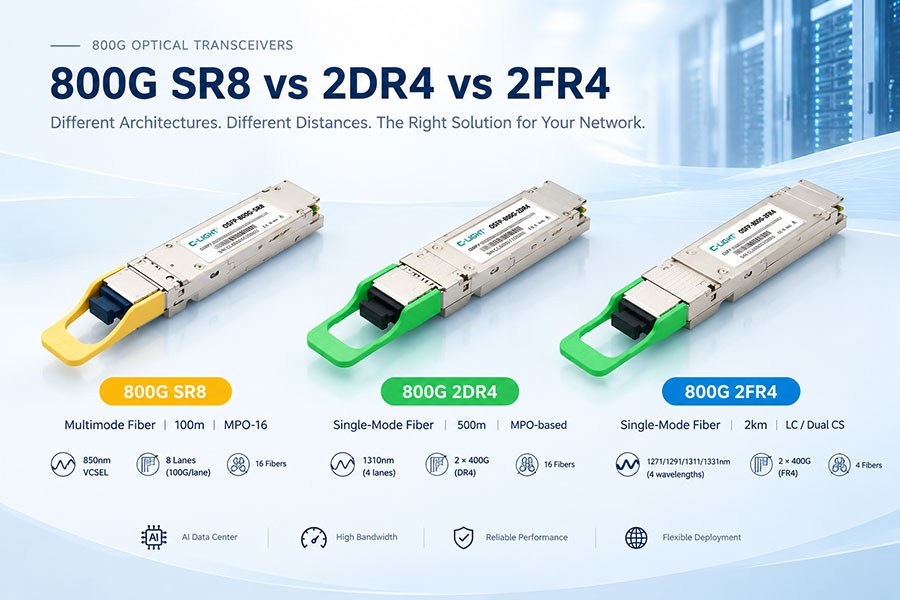
800G optical networks increasingly use multi-fiber interfaces for parallel optical transmission. MPO-16 is commonly associated with 8-lane 800G architectures, while other 800G designs can use duplex LC when wavelength multiplexing reduces the number of external fiber connections.
Therefore, 800G does not automatically mean MPO. The connector must be selected according to the optical architecture of the transceiver.
14. LC vs MPO for WDM Applications
WDM technology combines multiple wavelengths onto the same optical fiber. Because several wavelengths can share a fiber, WDM transceivers often require fewer external fibers.
100G LR4, ER4, CWDM4, and similar WDM-based modules commonly use duplex LC interfaces. MPO is more closely associated with parallel-fiber architectures where multiple fibers carry separate optical channels.
15. LC vs MPO for Parallel Optics
Parallel optics divides a high-speed connection across multiple optical lanes. Each lane can use a separate fiber, making multi-fiber connectors highly suitable for this architecture.
MPO simplifies the physical connection by grouping multiple fibers into one connector. This is one of the main reasons MPO has become important in high-speed AI data centers and hyperscale networks.
16. LC vs MPO for Data Center Cabling
LC is useful for conventional duplex connections, access-level patching, WDM links, and applications requiring frequent individual fiber management.
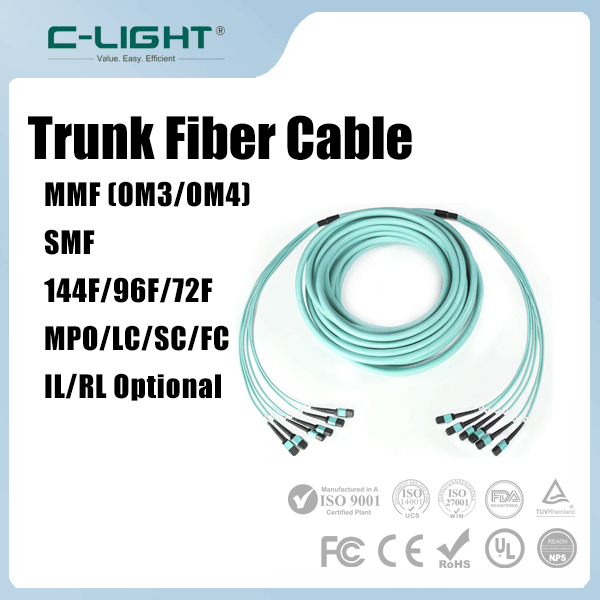
MPO is better suited to high-density backbone and trunk connections. MPO trunks can connect high-fiber-count systems while reducing the physical space required for individual fiber connectors.
17. LC vs MPO Cable Management
LC cables are relatively easy to identify, patch, and troubleshoot because individual fibers or duplex pairs can be managed separately.
MPO provides better density but requires more disciplined cable management. Polarity, fiber position, connector keying, and cassette or breakout configuration must be documented and maintained correctly.
18. LC vs MPO Breakout Cabling
MPO breakout cables provide a practical way to connect a multi-fiber trunk to individual LC or other duplex interfaces.
A typical architecture may use an MPO connector on one side and multiple LC connectors on the other side. This allows a high-density backbone to connect to equipment using individual duplex optical interfaces.
19. MPO-12 vs MPO-16
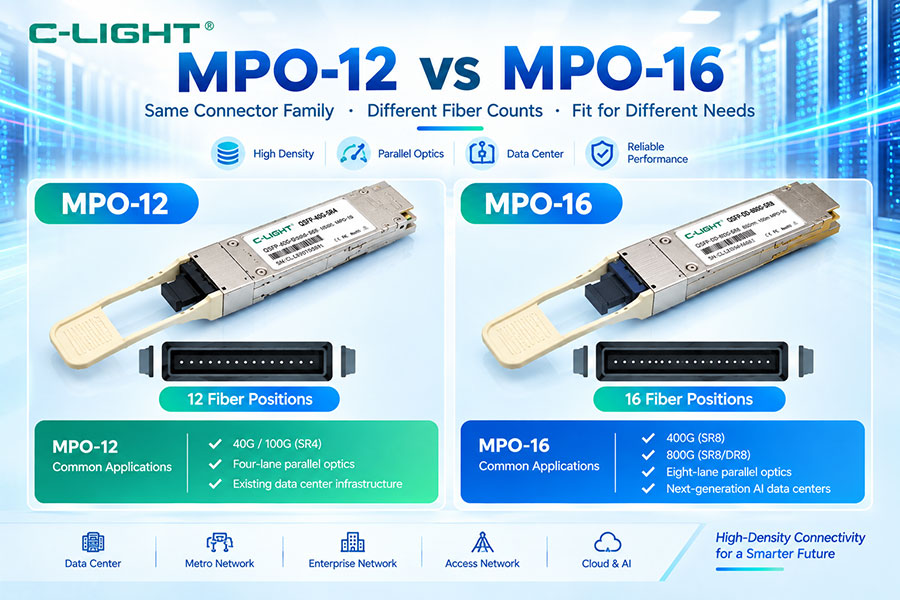
MPO-12 contains 12 fiber positions, while MPO-16 contains 16 fiber positions. The appropriate configuration depends on the transceiver architecture and the number of optical lanes required.
MPO-16 is particularly relevant to some 8-lane 400G and 800G parallel optical designs because the connector provides additional fiber positions for the required optical lanes and system architecture.
20. MPO vs MTP
MPO is a standardized multi-fiber connector family, while MTP is a branded, enhanced version of the MPO connector developed by US Conec.
MTP connectors are designed to provide improved mechanical and optical performance while remaining compatible with the broader MPO ecosystem when the relevant specifications are matched.
21. LC vs MPO: Installation and Maintenance
LC is generally easier to install and troubleshoot because each connector handles a small number of fibers.
MPO installation requires greater attention to connector orientation, polarity, fiber mapping, cleaning, inspection, and end-face condition. Proper MPO testing equipment and documentation become increasingly important in large-scale deployments.
22. LC vs MPO Cleaning Requirements
Both LC and MPO connectors must be kept clean. Dust or contamination on an optical end face can increase insertion loss, increase reflections, or potentially damage the mating interface.
MPO cleaning can be more demanding because several fiber end faces are located within the same connector. Dedicated MPO cleaning and inspection tools are commonly used for high-density installations.
23. LC vs MPO Cost
Connector cost depends on fiber count, performance grade, cable construction, manufacturing quality, and deployment volume.
LC components are generally simple for duplex applications, while MPO systems can require additional components such as trunks, cassettes, breakout modules, and polarity-management hardware. However, MPO can reduce overall infrastructure complexity and rack space in high-density deployments.
24. LC vs MPO: Which One Should You Choose?
| Application Requirement | Recommended Connector |
|---|---|
| Duplex optical link | LC |
| WDM optical transceiver | LC |
| Individual fiber patching | LC |
| High-density trunk cabling | MPO |
| Parallel optical transmission | MPO |
| 400G/800G high-density interconnect | MPO or LC depending on architecture |
| Breakout connection | MPO to LC or other required interface |
25. LC vs MPO for AI Data Centers
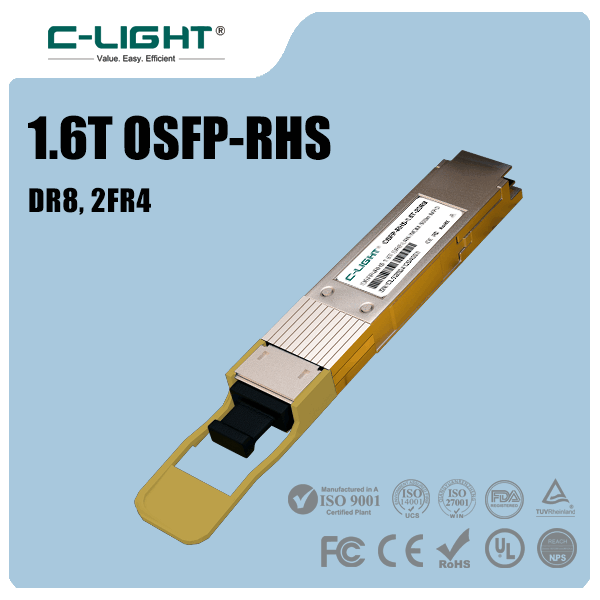
AI data centers are driving higher port speeds, greater fiber counts, and higher rack density. As 400G, 800G, and 1.6T connectivity becomes more common, multi-fiber architectures can help manage the large number of optical lanes required by high-bandwidth networks.
MPO is therefore increasingly important for parallel optical connections, while LC remains highly relevant for WDM, longer-reach, and duplex optical links.
26. LC vs MPO for 400G and 800G Optical Transceivers
The connector should be selected from the optical architecture rather than from the data rate alone.
A 400G or 800G WDM transceiver may use duplex LC, while a parallel-optics transceiver may use MPO. Parameters such as fiber type, lane count, wavelength architecture, transmission distance, polarity, and optical budget should all be considered.
27. LC vs MPO: Key Advantages
| LC Advantages | MPO Advantages |
|---|---|
| Compact duplex interface | High fiber density |
| Simple polarity | Multiple fibers in one connector |
| Easy individual fiber management | Efficient backbone cabling |
| Widely used with WDM optics | Well suited to parallel optics |
| Easy patching and troubleshooting | Suitable for high-speed data center networks |
28. LC vs MPO: Summary
LC and MPO serve different roles in modern fiber optic networks. LC is a compact and flexible connector for duplex fiber links and is widely used with WDM optical transceivers. MPO provides high-density multi-fiber connectivity and is particularly valuable for parallel optical architectures and high-speed data center cabling.
For 100G, 400G, 800G, and future 1.6T networks, the correct choice depends on the optical architecture, lane configuration, fiber count, transmission distance, and cabling design. LC and MPO are complementary technologies rather than direct replacements for each other.
 >
>

 >
>
 >
>
 >
>
 >
>
 >
>
 >
>
 >
>