TEL:+86 132 6656 7067





1. AI Infrastructure Is Reshaping the Optical Transceiver Industry
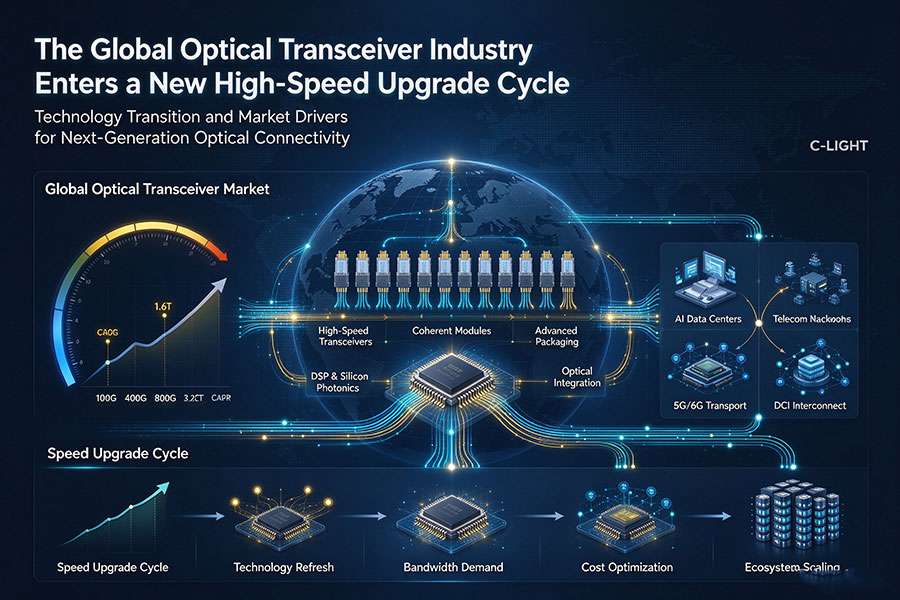
The global optical transceiver industry is entering a new phase of technological development as artificial intelligence, hyperscale cloud computing, and high-performance data center networks accelerate the demand for high-speed optical connectivity. The rapid expansion of GPU clusters and AI computing infrastructure is changing both the volume and specifications of optical communication equipment deployed across modern data centers.
For years, 100G and 400G optical transceivers supported the evolution of enterprise networks, cloud infrastructure, and large-scale data transmission. However, the increasing computational requirements of generative AI and large language models are creating stronger demand for 800G and 1.6T optical interfaces. At the same time, research and development activities surrounding 3.2T connectivity are beginning to influence future product roadmaps.
This transition is not simply a matter of increasing transmission speeds. It also involves improvements in optical integration, power efficiency, signal processing, manufacturing capacity, and network architecture. As a result, the optical transceiver industry is moving toward a broader upgrade cycle that will influence component suppliers, module manufacturers, system integrators, and data center operators.
2. AI Data Centers Are Driving Demand for Higher-Speed Optical Modules
AI training and inference workloads generate substantial communication traffic between GPUs, accelerators, storage systems, and network switches. In distributed computing environments, thousands of processing units must exchange information continuously to coordinate computing tasks.
As AI clusters become larger, the network infrastructure connecting these systems must provide higher aggregate bandwidth and more efficient data transmission. Optical transceivers are essential to this process because they convert electrical signals into optical signals for transmission through fiber networks.
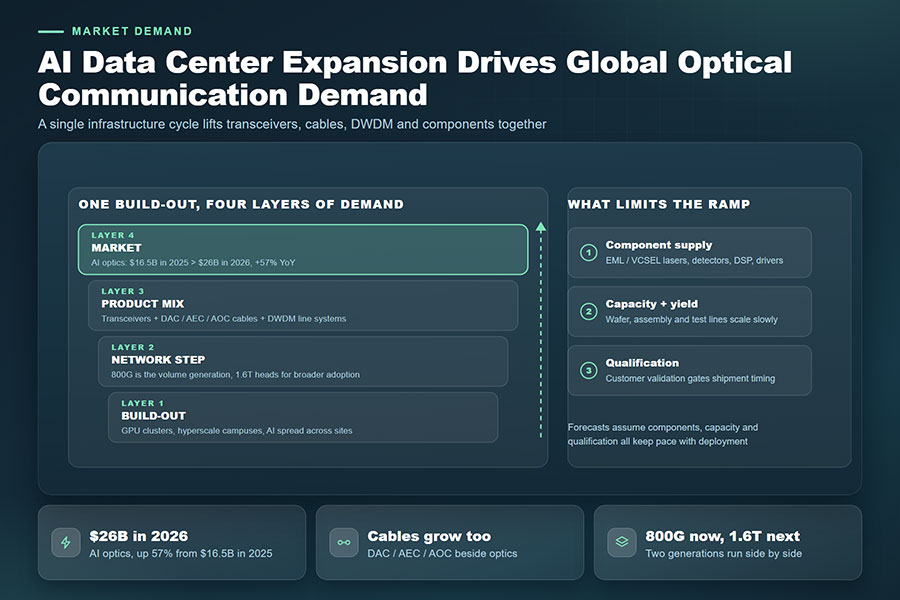
According to TrendForce, the global AI-focused optical transceiver market is projected to grow from approximately US$16.5 billion in 2025 to US$26 billion in 2026. This forecast reflects the rapid expansion of AI infrastructure and increasing demand for 800G and higher-speed optical connectivity.
Several factors are contributing to this growth:
Increasing deployment of GPU-based AI servers and accelerator clusters.
Higher bandwidth requirements between network switches and computing racks.
Expansion of hyperscale cloud data centers and AI infrastructure.
Migration from 400G toward 800G and 1.6T optical interfaces.
Growing requirements for high-capacity connections between data center facilities.
These developments are expanding the role of optical connectivity from conventional data transmission to a critical component of large-scale AI computing infrastructure.
3. The Industry Is Moving from 400G to 800G and 1.6T
Transmission speed upgrades are among the most visible changes in the optical transceiver industry. As network bandwidth requirements increase, manufacturers are developing higher-speed optical modules to support next-generation Ethernet and InfiniBand infrastructure.
400G remains important in many existing data center deployments, while 800G is becoming a major specification for new high-density AI networking systems. Meanwhile, 1.6T optical transceivers are moving into production and qualification programs, establishing the foundation for the next generation of network infrastructure.
| Transmission Generation | Development Stage in 2026 | Primary Application | Common Form Factors |
|---|---|---|---|
| 100G | Established deployment | Enterprise and data center networks | QSFP28, SFP112 |
| 400G | Established and expanding | Cloud and AI data center connectivity | QSFP-DD, OSFP, QSFP112 |
| 800G | Large-scale deployment and expansion | Hyperscale AI networking | OSFP, QSFP-DD |
| 1.6T | Production ramp and qualification | Next-generation AI switching infrastructure | OSFP, emerging advanced interfaces |
| 3.2T | Research and development | Future high-capacity optical networking | Future-generation optical interfaces |
The transition between generations is not instantaneous. Different data centers have different infrastructure lifecycles, budgets, transmission requirements, and compatibility considerations. Consequently, 400G, 800G, and 1.6T products are expected to coexist during the industry's upgrade cycle.
4. 800G Optical Transceivers Become a Major Growth Segment
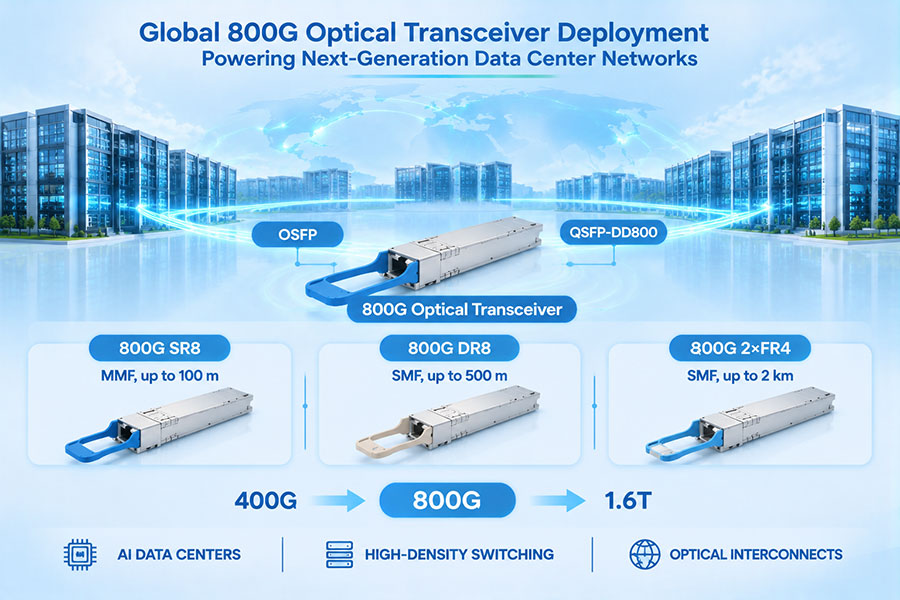
800G optical transceivers are gaining importance as AI data centers require higher bandwidth per network connection. Compared with 400G interfaces, 800G modules provide twice the nominal transmission capacity within a single optical interface, helping network operators increase port bandwidth density.
Several 800G optical configurations address different data center transmission requirements.
| 800G Module | Optical Configuration | Typical Reach | Fiber Type |
|---|---|---|---|
| 800G SR8 | 8 × 100G multimode lanes | Up to 100 m | OM4 MMF |
| 800G DR8 | 8 × 100G single-mode lanes | Up to 500 m | SMF |
| 800G 2FR4 | 8 × 100G electrical lanes with 4-wavelength optical transmission per fiber direction | Up to 2 km | SMF |
| 800G FR4 | 4 × 200G wavelength channels | Up to 2 km | SMF |
These configurations provide different approaches to bandwidth distribution, fiber utilization, and transmission distance. The selection depends on switch architecture, fiber infrastructure, connector type, and optical link requirements.
For AI data centers, 800G DR8, SR8, and FR4-family technologies are particularly relevant to high-density switching environments. Their deployment is also encouraging the development of more advanced optical engines, laser components, and high-speed electronic interfaces.
5. The Emergence of 1.6T and the Next Generation of Optical Connectivity
While 800G is becoming an important deployment generation, the industry is already moving toward 1.6T optical connectivity. The doubling of interface bandwidth provides a pathway for supporting increasingly demanding switching systems and larger AI clusters.
1.6T optical transceivers introduce additional engineering challenges involving electrical signaling, optical modulation, thermal management, and component integration. Higher transmission speeds require more sophisticated optical and electronic designs to maintain signal quality and reliable operation.
Important 1.6T configurations include:
1.6T DR8: Eight parallel 200G optical lanes designed for short-reach single-mode fiber connections.
1.6T 2DR4: A parallel optical architecture using multiple 200G channels for high-bandwidth single-mode fiber transmission.
1.6T SR8: A short-reach multimode optical architecture intended for compatible high-density applications.
The adoption of 1.6T will depend on more than module availability. Switch ASIC capabilities, host electrical interfaces, thermal budgets, optical component supply, and network qualification all influence deployment schedules.
For optical module manufacturers, the transition creates opportunities to develop new products while improving production processes, optical alignment, packaging technologies, and testing capabilities.
6. Silicon Photonics Is Changing Optical Transceiver Design
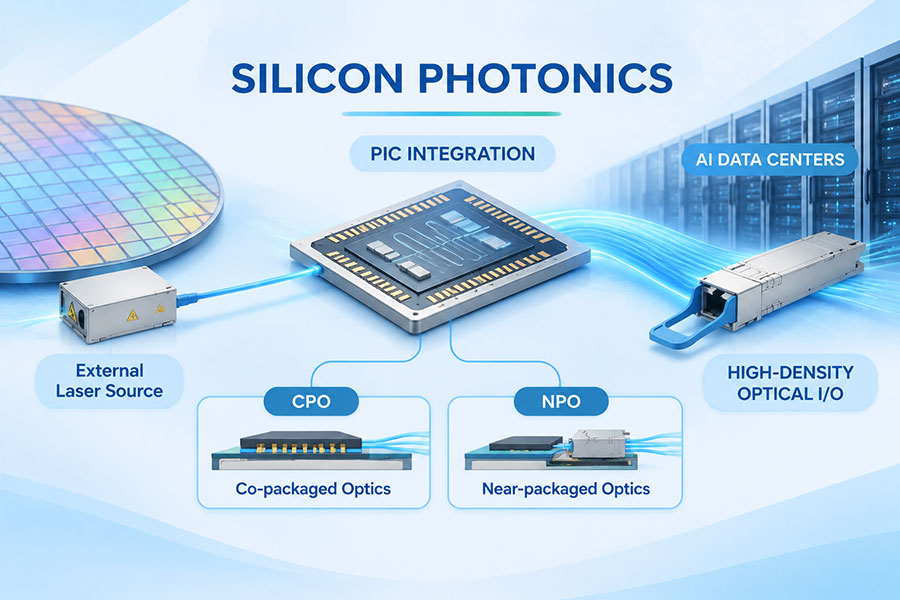
As optical transmission speeds increase, traditional optical component architectures face growing challenges related to integration density, power consumption, manufacturing complexity, and cost. Silicon photonics is becoming an important technology for addressing these requirements.
Silicon photonics uses semiconductor manufacturing techniques to integrate optical functions onto photonic integrated circuits. These circuits can support modulation, multiplexing, optical routing, and other functions required for high-speed optical transmission.
Compared with conventional discrete optical component designs, silicon photonics offers several potential advantages:
Higher integration of optical functions within compact photonic circuits.
Potential improvements in manufacturing scalability and component consistency.
Support for higher bandwidth density in advanced optical modules.
Flexible integration with electronic integrated circuits.
Potential reductions in laser-related costs for certain high-speed architectures.
External continuous-wave laser sources can be used in silicon photonics architectures to provide optical power for modulation. This approach is particularly relevant to emerging 800G and 1.6T designs.
Silicon photonics is not expected to replace every existing optical technology. EML-based solutions, VCSEL technology, and other optical components will continue to serve applications where their performance and cost characteristics remain suitable.
7. LPO, NPO, and CPO Are Expanding the Optical Connectivity Landscape
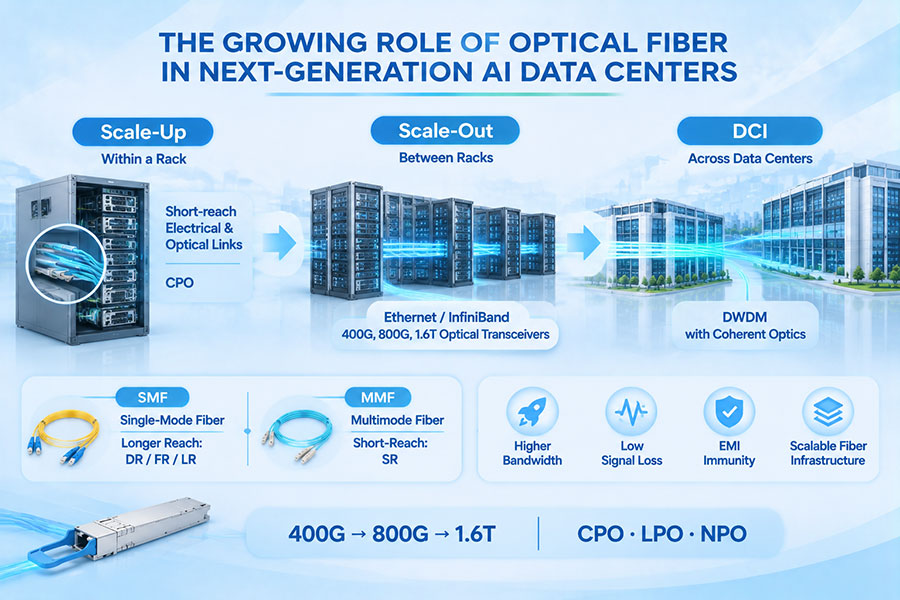
The optical transceiver industry's upgrade cycle is also changing how optical engines are integrated into networking systems. Traditional pluggable transceivers remain widely used, but alternative architectures are attracting attention as electrical interface speeds increase.
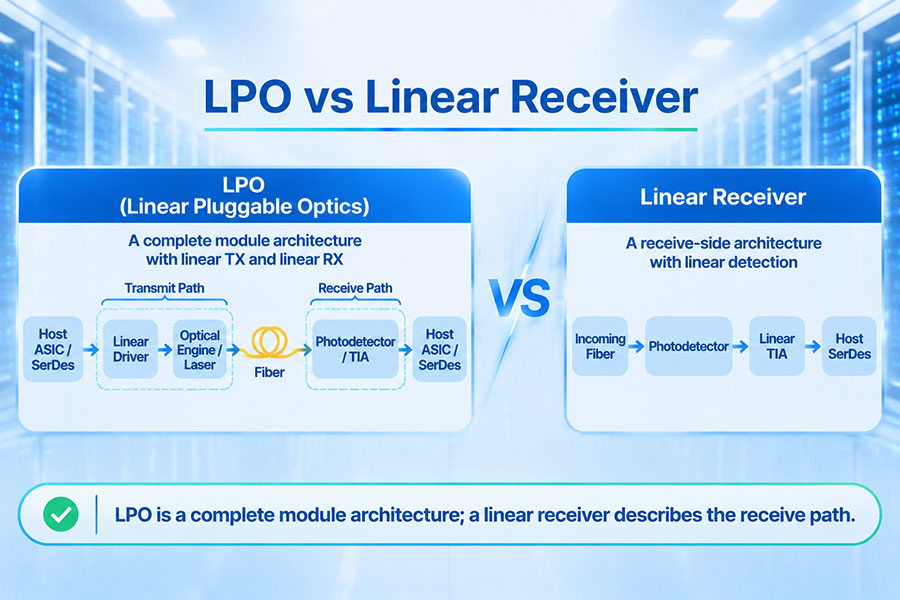
Linear Pluggable Optics (LPO)
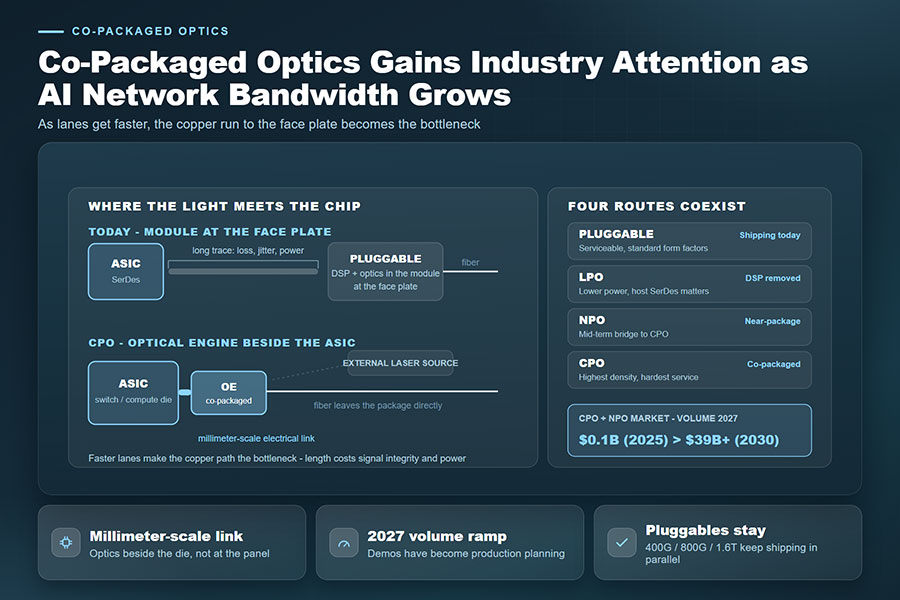
LPO reduces or removes certain DSP functions within the optical module, allowing a more direct electrical interface between the host system and optical components. The simplified architecture can potentially reduce module power consumption and latency, although it requires careful system-level signal integrity design.
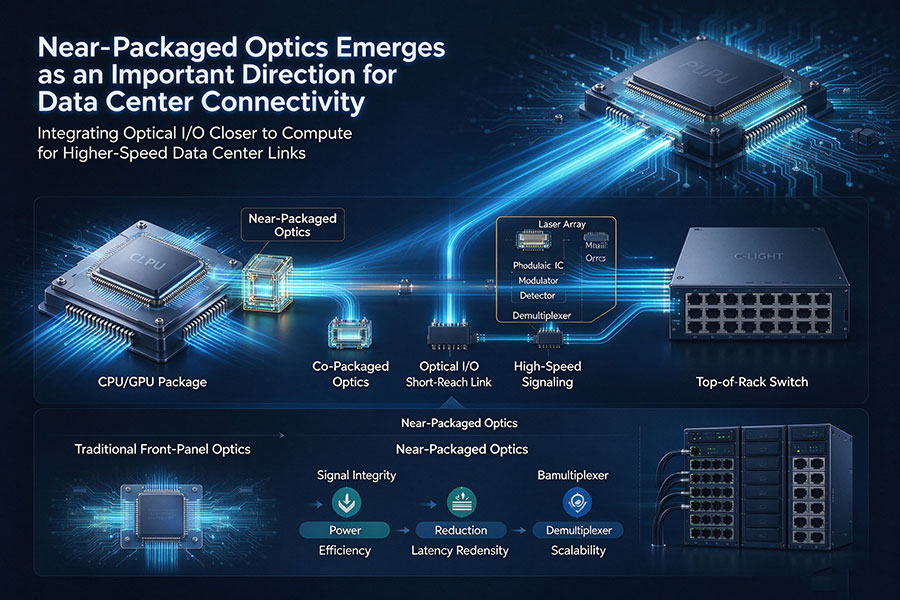
Near-Packaged Optics (NPO)
NPO positions optical engines close to the switching ASIC while maintaining a separate optical assembly. Shorter electrical connections can help address signal loss and power challenges associated with high-speed data transmission.
Co-Packaged Optics (CPO)
CPO integrates optical engines much closer to, or within the same package as, the switching ASIC. This architecture aims to reduce electrical transmission distances and support higher bandwidth density in advanced switching platforms.
| Technology | Integration Location | Main Development Objective |
|---|---|---|
| Traditional Pluggable | Front-panel module cage | Modular high-speed optical connectivity |
| LPO | Front-panel optical module | Reduced DSP complexity and power |
| NPO | Near the switching ASIC | Shorter electrical channels and higher density |
| CPO | ASIC package level | Advanced optical integration and bandwidth density |
These technologies represent different approaches to future optical networking. Their adoption will depend on system architecture, manufacturing readiness, thermal management, serviceability, and application requirements.
8. Optical Transceiver Supply Chains Face New Manufacturing Challenges
The increasing demand for high-speed optical modules is placing additional pressure on the global optical communications supply chain. Higher-speed products require advanced lasers, photonic integrated circuits, DSPs, drivers, receivers, precision optical components, and sophisticated packaging processes.
Manufacturing capacity is becoming an important factor in determining how quickly the industry can expand production.
Key supply-chain considerations include:
Laser Components: EML lasers and continuous-wave laser sources are essential components in many high-speed optical architectures.
DSP and Driver ICs: High-speed electronic components support signal processing, modulation, and transmission performance.
Photonic Integrated Circuits: Silicon photonics and other integrated optical platforms require advanced fabrication capabilities.
Optical Packaging: Precision alignment and assembly processes are essential for consistent optical performance.
Testing and Qualification: Higher-speed modules require comprehensive testing for optical power, sensitivity, BER, thermal performance, and interoperability.
TrendForce has identified optoelectronic component availability and precision manufacturing capacity as important constraints on AI optical transceiver production expansion. This means that future industry competitiveness will depend not only on product development but also on stable component sourcing and scalable manufacturing operations.
9. Power Consumption and Thermal Management Become Critical Factors
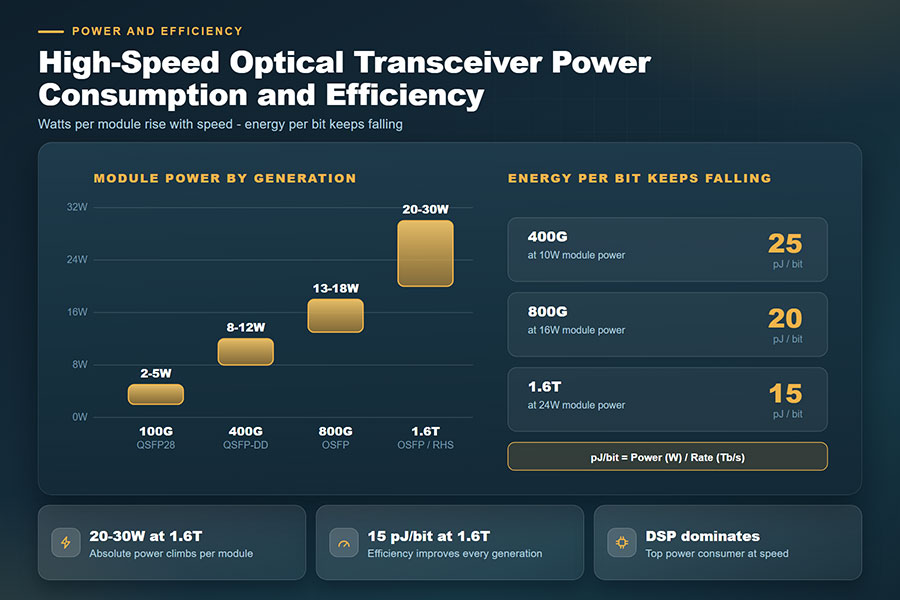
Higher transmission speeds introduce additional challenges in power efficiency and thermal management. Optical modules must process increasingly large data volumes while operating within the power and temperature limits of high-density switching systems.
For data center operators, total network power consumption is influenced by optical transceivers, switching ASICs, signal-processing components, cooling infrastructure, and the number of deployed connections.
Several technology developments are addressing these challenges:
More efficient optical and electronic component integration.
Advanced DSP architectures and signal-processing optimization.
Silicon photonics for higher levels of optical integration.
LPO and other linear-drive architectures for selected applications.
NPO and CPO for reducing high-speed electrical channel lengths.
Improved module thermal design and system-level cooling strategies.
Power efficiency must be evaluated at the complete system level. A lower-power optical module does not automatically guarantee a more efficient network if other components require additional power or introduce operational constraints.
10. The Optical Transceiver Industry Is Expanding Beyond AI Data Centers
Although AI infrastructure is currently a major growth driver, optical transceiver demand extends across several other communication markets. Cloud computing, telecommunications, enterprise networks, 5G transport, and data center interconnect applications continue to require reliable optical transmission.
Different application environments create demand for different transmission speeds, wavelengths, distances, and optical architectures.
| Application | Typical Optical Technologies | Primary Requirements |
|---|---|---|
| AI Data Centers | 400G, 800G, 1.6T | High bandwidth and low-latency connectivity |
| Cloud Computing | 100G, 400G, 800G | Scalable server and switch connectivity |
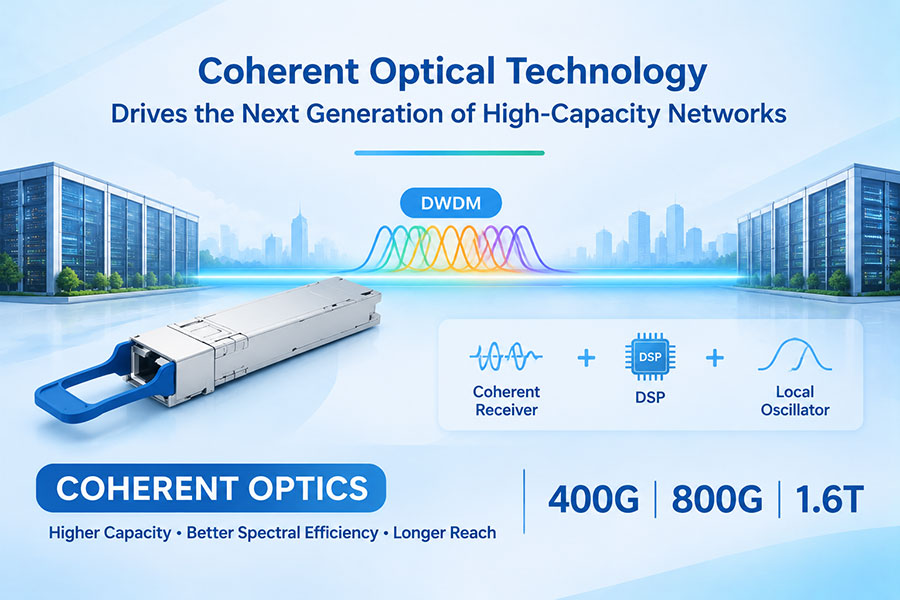
| Data Center Interconnect | 400G ZR/ZR+, 800G coherent | High-capacity longer-distance transmission |
| Telecommunications | 10G, 25G, 100G, 400G | Transport network capacity and reliability |
| 5G Infrastructure | 10G, 25G, 100G | Fronthaul, midhaul, and backhaul connectivity |
| Enterprise Networking | 10G, 25G, 100G, 400G | Flexible switching and fiber connectivity |
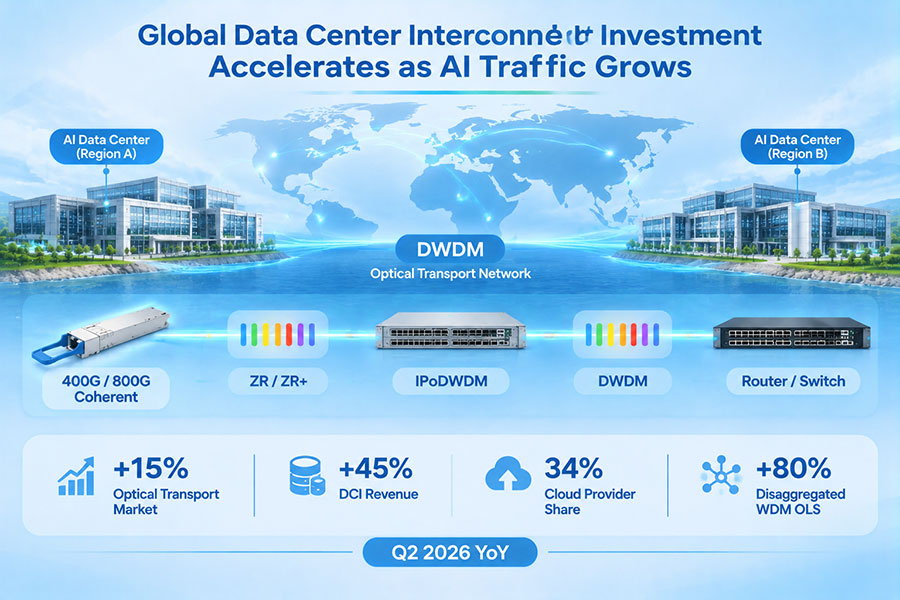
Data center interconnect is another important development area. As AI computing resources become distributed across multiple facilities, 800G and coherent optical technologies are gaining relevance for high-capacity links between data center locations.
This diversification helps create a broader market for optical transceivers, extending demand beyond short-reach connections inside individual data centers.
11. C-LIGHT Optical Transceiver Solutions for the High-Speed Upgrade Cycle
The transition toward 800G and 1.6T networking is increasing the importance of optical connectivity suppliers capable of supporting different data center architectures, transmission distances, and deployment requirements.
C-LIGHT provides optical transceivers, high-speed direct attach cables, active electrical cables, active optical cables, and fiber connectivity products for data center and networking applications.
Relevant product categories include:
400G Optical Transceivers: QSFP-DD and OSFP optical modules for high-speed Ethernet and InfiniBand networks, including 400G ER4 and other application-specific solutions.
800G Optical Transceivers: 800G SR8 and 800G 2FR4 solutions for short-reach and single-mode fiber connectivity.
1.6T Optical Transceivers: 1.6T DR8 and 1.6T 2DR4 solutions for next-generation high-bandwidth networking.
400G, 800G, and 1.6T DAC/AEC Cables: High-speed electrical connectivity solutions for compatible short-distance applications.
MPO/MTP Fiber Assemblies: High-density fiber cabling for parallel optical transmission and structured data center connectivity.
Successful optical network deployment requires more than selecting the highest available transmission rate. Compatibility with switches and network equipment, fiber type, transmission distance, connector configuration, optical power budget, and thermal performance must all be considered.
As the industry moves toward higher-speed connectivity, C-LIGHT continues to support different optical networking requirements with a range of transceiver and fiber connectivity solutions. For product specifications, compatibility support, and customized solutions, Contact C-LIGHT.
12. Conclusion
The global optical transceiver industry is entering a significant high-speed upgrade cycle driven by AI data centers, hyperscale cloud infrastructure, and increasing network bandwidth requirements. The transition from 400G to 800G and 1.6T is changing product development priorities, manufacturing requirements, and optical connectivity architectures.
At the same time, silicon photonics, LPO, NPO, and CPO are creating new opportunities to improve integration density and power efficiency. Advances in optical components, packaging, and manufacturing will remain essential to supporting the next generation of high-speed networks.
Although AI data centers are accelerating the current upgrade cycle, demand from telecommunications, cloud computing, enterprise networking, and data center interconnect will continue to contribute to the industry's long-term development.
As higher-speed optical technologies move toward broader deployment, reliable optical transceivers and scalable fiber infrastructure will remain fundamental to the evolution of global digital connectivity.
 >

 >
 >
 >
 >
 >
 >
 >