TEL:+86 132 6656 7067





Moving hundreds of gigabits of data across metropolitan and regional networks is no longer an isolated requirement for large telecommunications operators. AI infrastructure, cloud platforms, distributed computing, and hyperscale data centers are increasing the amount of traffic that must travel between facilities. Coherent optical technology is becoming increasingly important in this environment because it enables higher data rates, improved spectral efficiency, and flexible transmission over existing fiber infrastructure.
Recent industry developments point toward another major step in coherent networking. The publication of the 1600ZR Implementation Agreement in September 2026 established an interoperability framework for 1.6T coherent transmission over amplified DWDM links. At the same time, 800G ZR/ZR+ pluggable optics and compact optical line systems are advancing the deployment of high-capacity data center interconnects.
These developments reflect a broader change in optical transport. Coherent technology is moving beyond traditional long-haul equipment and becoming increasingly accessible through pluggable modules that can be installed directly into compatible routers and switches.
1. Why Coherent Optical Technology Is Becoming More Important
Modern optical networks must deliver more capacity without requiring a proportional increase in fiber resources, equipment space, and operating costs. This is particularly important for data center interconnect (DCI), metropolitan networks, and long-distance transport systems where bandwidth demand continues to increase.
Conventional intensity modulation and direct detection (IMDD) technologies are widely used in optical communication. They transmit information primarily through changes in optical signal intensity and are suitable for many short- and medium-reach applications.
Coherent optical technology uses a more advanced detection approach. It recovers information from multiple characteristics of the received optical signal, including amplitude, phase, and polarization. Combined with digital signal processing, this allows coherent systems to support sophisticated modulation formats and compensate for various transmission impairments.
Several factors are contributing to wider adoption:
Higher transmission capacity: Advanced modulation and signal processing support higher data rates over individual wavelengths.
Better spectral efficiency: More information can be transmitted within available optical spectrum, helping operators make better use of existing fiber infrastructure.
Longer transmission distances: Coherent systems can support metropolitan, regional, and long-haul applications depending on the optical design and link conditions.
Flexible network integration: Coherent pluggable modules can connect optical transport functions directly to compatible routers and switches.
Growing DCI demand: Distributed cloud and AI infrastructure require high-capacity connections between geographically separated data centers.
Coherent optics is therefore becoming a key technology for networks that need to increase capacity while controlling the cost and complexity of infrastructure expansion.
2. How Coherent Optical Transmission Works
A coherent optical system uses a local reference laser at the receiver to recover the characteristics of the incoming optical signal. The receiver combines the incoming signal with the local oscillator and processes the resulting electrical signals through a coherent receiver and digital signal processor (DSP).
Unlike basic direct-detection systems, coherent detection can recover information encoded in the phase and polarization of the optical carrier in addition to its amplitude. This enables more advanced modulation formats and provides the DSP with information needed to compensate for transmission impairments.
A typical coherent transmission system includes several major functional blocks:
Optical transmitter: Generates the modulated optical signal using a laser and optical modulator.
Modulation system: Encodes information onto the optical carrier through amplitude, phase, and polarization states.
Optical fiber: Carries the modulated signal between network locations.
Coherent receiver: Combines the received signal with a local oscillator and converts optical information into electrical signals.
Digital signal processor: Performs signal recovery, equalization, dispersion compensation, and other digital processing functions.
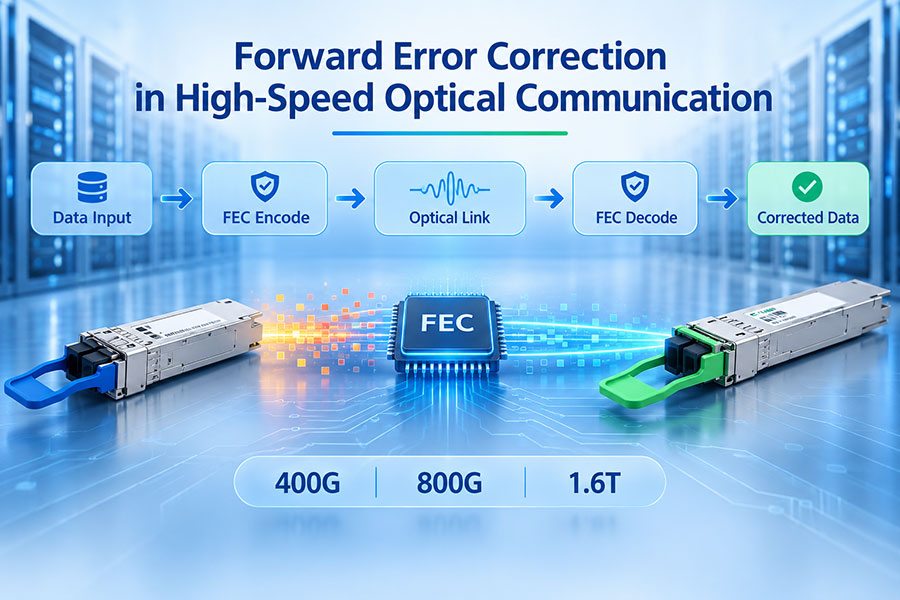
Forward error correction: Adds error-correction capability to improve transmission reliability within the supported operating conditions.
The DSP is particularly important because optical signals can be affected by chromatic dispersion, polarization-mode dispersion, noise, and nonlinear fiber effects. Digital processing helps compensate for these impairments and recover transmitted data.
3. Modulation Formats and Digital Signal Processing
Modulation format is one of the main factors determining how much information can be carried by an optical signal. Coherent systems commonly use phase and amplitude modulation formats that encode multiple bits per symbol.
Quadrature Phase Shift Keying (QPSK) and Quadrature Amplitude Modulation (QAM) are important examples. Higher-order modulation formats can increase spectral efficiency, but they generally require better signal quality and more demanding transmission conditions.
| Modulation Format | Information per Symbol | General Characteristics | Typical Engineering Considerations |
|---|---|---|---|
| DP-QPSK | 4 bits per dual-polarization symbol | Established coherent format with relatively strong tolerance to transmission impairments | Suitable for applications requiring a balance between reach and capacity |
| DP-8QAM | 6 bits per dual-polarization symbol | Higher spectral efficiency than DP-QPSK | Requires a more demanding optical signal-quality budget |
| DP-16QAM | 8 bits per dual-polarization symbol | Higher capacity per symbol with increased sensitivity to noise and impairments | Often used where link conditions support higher-order modulation |
| Higher-order QAM | Depends on constellation size and polarization configuration | Can increase spectral efficiency further | Requires careful optimization of optical performance and transmission conditions |
These values describe the theoretical number of bits represented by each symbol for the stated dual-polarization formats. Actual net data throughput is affected by FEC overhead, framing, implementation details, and other system parameters.
Baud rate is another important factor. It describes the number of symbols transmitted per second, whereas bit rate measures the amount of information transmitted per second. A coherent system can increase capacity through a combination of higher baud rates, more efficient modulation, and improved signal processing.
Modern coherent DSP development focuses on improving performance while controlling power consumption, latency, chip size, and thermal requirements. These factors become especially important when coherent technology is implemented in compact pluggable modules.
4. 400G ZR, 800G ZR, and 1600ZR Extend Coherent Networking
The ZR family of coherent optical interfaces has played an important role in bringing coherent transmission into router and switch platforms. Instead of relying exclusively on dedicated optical transport transponders, network operators can use standardized or interoperable pluggable coherent modules for supported applications.
The development of 400ZR established an important foundation for point-to-point data center interconnects. Subsequent 800G coherent solutions increase the capacity available per module, while the emerging 1600ZR interface extends this approach toward a single 1.6T client over one coherent wavelength.
| Technology | Nominal Capacity | Industry Role | Application Considerations |
|---|---|---|---|
| 400ZR | 400G | Established coherent pluggable generation | Point-to-point DCI and amplified DWDM applications within supported specifications |
| 800G ZR | 800G | Higher-capacity coherent pluggable development | High-capacity DCI and optical transport applications |
| 800G ZR+ | 800G | Extended coherent application options | Reach and optical performance depend on implementation and system configuration |
| 1600ZR | 1.6T | New interoperability framework for next-generation coherent DCI | Defined for amplified single-span DWDM links up to 120 km under the OIF agreement |
In September 2026, the Optical Internetworking Forum (OIF) published its 1600ZR Implementation Agreement. The specification defines an interoperable 1.6T coherent line interface and frame format for amplified, point-to-point DWDM links up to 120 km.
The agreement doubles the capacity of the 800ZR interface and establishes a common technical foundation for multi-vendor 1.6T coherent solutions. It covers important interoperability elements such as client mapping, framing, FEC, modulation, and optical characteristics.
The publication of an Implementation Agreement is an important standards milestone, but it should not be confused with universal commercial availability of 1.6T coherent modules. Product development, interoperability testing, qualification, and deployment will continue to determine the pace of adoption.
5. Coherent Pluggable Optics Changes Data Center Interconnect Architecture
Traditional optical transport networks often use dedicated transponders or transponder-based line systems to convert client signals into optical wavelengths suitable for transmission across DWDM infrastructure.
Coherent pluggable modules provide another deployment model. They integrate coherent optical transmission functions into compact module form factors that can be installed in compatible routers, switches, and transport equipment.
This architecture can reduce the need for separate transponder equipment in suitable applications. It also gives network operators greater flexibility when expanding capacity between data centers.
Important advantages include:
Direct router integration: Compatible coherent modules can connect router or switch client interfaces directly to optical transport links.
Flexible capacity expansion: Operators can add wavelengths or upgrade module capacity as traffic requirements change.
Reduced equipment footprint: Some network designs can eliminate separate transponder shelves for supported applications.
Operational flexibility: Pluggable formats can simplify certain installation and replacement procedures.
Multi-vendor development: Industry specifications and interoperability agreements help establish a broader ecosystem.
In September 2026, industry demonstrations at ECOC highlighted the development of 800G coherent pluggables, 1600ZR+, and other high-capacity optical transport technologies. These developments show that coherent connectivity is expanding across multiple network architectures rather than following a single upgrade path.
Dedicated transponders will nevertheless remain important where operators require specialized transmission performance, advanced line-system functions, or application-specific reach and spectral efficiency.
6. DWDM and Optical Line Systems Increase Fiber Capacity
Coherent optics and Dense Wavelength Division Multiplexing (DWDM) are closely related technologies in high-capacity optical transport. Coherent modules generate and receive high-performance optical signals, while DWDM systems combine multiple wavelengths onto a shared fiber pair.
Instead of deploying a separate fiber pair for every high-capacity connection, operators can use different optical wavelengths to carry multiple traffic channels over the same infrastructure.
A DWDM transmission system may include:
Coherent optical transceivers: Generate and receive individual high-capacity wavelengths.
Multiplexers and demultiplexers: Combine multiple wavelengths for transmission and separate them at the receiving end.
Optical amplifiers: Compensate for optical power loss across the transmission path.
Dispersion and line management: Support the required optical performance across the network.
Optical line monitoring: Provides information about signal power, channel conditions, and system operation.
Compact pluggable optical line systems are also developing alongside coherent transceivers. In September 2026, a full C-band pluggable optical line system was announced for 800G ZR/ZR+ applications. The system was designed to support up to 32 DWDM wavelengths over a single fiber pair, with a stated aggregate capacity of up to 25.6 Tbps for supported configurations.
This illustrates how compact optical amplification and wavelength management can complement coherent pluggables in DCI networks. The actual achievable capacity and reach depend on the complete optical system, including amplifier performance, channel spacing, fiber characteristics, and link engineering.
7. Coherent Optics Applications Across Modern Networks
Coherent optical technology is used across several network environments. The appropriate implementation depends on transmission distance, available fiber, required capacity, optical spectrum, equipment compatibility, and operational priorities.
| Application | Network Requirements | Role of Coherent Technology |
|---|---|---|
| Data Center Interconnect | High bandwidth between geographically separated data centers | Supports high-capacity point-to-point optical links and DWDM transport |
| Metropolitan Networks | Flexible capacity across city and regional infrastructure | Enables efficient wavelength transport over existing fiber routes |
| Regional Transport | Higher capacity over longer fiber paths | Uses advanced modulation and DSP to manage transmission impairments |
| Long-Haul Networks | High spectral efficiency and demanding optical performance | Supports advanced coherent transmission and optimized optical line systems |
| Cloud and AI Infrastructure | High-capacity connections between distributed computing facilities | Provides scalable optical connectivity for AI and cloud data traffic |
| Telecommunications Backbone | Large aggregate traffic volumes across national and international networks | Increases wavelength capacity and improves utilization of optical fiber infrastructure |
Not every application requires the same coherent module. A short metropolitan connection may prioritize power and cost, while a fiber-constrained long-haul route may require a higher-performance transponder with more advanced DSP capabilities.
Network planning should therefore begin with the required reach, capacity, fiber conditions, and optical system design rather than selecting a module based on data rate alone.
8. Coherent Optics and Direct-Detect Modules Serve Different Roles
Coherent and direct-detect optical technologies are complementary approaches. Both are important to modern optical networks, but they are designed around different transmission requirements and system constraints.
| Technical Factor | Direct-Detect Optics | Coherent Optics |
|---|---|---|
| Detection Method | Primarily detects optical signal intensity | Recovers amplitude, phase, and polarization information |
| Signal Processing | Depends on application and module design | Uses advanced coherent DSP |
| Modulation | Commonly uses NRZ or PAM4 in data center applications | Uses phase and amplitude modulation formats such as QPSK and QAM |
| Typical Network Role | Short-reach and many data center connections | DCI, metropolitan, regional, and long-haul transport |
| System Complexity | Generally simpler for suitable short-reach applications | More complex optical and digital processing architecture |
| Key Design Priorities | Cost, power, reach, and lane speed | Spectral efficiency, reach, DSP performance, and optical link conditions |
Direct-detect technologies remain highly relevant for connections inside data centers, including many 400G, 800G, and emerging 1.6T applications. Coherent technology is particularly valuable when higher spectral efficiency, longer reach, or direct integration with DWDM transport systems is required.
The two approaches should be selected according to the network application. Coherent optics is not automatically the most economical solution for every optical link.
9. Technical Challenges in High-Capacity Coherent Networks
Increasing coherent transmission rates introduces challenges that extend beyond the optical module itself. Higher baud rates, more advanced modulation formats, and greater integration density place additional demands on DSP performance, thermal management, optical components, and network engineering.
Important considerations include:
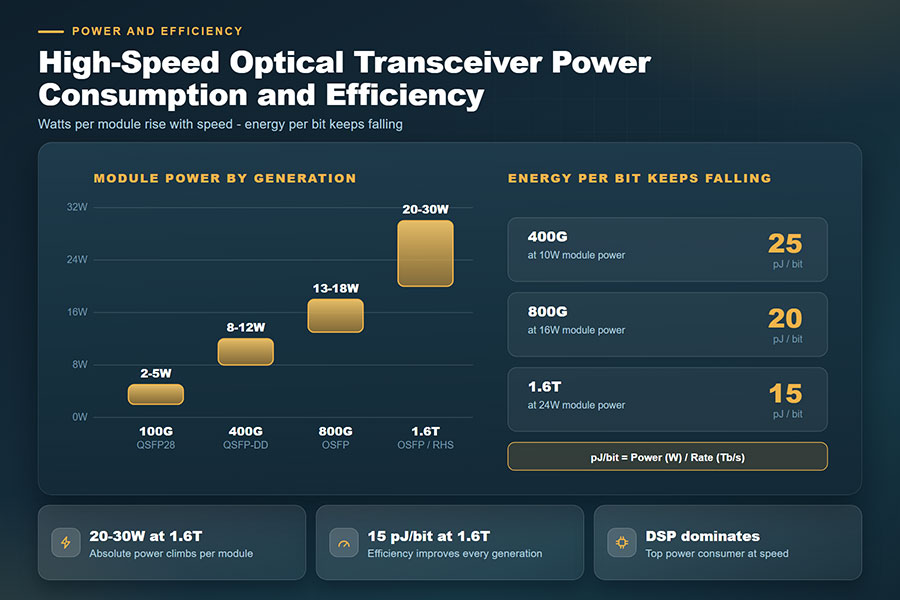
Power consumption: High-performance coherent DSPs and optical components require careful power budgeting, particularly in compact pluggable form factors.
Thermal management: Higher module power can increase operating temperatures and affect performance if cooling is insufficient.
Optical signal-to-noise ratio: The available OSNR must support the selected modulation format and target transmission performance.
Chromatic dispersion: Fiber dispersion affects signal propagation and must be addressed by the coherent receiver and DSP.
Nonlinear transmission effects: High optical launch power and dense wavelength configurations can introduce nonlinear impairments.
FEC and latency: Forward error correction improves error performance, but its implementation affects system overhead, power, and latency.
Interoperability: Multi-vendor operation requires compatible optical specifications, framing, FEC, and management interfaces.
These factors become more important as operators move from 400G to 800G and 1.6T coherent transmission. A higher nominal data rate does not guarantee that a module will achieve the desired reach on every fiber route.
10. Industry Outlook: The Road Toward 1.6T and Beyond
Coherent optical technology is entering a new development stage as data center interconnect requirements increase and network operators seek more capacity from existing fiber infrastructure.
The September 2026 publication of the OIF 1600ZR Implementation Agreement represents an important step toward interoperable 1.6T coherent DCI. Meanwhile, 800G ZR/ZR+ modules and compact DWDM line systems are helping expand the practical deployment options available to network operators.
Several trends are likely to influence the next stage of development:
Higher coherent data rates: The industry is progressing toward 1.6T coherent interfaces and exploring future generations of higher-capacity transmission.
More efficient DSP designs: Semiconductor process improvements and advanced signal processing will be important for controlling module power and size.
Expanded pluggable applications: Coherent modules are expected to support a broader range of DCI and transport environments.
Greater DWDM integration: Compact optical line systems and coherent pluggables can simplify selected network architectures.
Multi-vendor interoperability: Industry agreements will remain important for enabling flexible equipment selection and network expansion.
AI-driven network investment: Distributed AI infrastructure will continue to create demand for high-capacity links between data centers.
For optical communication suppliers, these changes create opportunities across coherent transceivers, optical amplifiers, DWDM components, high-speed electrical interfaces, fiber assemblies, and testing solutions.
C-LIGHT provides optical connectivity products for data center and telecommunications applications, including high-speed optical transceivers and related connectivity solutions. Product information is available through the C-LIGHT optical transceiver portfolio.
Coherent optical technology will remain an important part of high-capacity network development. Its continued progress depends on more than increasing transmission speed: interoperability, power efficiency, optical performance, manufacturing maturity, and practical deployment economics will determine how quickly the next generation of coherent networks is adopted.
For optical connectivity requirements and product information, please Contact C-LIGHT.
 >

 >
 >
 >
 >
 >
 >
 >