TEL:+86 132 6656 7067





The rapid expansion of artificial intelligence infrastructure is bringing co-packaged optics (CPO) into the spotlight of the global optical communications industry. As AI data centers deploy increasingly powerful processors and higher-capacity switching systems, conventional electrical interconnects face growing challenges related to signal integrity, power consumption, and bandwidth density. Moving optical connectivity closer to switching and computing silicon is emerging as an important direction for next-generation network architectures.
Throughout 2026, industry attention toward CPO has expanded beyond research and technology demonstrations. Investment in silicon photonics, optical engines, advanced packaging, external laser sources, and manufacturing infrastructure is creating a broader commercial ecosystem. At the same time, questions surrounding production yields, maintenance, thermal management, and interoperability remain important factors determining how quickly CPO can enter large-scale deployment.
1. AI Network Expansion Accelerates Interest in Co-Packaged Optics
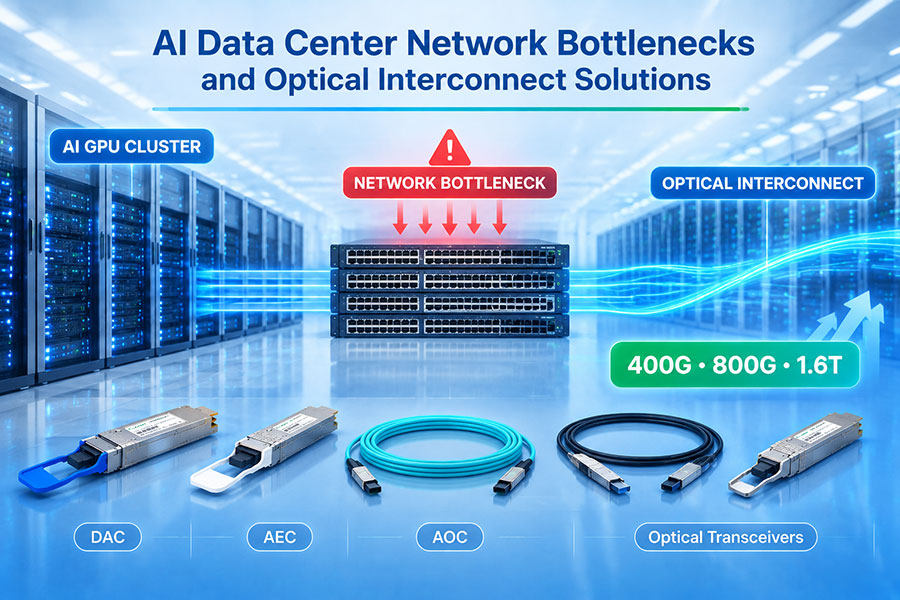
AI computing infrastructure is generating increasingly demanding network requirements. Large-scale GPU clusters depend on continuous communication between processors, memory systems, switches, and storage infrastructure. As the number of interconnected computing devices increases, network bandwidth and power efficiency become important factors affecting overall system performance.
Traditional pluggable optical transceivers have supported multiple generations of data center networking. However, increasing transmission rates and higher port densities are creating new engineering challenges for electrical signal routing between switching ASICs and front-panel optical modules.
These challenges are encouraging network designers to evaluate alternative optical integration architectures. CPO is attracting attention because it places optical engines close to the switching or computing silicon rather than relying entirely on conventional front-panel optical modules.
The industry interest is driven by several developments:
Increasing bandwidth requirements across AI accelerator clusters.
Higher switching capacity in next-generation data center platforms.
Growing pressure to improve power efficiency per transmitted bit.
Increasing electrical signal loss at higher data rates.
Demand for greater bandwidth density within limited equipment space.
Expansion of optical integration and advanced semiconductor packaging technologies.
These trends are positioning CPO as an important technology direction for future AI networking infrastructure, although its commercial adoption will depend on system-level performance and manufacturing readiness.
2. Industry Investment Shifts Toward Optical Integration
One of the most significant developments in 2026 is the growing investment in the technologies and manufacturing capabilities required to support CPO deployment.
On June 15, 2026, TrendForce published research highlighting the increasing importance of optical interconnects in AI infrastructure. The research projected that the combined CPO and NPO market could grow from approximately US$100 million in 2025 to more than US$39 billion by 2030.
This forecast reflects expectations surrounding the transition toward higher-density optical connectivity. It should be noted that the figure represents the combined CPO and NPO market projection rather than confirmed CPO revenue or shipments.
Investment activity is expanding across several parts of the optical supply chain:
| Investment Area | Industry Focus | Expected Strategic Value |
|---|---|---|
| Silicon Photonics | Photonic integration and wafer-level manufacturing | Improved integration density and manufacturing scalability |
| Optical Engines | High-bandwidth optical input and output components | Higher optical connectivity density |
| Advanced Packaging | Integration of optical and electrical components | Shorter electrical interconnections |
| External Laser Sources | High-power continuous-wave laser technologies | Flexible optical light-source architectures |
| Fiber Connectivity | High-density fiber connectors and detachable interfaces | Improved system integration and maintenance |
| Testing and Manufacturing | Optical engine testing and packaging processes | Higher production consistency and reliability |
The investment trend indicates that CPO development is becoming a broader semiconductor and optical communications industry initiative. Its commercial potential depends not only on optical performance but also on the ability to establish reliable production processes and scalable supply chains.
3. CPO Moves From Technology Demonstrations Toward Production Planning
Industry discussions in October and November 2026 indicate a gradual shift from evaluating CPO feasibility toward preparing the ecosystem for commercial manufacturing.
On October 14, 2026, EE Times published an industry report titled "Co-Packaged Optics Moves from Promise to Production Planning." The report covered discussions at an industry CPO summit, where participants examined manufacturing readiness, supply-chain coordination, and optical interface standardization.
One important topic was the expected development of CPO demand beginning around 2028. This timeline was discussed as an industry expectation rather than a confirmed universal deployment schedule.
On November 10, 2026, DIGITIMES also reported that a major AI infrastructure ecosystem was targeting CPO volume shipments in 2027. This is an important commercial development to monitor, but a shipment target should not be interpreted as evidence that the entire CPO industry has already entered mass production.
These developments highlight several stages in the commercialization process:
Technology research and optical architecture development.
Prototype development and system-level demonstrations.
Customer evaluation and platform qualification.
Manufacturing process development and production preparation.
Initial commercial shipments and volume production expansion.
The transition between these stages may vary significantly depending on the optical engine architecture, packaging process, switching platform, and customer deployment requirements.
Commercialization status: CPO is progressing toward broader commercial deployment, but the timing of volume production remains platform-dependent. Industry shipment targets, prototype demonstrations, and confirmed commercial deliveries should be reported as separate milestones.
4. CPO, NPO, and LPO Create Multiple Optical Integration Pathways
The development of optical integration is not limited to a single architecture. CPO, Near-Packaged Optics (NPO), and Linear Pluggable Optics (LPO) are attracting attention as different approaches to addressing the power and signal integrity challenges of high-speed data center networks.
Each technology has different integration characteristics and deployment considerations.
| Technology | Integration Approach | Primary Industry Focus | Key Considerations |
|---|---|---|---|
| CPO | Optical engines integrated within the same package or closely integrated assembly as switching silicon | High-density optical connectivity | Packaging, serviceability, thermal management, yield |
| NPO | Optical engines positioned close to the main switching ASIC | Shorter electrical paths while retaining modularity | Connector design, maintenance, integration |
| LPO | Pluggable optical modules using linear electrical interfaces with reduced or eliminated module DSP functions | Lower power and reduced signal-processing complexity | Host signal quality, interoperability, reach limitations |
| Traditional Pluggable Optics | Optical transceivers installed in front-panel ports | Flexible and serviceable optical connectivity | Power, port density, electrical routing |
According to TrendForce's June 2026 analysis, NPO is considered a near- to medium-term transition option in several data center architectures because it can shorten electrical signal paths while retaining more modularity and serviceability than tightly integrated CPO systems.
CPO, meanwhile, is attracting attention for applications requiring greater integration density and higher bandwidth capacity. LPO continues to offer another approach to reducing optical module power consumption without completely changing the traditional pluggable form factor.
These technologies are not necessarily direct replacements for one another in every application. Their adoption will depend on network architecture, system requirements, maintenance strategies, and the maturity of supporting ecosystems.
5. Silicon Photonics and Advanced Packaging Become Strategic Technologies
Silicon photonics is an important technology foundation for the development of CPO. It enables optical functions to be integrated using semiconductor manufacturing processes, creating opportunities for more compact and highly integrated optical engines.
In CPO architectures, optical engines are positioned close to switching or computing silicon. This arrangement can shorten high-speed electrical signal paths and help address signal loss and power consumption challenges associated with conventional interconnect structures.
However, integrating optical and electrical components within a compact package introduces significant manufacturing complexity. The optical engine, laser source, electrical interface, fiber connection, and thermal management system must operate reliably as part of the same platform.
Several technology areas are receiving increased industry attention:
Silicon photonic integrated circuits for optical signal generation and processing.
Advanced semiconductor packaging for optical and electrical integration.
High-speed electrical interfaces supporting next-generation switching ASICs.
External laser technologies providing optical power to integrated engines.
High-density fiber arrays and optical connector systems.
Thermal management technologies for densely integrated systems.
These developments are also expanding the role of semiconductor foundries, packaging and testing providers, optical component manufacturers, and specialized photonics suppliers.
The long-term competitiveness of CPO will depend on whether these technologies can achieve consistent manufacturing quality, acceptable production costs, and reliable operation at scale.
6. Power Efficiency and Thermal Management Drive CPO Development
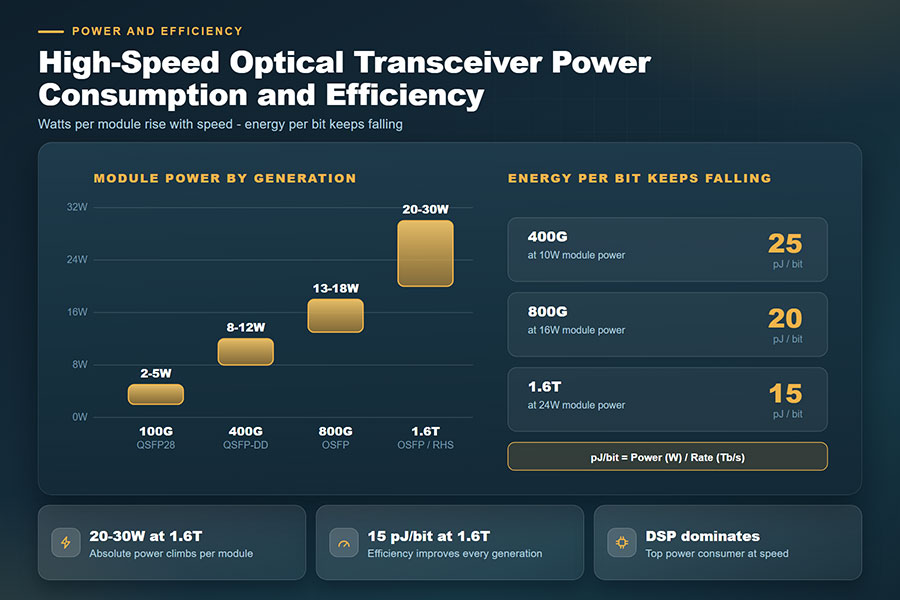
Power consumption is one of the major considerations behind the industry's interest in CPO. As AI data centers increase their computing capacity, the electrical power required to move data across high-speed networks is becoming an important part of overall infrastructure efficiency.
Conventional pluggable optical modules require electrical signals to travel between the switching ASIC and the optical module through high-speed circuit-board traces. As data rates increase, signal conditioning and electrical transmission losses can create additional power requirements.
CPO brings optical engines closer to switching silicon, potentially reducing the distance traveled by high-speed electrical signals. This architecture can provide opportunities to improve energy efficiency, particularly in high-density switching systems.
However, the benefits must be evaluated at the complete system level. Optical engines, laser sources, electrical drivers, packaging, and cooling systems all contribute to total power consumption.
| Engineering Factor | Traditional Pluggable Optics | CPO Architecture |
|---|---|---|
| Optical Integration | Optical components integrated within removable modules | Optical engines integrated close to switching silicon |
| Electrical Signal Path | Extends from ASIC to front-panel module | Can be significantly shortened |
| Serviceability | Individual modules can generally be replaced | May require more complex package-level maintenance |
| Thermal Design | Module-level and switch-level cooling | Requires coordinated management of optical and switching components |
| Deployment Flexibility | Established removable interface ecosystem | More closely tied to system-level integration |
| Manufacturing | Established transceiver assembly processes | Requires advanced optical packaging and integration processes |
CPO therefore represents an architectural change rather than simply a new optical transceiver form factor. Its advantages must be balanced against manufacturing complexity, repairability, component availability, and total system cost.
7. Optical Supply Chains Face New Commercial Opportunities and Challenges
The growing interest in CPO is creating new opportunities across the global optical communications supply chain. Unlike traditional pluggable transceivers, CPO systems require closer coordination between semiconductor manufacturing, optical packaging, laser technologies, fiber connectivity, and system-level integration.
This creates demand for specialized components and manufacturing capabilities.
Optical Components and Laser Sources
High-performance laser sources, photonic integrated circuits, modulators, and photodetectors are essential elements of optical engine development. Their availability and performance consistency will influence the scalability of future CPO systems.
Optical Packaging and Assembly
Advanced packaging processes must support precise alignment between optical and electrical components. Manufacturing yield, packaging reliability, and thermal performance are critical considerations.
Fiber Connectors and Connectivity
CPO systems require high-density optical fiber connections between integrated optical engines and external network infrastructure. Connector design, fiber routing, accessibility, and field maintenance are important parts of the overall system architecture.
Testing and Qualification
Testing integrated optical systems can be more complex than testing conventional removable transceivers. Manufacturers need reliable procedures for evaluating optical performance, electrical interfaces, thermal behavior, and long-term operating stability.
The supply chain is therefore likely to become more interconnected as CPO moves toward commercial deployment. Companies capable of providing specialized components, advanced manufacturing, and reliable testing infrastructure may benefit from the development of this market.
8. CPO Development Does Not Eliminate Demand for Pluggable Optical Transceivers
Although CPO is gaining attention, the development of integrated optical architectures does not mean that traditional pluggable optical transceivers will immediately disappear.
Pluggable modules continue to offer important advantages in network flexibility, equipment maintenance, product replacement, and multi-vendor compatibility. These characteristics remain valuable for existing data centers and many new network deployments.
As AI data center networks expand, different connectivity technologies are likely to coexist across various network layers.
| Connectivity Technology | Typical Application Direction | Development Outlook |
|---|---|---|
| 400G Pluggable Optics | Existing high-speed data center networks | Continued use across established deployments |
| 800G Pluggable Optics | High-bandwidth AI and hyperscale networks | Continued deployment and infrastructure upgrades |
| 1.6T Pluggable Optics | Next-generation high-density network platforms | Progressive product development and qualification |
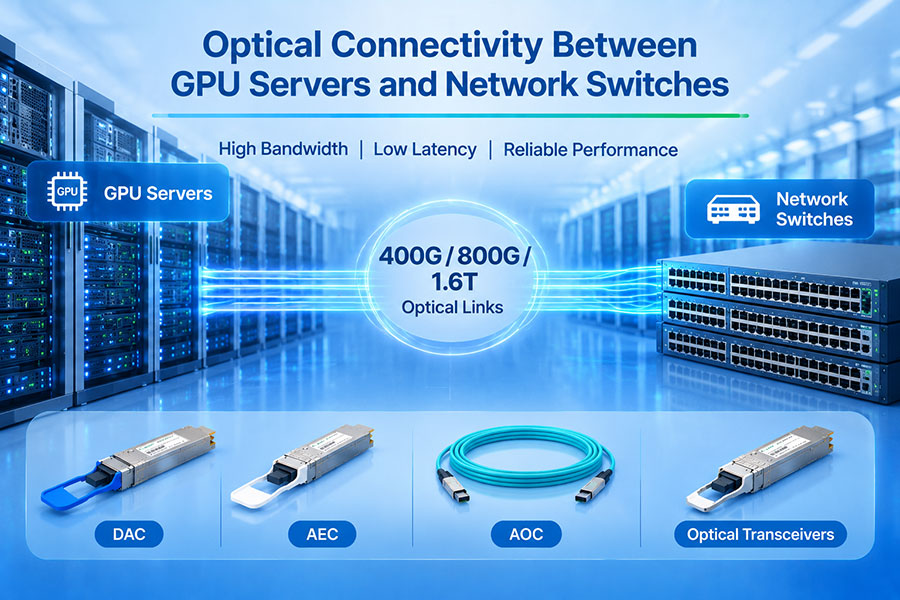
| DAC and AEC | Short-distance electrical interconnections | Continued relevance in rack-level connectivity |
| AOC | Short- and medium-distance optical cable connections | Continued use where integrated cable connectivity is preferred |
| CPO and NPO | Advanced optical integration in high-density systems | Growing development and commercialization activity |
For network operators, technology selection will depend on the requirements of each application rather than following a single industry-wide transition schedule.
C-LIGHT High-Speed Optical Connectivity Portfolio
As optical integration technologies continue to develop, pluggable optical transceivers and high-speed interconnect cables remain important parts of today's AI data center infrastructure.
C-LIGHT provides high-speed optical connectivity products supporting 400G, 800G, and next-generation 1.6T network architectures.
800G OSFP Optical Transceivers – Supporting SR8, DR8, and 2×FR4 configurations for high-bandwidth data center networks.
800G DAC Cables – Designed for short-distance copper connectivity in data center environments.
800G AEC Cables – Supporting active electrical connectivity for high-speed AI server and rack interconnections.
AOC, DAC, AEC, and ACC Solutions – Providing multiple interconnect options for different network distances and deployment requirements.
These products address current pluggable optical and electrical connectivity requirements. They should not be confused with CPO optical engines, which involve a different system integration architecture.
9. Industry Outlook: CPO Adoption Will Depend on Ecosystem Readiness
The development of CPO is expected to remain an important part of the optical communications industry's evolution as AI network bandwidth requirements continue increasing.
However, the pace of adoption will depend on several factors beyond theoretical bandwidth and power efficiency improvements.
Manufacturing Yield and Reliability
High-volume production requires consistent optical alignment, packaging quality, component reliability, and system-level testing. Improvements in these areas will be essential for reducing production costs.
Standardization and Interoperability
Common optical interfaces, fiber connectivity standards, and multi-vendor ecosystem development will help reduce integration risks and improve deployment flexibility.
Maintenance and Replacement Strategies
Traditional pluggable optics allow individual modules to be replaced relatively easily. CPO requires new approaches to system maintenance, optical connector accessibility, and component replacement.
Laser Supply and Thermal Management
External laser sources, optical power distribution, and thermal control will remain important engineering considerations as optical engines become more tightly integrated with switching systems.
Commercial Deployment Economics
Even when a new architecture offers technical advantages, widespread adoption depends on total system cost, manufacturing capacity, customer qualification, and measurable operational benefits.
In the near term, the optical communications market is likely to continue supporting multiple architectures, including traditional pluggable transceivers, LPO, NPO, and CPO. Their respective market positions will evolve as AI infrastructure requirements and manufacturing capabilities develop.
10. Conclusion
Co-packaged optics is gaining significant industry attention as AI data centers move toward higher bandwidth, greater port density, and improved network power efficiency. Increasing investment in silicon photonics, advanced packaging, optical engines, and laser technologies indicates that CPO is progressing beyond research discussions toward more structured commercialization efforts.
Nevertheless, large-scale adoption will require progress in manufacturing yield, system reliability, thermal management, fiber connectivity, and interoperability. The commercial development of CPO should therefore be viewed as a gradual industry transition rather than an immediate replacement for conventional optical transceivers.
For the global optical communications industry, this transition creates opportunities across both integrated optical architectures and established connectivity technologies. As AI infrastructure continues expanding, high-speed optical transceivers, active optical cables, copper interconnects, and advanced optical integration solutions will all contribute to the evolution of next-generation data center networks.
High-Speed Optical Connectivity for Next-Generation Data Centers
C-LIGHT provides 400G, 800G, and 1.6T optical transceivers, DAC, AOC, AEC, ACC, and optical connectivity solutions for AI data centers, cloud computing, and high-performance networking applications.
Contact our team for product specifications, compatibility support, and customized optical connectivity requirements.
Contact C-LIGHT >

 >
 >
 >
 >
 >
 >
 >