TEL:+86 132 6656 7067





The global deployment of 800G optical transceivers is accelerating as data center operators expand network capacity to support artificial intelligence, cloud computing, and high-performance computing workloads. Increasing bandwidth requirements between servers, switches, and computing clusters are driving infrastructure upgrades across hyperscale facilities and enterprise data centers. As a result, 800G optical connectivity is becoming an increasingly important part of the global optical communications market.
Throughout 2026, industry forecasts and market research have pointed to strong growth in high-speed optical transceiver shipments. The expansion of AI infrastructure, increasing network traffic, and the transition toward higher-capacity switching platforms are supporting demand for 800G products. At the same time, the industry is preparing for the next generation of 1.6T optical connectivity, creating a transition period in which multiple product generations will coexist.
1. Global Data Center Upgrades Accelerate 800G Optical Deployment
The expansion of AI computing infrastructure is changing the requirements of modern data center networks. Large AI clusters connect thousands of processors and servers through high-capacity switching systems, creating substantial traffic between computing nodes.
Traditional data center architectures increasingly require higher bandwidth to support distributed training, large-scale inference, and data-intensive workloads. As network capacity increases, operators are upgrading switch ports and optical connections to reduce network bottlenecks and improve infrastructure scalability.
800G optical transceivers provide an important bandwidth upgrade from previous 400G generations. They allow network operators to increase the capacity of individual optical links while supporting higher-density switching architectures.
Several developments are contributing to the expansion of 800G deployment:
New AI data center construction and infrastructure expansion.
Upgrades to high-capacity Ethernet switching platforms.
Increasing bandwidth requirements between GPU clusters.
Higher network port density in hyperscale facilities.
Expansion of cloud computing and high-performance computing infrastructure.
Growing demand for scalable optical connectivity between data center racks.
These factors are creating a broader market opportunity for 800G optical transceivers, high-speed optical cables, and supporting fiber connectivity products.
2. 800G Optical Transceiver Shipments Show Strong Growth Potential
Market research published by TrendForce on February 10, 2026, projected that 800G and higher-speed optical transceivers would account for more than 60% of global high-speed optical module shipments in 2026, compared with approximately 19.5% in 2024.
This projection highlights the rapid change in optical connectivity requirements across AI-focused data centers. The increasing deployment of high-bandwidth switching systems is accelerating the transition toward 800G and higher-speed optical interfaces.
Further industry research published by Lightwave Online on June 30, 2026, reported findings from Cignal AI's first-quarter optical components research. The report indicated that 800GbE had become the largest segment of high-speed datacom optical module shipments, with shipment volume forecast to more than double during 2026.
| Market Indicator | Reported or Forecast Value | Publication Date | Data Status |
|---|---|---|---|
| 800G and Above Shipment Share | More than 60% in 2026 | February 10, 2026 | TrendForce forecast |
| AI Optical Transceiver Market | US$26 billion in 2026 | April 20, 2026 | TrendForce forecast |
| 800GbE Shipment Growth | More than 2× during 2026 | June 30, 2026 | Cignal AI forecast reported by Lightwave Online |
| AI Networking and Interconnect Market | US$279.8 billion in 2027 | November 2, 2026 | TrendForce forecast |
The figures demonstrate the expected scale of the market transition, but they represent forecasts rather than confirmed full-year shipment results. Actual deployment will depend on data center construction schedules, equipment qualification, optical component availability, and customer purchasing decisions.
3. AI Data Center Networks Become a Major Driver of 800G Demand
AI infrastructure is one of the most important application areas supporting the adoption of 800G optical connectivity. Large-scale AI training requires communication between accelerators distributed across multiple servers and racks. The resulting traffic places significant demands on network bandwidth and switching capacity.
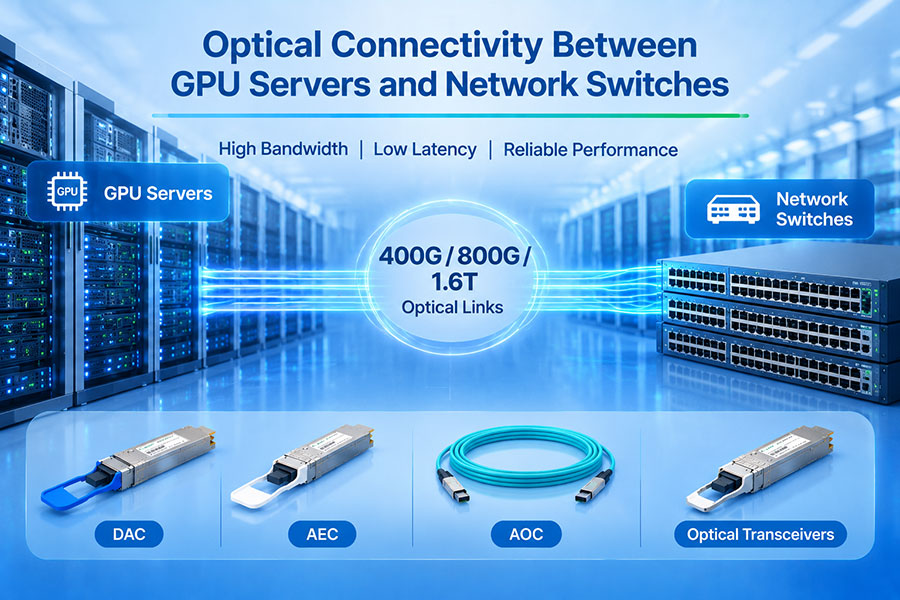
Within AI data centers, high-speed optical links are commonly used to connect network switches, server racks, and different parts of the computing fabric. As the number of accelerators increases, the aggregate bandwidth required by the network also grows.
800G optical transceivers help address these requirements through higher-capacity interfaces. They are particularly relevant to high-density Ethernet and InfiniBand networking environments.
Typical 800G deployment scenarios include:
Leaf-to-spine connections in high-performance data center networks.
Switch-to-switch connections across AI computing clusters.
High-bandwidth links between adjacent equipment racks.
Connections within hyperscale cloud infrastructure.
Optical links supporting distributed computing and storage networks.
The actual optical configuration depends on network topology, transmission distance, fiber infrastructure, switch interfaces, and the selected Ethernet or InfiniBand architecture.
4. 800G SR8, DR8, and 2×FR4 Address Different Deployment Requirements
The expansion of 800G networks is creating demand for multiple optical transceiver configurations. Although these products provide the same aggregate bandwidth, their optical designs, fiber requirements, connectors, and transmission distances differ.
SR8, DR8, and 2×FR4 are among the important 800G optical configurations used in data center infrastructure.
| 800G Configuration | Fiber Type | Typical Reach | Connector | Application |
|---|---|---|---|---|
| 800G SR8 | Multimode Fiber | Up to 100m | MPO-16 | Short-reach AI cluster connections |
| 800G DR8 | Single-Mode Fiber | Up to 500m | MPO-16 | Data center switch interconnections |
| 800G 2×FR4 | Single-Mode Fiber | Up to 2km | Dual duplex LC | Longer data center and campus links |
| 800G 2×LR4 | Single-Mode Fiber | Up to 10km | LC | Extended data center connectivity |
These configurations allow network designers to select optical products according to the distance and infrastructure requirements of each connection.
800G SR8 for Short-Reach Connectivity
800G SR8 uses multimode fiber and parallel optical transmission to support short-distance connections. It is relevant to high-density data center environments where network equipment is positioned within relatively short optical reach.
800G DR8 for Single-Mode Fiber Networks
800G DR8 uses parallel single-mode optical channels and is designed for connections with transmission distances of up to 500 meters under the applicable specifications. It provides a single-mode option for data center networks requiring higher bandwidth and greater reach than typical multimode links.
800G 2×FR4 for Extended Data Center Links
800G 2×FR4 uses wavelength-division multiplexing across two optical groups to provide an aggregate 800Gbps transmission capacity. It supports longer-distance single-mode fiber connectivity and can be used in data center campus environments.
Actual reach depends on the specific module specification, fiber quality, optical loss budget, and link engineering.
5. OSFP and QSFP-DD800 Form Factors Support 800G Network Expansion
Form factor selection is another important consideration in 800G network deployment. OSFP and QSFP-DD800 are two major pluggable interface approaches used in high-speed data center networking.
Both support 800Gbps aggregate transmission, but their mechanical dimensions, thermal characteristics, electrical interfaces, and platform requirements differ.
| Feature | 800G OSFP | 800G QSFP-DD800 |
|---|---|---|
| Form Factor | Octal Small Form-factor Pluggable | Quad Small Form-factor Pluggable Double Density |
| Aggregate Data Rate | 800Gbps | 800Gbps |
| Electrical Interface | 8 high-speed electrical lanes | 8 high-speed electrical lanes |
| Thermal Design | Designed for high-power optical applications | Designed for high-density pluggable applications |
| Typical Applications | AI switches, HPC, hyperscale networks | High-density Ethernet switching platforms |
| Platform Compatibility | OSFP-based host ports | QSFP-DD800-based host ports |
The two form factors are not interchangeable simply because they support the same transmission rate. Network operators must verify the switch hardware, port specifications, thermal design, firmware support, and optical module compatibility before deployment.
The availability of different form factors gives equipment manufacturers and network operators additional flexibility when designing high-capacity data center infrastructure.
6. Optical Supply Chain Expansion Supports Growing 800G Demand
The increasing demand for 800G optical transceivers is creating additional requirements across the global optical communications supply chain. High-speed modules depend on a broad range of components and manufacturing processes, including laser sources, photodetectors, optical subassemblies, DSPs, drivers, and precision packaging.
As production volumes increase, manufacturers must balance capacity expansion with quality control, production yields, and component availability.
TrendForce's April 20, 2026 research projected that the global AI-focused optical transceiver market would reach US$26 billion in 2026, up from US$16.5 billion in 2025. The report also identified component shortages as an important constraint on capacity expansion.
Several supply chain areas are particularly important:
High-speed EML and VCSEL laser sources.
Photodetectors and optical receiver components.
DSPs and high-speed electrical driver chips.
Optical packaging and module assembly capacity.
Precision fiber alignment and connector manufacturing.
Automated testing and production qualification.
These requirements are increasing the importance of supply chain coordination. Optical module manufacturers must ensure that components, production processes, and customer qualification schedules remain aligned with the growing demand for high-speed connectivity.
7. High-Speed Cables Remain Important Alongside 800G Optical Transceivers
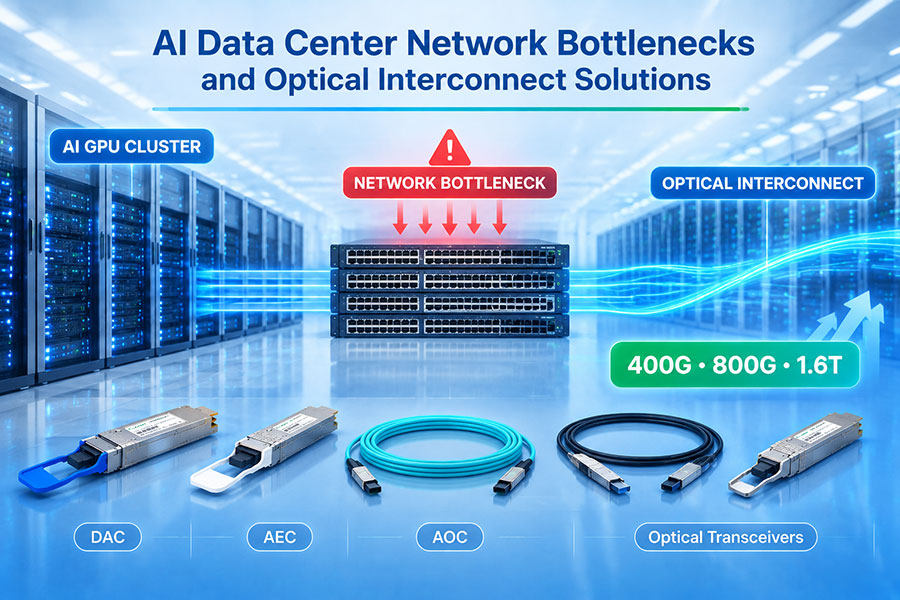
Although optical transceivers are essential for many 800G network connections, high-speed copper and optical cables also play important roles in data center infrastructure.
AI computing clusters contain different types of connections, ranging from very short links within equipment racks to longer connections between switches and network facilities. The appropriate connectivity technology depends on distance, power consumption, signal integrity, and system architecture.
| Technology | Transmission Medium | Typical Deployment Role | Main Consideration |
|---|---|---|---|
| DAC | Passive Copper | Very short-distance equipment connections | Low power and cost efficiency |
| AEC | Active Copper | High-speed short-reach connections | Signal conditioning and reach extension |
| ACC | Active Copper | High-speed electrical interconnections | Host compatibility and signal performance |
| AOC | Optical Fiber | Rack-to-rack and equipment interconnections | Optical reach and cable flexibility |
| Optical Transceivers | Optical Fiber | Switch-to-switch and network infrastructure links | Reach, interface, and optical specifications |
These technologies are complementary rather than interchangeable in every application. A network architecture may use DAC or AEC for short electrical connections while relying on AOC and optical transceivers for other links requiring optical transmission.
As 800G infrastructure expands, demand for compatible high-speed cabling and optical connectivity products is expected to develop alongside transceiver shipments.
8. The Transition Toward 1.6T Will Reshape the Future 800G Market
While 800G remains an important bandwidth generation for AI data center networks, the optical communications industry is already preparing for 1.6T connectivity.
TrendForce's November 2, 2026 AI networking research projected that the primary revenue growth driver for pluggable optical transceivers would gradually shift from 800G to 1.6T products in 2027. The report also projected that 1.6T transceivers could contribute approximately 56% of pluggable transceiver revenue in 2027.
This forecast indicates that the industry is preparing for a new generation of optical connectivity. However, it does not mean that 800G deployment will immediately slow or disappear.
Several factors will support the continued coexistence of 800G and 1.6T products:
Different data center operators follow different upgrade schedules.
Existing 800G network infrastructure will remain operational.
1.6T platforms require new host interfaces and system qualification.
Product availability and manufacturing capacity will influence deployment speed.
Network architecture and cost requirements will vary across applications.
For optical manufacturers, this transition creates opportunities to support both current 800G deployments and the development of next-generation 1.6T solutions.
C-LIGHT 800G and 1.6T Optical Connectivity Solutions
C-LIGHT provides high-speed optical transceivers designed for AI data centers, cloud computing, and high-performance networking environments.
The 800G OSFP portfolio covers multiple optical configurations, including SR8, DR8, and 2×FR4, supporting different transmission distances and deployment requirements.
Key product capabilities include:
800G OSFP optical transceivers for high-bandwidth network connections.
SR8 configurations supporting short-reach multimode fiber applications.
DR8 configurations for single-mode parallel optical connectivity.
2×FR4 configurations for longer-distance data center links.
800G QSFP-DD800 solutions for supported high-density platforms.
1.6T optical connectivity development for next-generation network architectures.
Explore C-LIGHT 800G OSFP Optical Transceivers
View the C-LIGHT Optical Transceiver Portfolio
For AI data center projects, product selection should consider optical reach, fiber type, host port specifications, protocol support, power consumption, and operating temperature.
9. Global 800G Deployment Outlook for the Coming Years
The global 800G optical transceiver market is expected to remain an important part of data center network investment as AI infrastructure continues expanding.
Several industry trends are likely to influence future deployment patterns.
Continued AI Data Center Construction
New AI facilities and the expansion of existing hyperscale infrastructure will create additional demand for high-bandwidth optical connectivity. Network capacity will remain an important consideration as computing clusters become larger and more interconnected.
Increasing Adoption of High-Density Switching
Higher-capacity switches will support larger numbers of high-speed network connections. This will increase the importance of optical transceiver density, thermal management, and system compatibility.
Broader Application of 800G Beyond AI Training
Cloud computing, high-performance computing, distributed storage, and data center interconnection will continue to provide opportunities for 800G optical technologies.
Continued Development of Optical Components
Laser technology, photonic integration, DSP development, and optical packaging improvements will influence product performance and manufacturing scalability.
Gradual Transition Toward 1.6T
As next-generation switching platforms become available, 1.6T optical products will gradually enter more deployment scenarios. During this process, 800G will continue supporting existing and newly upgraded networks.
Overall, the next stage of market development will be shaped by actual data center investment, optical module availability, platform qualification, and the economics of network upgrades.
10. Conclusion
The global deployment of 800G optical transceivers is accelerating as AI data center construction and high-speed network upgrades increase demand for greater bandwidth and connectivity density. Market research published in 2026 indicates strong growth potential for 800G and higher-speed optical technologies, while supply chain capacity and component availability remain important factors influencing industry development.
Different 800G configurations, including SR8, DR8, and 2×FR4, provide solutions for different network distances and fiber infrastructures. OSFP and QSFP-DD800 platforms also offer different integration options for high-speed data center equipment.
Looking ahead, the emergence of 1.6T optical connectivity will create another stage of industry development. Rather than immediately replacing 800G, the new generation is expected to coexist with established 800G infrastructure as data center operators gradually upgrade their networks.
For optical communication manufacturers, the opportunity lies in providing reliable high-speed connectivity across multiple generations of network infrastructure. As global AI and cloud computing investments continue to expand, 800G optical transceivers and supporting interconnect technologies will remain important components of modern data center networks.
High-Speed Optical Connectivity for Global Data Centers
C-LIGHT provides 800G and 1.6T optical transceivers, high-speed DAC, AOC, AEC, and ACC cables, and other optical connectivity solutions for AI data centers, cloud computing, and high-performance networking.
Contact our team for product specifications, compatibility support, and customized connectivity requirements.
Contact C-LIGHT >

 >
 >
 >
 >
 >
 >
 >