TEL:+86 132 6656 7067





The rapid expansion of artificial intelligence infrastructure is creating a new investment cycle for global data center interconnect (DCI) networks. As hyperscale operators distribute computing resources across multiple facilities and geographic regions, the demand for high-capacity optical connections between data centers is increasing. This development is extending the optical communications market beyond traditional intra-data-center networking and creating new opportunities for optical transport equipment, DWDM systems, coherent transceivers, and high-speed fiber infrastructure.
During 2026, industry research has highlighted accelerating investment in optical transport networks, particularly in connections between neighboring data centers and geographically separated AI computing facilities. The growth of distributed AI workloads, increasing data traffic, and the need for scalable computing infrastructure are making DCI an increasingly important component of global digital infrastructure.
For optical communication manufacturers, this market development represents an opportunity across multiple product categories, including 400G and 800G coherent optics, ZR/ZR+ transceivers, DCO modules, wavelength-division multiplexing systems, and supporting optical components.
1. AI Infrastructure Expansion Changes Global DCI Investment Priorities
The first wave of AI infrastructure investment focused heavily on building computing capacity, including GPU servers, high-performance switching systems, and data center facilities. As these computing environments become larger and more geographically distributed, the networks connecting individual facilities are receiving greater attention.
AI training and inference workloads generate substantial volumes of data. In some architectures, computing resources are distributed across multiple data centers to address power availability, facility capacity, geographic requirements, and infrastructure expansion constraints.
This creates new requirements for inter-data-center connectivity. Operators need networks capable of supporting high bandwidth, predictable latency, reliable transmission, and flexible capacity expansion.
Several developments are contributing to the growing importance of DCI:
Expansion of geographically distributed AI computing infrastructure.
Increasing data exchange between separate data center facilities.
Growth of cloud computing and multi-region infrastructure.
Higher bandwidth requirements for storage replication and data synchronization.
Increasing demand for optical transport between metropolitan and regional data center locations.
Greater investment in fiber infrastructure and wavelength capacity.
These requirements are changing how data center operators evaluate network investment. Optical connectivity is becoming an important part of infrastructure planning rather than simply an additional network component.
2. Global Optical Transport Investment Records Strong DCI Growth
A significant industry development emerged in August 2026 when Dell'Oro Group reported strong growth in the global optical transport equipment market.
According to its August 20, 2026 report, the optical transport equipment market increased by 15% year over year in the second quarter of 2026. More notably, DCI revenue generated by IP-over-DWDM ZR/ZR+ optics and WDM systems increased by 45% during the same period.
The research also indicated that cloud service providers accounted for 34% of optical transport market revenue in the quarter. Purchases of WDM systems and IPoDWDM ZR/ZR+ optics both recorded double-digit year-over-year growth.
These figures indicate that investment in data center connectivity is becoming an important contributor to the broader optical transport market.
| Market Indicator | Reported Result | Period | Source |
|---|---|---|---|
| Global Optical Transport Equipment Market | 15% year-over-year growth | Q2 2026 | Dell'Oro Group |
| DCI Revenue from IPoDWDM ZR/ZR+ and WDM | 45% year-over-year growth | Q2 2026 | Dell'Oro Group |
| Cloud Provider Share of Optical Transport Revenue | 34% | Q2 2026 | Dell'Oro Group |
| Disaggregated WDM Optical Line Systems | 80% year-over-year growth | Q2 2026 | Dell'Oro Group |
The growth in DCI-related optical equipment is particularly relevant because it reflects actual quarterly market performance rather than a long-term market projection.
For the optical communications industry, the figures highlight a shift in investment toward high-capacity connectivity between data centers, including both metropolitan and longer-distance transmission infrastructure.
3. Distributed AI Workloads Increase Demand for Inter-Data Center Connectivity
AI infrastructure is increasingly moving beyond individual data center facilities. Large computing projects may involve multiple campuses or geographically separated facilities, creating a need for reliable connections between different computing locations.
These networks support several important operations:
Data exchange between distributed AI computing resources.
Storage replication and large-scale dataset transfers.
Communication between cloud infrastructure regions.
Backup and disaster recovery between facilities.
Workload distribution across geographically separated computing environments.
Connectivity between enterprise data centers and cloud platforms.
Unlike many short-distance connections within a single data center, DCI links may extend across metropolitan areas or over long-distance fiber routes. This makes optical transmission performance, signal quality, wavelength efficiency, and fiber availability particularly important.
The architecture of each DCI network depends on geographic distance, traffic volume, redundancy requirements, and the availability of existing fiber infrastructure.
As AI applications become more distributed, the network connecting separate computing facilities is increasingly viewed as part of the overall AI infrastructure investment.
4. DWDM Technology Becomes More Important for High-Capacity DCI Networks
Dense Wavelength Division Multiplexing (DWDM) is an important technology for expanding optical network capacity between data centers.
Instead of transmitting all information through a single optical wavelength, DWDM systems allow multiple optical channels to operate over the same fiber infrastructure. Each channel uses a different wavelength, enabling operators to increase aggregate transmission capacity without requiring a proportional increase in physical fiber routes.
This approach is particularly useful in metropolitan and long-distance DCI networks where new fiber construction can involve substantial investment, permitting requirements, and deployment time.
DWDM infrastructure typically includes several components:
DWDM optical transceivers for wavelength-specific transmission.
Multiplexers and demultiplexers for combining and separating optical channels.
Optical amplifiers for supporting longer transmission distances.
Optical line systems for managing wavelength transmission.
Monitoring and control systems for network operation.
As data center traffic grows, operators can increase network capacity by introducing additional wavelengths, upgrading transmission rates, or improving the efficiency of existing optical transport systems.
DWDM therefore provides an important foundation for scalable DCI infrastructure, particularly where fiber resources are limited or expensive to expand.
5. Coherent Optical Technology Supports Higher-Capacity DCI Links
Coherent optical technology is becoming increasingly important for high-capacity data center interconnections. It enables optical systems to transmit more information efficiently by using advanced modulation formats and digital signal processing.
Traditional direct-detection optical systems are widely used in shorter-reach data center applications. Coherent optics, however, provides additional capabilities for applications requiring higher spectral efficiency and longer transmission distances.
Recent developments in coherent optical technology are expanding the range of available products and deployment architectures.
| Technology | Typical Application | Key Industry Value |
|---|---|---|
| 400G Coherent Optics | Metro and regional DCI | High-capacity optical transmission |
| 800G Coherent Optics | Higher-capacity DCI and optical transport | Greater bandwidth per optical channel |
| ZR Optics | Short-reach coherent interconnections | High-capacity pluggable connectivity |
| ZR+ Optics | Extended-reach DCI applications | Flexible reach and transmission configurations |
| DCO Modules | Optical transport and DCI equipment | Integrated coherent transmission functions |
The development of higher-speed coherent optical products is allowing operators to evaluate different approaches to DCI capacity expansion. Product selection depends on the optical reach, fiber characteristics, line-system design, transmission performance, and host equipment requirements.
6. IPoDWDM and ZR/ZR+ Technologies Change DCI Deployment Models
One important development in modern DCI networks is the growing use of IP-over-DWDM (IPoDWDM) architectures.
Traditional optical transport networks often use dedicated transponders or transport equipment between routers and optical line systems. IPoDWDM integrates coherent optical transmission capabilities more directly into network equipment, potentially reducing the number of intermediate devices required.
This architecture can simplify network designs and reduce equipment requirements in suitable applications.
ZR and ZR+ optical technologies are relevant to this development because they provide coherent transmission capabilities in pluggable form factors.
ZR Optical Modules
ZR optical modules are designed for high-capacity coherent transmission over relatively short optical transport distances. They can support DCI applications where high bandwidth and simplified connectivity are important.
ZR+ Optical Modules
ZR+ solutions extend coherent transmission capabilities toward longer distances through different implementation approaches and performance configurations. Actual transmission reach depends on the module specification, modulation format, optical line conditions, and system design.
IPoDWDM Deployment
By integrating coherent optical interfaces into routing and switching equipment, IPoDWDM can reduce the need for separate transponder layers in suitable network architectures.
These developments are contributing to the evolution of DCI networks from traditional multi-layer transport systems toward more integrated and flexible optical networking solutions.
7. Optical Line Systems Receive Greater Investment Attention
Growing DCI demand is also supporting investment in optical line systems (OLS). These systems provide the optical infrastructure required to transport multiple wavelengths across fiber routes.
Dell'Oro Group reported that disaggregated WDM optical line systems grew by 80% year over year in the second quarter of 2026. This growth highlights the increasing importance of flexible optical transport infrastructure.
Disaggregated optical line systems separate optical transport functions from specific transponder platforms, allowing operators to build more flexible networks using different equipment components.
Potential advantages include:
Greater flexibility in optical network architecture.
More options for selecting transponders and line-system equipment.
Improved wavelength capacity management.
Support for multi-vendor optical transport environments.
Scalable network upgrades as traffic requirements increase.
However, disaggregated networks also require careful engineering, interoperability testing, optical performance validation, and network management integration.
The growth of OLS investment demonstrates that the DCI market is not limited to optical transceivers. The supporting transport infrastructure is also becoming a significant part of industry investment.
8. Global DCI Market Growth Creates New Opportunities for Optical Suppliers
AI infrastructure investment is creating opportunities across the broader DCI supply chain. Optical connectivity requirements extend from individual transceiver components to complete wavelength transport systems.
A market report published by SNS Insider on September 22, 2026, estimated the global AI Data Center Interconnect market at US$12.85 billion in 2025 and projected it to reach US$53.35 billion by 2035, representing a compound annual growth rate of 15.32% over the forecast period.
The report also projected that the Asia-Pacific region would be the fastest-growing regional market during 2026–2035.
These figures represent the research firm's market estimates and long-term projections. They should not be interpreted as confirmed industry revenue or actual future investment commitments.
The expansion of the DCI market creates opportunities across several product categories:
| Product Category | Industry Application | Market Opportunity |
|---|---|---|
| DWDM Transceivers | Multi-wavelength optical transport | Increasing fiber capacity |
| 400G Coherent Optics | Metro and regional DCI | High-capacity interconnections |
| 800G Coherent Optics | Next-generation DCI infrastructure | Higher bandwidth per channel |
| DCO Modules | Integrated optical transport platforms | Flexible coherent connectivity |
| Optical Amplifiers | Long-distance optical transmission | Extended transmission reach |
| Optical Line Systems | Wavelength management and transport | Scalable fiber infrastructure |
| Fiber Connectivity | Optical network interconnections | Infrastructure expansion and upgrades |
For optical communication suppliers, the growing DCI market provides opportunities to serve both traditional telecommunications infrastructure and the expanding AI data center ecosystem.
9. Power, Fiber Availability, and Network Cost Influence DCI Investment
Although DCI demand is increasing, network expansion involves several infrastructure challenges. Building high-capacity connections between data centers requires more than selecting faster optical transceivers.
Operators must evaluate fiber availability, transmission distance, optical loss, equipment costs, power consumption, and network redundancy.
Fiber Infrastructure Availability
Fiber availability can determine the feasibility and cost of new DCI projects. In some regions, existing fiber routes provide sufficient capacity, while other areas may require new construction or leased fiber resources.
Transmission Distance and Optical Performance
Longer optical links introduce additional engineering requirements, including optical amplification, dispersion management, signal quality monitoring, and appropriate coherent transmission configurations.
Power Consumption
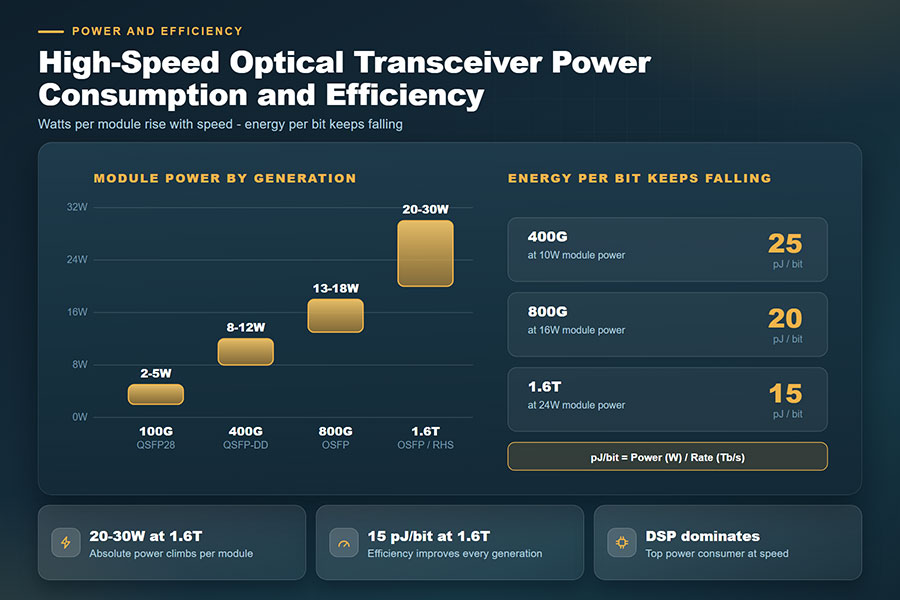
As transmission rates increase, the power consumption of optical modules, routers, switches, and transport equipment becomes an important part of total network operating costs.
Network Reliability
AI infrastructure depends on reliable data exchange. DCI networks therefore require appropriate redundancy, route diversity, fault monitoring, and recovery strategies to reduce the impact of network interruptions.
Total Cost of Ownership
Network operators must balance initial capital expenditure with long-term operational costs. Higher-speed optical technology can increase capacity, but the financial benefits depend on traffic requirements, fiber utilization, equipment efficiency, and the expected lifetime of the infrastructure.
10. Industry Outlook: DCI Becomes an Important Part of AI Infrastructure
The expansion of AI data centers is changing the investment landscape for optical communications. As computing resources become more geographically distributed, high-capacity optical connections between facilities will play an increasingly important role.
Several developments are likely to influence the next stage of DCI market growth.
Increasing Deployment of 400G and 800G Optical Connectivity
Higher-speed coherent optics will support capacity upgrades across metropolitan and regional DCI networks. The transition toward 800G will depend on transmission requirements, equipment availability, and the economics of individual projects.
Broader Adoption of IPoDWDM Architectures
Integrated coherent optics may simplify network architectures in suitable deployments, reducing the need for separate intermediate transport equipment.
Expansion of DWDM and Optical Line Infrastructure
As traffic increases, operators will continue evaluating wavelength capacity expansion, optical line system upgrades, and more efficient utilization of existing fiber resources.
Increasing Demand for Coherent DCO Modules
Pluggable coherent technologies provide additional flexibility for DCI and optical transport deployments. Improvements in integration and transmission performance may expand their application range.
Regional Expansion of AI Connectivity Infrastructure
North America currently represents an important center of AI data center investment, while other regions are developing additional cloud and AI infrastructure. Regional fiber availability, power capacity, and investment conditions will influence the distribution of future DCI projects.
Overall, DCI is becoming an increasingly important investment category within the global optical communications market. Its development will be influenced by the relationship between AI computing growth, data traffic, optical transmission capacity, and infrastructure economics.
11. Conclusion
Global investment in data center interconnect infrastructure is accelerating as AI traffic continues to grow and computing resources become more distributed. The 45% year-over-year increase in DCI revenue from IPoDWDM ZR/ZR+ optics and WDM systems reported for the second quarter of 2026 demonstrates the growing importance of optical transport in modern data center infrastructure.
DWDM systems, coherent optical transceivers, ZR/ZR+ technologies, DCO modules, and optical line systems are becoming important elements of high-capacity DCI networks. These technologies allow operators to increase fiber utilization, improve transmission capacity, and connect geographically separated computing facilities.
At the same time, fiber availability, power consumption, network reliability, and total infrastructure cost will continue influencing deployment decisions. The long-term development of the DCI market will depend on how effectively optical networking technologies support the expanding requirements of AI and cloud infrastructure.
For optical communication manufacturers, this creates opportunities beyond conventional data center connectivity. As global DCI investment expands, suppliers capable of providing reliable optical transceivers, coherent solutions, DWDM products, and flexible connectivity technologies will play an increasingly important role in the evolving optical communications ecosystem.
C-LIGHT Optical Connectivity Solutions for DCI Networks
Data center interconnect projects require optical products selected according to transmission distance, bandwidth, fiber infrastructure, and network architecture.
C-LIGHT provides optical transceiver and fiber connectivity solutions covering multiple data rates and optical transmission technologies for data center, metropolitan networking, and optical transport applications.
DWDM and CWDM optical transceivers for wavelength-based optical connectivity.
400G optical transceivers for high-capacity network connections.
800G optical connectivity for next-generation data center infrastructure.
DCO and coherent optical solutions for applicable optical transport platforms.
High-speed fiber connectivity products for data center and network infrastructure.
Product selection should consider optical reach, wavelength, modulation format, host equipment compatibility, fiber type, and transmission performance requirements.
Optical Connectivity for Global Data Center Networks
C-LIGHT provides optical transceivers, DWDM connectivity, coherent optical solutions, and high-speed fiber products for data centers, cloud computing, and optical transport networks.
Contact our team for product specifications, technical support, and customized optical connectivity requirements.
Contact C-LIGHT >

 >
 >
 >
 >
 >
 >
 >