TEL:+86 132 6656 7067




1. What Is Silicon Photonics?
Silicon photonics is an optical technology that integrates photonic functions with silicon-based semiconductor manufacturing. Instead of relying entirely on discrete optical components, silicon photonics can integrate functions such as optical modulation, wavelength management, detection, and optical routing into photonic integrated circuits (PICs).
This approach is increasingly relevant to AI data centers because network bandwidth is growing rapidly while power, space, thermal density, and manufacturing scalability are becoming more important.
2. Why AI Data Centers Need Silicon Photonics
AI infrastructure requires large numbers of GPUs and other compute devices to exchange data at very high speeds. As clusters grow, the amount of traffic between servers and switches increases significantly.
Silicon photonics provides a path toward higher-density optical connectivity while supporting the bandwidth requirements of modern data center networks.
3. The Growth of AI Network Bandwidth
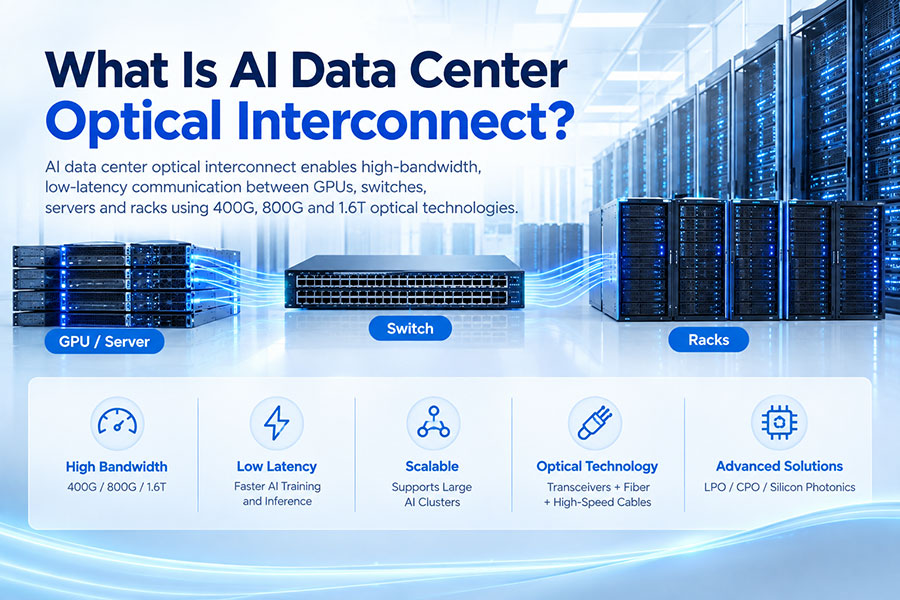
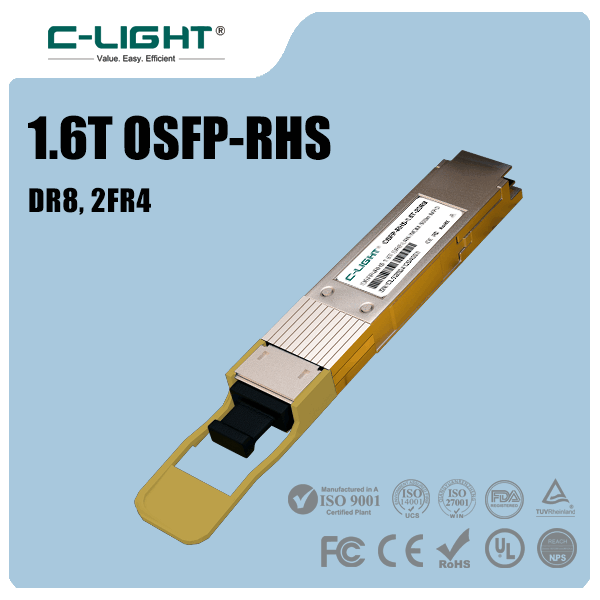
AI data center networks are moving from 400G toward 800G and 1.6T connectivity. Higher-speed switch ports require optical interfaces capable of handling higher lane rates and greater aggregate bandwidth.
Industry silicon photonics platforms are already being developed for 400G, 800G, and 1.6T applications, including parallel-fiber and WDM architectures.
4. Optical Connectivity Is Critical to AI Clusters
AI clusters rely on communication between GPUs, network adapters, leaf switches, spine switches, storage systems, and other infrastructure.
Optical fiber is particularly useful for high-speed links where electrical interconnects become increasingly difficult to scale because of channel loss, power consumption, reach, and signal-integrity limitations.
5. Silicon Photonics Integrates Multiple Optical Functions
A silicon photonic integrated circuit can combine multiple optical functions within a compact device. Depending on the design, these functions can include modulators, waveguides, wavelength multiplexers, splitters, and photodetectors.
This integration can reduce the number of discrete optical components required by the overall module architecture.
6. Silicon Photonics and Optical Transceivers
Silicon photonics can be used as the optical engine inside pluggable transceivers. The complete module can combine a PIC with electrical ICs, drivers, TIAs, controllers, lasers, fiber coupling, and thermal-management components.
Commercial silicon photonics platforms have already been used in data center optical transceivers, while newer generations target higher-speed 800G and 1.6T applications.
7. Why Integration Matters at 800G
At 800G, the number of high-speed optical channels and the amount of signal processing required by the module increase substantially compared with earlier generations.
Higher integration can help reduce optical complexity and support compact architectures with multiple optical channels in a single module.
8. Silicon Photonics for 1.6T
1.6T optical connectivity places additional pressure on lane rate, optical integration, power consumption, packaging, and thermal management.
Silicon photonics is being developed for 1.6T-class solutions because its integrated architecture can support multiple high-speed optical channels while providing a path toward further scaling.
9. Multi-Channel Optical Integration
AI networks frequently require multiple optical lanes within a single transceiver. Silicon photonics can integrate multiple optical paths and related functions on a PIC.
This makes it possible to build compact multi-channel optical engines for high-bandwidth networking.
10. Silicon Photonics and WDM
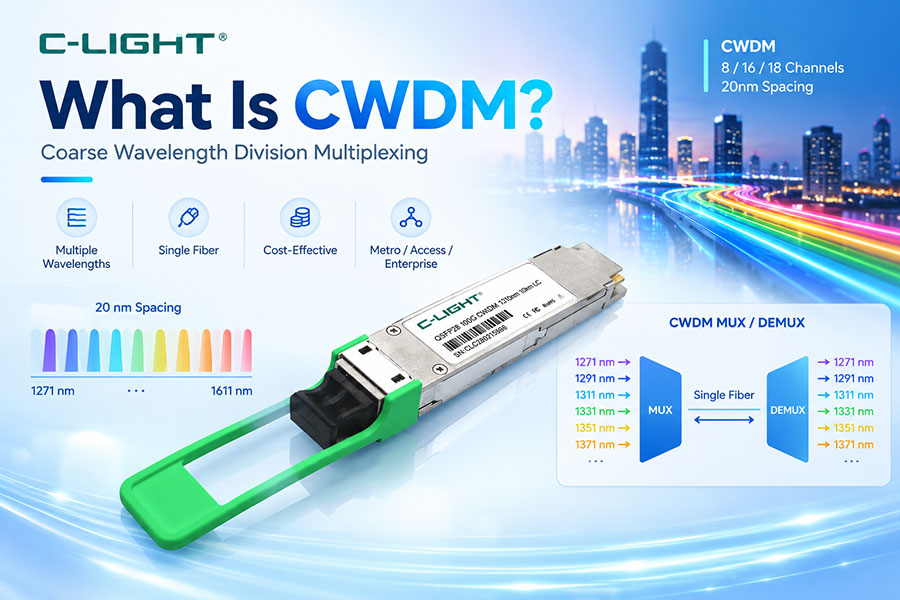
Wavelength-division multiplexing (WDM) allows multiple optical wavelengths to share a fiber interface. Silicon photonics can integrate wavelength multiplexing and demultiplexing functions into the optical engine.
This is particularly useful for architectures that need higher bandwidth while maintaining practical fiber and connector configurations.
11. Silicon Photonics and DR Architectures
DR architectures generally use parallel optical channels over single-mode fiber for short data center reaches. Silicon photonics can integrate multiple transmit and receive optical functions for these multi-lane interfaces.
DR4 and DR8 architectures are examples of parallel-fiber configurations used in high-speed data center networking.
12. Silicon Photonics and FR Architectures
FR architectures use wavelength multiplexing to carry multiple channels over fewer fiber pairs. Silicon photonics can integrate the optical functions required for WDM-based designs.
This can help reduce fiber-count requirements in high-density data center networks.
13. Silicon Photonics and PAM4
PAM4 is widely used in high-speed optical networking. It uses four signal levels to transmit two bits per symbol, allowing higher data rates without simply doubling the symbol rate.
Silicon photonics can provide high-speed modulators and photonic circuits suitable for PAM4-based optical transceiver architectures.
14. Silicon Photonics and Optical Modulators
The modulator converts electrical information into changes in the optical signal. In silicon photonics, modulators can be integrated directly into the PIC.
Integrated modulators are an important part of achieving compact multi-channel optical engines for high-speed data center applications.
15. Silicon Photonics and Photodetectors
On the receive side, photodetectors convert incoming optical signals into electrical signals. Silicon photonics platforms can integrate photodetection functions with waveguides and other optical structures.
This integration can help reduce the size and complexity of the optical engine.
16. The Role of Lasers
Silicon itself is not normally used as the primary light source. Silicon photonics systems therefore require a suitable laser architecture.
Depending on the design, lasers can be externally supplied or integrated with the photonic platform through approaches such as hybrid or heterogeneous integration. The laser architecture has important implications for power, reliability, packaging, and manufacturing.
17. On-Chip Laser Integration
Integrated laser approaches can reduce optical coupling complexity and support wafer-scale manufacturing and testing.
Some commercial silicon photonics platforms use integrated laser technologies for data center optical transceivers, demonstrating that silicon photonics can move beyond laboratory research into volume deployment.
18. Silicon Photonics and Power Efficiency
Power efficiency is a major consideration in AI data centers. Thousands of optical ports can create a significant aggregate power load.
Silicon photonics can reduce optical component count and integrate multiple functions, potentially improving the efficiency of the optical engine. Actual module power, however, depends on the complete transceiver architecture, including DSP, driver, laser, TIA, cooling, and control electronics.
19. Power per Bit Is More Important Than Power Alone
A higher-speed optical module may consume more total power while still providing better energy efficiency per transmitted bit.
For AI data centers, evaluating watts per gigabit is therefore useful when comparing 400G, 800G, and 1.6T optical technologies.
20. Silicon Photonics and Thermal Management
High-speed optical modules generate heat through their electrical and optical components. As port density increases, thermal management becomes increasingly important.
Silicon photonics can contribute to compact optical architectures, but the complete module still requires careful management of laser, driver, TIA, DSP, and other heat sources.
21. Silicon Photonics and Data Center Port Density
AI switches are increasingly designed around high port counts and high aggregate switching capacity. Optical modules must therefore provide high bandwidth without occupying excessive space.
Integrated photonic circuits can help support compact multi-channel optical engines and high-density transceiver designs.
22. Silicon Photonics and Manufacturing Scale
One of the major attractions of silicon photonics is its relationship with semiconductor manufacturing processes.
Wafer-level manufacturing, integrated testing, and high-volume semiconductor processes can provide a path toward greater production scalability compared with architectures that depend heavily on individually assembled optical components.
23. Silicon Photonics and Cost
Silicon photonics can provide manufacturing advantages through integration and wafer-scale processing. However, total module cost depends on much more than the PIC.
Laser integration, fiber coupling, packaging, electrical ICs, testing, thermal management, yield, and production volume all influence the final cost.
24. Silicon Photonics and Packaging
Packaging remains one of the most important challenges for silicon photonics. Optical coupling between the PIC and external fibers must maintain low loss and mechanical reliability.
High-speed electrical connections between the PIC, driver, TIA, and host interface also require careful packaging and signal-integrity design.
25. Fiber Coupling Efficiency
Efficient coupling between the photonic integrated circuit and optical fiber is critical to achieving the required optical budget.
Packaging technologies must control alignment, coupling loss, temperature effects, mechanical stress, and long-term reliability.
26. Silicon Photonics and Single-Mode Fiber
Silicon photonics is particularly relevant to single-mode fiber applications because integrated photonic circuits can support high-speed optical transmission across the wavelengths commonly used for data center single-mode links.
Single-mode fiber also provides longer reach than multimode fiber and is widely used for higher-speed switch-to-switch connections.
27. Silicon Photonics in AI Leaf-Spine Networks
AI data centers commonly use multi-stage switching architectures in which leaf switches connect compute systems and spine switches provide high-bandwidth fabric connectivity.
Silicon photonics can support the high-speed optical links required between these switching layers.
28. Silicon Photonics for GPU Clusters
GPU clusters generate large amounts of east-west traffic. Optical connectivity is used to connect GPU servers and network switches while maintaining high bandwidth across the cluster.
Silicon photonics can support the compact, multi-channel optical interfaces needed for these environments.
29. Silicon Photonics and Distributed AI Training
Distributed AI training involves frequent communication between compute nodes. Operations such as all-reduce, all-to-all communication, gradient exchange, and parameter synchronization can generate intense network traffic.
High-bandwidth optical interconnects can help provide the network capacity required by these communication patterns.
30. Silicon Photonics vs. Conventional Discrete Optics
| Item | Silicon Photonics | Conventional Discrete Optics |
|---|---|---|
| Integration | High integration on PIC | More discrete components |
| Multi-Channel Design | Well suited to integrated multi-channel architectures | More component-level integration |
| WDM | Can integrate wavelength functions | Often uses separate optical components |
| Manufacturing | Compatible with semiconductor-style processing | More component assembly |
| Scalability | Designed for high-volume integration | Depends strongly on component architecture |
| Packaging | Highly important | Also important |
31. Silicon Photonics vs. EML
Silicon photonics and EML represent different approaches to optical transmission. EML combines a laser with an electro-absorption modulator, while silicon photonics uses integrated photonic circuits containing optical waveguides and modulation structures.
Both technologies can support high-speed data center optics. The appropriate choice depends on reach, wavelength, power, integration, manufacturing, packaging, and system requirements.
32. Silicon Photonics and LPO
Silicon photonics and linear-drive pluggable optics (LPO) are not competing definitions of the same technology.
Silicon photonics describes the optical integration platform, while LPO describes how signal processing and drive functions are distributed between the optical module and host system.
A silicon photonics optical engine can therefore be designed as part of an LPO architecture when the electrical and optical interfaces support the required implementation.
33. Silicon Photonics and Co-Packaged Optics
Co-packaged optics (CPO) places optical engines much closer to the switching ASIC. Silicon photonics is one of the technologies being considered for such integrated optical architectures.
Moving optics closer to the ASIC can reduce the length of high-speed electrical traces and potentially address electrical I/O scaling challenges.
34. From Pluggable Optics to Integrated Optical I/O
Traditional data center networks use pluggable optical transceivers connected to switch ASICs through electrical interfaces. As electrical signaling becomes more difficult to scale, the industry is investigating optical I/O architectures that move optical conversion closer to the compute or switching silicon.
Silicon photonics provides an important technology foundation for this transition.
35. Silicon Photonics for Future Optical I/O
Beyond conventional pluggable transceivers, integrated photonics can potentially support optical I/O directly around CPUs, GPUs, accelerators, and switching devices.
Recent industry research has demonstrated multi-terabit optical I/O concepts designed to address the bandwidth and energy requirements of future AI infrastructure.
36. Silicon Photonics and Multi-Terabit Connectivity
Future AI systems will require communication bandwidth beyond individual 800G interfaces. Multi-terabit optical engines and optical I/O architectures are being investigated to support these requirements.
Silicon photonics provides a scalable platform for integrating multiple optical channels and supporting higher aggregate bandwidth.
37. Silicon Photonics and Network Reach
Silicon photonics does not define a specific transmission distance. The actual reach depends on the complete optical architecture, including laser, modulation, receiver performance, wavelength, fiber, optical budget, and signal processing.
Silicon photonics can therefore be used in different data center optical applications with different reach requirements.
38. Silicon Photonics and Reliability
High-volume AI data centers require optical components that can operate reliably for long periods under demanding thermal and electrical conditions.
Integrated manufacturing and wafer-level testing can provide opportunities for process control and production consistency, although packaging and laser reliability remain important parts of the complete system.
39. Key Challenges of Silicon Photonics
Complex optical packaging
Fiber coupling efficiency
Laser integration
Thermal management
High-speed electrical interfaces
Manufacturing yield
Testing and calibration
Optical and electrical interoperability
Cost optimization at different production volumes
40. How to Evaluate Silicon Photonics for AI Networks
When selecting a silicon photonics solution, engineers should evaluate the complete optical system rather than the PIC alone.
Data rate and lane configuration
Optical reach
Wavelength architecture
Fiber type
Optical power budget
Module power consumption
DSP and signal-processing architecture
Thermal performance
Packaging and fiber coupling
Host compatibility
BER and FEC performance
Reliability and manufacturing consistency
41. Why Silicon Photonics Matters for AI Data Centers
Silicon photonics matters because AI data centers need to move increasingly large amounts of information between compute and networking systems while controlling power, thermal density, space, and manufacturing complexity.
Its ability to integrate multiple optical functions into compact photonic circuits makes it suitable for high-bandwidth 400G, 800G, and emerging 1.6T optical connectivity. Its longer-term potential also extends to co-packaged optics and integrated optical I/O.
42. Frequently Asked Questions
Q1. Why is silicon photonics important for AI data centers?
Q2. Is silicon photonics used in 800G optical transceivers?
Q3. Can silicon photonics support 1.6T?
Q4. Does silicon photonics mean lower power?
Q5. Is silicon photonics the same as LPO?
Q6. Is silicon photonics the same as CPO?
Q7. Does silicon photonics replace lasers?
Q8. What are the main challenges of silicon photonics?
43. Summary
Silicon photonics is becoming an important technology for AI data center connectivity because network bandwidth requirements continue to increase while power, thermal density, port density, and manufacturing scalability become more challenging.
By integrating optical functions into compact photonic circuits, silicon photonics can support high-speed 400G, 800G, and 1.6T optical transceivers while providing a technology path toward WDM integration, co-packaged optics, and future optical I/O.
Its value should be evaluated at the system level. Laser architecture, electrical interfaces, DSP or LPO design, packaging, thermal management, fiber coupling, optical budget, and host compatibility all influence the final performance of a silicon photonics solution.
 >
>

 >
>
 >
>
 >
>
 >
>
 >
>
 >
>
 >
>