TEL:+86 132 6656 7067




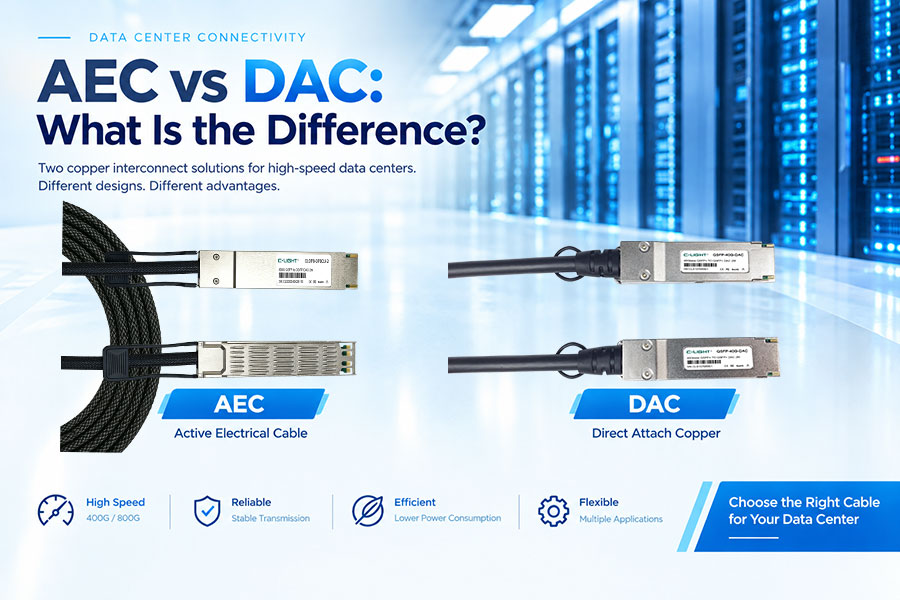
AEC and DAC are high-speed copper interconnect solutions used in modern data centers, AI clusters, and HPC networks. Both provide short-reach connectivity between switches, servers, and GPUs, but they differ in signal processing, transmission distance, power consumption, cost, and application scenarios. Understanding the difference between AEC and DAC is important when selecting connectivity for 400G and 800G networks.
1. What Is DAC?
DAC, or Direct Attach Copper, is a copper cable assembly with high-speed connectors integrated at both ends. A passive DAC transmits electrical signals directly through copper without active signal processing inside the cable.
DAC is mainly designed for short-distance connections where low cost, low power consumption, low latency, and simple installation are important.
2. What Is AEC?
AEC, or Active Electrical Cable, is also based on copper transmission but integrates active electronic components into the cable assembly. These components help condition or retime the electrical signal to compensate for signal degradation.
Compared with passive DAC, AEC can support longer electrical links while maintaining the signal quality required by high-speed interfaces.
3. AEC vs DAC: Basic Comparison
| Feature | DAC | AEC |
|---|---|---|
| Transmission medium | Copper | Copper |
| Active electronics | No for passive DAC | Yes |
| Reach | Short | Longer than passive DAC |
| Power consumption | Very low | Higher |
| Latency | Very low | Low |
| Cost | Lower | Higher |
| Cable medium | Copper | Copper |
| Signal conditioning | Passive | Active |
| Typical applications | Short intra-rack links | Extended copper links |
4. The Main Difference Between AEC and DAC
The fundamental difference is that passive DAC relies on the electrical characteristics of the copper channel, while AEC incorporates active electronics to improve signal transmission.
As cable length and data rate increase, electrical losses become more difficult to manage. AEC uses active signal conditioning to compensate for part of this degradation, allowing longer copper connections than comparable passive DAC designs.
5. AEC vs DAC: Transmission Distance
Distance is one of the most important differences between AEC and DAC.
Passive DAC is generally optimized for very short connections, commonly around several meters or less depending on the data rate and cable design.
AEC can extend copper connectivity beyond the practical reach of passive DAC. The exact distance depends on the AEC architecture, signaling rate, host interfaces, and manufacturer specifications.
For links that require substantially greater distances, AOC or optical modules are generally more suitable than either DAC or AEC.
6. AEC vs DAC for 400G
400G networking places higher electrical requirements on copper interconnects than previous generations.
400G DAC is suitable for short server-to-switch, GPU-to-switch, and intra-rack connections where the electrical channel remains within the required limits.
400G AEC can be considered when a longer copper connection is required. Active signal conditioning helps maintain signal integrity over an extended electrical channel.
7. AEC vs DAC for 800G
At 800G, signal integrity becomes even more critical. PAM4 signaling and high-speed electrical interfaces require careful control of insertion loss, return loss, crosstalk, and jitter.
800G DAC is therefore mainly used for short connections where the complete electrical channel can meet the required performance.
800G AEC provides an alternative when the required copper reach exceeds the practical capability of passive DAC. It can help extend electrical connectivity without switching to an optical cable.
8. How Does AEC Extend Copper Reach?
Electrical signals lose strength and quality as they travel through copper. At high data rates, attenuation and other high-frequency effects can significantly reduce the available signal margin.
AEC incorporates active components that can compensate for signal degradation and improve the quality of the electrical signal delivered to the receiving device.
This active approach allows AEC to achieve longer electrical reach than a comparable passive copper cable, although it also introduces additional power consumption and circuit complexity.
9. Power Consumption: AEC vs DAC
Passive DAC has a major power advantage because it does not require active signal-processing components inside the cable.
AEC requires active electronics at the cable ends, so its power consumption is higher than passive DAC.
For large AI clusters with thousands of high-speed connections, this difference can become an important consideration. However, the additional power of AEC may be justified when it avoids replacing a copper connection with a more power-intensive or expensive alternative.
10. Latency: AEC vs DAC
Both DAC and AEC can provide low-latency connectivity for data center networks.
Passive DAC has a particularly simple electrical path and does not require active signal processing in the cable.
AEC introduces active electronic processing, but the resulting latency can still be very low and suitable for high-performance data center, AI, and HPC applications.
Actual system latency depends on the complete network architecture, including switches, retimers, DSPs, FEC, and other components.
11. Cost: AEC vs DAC
Passive DAC is generally less expensive than AEC because its construction is simpler and does not require active electronics.
AEC has additional electronic components and therefore normally costs more than passive DAC.
However, cost should be evaluated together with reach and system architecture. AEC can be cost-effective when a longer copper connection is required and optical connectivity is not necessary.
12. Cable Management
Both DAC and AEC use copper cable, so their mechanical characteristics are broadly similar to other copper interconnects.
Copper cables can be thicker and heavier than fiber-based AOC cables or optical patch cords. In high-density racks, cable routing, bend radius, airflow, and connector accessibility should therefore be considered.
AEC can provide longer copper reach, but this does not eliminate the physical cable-management considerations associated with copper.
13. AEC vs DAC for AI Data Centers
AI data centers require large numbers of high-bandwidth connections between GPUs, servers, and network switches.
DAC is well suited to short intra-rack connections where devices are physically close together.
AEC becomes useful when the required copper connection is longer than the practical reach of passive DAC. This can reduce the need to immediately move to optical connectivity for certain network links.
The final choice should consider reach, power consumption, cable density, thermal management, cost, and the specific electrical requirements of the host equipment.
14. AEC vs DAC for GPU Clusters
GPU clusters often require high-speed connections between GPUs, compute nodes, and switches. These links can place significant demands on electrical signal integrity.
Short GPU-to-switch connections can often use passive DAC when the cable length is within specification.
For longer copper connections, AEC provides active signal conditioning and can offer additional electrical reach.
15. AEC vs DAC for Switch-to-Switch Connections
Switch-to-switch connections can use either DAC or AEC depending on physical distance and electrical channel requirements.
For adjacent switches with a short connection, passive DAC is often the simpler and more economical option.
When the distance increases beyond the practical passive DAC range, AEC can provide an extended copper alternative.
16. AEC vs DAC vs AOC
| Feature | DAC | AEC | AOC |
|---|---|---|---|
| Medium | Copper | Copper | Optical fiber |
| Active electronics | No | Yes | Yes |
| Reach | Shortest | Extended copper reach | Longer optical reach |
| Power | Lowest | Medium | Medium |
| Cable weight | Higher | Higher | Lower |
| Best suited for | Short links | Longer copper links | Longer fiber links |
DAC, AEC, and AOC should therefore be viewed as complementary technologies. DAC is optimized for the shortest connections, AEC extends the usable copper range, and AOC provides optical connectivity for longer links.
17. When Should You Choose DAC?
Choose DAC when the connection is short enough to meet the passive electrical channel requirements and low cost and low power are priorities.
Short server-to-switch links
Intra-rack connections
Short GPU-to-switch links
Short switch-to-switch connections
High-density AI and HPC racks
18. When Should You Choose AEC?
Choose AEC when you want to maintain copper connectivity but passive DAC cannot provide sufficient electrical reach or signal integrity.
Extended copper connections
400G and 800G networks
AI data center interconnects
GPU cluster networking
High-speed switch connections
Applications where optical cabling is not preferred
19. When Should You Choose AOC?
AOC is generally more appropriate when the required distance is beyond the practical range of both passive DAC and AEC, or when lower cable weight and optical transmission are important.
AOC is commonly considered for longer data center connections, rack-to-rack links, and high-density environments where fiber provides advantages in routing and electromagnetic immunity.
20. C-LIGHT AEC and DAC Solutions
C-LIGHT provides high-speed DAC and AEC solutions for modern data center, AI, and HPC networks.
C-LIGHT 400G and 800G DAC solutions are designed for short-reach connections between servers, switches, GPUs, and other high-speed network devices.
C-LIGHT AEC solutions provide active copper connectivity for applications requiring greater electrical reach and signal conditioning. These solutions can be used for high-bandwidth AI clusters, GPU interconnects, and data center switching environments.
21. AEC vs DAC: Which One Should You Choose?
The choice between AEC and DAC mainly depends on the required reach and electrical channel performance.
Choose DAC when the link is short and low power, low cost, and simple deployment are the main priorities.
Choose AEC when a longer copper connection is required and active signal conditioning can provide the necessary electrical performance.
Choose AOC when the connection requires optical transmission, longer reach, lower cable weight, or better immunity to electromagnetic interference.
For 400G and 800G AI data centers, DAC and AEC can be used together to optimize connectivity according to the physical distance and electrical requirements of each link.
 >
>

 >
>
 >
>
 >
>
 >
>
 >
>
 >
>
 >
>