TEL:+86 132 6656 7067




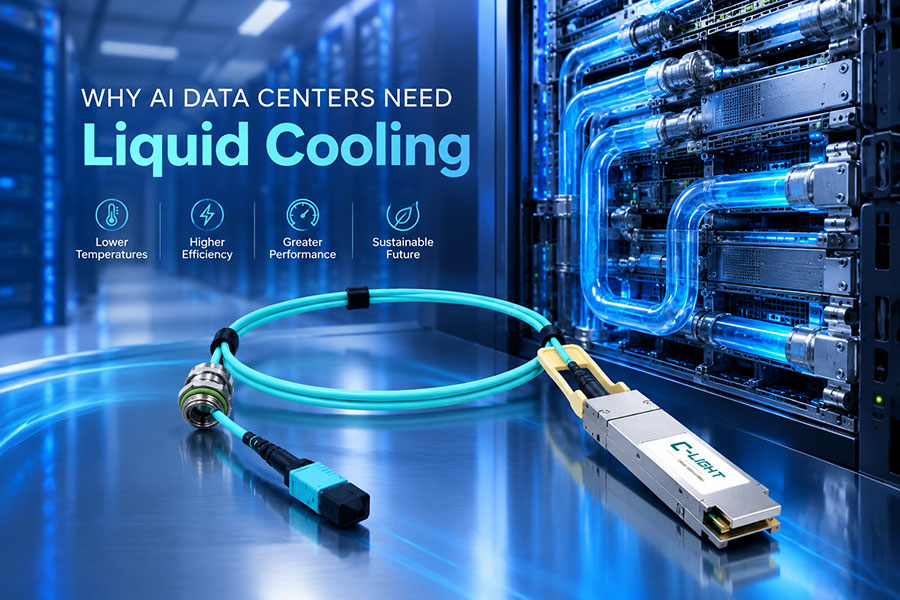
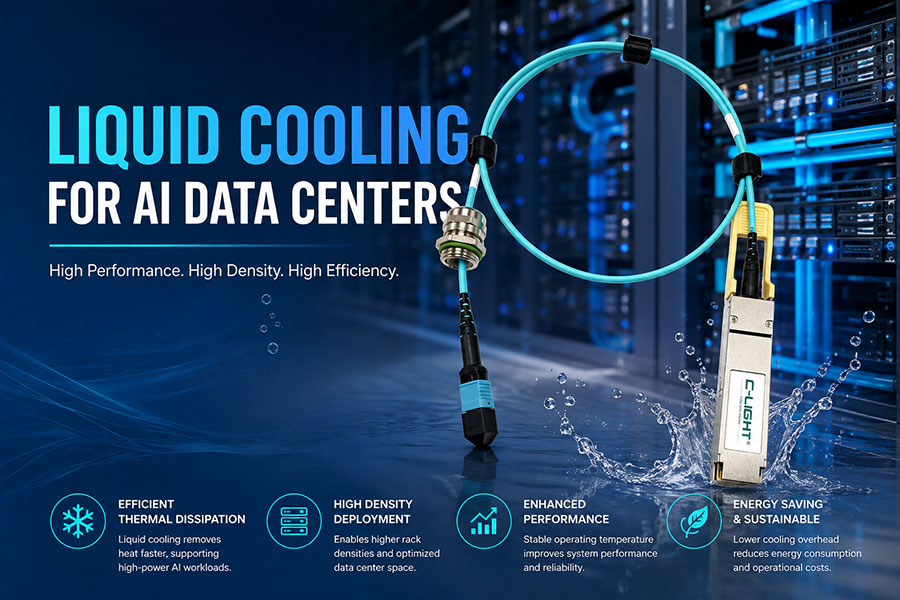
Liquid cooling is becoming an important thermal management technology for AI data centers as GPU power, rack density, and computing workloads continue to increase. Compared with traditional air cooling, liquid cooling can remove heat more efficiently and support higher-density AI servers, GPU clusters, and high-performance computing infrastructure.
1. Why AI Data Centers Need Liquid Cooling
AI workloads rely on high-performance GPUs and accelerators that generate significant heat during continuous operation. As more GPUs are deployed in a single server or rack, the resulting thermal load can exceed the practical limits of conventional air cooling.
Liquid cooling transfers heat through a liquid medium with much higher thermal capacity than air. This makes it suitable for high-density racks where efficient heat removal, stable operating temperatures, and energy efficiency are important.
2. How Liquid Cooling Works in AI Data Centers
Liquid cooling systems circulate coolant through components or cooling plates located close to heat-generating devices. Heat from GPUs, CPUs, and other high-power components is transferred into the coolant and then removed through a cooling distribution unit or facility cooling system.
A typical liquid cooling architecture includes cold plates, coolant loops, pumps, manifolds, quick connectors, heat exchangers, and cooling distribution units (CDUs).
3. Direct-to-Chip Liquid Cooling
Direct-to-chip liquid cooling places a cold plate directly over high-power components such as GPUs and CPUs. Coolant flows through channels inside the cold plate and absorbs heat from the semiconductor package.
This approach provides targeted cooling and can be integrated into high-density AI servers without immersing the entire system in liquid. It is one of the practical approaches for modern GPU-based data centers.
4. Cold Plate Cooling for AI GPUs
Cold plates are designed to transfer heat from processors into the liquid cooling loop. Their thermal performance depends on factors such as channel structure, coolant flow, contact resistance, material selection, and system pressure.
For AI servers, cold plates are commonly used for GPUs, CPUs, and other components with high thermal loads.
5. Immersion Cooling
Immersion cooling places electronic components or complete servers in a specially engineered dielectric fluid. The liquid directly surrounds the heat-generating components and transfers heat away from the electronics.
Immersion cooling can support very high rack densities and reduce dependence on traditional air-conditioning systems. However, it requires compatible hardware, fluid management, maintenance procedures, and specialized infrastructure.
6. Single-Phase vs. Two-Phase Liquid Cooling
Single-phase cooling keeps the coolant in a liquid state throughout the cooling loop. Heat is transferred from the components to the coolant and then removed through a heat exchanger or CDU.
Two-phase cooling uses a fluid that changes phase during operation. The phase transition can absorb significant amounts of heat, but the system is more complex and requires careful control of fluid properties and containment.
7. Cooling Distribution Units in AI Data Centers
A cooling distribution unit separates and manages the facility cooling loop and the technology cooling loop. The CDU typically controls coolant flow, temperature, pressure, and heat exchange between the two systems.
For large AI clusters, CDUs help provide consistent thermal conditions across multiple racks and allow liquid cooling systems to scale with computing infrastructure.
8. Liquid Cooling and High-Density AI Racks
AI infrastructure is moving toward increasingly dense server configurations. More GPUs per rack increase both computational capacity and thermal requirements.
Liquid cooling allows data center operators to design higher-density racks while maintaining appropriate component temperatures. This can be particularly useful for GPU clusters, AI training systems, HPC environments, and other compute-intensive deployments.
9. Liquid Cooling vs. Air Cooling
| Feature | Liquid Cooling | Air Cooling |
|---|---|---|
| Heat transfer | High thermal efficiency | Lower thermal capacity |
| High-density racks | Well suited | More challenging at very high densities |
| Infrastructure | Requires coolant loop and liquid components | Primarily air-handling infrastructure |
| Maintenance | Requires liquid system management | Generally simpler |
| AI GPU deployment | Suitable for high-power GPU systems | Suitable for lower-density configurations |
10. Liquid Cooling and Data Center Power Efficiency
Cooling is an important part of overall data center energy consumption. More efficient thermal management can reduce the cooling infrastructure required to maintain operating temperatures.
Liquid cooling can improve cooling efficiency by transferring heat closer to the source instead of relying entirely on large volumes of conditioned air. The actual energy savings depend on the rack design, coolant system, facility infrastructure, and operating conditions.
11. Liquid Cooling for GPU Clusters
AI GPU clusters require high-speed communication between GPUs, servers, and switches. At the same time, the computing hardware generates substantial heat.
A liquid-cooled GPU cluster therefore needs coordinated thermal, electrical, and networking infrastructure. Cooling systems, power distribution, high-speed optical links, DAC cables, AOCs, and network switches must work together as part of the overall AI data center architecture.
12. Impact on High-Speed Networking
Liquid cooling does not replace high-speed networking, but it changes how dense AI infrastructure can be deployed. Higher rack density can increase the number of high-speed connections required between GPUs, servers, and switches.
400G and 800G optical transceivers, DAC, AOC, and AEC solutions are increasingly used for high-bandwidth connections in AI and HPC environments. As network speeds move toward 1.6T, thermal management becomes an increasingly important consideration for both computing and networking equipment.
13. Optical Interconnects in Liquid-Cooled AI Data Centers
Optical interconnects provide high-bandwidth communication between AI servers, GPU clusters, and network switches. Liquid cooling mainly addresses thermal management, while optical transceivers and high-speed interconnects address data transmission.
These technologies complement each other in high-density AI infrastructure. Efficient cooling enables dense computing and networking hardware, while high-speed optical connectivity provides the bandwidth required for distributed AI workloads.
14. 400G and 800G Connectivity for AI Infrastructure
400G and 800G connectivity is widely used in modern high-performance data center networks. Short-reach connections can use DAC or AEC solutions, while longer links can use optical transceivers and fiber infrastructure.
For example, 800G DAC is suitable for short-distance connections between switches, servers, and GPU systems, while 800G optical transceivers can support longer fiber links within AI data center networks.
15. 1.6T Optical Connectivity and Cooling
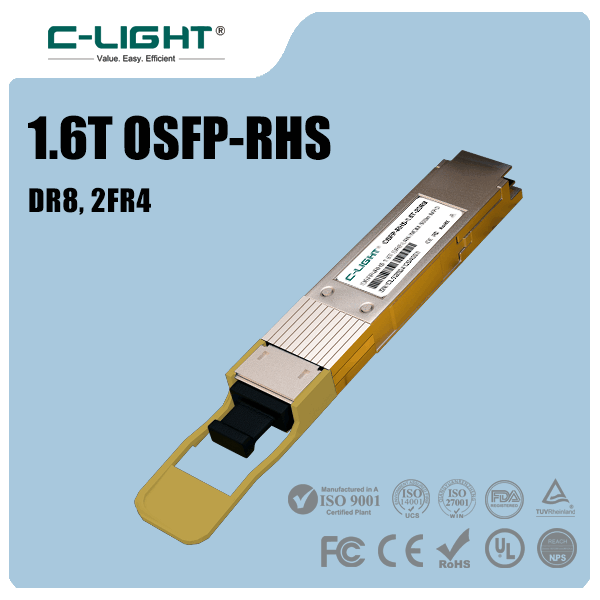
As network bandwidth continues to increase, 1.6T optical modules are being developed for next-generation AI data centers. Higher-speed optical modules introduce additional thermal and power-management requirements.
Reduced-height heatsinks, improved thermal interfaces, efficient optical architectures, and advanced data center cooling systems can help support high-speed optical connectivity in dense AI environments.
16. Key Components of a Liquid Cooling System
A complete liquid cooling solution can include several components working together:
Cold plates for GPUs and CPUs
Coolant distribution manifolds
Pumps and coolant loops
Cooling distribution units (CDUs)
Heat exchangers
Quick-disconnect fittings
Temperature and flow sensors
Leak detection and monitoring systems
17. Challenges of Liquid Cooling
Liquid cooling provides significant benefits for high-density computing, but it also introduces additional engineering requirements. Data center operators need to consider coolant selection, leak prevention, maintenance, plumbing infrastructure, system reliability, and compatibility with existing facilities.
Retrofitting liquid cooling into an existing data center can also require significant infrastructure changes, particularly when racks and power systems were originally designed around conventional air cooling.
18. Liquid Cooling and Data Center Design
AI data center design increasingly requires thermal management to be considered alongside power and networking from the beginning. Rack layout, power distribution, cooling capacity, cable management, and network topology all influence the final system design.
For new AI facilities, liquid cooling can be integrated into the rack and facility architecture from the planning stage. This approach can simplify deployment and provide greater flexibility for future GPU and accelerator upgrades.
19. Liquid Cooling for AI Training and Inference
AI training workloads can maintain high accelerator utilization for extended periods, creating substantial and continuous thermal loads. AI inference infrastructure can also require high-density deployment as demand increases.
Liquid cooling provides a scalable thermal management approach for both applications, particularly where compute density is a major design requirement.
20. Future Trends in AI Data Center Cooling
Future AI data centers are expected to place greater emphasis on direct-to-chip cooling, advanced cold plates, higher-capacity CDUs, improved coolant management, and integrated facility-level thermal monitoring.
Cooling will increasingly be designed together with GPU architecture, power delivery, rack density, and high-speed networking. This integrated approach will be important as AI infrastructure moves toward higher compute density and faster optical connectivity.
21. C-LIGHT Optical Connectivity for AI Data Centers
C-LIGHT provides high-speed optical transceivers and direct-attach connectivity solutions for modern data center and AI infrastructure. Its portfolio includes 400G and 800G DAC, AEC, AOC, and optical transceiver solutions, as well as next-generation 1.6T optical modules.
These products can support high-bandwidth connections between GPU servers, switches, and AI networking infrastructure, complementing the high-density computing and liquid cooling systems used in modern AI data centers.
22. Conclusion
Liquid cooling is becoming an important technology for AI data centers as GPU performance, rack density, and computing requirements continue to grow. Direct-to-chip cooling, cold plates, immersion cooling, and advanced CDUs provide different approaches for managing high thermal loads.
When combined with high-capacity power systems, 400G/800G networking, 1.6T optical connectivity, and efficient data center infrastructure, liquid cooling can provide a foundation for the next generation of high-density AI computing environments.
 >
>

 >
>
 >
>
 >
>
 >
>
 >
>
 >
>
 >
>