TEL:+86 132 6656 7067




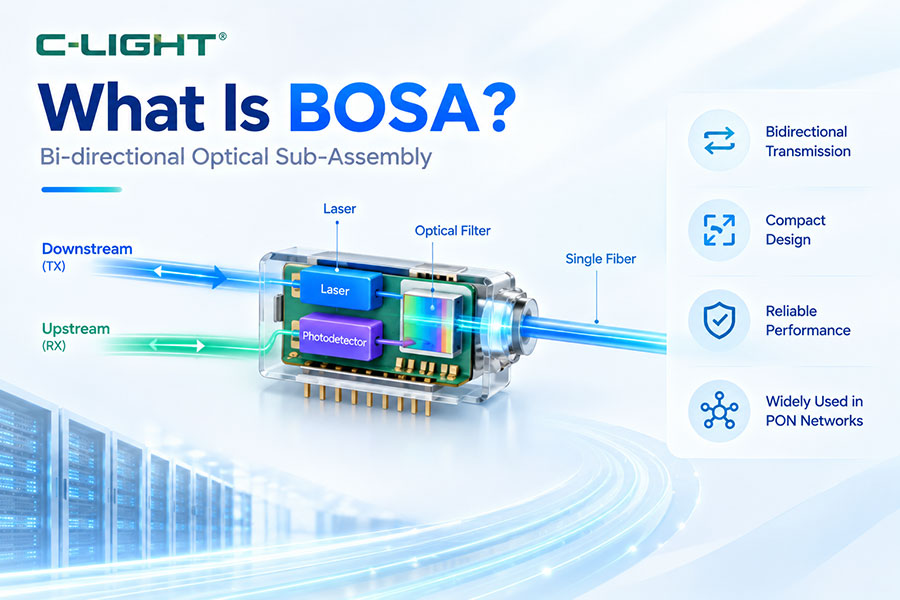
Bidirectional optical communication requires a transmitter and receiver to operate through the same optical infrastructure while maintaining reliable separation between upstream and downstream signals. A BOSA, or Bi-directional Optical Sub-Assembly, integrates these optical functions into a compact assembly and is widely used in PON-based access networks. By combining a transmitter, receiver, optical filtering, and fiber interface within one assembly, BOSA technology helps reduce optical complexity and supports compact ONU, ONT, and other optical access equipment.
1. What Is BOSA?
BOSA stands for Bi-directional Optical Sub-Assembly. It is an optical sub-assembly that integrates both optical transmission and optical reception functions for bidirectional communication.
Unlike a simple transmitter or receiver assembly, a BOSA can send and receive optical signals through a shared fiber interface. Optical filters or wavelength-selective components separate the transmit and receive wavelengths so that the two signal directions can coexist on the same fiber.
2. What Is the Basic Structure of a BOSA?
A typical BOSA contains several key optical and optoelectronic components:
| Component | Function |
|---|---|
| Laser | Converts electrical signals into optical signals for transmission |
| Photodetector | Converts received optical signals into electrical signals |
| Optical Filter | Separates transmit and receive wavelengths |
| Optical Coupling Structure | Directs optical signals between components and the fiber |
| Fiber Interface | Provides the optical connection to the external fiber |
| Package | Provides mechanical alignment and optical protection |
The exact internal structure depends on the application, wavelength plan, optical power requirements, package design, and PON standard.
3. How Does BOSA Work?
The BOSA performs transmission and reception in two optical directions.
During transmission, the laser converts the electrical input signal into an optical signal. The optical coupling structure directs the signal toward the common fiber port.
During reception, an incoming optical signal enters through the same fiber interface. The wavelength-selective optical structure directs the appropriate receive wavelength toward the photodetector while reducing unwanted optical coupling from the transmitter path.
The basic signal path can be represented as:
Electrical TX → Laser → Optical Filter/Coupler → Single Fiber
Single Fiber → Optical Filter/Coupler → Photodetector → Electrical RX
4. Why Does BOSA Use a Single Fiber?
One of the main advantages of BOSA is its ability to support bidirectional communication through a single optical fiber.
PON networks commonly use wavelength division to separate upstream and downstream signals. This allows both directions to share the same physical fiber while using different optical wavelengths.
This architecture significantly reduces the amount of fiber required in access networks and is one of the reasons BOSA is widely used in ONU and ONT equipment.
5. BOSA and Wavelength Division Multiplexing
BOSA commonly works together with wavelength-selective optical components. The transmitter and receiver operate at different wavelengths, while an optical filter or wavelength division structure separates the two paths.
| Optical Function | Typical Role |
|---|---|
| TX Wavelength | Upstream or downstream optical transmission |
| RX Wavelength | Opposite-direction optical reception |
| Filter | Separates the two wavelength bands |
| Common Fiber | Carries both optical directions |
The actual wavelength plan depends on the PON generation and network architecture.
6. BOSA in PON Networks
BOSA is strongly associated with passive optical network technology. PON systems use a shared optical distribution network to connect an OLT with multiple ONUs or ONTs.
At the subscriber side, compact optical assemblies are important because ONU and ONT equipment must provide optical transmission and reception within a small form factor.
BOSA provides an integrated optical solution for these bidirectional requirements.
7. BOSA in GPON
GPON uses different optical wavelengths for upstream and downstream transmission. A BOSA can integrate the corresponding transmitter and receiver paths into a single optical assembly.
This makes BOSA particularly suitable for compact GPON ONU and ONT designs where bidirectional communication must be supported through a single fiber.
8. BOSA in XG-PON
XG-PON increases the downstream and upstream bandwidth compared with earlier PON generations. The higher performance requirements place greater demands on the laser, photodetector, optical isolation, wavelength filtering, and package design.
BOSA remains an important architecture for integrating these functions into compact optical access equipment.
9. BOSA in XGS-PON
XGS-PON supports symmetrical 10Gbps-class upstream and downstream transmission. This requires optical components capable of supporting the relevant wavelength plan and higher-speed electrical interfaces.
A BOSA can combine the transmitter and receiver optical paths while maintaining wavelength separation between upstream and downstream signals.
10. BOSA vs TOSA
| Feature | BOSA | TOSA |
|---|---|---|
| Full Name | Bi-directional Optical Sub-Assembly | Transmitter Optical Sub-Assembly |
| Function | Transmission and reception | Optical transmission |
| Laser | Yes | Yes |
| Photodetector | Yes | No |
| Typical Application | PON and bidirectional optical systems | Optical transmitters and transceivers |
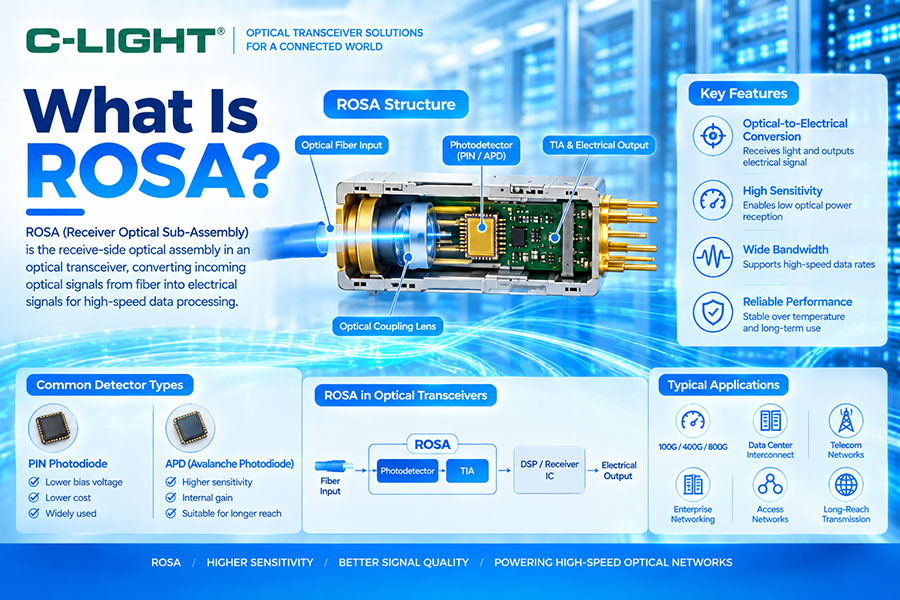
11. BOSA vs ROSA
| Feature | BOSA | ROSA |
|---|---|---|
| Transmission | Yes | No |
| Reception | Yes | Yes |
| Laser | Typically included | No |
| Photodetector | Typically included | Yes |
| Bidirectional Operation | Designed for it | Receiver function only |
12. BOSA vs Optical Transceiver
A BOSA is an optical sub-assembly rather than necessarily a complete optical transceiver.
A complete optical transceiver normally includes optical sub-assemblies together with electrical interfaces, driver and receiver electronics, management functions, mechanical housing, and other components required for direct integration into network equipment.
BOSA is therefore often an internal optical building block used to create compact bidirectional optical products.
13. BOSA vs Traditional Separate TX and RX Components
| Feature | Integrated BOSA | Separate TX/RX Assemblies |
|---|---|---|
| Integration | High | Lower |
| Optical Interface | Common bidirectional path | May require separate optical paths |
| Package Size | Compact | Potentially larger |
| Assembly Complexity | Reduced system integration | More individual alignment and assembly |
| PON Suitability | Excellent | Application-dependent |
14. What Type of Laser Is Used in BOSA?
The laser depends on the PON standard and required optical performance. Different BOSA designs can use DFB lasers, Fabry-Perot lasers, or other suitable laser technologies.
For higher-speed PON systems, the laser must satisfy requirements for output power, wavelength accuracy, modulation bandwidth, extinction ratio, temperature stability, and reliability.
15. What Type of Photodetector Is Used in BOSA?
The receiver side of a BOSA commonly uses a PIN photodiode or another suitable photodetection structure depending on the application.
The photodetector converts the incoming optical signal into an electrical current. Its sensitivity, bandwidth, responsivity, overload capability, and wavelength response directly affect receiver performance.
16. BOSA Optical Isolation
Because the transmitter and receiver share an optical interface, optical isolation is an important BOSA design consideration.
Excessive transmitter-to-receiver optical leakage can interfere with the receiver and reduce system performance. Optical filtering, physical alignment, wavelength separation, and package design are therefore important factors in BOSA development.
17. BOSA Insertion Loss
Optical components inside a BOSA introduce some insertion loss. Filters, couplers, optical interfaces, and alignment structures can all contribute to the total optical loss.
Low insertion loss is important because the available optical link budget must accommodate fiber attenuation, connectors, splitters, and other passive losses in addition to losses introduced by the optical assembly.
18. BOSA and Optical Link Budget
BOSA performance directly affects the optical power available to the network receiver. Important parameters include transmitter launch power, receiver sensitivity, insertion loss, isolation, and optical return loss.
For PON applications, these parameters must be considered together with fiber attenuation and the loss introduced by optical splitters.
19. BOSA and Optical Return Loss
Optical return loss describes the amount of optical power reflected back toward the source. Reflections can affect laser stability and receiver performance.
BOSA optical design therefore needs to control reflection at the fiber interface, optical filter, coupling structure, and other internal optical interfaces.
20. BOSA and Temperature Performance
PON equipment can operate across a relatively wide environmental temperature range. Changes in temperature can affect laser wavelength, optical output power, photodetector characteristics, and mechanical alignment.
High-quality BOSA designs therefore require stable optical alignment and component characteristics across the specified operating temperature range.
21. BOSA Packaging
Packaging is critical because optical alignment must be maintained at a very small scale. The package must provide mechanical stability while protecting the laser, photodetector, filter, and optical coupling structure.
Compact packaging is especially important for ONU and ONT equipment where PCB space and optical module volume are limited.
22. BOSA and ONU/ONT
ONU and ONT devices need to communicate in both directions through the PON fiber. BOSA provides an efficient optical architecture for integrating the required transmit and receive functions.
Its compact structure makes it suitable for residential gateways, enterprise optical terminals, fiber access equipment, and other subscriber-side PON products.
23. BOSA in OLT Equipment
BOSA technology is primarily associated with compact bidirectional optical assemblies, particularly in subscriber-side PON equipment. OLT implementations can use different optical architectures depending on port density, wavelength plan, reach, and transceiver design.
Therefore, the specific optical assembly used in an OLT should be determined from the applicable PON standard and product architecture.
24. BOSA and PON Wavelengths
Different PON generations use different wavelength plans. The BOSA must therefore be designed around the required transmit and receive bands.
| PON Technology | Typical Application | Wavelength Strategy |
|---|---|---|
| GPON | FTTH and access networks | Separate upstream/downstream wavelength bands |
| XG-PON | 10G-class asymmetric PON | Separate wavelength bands |
| XGS-PON | 10G symmetric PON | Separate wavelength bands |
| 50G PON | Next-generation access | Higher-speed wavelength plan |
The exact wavelength values should be selected according to the applicable ITU-T specification and optical architecture.
25. Advantages of BOSA
Integrates optical transmission and reception
Supports bidirectional communication over a common fiber
Provides compact optical integration
Supports wavelength-based TX/RX separation
Suitable for PON access equipment
Can simplify optical system assembly
Supports compact ONU and ONT designs
26. BOSA Design Challenges
Maintaining accurate optical alignment
Controlling transmitter-to-receiver optical leakage
Minimizing insertion loss
Maintaining wavelength stability
Managing optical reflections
Maintaining performance across temperature changes
Achieving consistent manufacturing yield
27. BOSA in Next-Generation PON
As PON evolves from GPON and EPON toward XG-PON, XGS-PON, 25G PON and 50G PON, optical assemblies must support higher data rates and tighter optical performance requirements.
Future BOSA designs will need to address higher transmitter bandwidth, improved receiver sensitivity, tighter wavelength control, better optical isolation, and increasingly compact packaging.
28. BOSA and 50G PON
50G PON introduces substantially higher access bandwidth and creates new requirements for optical transmitters, receivers, filters, and packaging.
The BOSA concept remains relevant where bidirectional optical functions need to be integrated into a compact assembly, although the exact architecture depends on the selected 50G PON implementation.
29. BOSA Applications
| Application | Role of BOSA |
|---|---|
| FTTH | Bidirectional optical access |
| GPON ONU/ONT | Integrated optical TX/RX |
| XG-PON ONU/ONT | Higher-speed bidirectional access |
| XGS-PON ONU/ONT | Symmetric 10G-class optical access |
| Enterprise PON | Optical access connectivity |
| FTTx | Compact bidirectional optical interface |
30. BOSA vs TOSA vs ROSA
| Parameter | BOSA | TOSA | ROSA |
|---|---|---|---|
| Transmit Function | Yes | Yes | No |
| Receive Function | Yes | No | Yes |
| Laser | Yes | Yes | No |
| Photodetector | Yes | No | Yes |
| Bidirectional | Yes | No | No |
| Typical PON Use | Very common | Transmit path | Receive path |
31. How to Select a BOSA
When selecting a BOSA, the main parameters should match the target PON system and equipment architecture.
PON standard and generation
Transmit wavelength
Receive wavelength
Transmission distance
Optical output power
Receiver sensitivity
Optical isolation
Insertion loss
Operating temperature
Package and mechanical dimensions
Electrical interface requirements
32. Conclusion
BOSA is an important optical sub-assembly for bidirectional communication, particularly in PON and fiber access networks. By integrating the transmitter, receiver, wavelength filtering, and common fiber interface into a compact optical structure, BOSA simplifies the implementation of single-fiber bidirectional communication.
As access networks progress toward XGS-PON, 25G PON and 50G PON, BOSA technology will continue to evolve toward higher bandwidth, better optical isolation, lower insertion loss, improved temperature stability, and more compact packaging.
 >
>

 >
>
 >
>
 >
>
 >
>
 >
>
 >
>
 >
>