TEL:+86 132 6656 7067




Every fiber optic link must be terminated at both ends. The connector that joins the fiber to a transceiver, a patch panel, or another fiber is the single most critical interface in the optical path—and the single most vulnerable to installation errors, contamination, and loss. How that termination is performed—whether in a factory cleanroom or on a ladder in a data hall—determines the link's performance, its cost, and how long it takes to deploy.
Two methods dominate modern fiber termination: pigtail splicing and pre-terminated cables. A pigtail is a short fiber stub with a factory-terminated connector on one end and bare fiber on the other; the bare end is fusion-spliced to the incoming cable in the field. A pre-terminated cable arrives from the factory with connectors already installed on both ends, tested and ready to plug in.
The choice between them is often framed as speed versus flexibility, or cost versus quality. But the reality is more nuanced. Each method has a specific set of conditions under which it is the correct choice, and the wrong choice—whether driven by cost assumptions or by habit—can leave a project with higher total cost, longer timelines, or links that fail certification.
This guide examines both methods in depth: how they work, what they cost, how they perform optically, where each excels, and how to decide between them for data center, enterprise, and outside-plant deployments.
1. What Is a Fiber Pigtail?
A fiber pigtail is a short length of optical fiber—typically 1 to 5 meters—with a factory-terminated connector on one end and an exposed, unterminated fiber on the other. The connector end is polished and tested at the factory; the bare end is cleaved and fusion-spliced to the incoming fiber cable in the field.
The splice is protected inside a splice sleeve—a transparent tube surrounded by a heat-shrinkable outer layer and a strength member. Splices and their sleeves are stored in splice trays within a splice enclosure or patch panel. The connector end of the pigtail plugs into an adapter, where it can be connected to a patch cord or another pigtail.
Pigtails are available for all common connector types (LC, SC, FC, ST) and for both single-mode and multimode fiber. They are color-coded to match the fiber type—yellow for single-mode, aqua for OM3/OM4 multimode, lime green for OM5—and often supplied in sets of 12 with distinct colors to simplify identification in high-density panels.
1.1 Why Pigtails Are Used
The pigtail approach exists because factory-terminated connectors perform better than field-terminated connectors. A factory connector is polished on precision equipment in a controlled environment, with automated testing of insertion loss and return loss. A field-terminated connector—whether epoxy-polish, hot-melt, or crimp—depends on the skill of the technician, the condition of the tools, and the cleanliness of the environment. Single-mode terminations are particularly sensitive to these variables; field termination may not achieve losses below 1 dB, whereas factory pigtails typically achieve 0.1 dB typical and 0.25–0.3 dB maximum.
By splicing a factory pigtail onto the cable, the installer obtains the performance of a factory connector while still accommodating the actual cable length in the field. This is why pigtail splicing is the standard method for single-mode fiber termination, where tolerances are tightest and the consequences of a poor connector are most severe.
2. What Is a Pre-Terminated Cable?
A pre-terminated cable—also called a pre-terminated assembly or pre-terminated trunk—arrives from the factory with connectors already installed on both ends, fully tested and ready to plug in. No field termination, no splicing, no polishing. The installer pulls the cable into place, removes the protective pulling eye or sleeve, and plugs the connectors directly into the patch panel or equipment.
Pre-terminated cables are manufactured in a controlled factory environment using precision fixtures, automated polishing equipment, and benchtop testing. Every connector undergoes insertion loss (IL) and return loss (RL) testing before shipment, and the assembly ships with test documentation for every fiber strand.
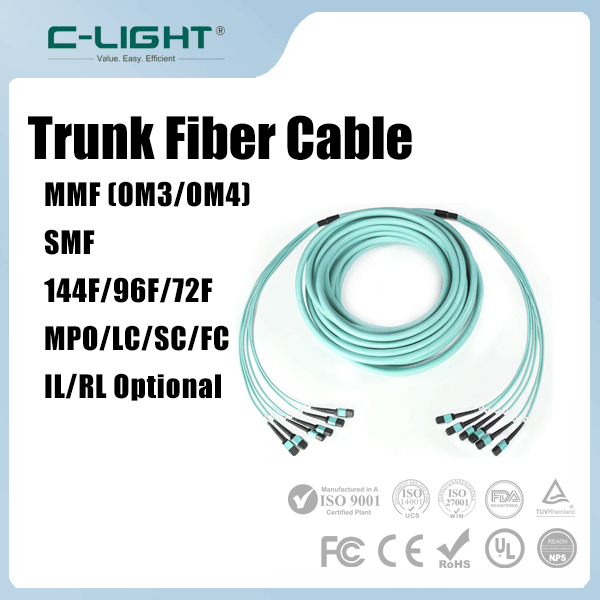
The connectors used on pre-terminated cables vary by application. For duplex applications, LC, SC, or FC connectors are common. For high-density parallel optics—40G, 100G, 400G, and 800G—MPO/MTP multi-fiber connectors are the standard. A single MTP connector can terminate 12, 16, or 24 fibers in a ferrule smaller than a duplex LC connector, enabling the high port densities that modern data centers require.
2.1 Why Pre-Terminated Cables Are Used
The case for pre-terminated cables is primarily about time and consistency. Factory termination moves the labor-intensive work—stripping, cleaving, splicing, polishing, testing—from the job site to the manufacturing floor. On-site, the work reduces to pulling and plugging. This can reduce installation time by 70 to 85 percent compared to field termination.
Equally important, factory termination produces consistent results. Every connector is made on the same equipment, by the same process, with the same quality controls. There is no variability from technician skill, tool condition, or site contamination. For high-density deployments where thousands of connectors must perform identically, this consistency is decisive.
3. The Fundamental Trade-Off: Factory Consistency vs Field Flexibility
The choice between pigtails and pre-terminated cables comes down to where the labor is performed and who bears the risk of a poor termination.
| Dimension | Pigtail Splicing | Pre-Terminated Cable |
|---|---|---|
| Termination Location | Factory connector, field splice | Factory connector, factory termination |
| Field Work | Strip, cleave, fusion splice, protect, test | Pull, plug in, label |
| Equipment Required | Fusion splicer, cleaver, splice trays, test set | None (beyond standard cable handling) |
| Skilled Labor | Certified fiber technicians required | Any trained installer can deploy |
| Insertion Loss per Connector | Typical 0.1 dB; max 0.25–0.3 dB | Typical 0.2–0.5 dB per mated pair |
| Return Loss | Depends on connector type (UPC/APC) | Factory-verified; -35 to -55 dB typical |
| Lead Time | Components in stock; splice on site | Made to order; 2–4 days to several weeks |
| Length Flexibility | High; cable cut to exact length on site | Low; must be ordered to precise length |
| Scalability for MPO | Limited; field MPO termination is impractical | High; factory MPO termination is standard |
The trade-off is clear. Pigtail splicing offers maximum flexibility in length and timing, at the cost of field labor, equipment, and the risk of a poor splice or contaminated connector. Pre-terminated cables offer speed, consistency, and factory-tested performance, at the cost of longer lead times and less flexibility to adjust on site.
4. Optical Performance: Insertion Loss and Return Loss
Optical performance is the dimension where the two methods are most often compared—and most often misunderstood.
4.1 Insertion Loss
A fusion splice, when properly executed, achieves insertion loss of less than 0.1 dB. This is lower than the loss of a mated connector pair, which typically ranges from 0.2 to 0.5 dB. The splice is a permanent fusion of two glass fibers, with no air gap, no mechanical interface, and no alignment tolerance beyond the precision of the splicer.
A factory-terminated connector on a pre-terminated cable has insertion loss of approximately 0.2 to 0.5 dB per mated pair, depending on connector type and polish. This is comparable to the loss of a field-terminated connector made with a pigtail, because both use factory-polished connectors. The difference is that the pre-terminated cable eliminates the splice entirely, replacing it with a mated connector pair.
At the channel level, the calculation is more complex. A pigtail-spliced channel includes the splice (less than 0.1 dB) plus the mated connector pair at the patch panel (0.2–0.5 dB). A pre-terminated channel includes only the mated connector pairs at each end of the trunk. The total loss depends on how many connection points exist in the channel, not on which termination method was used.
| Connection Point | Pigtail Method | Pre-Terminated Method |
|---|---|---|
| Fusion splice | <0.1 dB | N/A |
| Mated connector pair (patch panel) | 0.2–0.5 dB | 0.2–0.5 dB |
| Mated connector pair (equipment) | 0.2–0.5 dB | 0.2–0.5 dB |
| Typical channel total | Splice + 2 connector pairs | 2 connector pairs |
The key insight is that both methods use factory-polished connectors. The splice adds negligible loss. The dominant loss in any channel comes from the mated connector pairs, and those are present regardless of termination method. The choice between pigtail and pre-terminated cable is not primarily about optical loss—it is about labor, speed, and consistency.
4.2 Return Loss
Return loss—the ratio of reflected power to incident power—is another performance parameter where factory termination excels. Factory-polished connectors achieve return loss of -35 to -55 dB, depending on polish type (UPC or APC). Field-polished connectors may struggle to achieve these values consistently, particularly in single-mode applications where reflectance can destabilize the laser.
Fusion splices have negligible reflectance—the fused glass interface reflects almost no light. This is one reason why pigtail splicing is preferred for single-mode links: the splice itself adds no reflection, and the factory connector provides the required return loss at the patch point.
5. Total Cost of Ownership: Where the Money Actually Goes
The cost comparison between pigtail splicing and pre-terminated cables is one of the most misunderstood aspects of fiber deployment. The raw material cost of a bulk cable and a bag of pigtails is lower than the purchase price of a pre-terminated assembly. But that comparison ignores the labor, equipment, rework, and timeline costs that dominate total cost of ownership.
5.1 Field Termination Costs
Field termination—whether by pigtail splicing or by direct connectorization—requires a set of capital equipment and consumables that are not needed for pre-terminated deployment:
Fusion splicer: $3,800 to $12,000 for a complete kit with a cleaver. Higher-end ribbon splicers cost more.
Optical test equipment: OTDR, light source and power meter, inspection probe. Several thousand dollars.
Consumables: Splice sleeves, cleaning materials, polishing film, epoxy (if direct termination), protective sleeves.
Skilled labor: A certified fiber technician must perform every splice. A single 12-fiber trunk requires 2 to 4 hours of skilled splicing work per end. At loaded labor rates of $75 to $150 per hour, this is $150 to $600 per end—per trunk.
For a deployment with hundreds of trunks, the labor cost alone is substantial. And it scales linearly with fiber count: doubling the number of fibers doubles the splicing time.
5.2 Pre-Terminated Costs
Pre-terminated cables carry a higher material cost per unit. A 12-fiber pre-terminated trunk starts at around $49 for a 1-meter length, and prices rise with length, fiber count, and connector type. But the field labor is minimal: the installer pulls the cable, removes the protective pulling eye, and plugs in the connectors. No fusion splicer, no test set beyond a simple insertion loss measurement, no certified technicians.
For a 144-fiber trunk deployment, field splicing requires hours of skilled labor per rack, with the risk of human error, dirty cleaves, and splice tray management problems. A pre-terminated MTP trunk installs in minutes. In a hyperscale environment where this process is repeated thousands of times, pre-terminated trunks compress an eight-week cabling schedule into days.
5.3 The Break-Even Point
The break-even point between the two methods depends on loaded labor rates, fiber count, and project scale. The general pattern is:
| Deployment Scale | Preferred Method | Rationale |
|---|---|---|
| Few fibers (1–12), short runs | Pigtail splicing | Material cost dominates; splicer amortized over few splices |
| Moderate fiber count (12–144) | Evaluate both | Labor savings may offset material premium |
| High fiber count (144+), dense deployment | Pre-terminated | Labor and timeline savings dominate; factory consistency essential |
| MPO/MTP multi-fiber | Pre-terminated (almost always) | Field MPO termination is impractical; factory termination is the only viable option |
The break-even point is not fixed. It moves lower as labor rates rise, as project timelines compress, and as fiber counts increase. In a hyperscale data center where every week of delay costs revenue, the calculus favors pre-terminated cables even when the material premium is significant.
6. Deployment Speed and Project Timeline
Deployment speed is the most visible difference between the two methods, and often the most decisive.
6.1 Pre-Terminated Cable Speed
Pre-terminated solutions can reduce installation time by up to 70 percent in high-density environments, meaning a six-week project can be completed in two weeks. In hyperscale deployments, pre-terminated MTP trunks have compressed eight-week cabling schedules into a matter of days. RapidNet systems have demonstrated installation time reductions of up to 85 percent with fiber and 95 percent with copper compared to traditional field-terminated systems.
The speed advantage comes from eliminating the splicing and termination steps entirely. The installer's work is reduced to pulling the cable and plugging in connectors—tasks that require no specialized fiber skills and can be performed by a larger pool of installers.
6.2 Pigtail Splicing Speed
Pigtail splicing is slower by nature. Each fiber requires stripping, cleaning, cleaving, splicing, and splice protection. A 12-fiber ribbon splicer can fuse 12 fibers at once, but even with mass fusion, the preparation and handling steps take time. A 144-fiber trunk requires hours of skilled work per end.
For projects with flexible timelines, this is acceptable. For projects under compressed schedules—which describes most AI data center buildouts—the splicing time becomes a bottleneck that delays revenue-generating capacity.
7. Reliability, Consistency, and the Human Factor
Pre-terminated cables are manufactured in temperature-controlled, dust-free cleanrooms, where every connector undergoes automated insertion loss and return loss testing before shipment. Field splicing suffers variable performance due to site dust, temperature fluctuations, human error, and worn tooling. Defective splices trigger costly re-runs, material scrap, and delayed project handover.
The human factor is particularly important for multi-fiber MPO/MTP connectors. Unlike a simple LC connector, an MTP connector houses 12, 16, or 24 microscopic fibers inside a single ferrule. If the polishing angle is off by a fraction of a degree, or if one fiber protrudes slightly more than the rest, the physical contact is compromised. Field-terminating MPO connectors is virtually impossible to do correctly on a construction site. High-performance MTP trunk cables must be manufactured in a strictly controlled cleanroom environment, with every ferrule undergoing multi-stage polishing and validation by 3D interferometry.
For duplex connectors, field splicing can achieve excellent results when performed by a skilled technician with good tools. But the consistency is lower: two splices made by the same technician on the same day may have different losses, and the variability increases in adverse conditions. Factory termination eliminates this variability.
8. MPO/MTP: Where Pre-Terminated Cables Are Not Optional
For multi-fiber connectors, the choice between pigtail splicing and pre-terminated cable is not a choice at all. Field termination of MPO/MTP connectors is impractical for several reasons:
Physical precision: Aligning 12 or 24 fibers within a single ferrule requires sub-micron precision that is not achievable with field equipment.
Polishing geometry: MPO connectors require specific endface geometry—radius of curvature, apex offset, fiber height—that must be verified with interferometry.
Testing complexity: Testing a 24-fiber MPO connector requires specialized equipment and procedures that are not part of standard field toolkits.
As a result, virtually all MPO/MTP deployments use pre-terminated trunk cables. The trunk connects to a cassette or module at each end, which breaks out the multi-fiber connector into individual duplex LC connectors for patching. The cassette itself is pre-terminated and tested, and the trunk is pre-terminated and tested. The only field work is plugging the trunk into the cassette.
9. Lead Time and Logistics
Pre-terminated cables have a lead time disadvantage. Because they are made to order, they must be manufactured, tested, and shipped before installation can begin. Lead times vary from a few days for standard configurations to several weeks for custom lengths and high fiber counts. Inaccurate length measurements can lead to cables that are too short (requiring reorder and delay) or too long (requiring slack storage and management).
Pigtail splicing has no such lead time constraint. Bulk cable and pigtails can be stocked in inventory, and the termination is performed on site at the time of installation. This makes pigtail splicing attractive for projects with unpredictable timelines, for emergency repairs, and for situations where cable lengths cannot be accurately determined in advance.
The trade-off is that pigtail splicing requires the fusion splicer and skilled technician to be available when the installation is ready. If the technician is not available—or if the splicer is broken—the installation stalls. Pre-terminated cables decouple the termination work from the installation schedule: the termination happens in the factory, weeks before, and the installation is a simple plug-in operation.
10. Hybrid Approaches: The Best of Both
The choice between pigtail splicing and pre-terminated cables is not binary. A hybrid approach—pre-terminating one end and splicing the other—captures many of the benefits of both methods.
In a hybrid deployment, the cable is ordered with a factory-terminated connector on one end and a bare fiber on the other. The terminated end is pulled to the destination and plugged in. The bare end is cut to the exact length required and spliced to a pigtail in the field. This reduces the number of splices by half, saving significant installation time, while retaining the flexibility to adjust the cable length on site.
This approach is particularly useful when the cable path involves an unknown or variable length—for example, when the cable must be routed through a building where the exact path is not known until installation. The factory-terminated end handles the end where length is predictable; the spliced end handles the end where length must be determined on site.
11. Application Mapping: Which Method for Which Deployment
| Application | Recommended Method | Rationale |
|---|---|---|
| Hyperscale data center, high fiber count | Pre-terminated MPO/MTP trunks | Speed, consistency, labor savings; field MPO termination impractical |
| Enterprise data center, moderate fiber count | Evaluate both; hybrid if possible | Labor rates and timeline determine the break-even |
| Single-mode long-haul | Pigtail splicing | Factory connector on pigtail provides best performance; splice adds no reflection |
| OSP building entrance | Pigtail splicing | Field length determination; transition from 250µm OSP to 900µm ISP |
| Emergency repair | Pigtail splicing | No lead time; splice on site with available stock |
| New build with predictable lengths | Pre-terminated | Fastest deployment; factory-tested performance |
| Colocation cage, limited access hours | Pre-terminated | Minimal time on site; no splicing equipment or debris |
| MPO/MTP backbone | Pre-terminated (required) | Field MPO termination is not viable |
12. Selection Framework
The following checklist organizes the evaluation of pigtail splicing versus pre-terminated cable for a specific deployment.
| Evaluation Factor | What to Assess |
|---|---|
| Fiber Count | Low counts favor pigtails; high counts and MPO favor pre-terminated |
| Timeline | Compressed schedules favor pre-terminated; flexible schedules allow splicing |
| Labor Availability | Certified fiber technicians available: splicing viable. Not available: pre-terminated |
| Equipment Availability | Fusion splicer on hand or rental feasible: splicing viable. No splicer: pre-terminated |
| Length Predictability | Exact lengths known in advance: pre-terminated. Lengths uncertain: pigtail or hybrid |
| Connector Type | LC/SC: either method. MPO/MTP: pre-terminated required |
| Site Access | Limited access hours: pre-terminated. Full access: splicing viable |
| Environmental Conditions | Clean, controlled: splicing viable. Dusty, uncontrolled: pre-terminated |
| Total Cost of Ownership | Compare loaded labor rate × termination time against material premium |
| Future Growth | Modular pre-terminated systems scale incrementally; splicing scales with technician availability |
13. Emerging Trends
13.1 Higher Fiber Counts Drive Pre-Termination
As AI clusters and hyperscale data centers push fiber counts higher—3,456 fibers per trunk and beyond—the labor required for field splicing becomes prohibitive. Pre-terminated trunk cables with 24-fiber or 32-fiber MTP connectors are becoming the standard for backbone cabling, with pulling eyes and reduced-diameter designs that allow high-count trunks to be pulled through crowded conduits.
13.2 Splice-On Connectors
Splice-on connectors combine the convenience of a connector with the performance of a fusion splice. The connector includes a short fiber stub that is fusion-spliced to the incoming fiber, and the connector body is assembled around the ferrule. This eliminates the need for a separate pigtail and splice tray, making it attractive for field termination where splice tray space is limited. However, splice-on connectors still require a fusion splicer and skilled technician, so they do not eliminate the field labor requirement.
13.3 Modular Pre-Terminated Systems
Pre-terminated systems are becoming more modular, with cassettes, modules, and panels that can be configured and reconfigured in the field without new cable pulls. This modularity supports incremental growth: capacity can be added by inserting a new cassette rather than pulling a new trunk. It also simplifies moves, adds, and changes, since the trunk infrastructure remains in place while the cassette is swapped.
13.4 Shorter Lead Times for Custom Assemblies
Manufacturers are reducing lead times for custom pre-terminated assemblies through regional manufacturing and automated production. Some suppliers now offer bespoke pre-terminated assemblies delivered within days rather than weeks, reducing the lead time disadvantage that has historically favored field splicing.
14.Conclusion
Pigtail splicing and pre-terminated cables represent two approaches to the same problem: terminating a fiber optic cable with a factory-quality connector. Pigtail splicing brings a factory connector to the field by fusing it onto the cable on site, accepting the labor and equipment requirements of fusion splicing in exchange for maximum flexibility in length and timing. Pre-terminated cables bring the entire assembly from the factory, eliminating field termination entirely in exchange for longer lead times and less flexibility to adjust on site.
Both methods use factory-polished connectors, so both achieve comparable optical performance. The splice itself adds less than 0.1 dB and negligible reflectance, while the dominant loss in any channel comes from mated connector pairs—which are present regardless of termination method. The choice between them is not about optical loss; it is about labor, speed, consistency, and total cost.
The correct choice depends on the deployment. For high-fiber-count, time-critical data center builds—especially those using MPO/MTP connectors—pre-terminated cables are the only practical option. For single-mode long-haul, outside-plant installations, and emergency repairs where length cannot be predetermined, pigtail splicing remains the standard. Hybrid approaches that pre-terminate one end and splice the other capture the benefits of both methods for deployments with mixed requirements.
As fiber counts rise and project timelines compress, the balance is shifting toward pre-termination. The labor savings, timeline acceleration, and factory consistency of pre-terminated assemblies are increasingly decisive, and the lead time disadvantage is shrinking as manufacturers expand regional production. But pigtail splicing will remain essential for the applications where flexibility matters more than speed, and where the precision of a factory connector must be brought to a cable whose length is not known until the moment of installation.
 >
>

 >
>
 >
>
 >
>
 >
>
 >
>
 >
>
 >
>