TEL:+86 132 6656 7067





AI data center networks are evolving rapidly as GPU clusters grow and distributed computing workloads require increasingly high bandwidth between accelerators, switches, and storage systems. Optical interconnects play a critical role in connecting these components while maintaining the throughput and scalability required for large-scale AI training and inference.
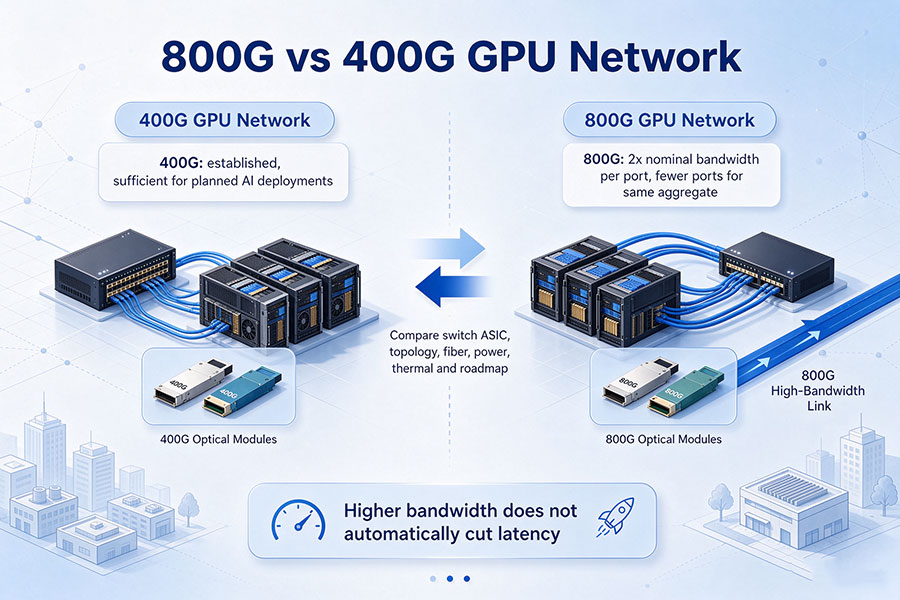
800G AI interconnects provide high-capacity connectivity for current-generation AI fabrics, while 1.6T interconnects double the nominal bandwidth per interface. This increase can support higher network capacity and port density, but it also introduces more demanding electrical signaling, optical transmission, thermal management, and system integration requirements.
The transition from 800G to 1.6T is therefore more than a simple speed upgrade. It changes how network ports, optical modules, switch platforms, and fiber infrastructure are designed and deployed.
1. What Are 800G and 1.6T AI Interconnects?
1.1 800G AI Interconnect
An 800G AI interconnect provides a nominal aggregate bandwidth of 800 Gbps per interface. It is used in high-performance data center networks to connect GPU servers, leaf switches, spine switches, and other high-bandwidth network equipment.
Common 800G optical transceiver platforms include OSFP and QSFP-DD. Depending on the optical interface, an 800G module may support short-reach multimode connections or longer-reach single-mode links.
Representative applications include:
GPU server-to-switch connectivity.
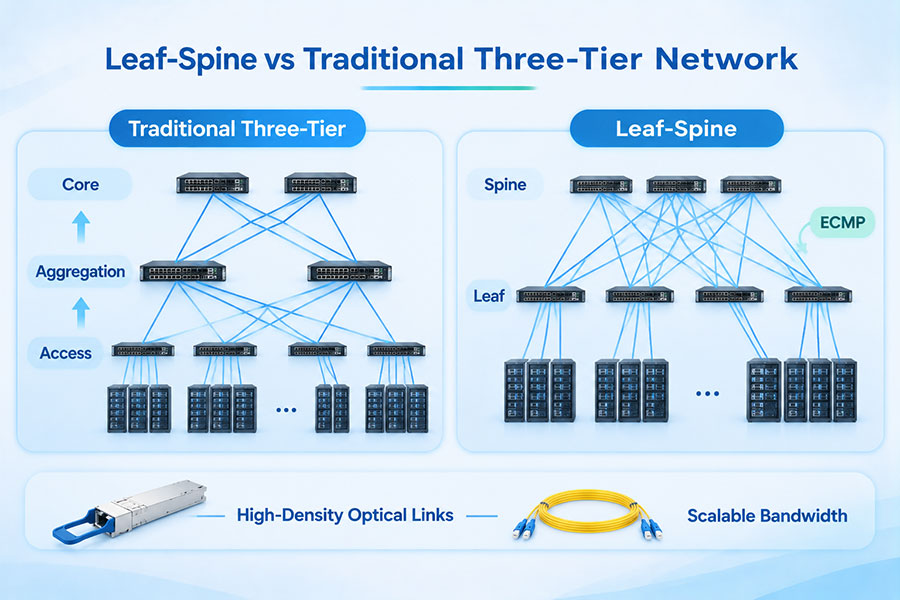
Leaf-to-spine connections in AI network fabrics.
High-bandwidth links between data center switching systems.
Interconnections supporting distributed AI training and large-scale inference.
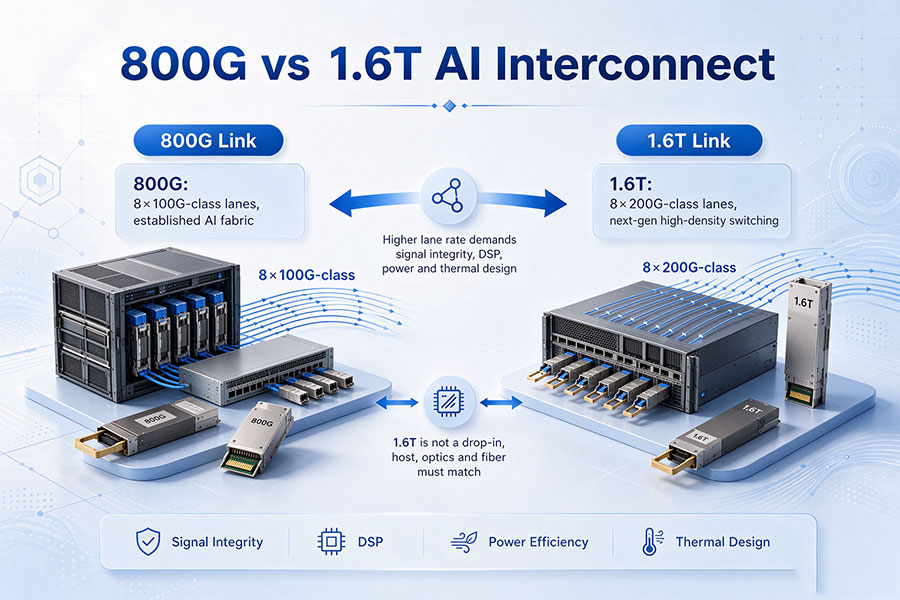
Many 800G client interfaces use eight 100G-class electrical lanes, although other lane arrangements and optical architectures are also available. The exact configuration depends on the module design and supported interface standard.
1.2 1.6T AI Interconnect
A 1.6T AI interconnect provides a nominal aggregate bandwidth of 1.6 Tbps, or 1,600 Gbps, per interface. It is designed for next-generation switching platforms and AI networks that need greater bandwidth per port.
Common 1.6T optical module development uses eight 200G-class lanes. This approach doubles the per-lane signaling rate compared with a conventional eight-lane 800G architecture. Other implementations may use different electrical or optical lane arrangements, so the complete product specification must always be checked.
1.6T connectivity is relevant to:
Next-generation AI spine and leaf switching systems.
High-density GPU cluster networks.
Large-scale data center fabrics requiring higher aggregate throughput.
Future network platforms designed around 200G-class SerDes technology.
2. 800G vs 1.6T AI Interconnect: Key Differences
| Comparison | 800G AI Interconnect | 1.6T AI Interconnect |
|---|---|---|
| Nominal bandwidth | 800 Gbps | 1.6 Tbps |
| Common electrical lane architecture | 8 × 100G-class lanes | 8 × 200G-class lanes |
| Signal rate generation | 100G-class SerDes | 200G-class SerDes |
| Optical module platforms | OSFP, QSFP-DD | Next-generation 1.6T platforms, including OSFP-related designs |
| Optical interfaces | SR8, DR4, FR4 and other implementations | DR8, DR8-2, 2×FR4 and other platform-specific implementations |
| Network capacity per port | 800 Gbps | 1,600 Gbps |
| Electrical signal integrity | Established 100G-class lane ecosystem | More demanding 200G-class lane requirements |
| Power and thermal design | High-density optical cooling requirements | More demanding module and system thermal design |
| Deployment maturity | Established in high-speed AI networking deployments | Emerging with next-generation switching platforms |
These are representative architectures rather than universal specifications. The optical interface, module form factor, lane mapping, and reach depend on the specific product and platform.
3. Bandwidth and Lane Architecture: 100G vs 200G per Lane
One of the most important differences between 800G and 1.6T AI interconnects is the signaling rate of their electrical lanes.
A common 800G architecture uses eight electrical lanes operating at approximately 100G-class signaling rates. A common 1.6T architecture doubles this to eight 200G-class lanes.
| Architecture | Lane Configuration | Aggregate Bandwidth |
|---|---|---|
| 800G | 8 × 100G-class | 800 Gbps |
| 1.6T | 8 × 200G-class | 1.6 Tbps |
Both generations commonly use PAM4 signaling. However, doubling the lane rate creates more demanding requirements for transmitter and receiver bandwidth, signal integrity, equalization, clock recovery, and DSP design.
At higher signaling rates, electrical channels become more sensitive to insertion loss, reflections, crosstalk, and connector performance. These challenges affect the design of switch ASICs, PCB traces, connectors, and optical modules.
For AI data centers, the move to 200G-class lanes is an important step toward supporting higher-capacity switching platforms without simply increasing the number of physical ports.
4. Optical Transceiver Architecture and Form Factors
4.1 800G Optical Transceiver Architecture
800G optical transceivers are available in different form factors and optical configurations. OSFP and QSFP-DD are widely used platforms, with specific implementations designed for different switch generations and port requirements.
Representative 800G optical interfaces include:
800G SR8: A short-reach multimode optical interface using parallel optical lanes.
800G DR8: A single-mode parallel optical interface designed for data center connections.
800G FR4: A single-mode interface using wavelength multiplexing for duplex-fiber connectivity.
Other 800G implementations: Additional optical and electrical configurations are available depending on the application and MSA design.
For product examples, see C-LIGHT's 800G QSFP-DD and 800G OSFP optical transceiver solutions.
4.2 1.6T Optical Transceiver Architecture
1.6T optical transceivers are designed to handle higher electrical and optical data rates. Their architecture must accommodate 200G-class signaling, more demanding signal integrity, and increased thermal requirements.
Representative 1.6T optical configurations include:
1.6T DR8: An eight-lane single-mode parallel optical interface. A representative implementation supports a reach of up to 500 meters, subject to the applicable specification.
1.6T 2×FR4: A wavelength-multiplexed architecture using two FR4 optical interfaces, with representative implementations supporting up to 2 km.
Other 1.6T designs: Module architecture and optical interface options depend on the relevant standards, MSAs, and host platform.
C-LIGHT's 1.6T OSFP-RHS platform is relevant to next-generation AI optical connectivity. The available DR8 and 2×FR4 configurations address different link requirements and should be selected according to the network topology and optical reach.
5. How 800G and 1.6T Affect AI Data Center Network Capacity
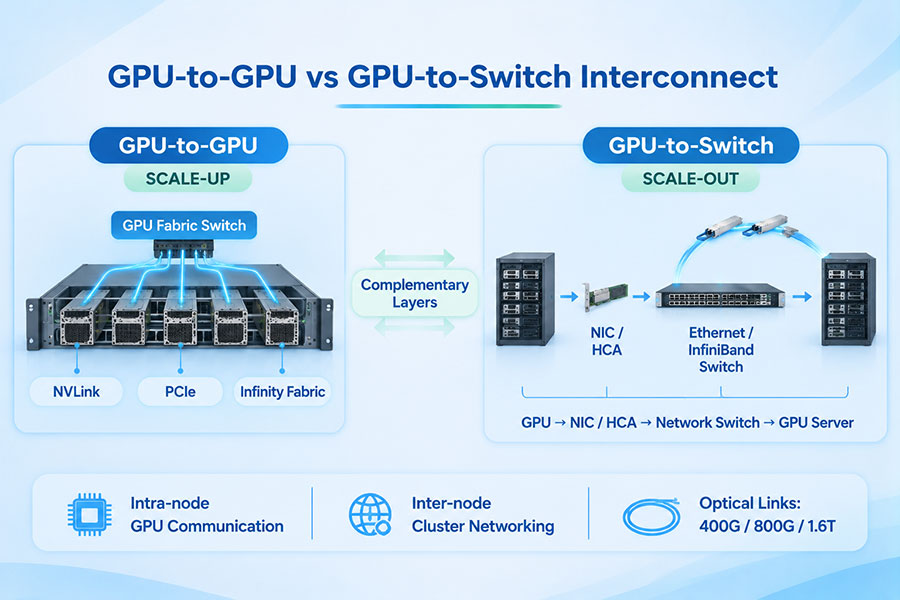
AI data center networks connect large numbers of GPUs and accelerators through high-speed switching fabrics. As the number of compute nodes increases, the network must provide enough bandwidth to support communication between GPUs, storage systems, and other resources.
Moving from 800G to 1.6T increases the bandwidth available per port. This can reduce the number of physical interfaces needed to deliver a given aggregate link capacity.
| Network Capacity Target | 800G Ports Required | 1.6T Ports Required |
|---|---|---|
| 6.4 Tbps | 8 | 4 |
| 12.8 Tbps | 16 | 8 |
| 25.6 Tbps | 32 | 16 |
| 51.2 Tbps | 64 | 32 |
The figures above are theoretical port-count comparisons based on nominal bandwidth, not complete switch-capacity or deployment calculations. Actual network design must account for port direction, switching capacity, oversubscription, redundancy, and the required number of links.
5.1 Higher Port Density
1.6T interfaces can provide twice the bandwidth per port compared with 800G. This creates opportunities to increase aggregate network capacity while using fewer physical ports for the same nominal bandwidth target.
For large AI clusters, reducing port count can help simplify cabling, port allocation, and parts of the switching architecture. However, the overall benefit depends on the switch ASIC, available port configuration, and network topology.
5.2 Supporting Larger GPU Clusters
GPU clusters generate substantial east-west traffic during distributed training and inference. Higher-capacity optical links can provide more bandwidth between network layers and help reduce potential network bottlenecks.
800G remains suitable for many high-performance AI fabrics. 1.6T becomes increasingly relevant when the switching platform and compute infrastructure require higher bandwidth per connection.
6. Power Consumption and Thermal Management
Power efficiency is a major consideration in AI data center design. Optical transceivers operate in dense switch environments, where thousands of modules may contribute to the total power and cooling requirements.
Moving from 800G to 1.6T increases the amount of data handled by each interface, but it does not guarantee that every 1.6T module consumes less power per transmitted bit.
Several factors influence module power consumption:
Electrical lane rate and signal-processing requirements.
DSP architecture and equalization complexity.
Laser technology and optical engine design.
Optical reach and transmission architecture.
Module packaging and thermal dissipation capability.
Host switch airflow and cooling design.
Higher-speed modules can create greater thermal challenges at the switch faceplate. The cooling system must maintain appropriate operating temperatures for both the optical modules and the switch hardware.
When comparing 800G and 1.6T solutions, network designers should evaluate total module power, power per gigabit, cooling requirements, and system-level energy efficiency rather than relying on bandwidth alone.
7. Signal Integrity and Electrical Interface Requirements
The transition to 1.6T places greater demands on electrical signal transmission between the switch ASIC and optical module. Higher lane rates increase sensitivity to electrical channel loss and other signal-integrity limitations.
Important design considerations include:
PCB channel quality: High-speed traces require careful control of insertion loss, impedance, and crosstalk.
Connector performance: Electrical connectors must support the required signal bandwidth.
SerDes capability: The switch ASIC must support the electrical lane rate required by the optical interface.
DSP and equalization: Signal-processing architecture must compensate for channel impairments within the available power and latency budget.
Thermal stability: Electrical and optical performance must remain within specification under operating temperatures.
These requirements mean that 1.6T adoption depends on the readiness of the entire platform, not only the availability of a compatible optical transceiver.
8. 800G vs 1.6T in Different AI Network Scenarios
| Application Scenario | 800G AI Interconnect | 1.6T AI Interconnect |
|---|---|---|
| GPU server connections | Suitable for many current high-bandwidth deployments | Relevant to next-generation platforms requiring greater bandwidth per connection |
| Leaf-to-spine links | Established high-capacity option | Can increase capacity per uplink when supported by the switching platform |
| Large GPU clusters | Supports scalable multi-tier network fabrics | Can help increase network capacity and reduce port requirements |
| Data center expansion | Suitable for existing 800G infrastructure | Suitable for new infrastructure designed around 1.6T switching |
| Network migration | Can remain part of a mixed-generation network | Requires coordinated host, module, and infrastructure upgrades |
8.1 When 800G Is a Practical Choice
800G is a practical option for AI data centers that already use compatible 800G switch platforms and need high-bandwidth optical connectivity. It offers a mature ecosystem of optical modules, fiber interfaces, and network components.
It is particularly suitable when:
The existing switch platform supports 800G ports.
The network architecture is already designed around 800G connectivity.
Current bandwidth requirements can be met without moving to 1.6T.
Operators want to expand capacity while maintaining compatibility with existing infrastructure.
8.2 When 1.6T Becomes More Relevant
1.6T is relevant when new AI network platforms require greater bandwidth per port and support 200G-class electrical signaling. It can be attractive for large-scale switching systems where port density, bandwidth aggregation, and network scalability are major design priorities.
It is particularly relevant when:
The switch ASIC supports 1.6T interfaces.
The platform provides the required 200G-class SerDes capability.
The network needs greater bandwidth per physical port.
The power and cooling infrastructure can support the new module generation.
The optical fiber plant and link architecture meet the required specifications.
9. Migration from 800G to 1.6T AI Interconnect
The migration from 800G to 1.6T requires coordination across the complete network system. Replacing an 800G optical module with a 1.6T module alone will not upgrade an existing 800G port to 1.6T.
A successful migration plan should consider the following areas:
Switch ASIC upgrade: Confirm that the switching platform supports 1.6T port operation and the required aggregate switching capacity.
Host electrical interface: Verify the availability of compatible 200G-class SerDes lanes and the corresponding signal-integrity design.
Optical module selection: Select the appropriate 1.6T form factor, optical interface, and transmission distance.
Fiber infrastructure: Check fiber type, connector configuration, polarity, and optical link budget.
Power and cooling: Evaluate module power consumption, airflow, and thermal limits.
Network configuration: Validate port profiles, FEC settings, link configuration, and device compatibility.
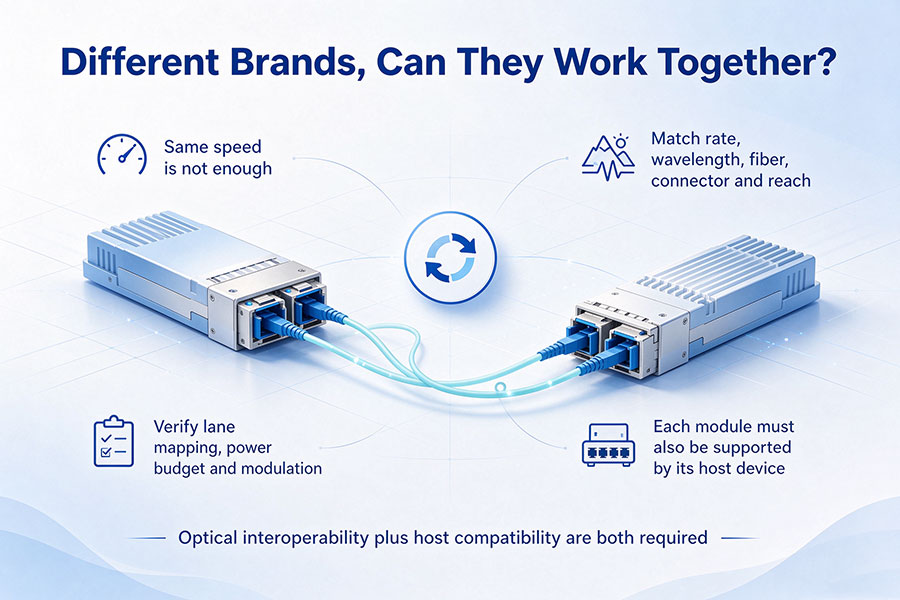
Interoperability testing: Test the complete link using the intended host equipment and optical modules.
During a transition period, 800G and 1.6T equipment may coexist within the same data center. However, this does not mean that every 800G module can connect directly to every 1.6T module. Mixed-generation connectivity requires a specifically supported interface or network architecture.
10. The Role of Optical Interconnects in Future AI Infrastructure
As AI computing continues to scale, network bandwidth, power efficiency, and physical connectivity become increasingly important. Optical interconnect technology will remain central to connecting high-performance compute systems and switching infrastructure.
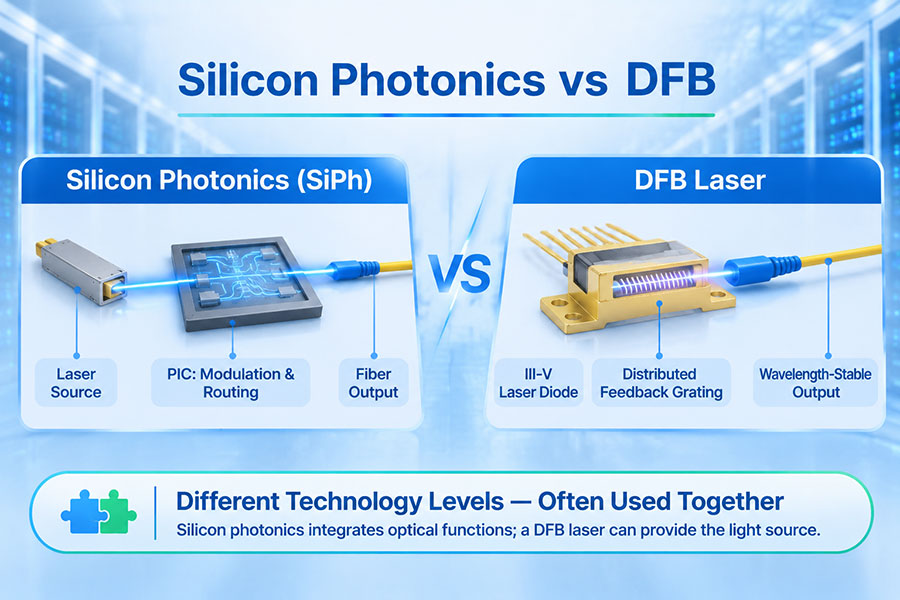
The development of 1.6T optical connectivity is part of a broader industry transition toward higher-speed electrical and optical interfaces. Silicon photonics, advanced DSP, improved laser technologies, and new packaging approaches are contributing to this evolution.
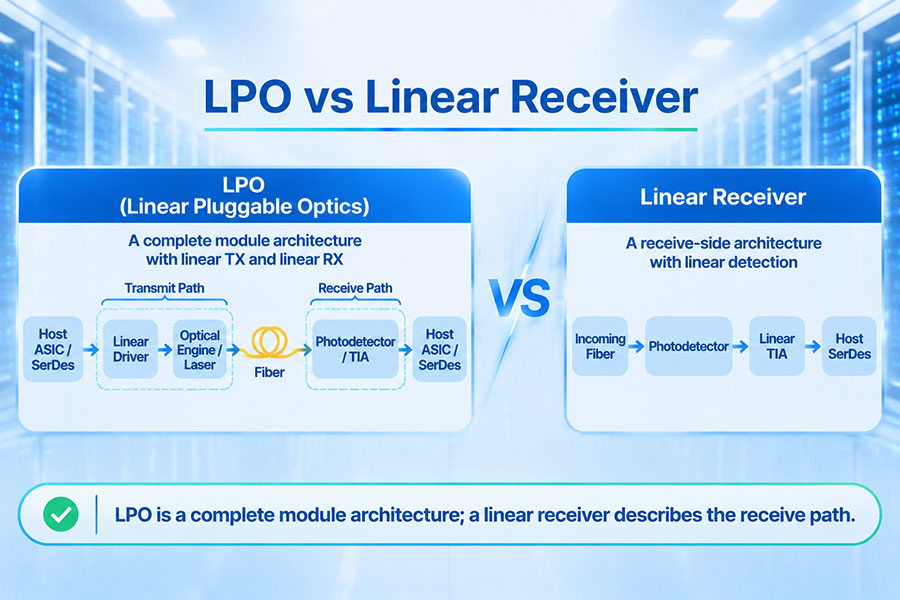
Technologies such as Linear Pluggable Optics (LPO), Linear Receive Optics (LRO), Near-Packaged Optics (NPO), and Co-Packaged Optics (CPO) are also being evaluated for different system architectures. These approaches address different trade-offs involving power consumption, signal integrity, reach, serviceability, and integration.
For AI infrastructure designers, the long-term objective is not simply to achieve a higher optical data rate. It is to build a balanced network in which compute performance, switching capacity, optical bandwidth, power consumption, and cooling requirements scale together.
11. Conclusion
800G and 1.6T AI interconnects represent two important stages in the development of high-bandwidth data center networking. 800G provides established connectivity for many current AI fabrics, while 1.6T offers twice the nominal bandwidth per interface and supports the development of higher-density switching platforms.
The transition introduces significant changes in electrical lane rates, optical module architecture, signal integrity, power consumption, and thermal management. Therefore, 1.6T is not simply a drop-in replacement for 800G. Its adoption requires compatible switch platforms, electrical interfaces, optical modules, and fiber infrastructure.
For network operators, the right choice depends on existing infrastructure, AI cluster scale, bandwidth requirements, and future expansion plans. A carefully planned transition can help data centers increase network capacity while maintaining reliable and scalable optical connectivity.
 >

 >
 >
 >
 >
 >
 >
 >