TEL:+86 132 6656 7067





As network bandwidth moves beyond 800G and toward 1.6T and higher-capacity switching platforms, the electrical connection between a switch ASIC and its optical interface is becoming increasingly difficult to manage. Higher signaling rates increase channel loss, equalization requirements, power consumption, and the complexity of board-level signal routing. These limitations are driving optical conversion closer to the switching silicon.
Near-Packaged Optics (NPO) and Co-Packaged Optics (CPO) address this challenge through different levels of optical integration. NPO positions optical engines near the host ASIC while retaining a separate assembly. CPO integrates optical engines much more closely with the ASIC package, enabling shorter electrical connections and higher potential bandwidth density.
The difference extends beyond physical placement. It affects electrical channel design, package construction, optical routing, thermal management, manufacturing yield, system maintenance, and multi-vendor interoperability. For high-speed networks, selecting between NPO and CPO requires evaluating the complete system rather than comparing optical modules in isolation.
1. Why High-Speed Networks Are Moving Optical Conversion Closer to the ASIC
1.1 The Limitations of Traditional Front-Panel Optics
In a conventional pluggable optical architecture, the switch ASIC communicates with optical transceivers installed at the front panel. High-speed electrical signals travel from the ASIC through package connections, PCB traces, connectors, and module interfaces before reaching the optical conversion circuitry.
This arrangement has several advantages. Front-panel transceivers are replaceable, support established form factors, and provide a mature multi-vendor ecosystem. However, as electrical lane rates increase, the channel between the ASIC and optical module becomes more challenging to design.
Longer electrical paths introduce insertion loss, reflections, crosstalk, and other signal-integrity concerns. The host and module may need more sophisticated equalization or retiming to maintain reliable operation. These functions consume power and increase system design complexity.
The physical distance between the switch ASIC and optical conversion point is therefore becoming a major design consideration for next-generation switching platforms.
1.2 The Shift Toward Near-Package and Co-Packaged Architectures
NPO and CPO reduce the length of the high-speed electrical connection by relocating optical engines closer to the switching silicon.
NPO: Moves the optical engine to the same board or a nearby high-density interconnect structure, outside the main ASIC package.
CPO: Integrates the optical engine within or directly alongside the ASIC package through a closely coupled package structure.
Both approaches aim to reduce electrical channel loss and improve bandwidth density. Their key difference is how far optical integration is taken and how much independence remains between the optical engine and the switching ASIC.
2. NPO and CPO Architecture: Different Levels of Integration
2.1 NPO Architecture
Near-Packaged Optics places optical engines close to the host ASIC but generally keeps them physically separate from the ASIC package. The electrical connection between the ASIC and optical engine is therefore much shorter than in a conventional front-panel pluggable design.
Depending on the system architecture, an NPO optical engine can be mounted directly on the PCB, installed on a high-density interconnect substrate, or attached through a dedicated socket or connector.
The optical engine performs electrical-to-optical and optical-to-electrical conversion. Optical fibers then carry signals between the engine and external network connections.
This arrangement reduces high-speed electrical routing distance without requiring the same degree of package-level integration as CPO. It can preserve more separation between the optical engine and switching silicon, offering additional flexibility in manufacturing, testing, and maintenance.
2.2 CPO Architecture
Co-Packaged Optics integrates optical engines much closer to the switching ASIC, typically within a common package or a tightly coupled package-level structure.
The ASIC and optical engines share a highly integrated physical environment. Electrical connections between the switching silicon and optical conversion circuitry can therefore be significantly shorter than those in NPO implementations.
This architecture is designed to support high aggregate bandwidth, dense optical interfaces, and lower electrical interconnect overhead. It is particularly relevant to systems where the number of high-speed optical connections and the power required to drive them become major architectural constraints.
However, CPO requires close coordination between ASIC packaging, photonic integration, optical coupling, fiber routing, thermal design, and manufacturing processes. It also changes the way optical components are tested, replaced, and maintained.
2.3 NPO-PCB, NPO-HDI, and Advanced CPO Packaging
NPO and CPO should not be treated as two completely uniform packaging designs. Industry architecture discussions distinguish several implementation types according to where the optical engine is placed and how it connects to the host ASIC.
| Architecture | Optical Engine Location | Typical Attachment | Key Design Characteristic |
|---|---|---|---|
| Front-panel pluggable optics | Front panel | Plug-in optical transceiver | Established replaceable module architecture. |
| NPO-PCB / OBO | On the host PCB, near the ASIC | Socketed or soldered | Shorter electrical routing while keeping optics outside the ASIC package. |
| NPO-HDI | On a high-density interconnect structure | Socketed or soldered | Higher-density board-level or near-package routing. |
| CPO with standard packaging | Within the common package environment | Package-level integration | Very short electrical paths and close integration. |
| CPO with advanced packaging | Advanced package or interposer structure | Advanced chip-to-chip or package-level connection | Higher potential integration density and more demanding assembly. |
The OIF's 2026 packaging comparison distinguishes NPO-PCB, NPO-HDI, standard CPO, and advanced CPO packaging. It also notes that some implementations close to the boundary between NPO-HDI and CPO may use different industry terminology. This is important because NPO and CPO do not yet represent one universally identical mechanical implementation across all suppliers.
3. Electrical Signal Path and Signal Integrity
3.1 Why Electrical Channel Length Matters
High-speed electrical signals are sensitive to the characteristics of the transmission channel. As data rates increase, the available signal margin becomes smaller and the impact of channel loss, impedance discontinuities, crosstalk, and reflections becomes more significant.
In a front-panel architecture, the electrical channel can include multiple PCB sections, connectors, module contacts, and internal module routing. Each transition can contribute to channel loss or signal degradation.
NPO reduces the distance between the ASIC and optical engine by moving the conversion point onto or closer to the system board. CPO takes this further by locating optical engines within the ASIC's package environment.
Shorter electrical paths can reduce the amount of compensation required and make higher-speed interface design more manageable. However, the final electrical performance still depends on the package, substrate, connector, routing materials, signal return paths, and transmitter and receiver design.
3.2 NPO: Board-Level Electrical Channel Optimization
In NPO systems, the electrical interface usually remains a short board-level or high-density interconnect channel. The design still needs to control trace geometry, impedance, insertion loss, crosstalk, connector transitions, and power integrity.
NPO-PCB and NPO-HDI implementations can have different electrical characteristics. High-density interconnect structures can support more compact routing, while board-level implementations may offer a different balance of cost, assembly complexity, and mechanical flexibility.
The optical engine's placement must also consider the ASIC pinout, high-speed escape routing, fiber connector position, and available board area.
3.3 CPO: Package-Level Electrical Integration
CPO minimizes the electrical distance between the ASIC and optical engine by using short package-level connections. Depending on the implementation, these connections can involve advanced substrates, interposers, die-to-die interfaces, fine-pitch bumps, or other high-density packaging technologies.
This creates an opportunity to reduce electrical channel loss and increase the density of connections around the switching silicon.
However, package-level integration introduces its own challenges. High-density connections require strict control of bump quality, substrate performance, alignment, thermal expansion, and assembly yield.
The shorter electrical path is an architectural advantage, but it does not remove the need for detailed signal-integrity and package-level validation.
3.4 The Importance of 200G-Per-Lane and Future Electrical Interfaces
The transition toward 200G-class lanes increases pressure on traditional electrical interconnects. Representative 200G-per-lane PAM4 signaling may operate at approximately 106.25 GBd, with the effective data rate depending on coding and protocol overhead.
Open CPX's September 2026 specification addresses near-package and co-packaged connectivity using electrical signaling up to 212.5 Gbps per lane toward the host ASIC. This demonstrates how packaging, connector design, and optical interfaces are being developed together to support the next generation of AI infrastructure.
For future 400G-class electrical lanes, the electrical channel budget, packaging density, and optical engine integration requirements may become even more demanding. This does not mean that every high-speed product must use CPO; the appropriate architecture depends on the actual channel budget and system design.
4. Power Efficiency: NPO and CPO Under System-Level Evaluation
4.1 Where Optical Interconnect Power Is Consumed
The power consumption of an optical interconnect system is distributed across several components:
ASIC SerDes and electrical transmit and receive circuits.
Retimers, DSPs, drivers, and transimpedance amplifiers where used.
Optical engines, lasers, photonic integrated circuits, and associated control circuits.
Power conversion, clocking, monitoring, and management functions.
Cooling infrastructure required to maintain acceptable operating temperatures.
A comparison based only on optical-engine power can therefore produce an incomplete result. A meaningful evaluation should include the host ASIC, electrical interface, optical components, and system cooling requirements.
4.2 NPO Power Characteristics
NPO can reduce electrical interconnect power because the channel between the ASIC and optical engine is shorter than in a traditional front-panel design. This can reduce the compensation requirements associated with a long electrical path.
At the same time, the optical engine remains a separate assembly with its own electronic and photonic components. The actual power savings depend on whether the implementation uses DSP-based processing, linear electrical interfaces, external laser sources, and other system-level design choices.
4.3 CPO Power Characteristics
CPO provides the potential for further electrical power reduction because the optical engine is integrated much closer to the switching silicon. The shorter electrical path can reduce the need for high-power signal compensation and support higher bandwidth density.
However, the optical engine operates in a package environment that also contains a high-performance ASIC. The heat generated by the switching silicon, laser architecture, photonic components, and surrounding circuitry must be managed together.
System-level power efficiency must therefore account for optical conversion, laser delivery, management electronics, and cooling. A shorter electrical channel does not automatically guarantee lower total system power in every implementation.
5. Thermal Management and Optical Engine Placement
5.1 Thermal Challenges in NPO Systems
NPO places optical engines close to the ASIC, which reduces electrical routing distance but also concentrates high-speed electronic and photonic components within a limited board area.
The system must provide adequate airflow or other cooling methods around the ASIC, optical engines, power components, and fiber interfaces. The position of optical engines should be evaluated against local temperature distribution and the thermal characteristics of the selected components.
Socketed and soldered NPO modules may also require different thermal and mechanical interface designs. Connector access, airflow restrictions, and replacement procedures should be considered during system development.
5.2 Thermal Challenges in CPO Systems
CPO brings optical engines into the same package environment as the switching ASIC. This creates a more integrated thermal design because the optical components are located close to a major heat-generating device.
Temperature variation can influence laser operation, photonic device characteristics, optical coupling, and long-term reliability. Package design must therefore consider heat spreading, thermal resistance, material selection, and operating temperature limits.
Depending on the system, liquid cooling may be considered to manage high thermal loads. However, cooling design must be evaluated for the complete package and switch system rather than treated as a simple add-on to the optical engine.
5.3 Internal and External Laser Architectures
Laser placement is an important part of both NPO and CPO system design.
Some implementations integrate the laser source within the optical engine or its module assembly. Others use external laser sources to separate the laser from the main optical engine environment.
External laser architectures can provide additional flexibility in thermal design and laser maintenance. However, they require optical connections, laser distribution, control interfaces, and additional system-level validation.
OIF has included External Laser Small Form-Factor Pluggable (ELSFP) management in its work on co-packaged optical solutions. Open CPX also specifies options for internal and external lasers, illustrating that laser placement is an architectural choice rather than a feature unique to one packaging category.
6. Serviceability, Reliability, and Manufacturing
6.1 NPO Serviceability Depends on the Attachment Method
NPO can preserve more serviceability than a tightly integrated CPO design, but this depends on the optical engine's mechanical attachment.
A socketed NPO engine can be designed for replacement without replacing the complete switch ASIC package. Nevertheless, access may require removing the relevant blade or system assembly. It should not automatically be treated as a front-panel hot-swappable module.
A soldered NPO optical engine is less independently replaceable. Repair may require board-level rework or replacement of the host assembly.
6.2 CPO Maintenance and System-Level Replacement
CPO creates a closer relationship between the optical engine and the switching ASIC. If an integrated optical component fails, replacing it may involve a larger package or board-level service operation.
This can increase the importance of manufacturing quality, package reliability, fault isolation, and pre-deployment testing.
Some CPO designs use external laser modules or other removable optical interfaces to improve the serviceability of specific components. However, a replaceable laser source does not necessarily make the co-packaged optical engine itself independently replaceable.
6.3 Manufacturing and Yield Considerations
NPO and CPO require different manufacturing processes and yield-management strategies.
NPO manufacturing focuses on board-level or high-density substrate assembly, optical alignment, connector attachment, electrical interface quality, and module-level testing.
CPO adds more tightly coupled package-level manufacturing steps. Optical engines, ASICs, substrates, interposers, and high-density connections must work together within the same package architecture.
As a result, failure in one integrated component can have a wider impact on the complete assembly. Manufacturing yield and test coverage become especially important when a system uses a large number of optical engines.
| Engineering Factor | NPO | CPO |
|---|---|---|
| Assembly level | Primarily board-level or near-package assembly | Package-level or closely integrated assembly |
| Optical engine testing | Can support separate module testing before system integration | Requires careful package-level and system-level test planning |
| Manufacturing focus | Board routing, connectors, optical alignment, module attachment | Advanced packaging, die-to-die connections, coupling, substrate yield |
| Failure isolation | Potentially more independent, depending on attachment design | More closely coupled to the ASIC package and system assembly |
| Repair approach | Socket or board replacement, depending on design | Often requires package or board-level service |
7. NPO vs CPO in AI Data Center Network Architectures
7.1 Scale-Out Networks
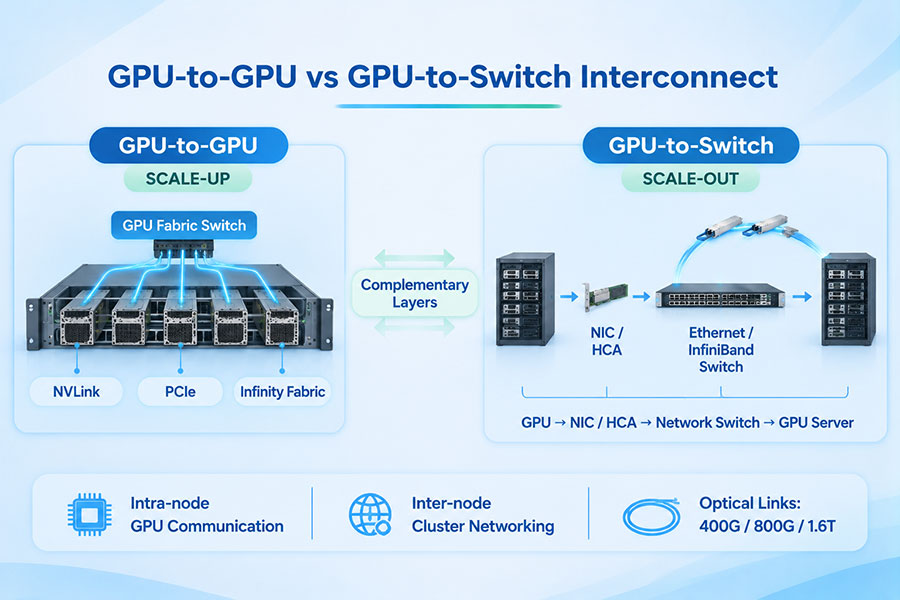
Scale-out networks connect servers, racks, and network switches across data center facilities. They commonly use Ethernet switching and high-speed optical links to move traffic between computing resources.
Front-panel pluggable optics remain attractive for many scale-out applications because they provide replaceability, mature management interfaces, and flexible sourcing. As switch bandwidth increases, however, the electrical connection between the ASIC and front-panel modules becomes more challenging.
NPO can help reduce this electrical distance while retaining more separation between optical engines and switching silicon. CPO may become relevant in systems where port density and electrical power requirements justify a higher level of integration.
7.2 Scale-Up Networks
Scale-up networks connect GPUs, accelerators, and other computing resources within tightly integrated systems. These networks can require large numbers of high-bandwidth connections with strict requirements for latency, link reliability, and energy efficiency.
As scale-up bandwidth increases, the electrical interconnect between accelerators and switches can become a major limitation. NPO and CPO provide alternative ways to move optical conversion closer to the computing silicon.
NPO may offer a useful balance when system designers need to shorten electrical paths while retaining more modularity. CPO can be attractive where high bandwidth density and electrical power reduction are more important than independent optical-engine replacement.
7.3 Scale-Across and Distributed AI Infrastructure
Scale-across networks connect computing resources across multiple data centers or geographically distributed facilities. These applications place greater emphasis on transmission reach, optical transport architecture, wavelength management, and coherent communication technologies.
NPO and CPO primarily address the placement of optical conversion within computing and switching systems. They do not replace the optical transport technologies required for longer-distance connections.
High-capacity DCI links may still use conventional pluggable coherent optics, DWDM systems, optical amplification, and other transport solutions according to the required reach and network topology.
8. NPO vs CPO: High-Speed Network Comparison
The following comparison summarizes the major architectural differences. Actual performance and implementation complexity depend on the specific ASIC, optical engine, package design, and network platform.
| Comparison Factor | NPO | CPO |
|---|---|---|
| Optical engine location | Near the ASIC, outside its main package | Within or directly coupled to the ASIC package |
| Electrical connection | Short board-level or HDI path | Very short package-level path |
| Signal integrity | Improved through reduced electrical routing distance | Further potential improvement through deeper integration |
| Bandwidth density | Higher than traditional front-panel architectures in suitable designs | Very high potential density around the ASIC package |
| Power efficiency | Can reduce electrical interconnect power | Can further reduce electrical interconnect power |
| Thermal design | Requires board-level thermal coordination | Requires close coordination with ASIC package cooling |
| Manufacturing | Board or HDI assembly and optical engine integration | Advanced package integration and optical coupling |
| Serviceability | Potentially higher, depending on socketed or soldered design | Generally more difficult at the optical-engine level |
| Upgrade flexibility | Can retain more module-level flexibility | More closely tied to the ASIC and package generation |
| System integration | High | Very high |
| Design priority | Balance between electrical performance and modularity | Maximum integration and bandwidth density |
9. Industry Standardization and Multi-Vendor Interoperability
9.1 Why Open Interfaces Matter
Traditional front-panel optical modules benefit from established form factors, electrical interfaces, management specifications, and multi-vendor sourcing practices. NPO and CPO introduce new mechanical, electrical, optical, and thermal interfaces that must be coordinated across multiple suppliers.
Without common interface definitions, system designers may face vendor-specific optical engines, connectors, management functions, and replacement procedures. This can increase integration risk and reduce supply-chain flexibility.
Open specifications and multi-source agreements are therefore important to the development of an interoperable optical-engine ecosystem.
9.2 Open CPX MSA
The Open CPX Multi-Source Agreement is one of the industry initiatives addressing near-package and co-packaged connectivity. Its specification covers connector and optical module requirements for high-density applications, including electrical, optical, mechanical, thermal, and management considerations.
In September 2026, Open CPX MSA announced the general availability of its specification for co-packaged and near-package connectors and optical modules. The release describes connectivity options up to 7.2 Tbps per socket based on 200 Gbps-per-lane signaling, with both internal and external laser options.
The specification also addresses pluggable module form factors, liquid-cooling-focused thermal requirements, and module management. These developments aim to support multi-vendor sourcing and reduce dependence on proprietary implementations.
Open CPX is an MSA specification, not proof that every NPO or CPO implementation is automatically interchangeable. Actual interoperability still depends on conformance, implementation details, host-system support, and qualification testing.
9.3 OIF and Other Industry Activities
OIF is working on electrical and optical interfaces, energy-efficient interconnects, compute optics, external laser sources, and co-packaging-related technologies.
Its 2026 industry demonstrations included Compute Optics Interface (COI), External Laser Small Form-Factor Pluggable (ELSFP), high-density connectivity, and near-package and co-packaged optical approaches.
These activities show that the ecosystem is developing multiple building blocks rather than relying on a single packaging architecture. Electrical interfaces, optical engines, lasers, connectors, management, and testing all need to evolve together.
10. NPO or CPO: How to Select the Right Architecture
There is no universal rule that NPO should always be selected before CPO or that CPO is automatically the better architecture. The decision depends on the bandwidth target, electrical channel budget, package design, thermal constraints, and operational requirements.
10.1 When NPO May Be the More Practical Choice
NPO may be suitable when a system requires shorter electrical channels but still benefits from separating the optical engine from the ASIC package.
It can be considered when:
The electrical channel from the ASIC to front-panel optics is becoming difficult to manage.
The design needs higher optical density without fully integrating optics into the ASIC package.
Module-level testing or replacement is an important operational consideration.
The platform needs flexibility in optical engine suppliers or attachment methods.
Board-level or HDI integration is compatible with the system's manufacturing and thermal design.
10.2 When CPO May Be the Better Architectural Fit
CPO may be more appropriate when the system has demanding bandwidth-density and electrical power requirements that justify package-level optical integration.
It can be considered when:
The electrical path between the ASIC and optical interface must be minimized.
The switching platform requires very high aggregate optical bandwidth.
Package-level integration can provide meaningful improvements in electrical performance.
The manufacturer can support advanced packaging, optical coupling, and integrated thermal management.
The operational model can accommodate more tightly integrated optical components.
10.3 A Practical Network Design Checklist
Before choosing an architecture, system designers should evaluate the following factors:
| Design Question | What to Evaluate |
|---|---|
| Bandwidth target | Aggregate switch bandwidth, port count, lane rate, and future scaling requirements. |
| Electrical channel | Insertion loss, return loss, crosstalk, routing distance, and signal margin. |
| Optical performance | Optical power budget, wavelength plan, fiber interface, coupling loss, and reach. |
| Power efficiency | ASIC SerDes, DSP, optical engine, laser, and cooling power. |
| Thermal design | Local temperature distribution, heat removal, airflow, and cooling interfaces. |
| Maintenance | Module replacement method, repair level, service access, and expected downtime. |
| Manufacturing | Assembly yield, package quality, optical alignment, and production scalability. |
| Interoperability | Electrical interfaces, optical specifications, connectors, control interfaces, and management. |
| Total cost | Component cost, system integration, cooling, testing, replacement, and lifecycle expenses. |
11. The Role of Pluggable Optics During the NPO and CPO Transition
NPO and CPO are expanding the available optical packaging options, but conventional pluggable optical transceivers remain important in high-speed networks.
Front-panel modules offer a mature ecosystem, established management approaches, straightforward replacement, and flexibility across different equipment platforms. They are useful where the electrical channel remains manageable and the system benefits from replaceable optical interfaces.
As an example of the established pluggable product ecosystem, C-LIGHT provides different high-speed product families, including 800G QSFP-DD, 800G OSFP, and 1.6T OSFP-RHS optical transceivers.
These product categories illustrate the continuing development of front-panel optical connectivity. They should not be confused with NPO or CPO optical engines, which use different physical placement and system integration models.
The transition will likely involve multiple architectures operating in parallel. Pluggable optics can serve applications where modularity and serviceability are priorities, while NPO and CPO address systems with increasingly demanding electrical and bandwidth-density requirements.
12. Future Outlook: Multiple Optical Architectures Will Coexist
The development of high-speed networks is unlikely to produce a single optical packaging architecture for every application. Network operators and system manufacturers have different requirements for bandwidth, electrical reach, cost, cooling, reliability, and serviceability.
NPO is attracting attention as a way to move optical conversion closer to the ASIC while retaining a degree of physical separation. This balance can be useful for systems that need higher bandwidth density without adopting the full complexity of package-level integration.
CPO is expected to remain an important direction for systems where electrical interconnect power and bandwidth density become major limitations. Its broader adoption will depend on package yield, thermal management, optical coupling, laser supply, reliability, and service models.
At the same time, silicon photonics, external laser sources, advanced connectors, high-density substrates, and common management specifications will influence how both architectures develop.
The most practical approach is to treat NPO and CPO as different system design options rather than mandatory stages in a single upgrade path. Their long-term roles will depend on the performance and operational requirements of each network generation.
Conclusion
Near-Packaged Optics and Co-Packaged Optics address the growing limitations of electrical interconnects in high-speed networks by moving optical conversion closer to switching and computing silicon.
NPO provides a balance between shorter electrical paths and a more independent optical-engine assembly. CPO takes integration further by placing optical engines within or directly alongside the ASIC package, creating opportunities for higher bandwidth density and lower electrical interconnect power.
The trade-offs involve more than signal integrity. Thermal design, optical coupling, manufacturing yield, maintenance, external laser architecture, and multi-vendor interoperability all influence the suitability of each approach.
For next-generation AI and data center networks, NPO and CPO are likely to coexist with conventional pluggable optics. The right architecture will be determined by the complete system's bandwidth, power, reliability, serviceability, and lifecycle requirements.
Frequently Asked Questions
Technical References
OIF – AI-Era Interoperability, Compute Optics Interface, and Co-Packaging Activities
TrendForce – Optical Interconnects and CPO/NPO Market Outlook, June 2026
NPO and CPO implementations differ across vendors. Architecture descriptions and performance characteristics should be checked against the relevant system, module, and interface specifications.
 >

 >
 >
 >
 >
 >
 >
 >