TEL:+86 132 6656 7067





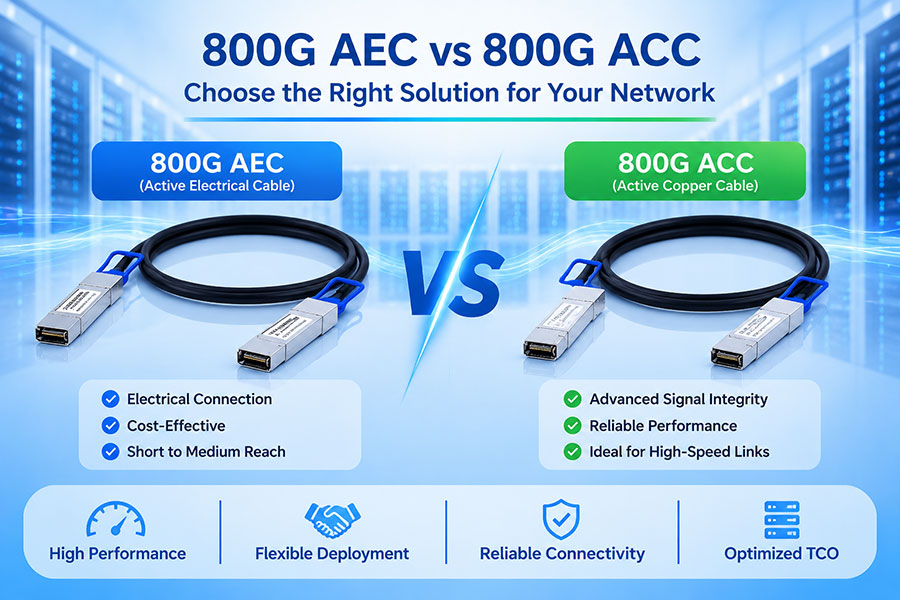
As 800G Ethernet and InfiniBand connectivity becomes increasingly important in AI data centers, copper interconnect technologies must deliver high bandwidth while maintaining signal integrity, power efficiency, and manageable thermal performance. Active Electrical Cables (AECs) and Active Copper Cables (ACCs) both use copper conductors with integrated active electronics, but their signal-conditioning architectures are different. AEC implementations commonly use retimers to recover and retransmit electrical signals, while ACC implementations typically rely on redrivers and active equalization to compensate for channel losses. These differences influence transmission reach, latency, power consumption, cable complexity, and deployment flexibility.
1. What Is an 800G AEC Cable?
An 800G Active Electrical Cable is a high-speed copper interconnect assembly with active signal-processing electronics integrated into its connectors. It is designed to support 800Gbps connectivity between compatible switches, servers, GPUs, and other network equipment.
Unlike passive Direct Attach Copper (DAC), which relies on the electrical characteristics of the copper channel without active signal regeneration, AEC incorporates active circuitry to improve signal quality. Many AEC implementations use retimers with clock and data recovery (CDR) functions.
A retimer receives an incoming electrical signal, recovers its clock and data information, and retransmits a newly conditioned signal. This process helps compensate for signal degradation caused by insertion loss, reflections, crosstalk, and other channel impairments.
Typical 800G AEC Characteristics
Uses twinaxial copper conductors for electrical signal transmission.
Integrates active electronics, commonly including retimers.
Performs clock and data recovery to improve signal integrity.
Supports copper connectivity beyond the practical reach of comparable passive DAC designs.
Requires electrical power for its active signal-processing circuitry.
Can be used for high-bandwidth server, switch, and AI infrastructure connections.
At 800G, the electrical channel is particularly challenging because the aggregate bandwidth is distributed across multiple high-speed electrical lanes. Retiming helps restore signal quality, making AEC a practical option for selected short-distance connections where passive copper cannot provide sufficient signal margin.
2. What Is an 800G ACC Cable?
An 800G Active Copper Cable is a copper-based high-speed interconnect that uses active analog signal-conditioning circuitry to compensate for electrical channel losses. Unlike a retimed AEC architecture, a typical ACC implementation uses redrivers or active equalization rather than full clock and data recovery.
A redriver receives an electrical signal and applies equalization or amplification to compensate for channel attenuation and frequency-dependent signal degradation. It improves the signal presented to the receiving side without necessarily recovering and regenerating the data using a retiming process.
Because ACC generally avoids the complete retiming process, its architecture can offer lower processing latency and potentially lower power consumption. However, its performance remains more dependent on the electrical channel characteristics and the quality of the original transmitted signal.
Typical 800G ACC Characteristics
Uses copper conductors as the transmission medium.
Integrates active analog signal-conditioning components.
Typically uses redrivers and equalization rather than full retiming.
Compensates for insertion loss and other channel impairments.
Can provide lower processing latency than a retimed AEC design.
Requires careful channel design and host-platform validation.
3. 800G AEC vs 800G ACC: Key Technical Differences
Both technologies use copper transmission and active electronics, but their internal signal-processing approaches are different. The main engineering distinction is whether the cable relies on retiming or primarily on analog equalization.
| Technical Aspect | 800G AEC | 800G ACC |
|---|---|---|
| Full Name | Active Electrical Cable | Active Copper Cable |
| Transmission Medium | Twinaxial copper | Twinaxial copper |
| Signal Type | Electrical | Electrical |
| Typical Signal Architecture | Retimer-based | Redriver-based |
| Clock and Data Recovery | Typically supported by retimer | Not normally performed by a conventional redriver |
| Signal Processing | Signal recovery and retransmission | Analog equalization and amplification |
| Signal Integrity | Can restore timing and signal quality | Compensates for channel loss while retaining the original signal timing characteristics |
| Latency | Includes retimer processing delay | Generally lower active-processing latency |
| Power Consumption | Generally higher for comparable designs | Potentially lower due to simpler signal processing |
| Channel Requirements | Can tolerate more challenging electrical channels within its qualified operating range | More dependent on the original channel signal quality |
| Transmission Reach | Typically supports longer copper reach than comparable ACC implementations | Generally intended for shorter copper channels |
| EMI Characteristics | Requires appropriate copper shielding | Requires appropriate copper shielding |
| Typical Application | Longer short-reach connections in AI and data center networks | Low-latency short-reach connections |
These characteristics describe common implementation approaches rather than universal specifications. The actual power, reach, latency, and signal-integrity performance depend on the selected retimer or redriver, cable construction, electrical lane rate, connector design, and host platform.
4. Retimer vs Redriver: How Signal Processing Works
The retimer-versus-redriver distinction is central to understanding the engineering differences between AEC and ACC. Both devices help compensate for electrical signal degradation, but they operate differently.
Retimer Architecture in AEC
A retimer uses clock and data recovery circuitry to identify the timing information embedded in an incoming high-speed serial signal. After recovering the data and clock, it retransmits the information with a newly generated electrical signal.
Receives an electrically degraded high-speed signal.
Performs clock recovery and data recovery.
Reconstructs the timing reference.
Transmits a conditioned signal toward the next channel segment.
Helps improve signal integrity across challenging copper channels.
This architecture is valuable when electrical channel loss and accumulated signal impairments make direct signal transmission difficult. The retimer effectively divides a challenging channel into manageable electrical segments.
Redriver Architecture in ACC
A redriver operates primarily in the analog domain. It uses equalization and amplification to compensate for frequency-dependent channel attenuation. Rather than fully recovering and regenerating the transmitted data, it improves the electrical waveform so that the receiving device can process it.
Receives the original electrical signal.
Applies equalization to compensate for channel loss.
Amplifies or conditions the signal.
Passes the conditioned waveform toward the receiver.
Avoids the full clock and data recovery process used by a retimer.
800G AEC: Retimer
Recovers clock and data information and retransmits a newly conditioned signal. This provides stronger signal recovery for demanding electrical channels, with additional processing complexity and latency.
800G ACC: Redriver
Uses analog equalization and amplification to compensate for channel loss. Its simpler processing path can reduce latency and power requirements, provided the electrical channel remains within the supported operating limits.
5. Transmission Distance and Electrical Channel Loss
Transmission distance is one of the most important factors when selecting an 800G active copper cable. At high data rates, electrical signals experience frequency-dependent attenuation, impedance discontinuities, reflections, and crosstalk. These impairments become increasingly significant as cable length increases.
AEC uses retiming to recover the signal before retransmission. This can support more challenging copper channels than a conventional redriver-based approach. ACC relies primarily on equalization, so its operating distance is more closely tied to the remaining signal quality at the redriver input.
| Distance Consideration | 800G AEC | 800G ACC |
|---|---|---|
| Very Short Connections | Supported | Supported |
| Short In-Rack Links | Suitable | Suitable when channel loss is within specification |
| Longer Copper Links | Generally more suitable | More constrained by electrical channel loss |
| Signal Recovery | Retiming can restore timing and data quality | Equalization compensates for signal attenuation |
| Maximum Reach | Depends on retimer, cable, and platform qualification | Depends on redriver performance and channel qualification |
There is no universal maximum distance for every 800G AEC or ACC product. Different electrical lane rates, cable gauges, shielding structures, active chipsets, and host interfaces produce different results. The qualified cable length stated in the manufacturer's datasheet should always be used for system design.
When a connection exceeds the supported reach of both active copper options, an optical interconnect such as an 800G AOC or a pair of compatible optical transceivers with fiber may be more appropriate.
6. Power Consumption and Thermal Performance
Power efficiency is particularly important in large AI data centers, where thousands of high-speed connections can contribute to the overall infrastructure power budget. The active circuitry inside an AEC or ACC consumes power and generates heat near the host ports.
800G AEC Power Characteristics
AEC commonly uses retimer circuitry to recover and retransmit high-speed signals. The additional clock recovery, data recovery, and signal-processing functions can increase the power requirements compared with simpler redriver-based architectures.
Power consumption varies according to the retimer chipset, electrical lane configuration, cable length, operating temperature, and product design. Engineers should review the maximum power specification rather than relying only on typical values.
800G ACC Power Characteristics
ACC generally uses simpler active equalization circuitry. Without the full retiming process, a redriver-based implementation can offer lower power consumption than a comparable retimer-based AEC.
However, the actual power advantage depends on the number of active components, equalization requirements, operating conditions, and cable architecture. An ACC design with demanding equalization requirements may not always achieve the same power advantage as a simpler implementation.
| Power Factor | 800G AEC | 800G ACC |
|---|---|---|
| Active Component | Retimer and associated circuitry | Redriver and equalization circuitry |
| Processing Complexity | Generally higher | Generally lower |
| Relative Power | Generally higher for comparable designs | Potentially lower |
| Thermal Sources | Retimer and active electronics | Redriver and active electronics |
| Deployment Consideration | Evaluate retimer power and connector temperature | Evaluate equalization power and connector temperature |
For high-density 800G switch deployments, thermal evaluation should include port-level power limits, airflow, connector temperature, cable bundling, and cumulative active-cable power.
7. Latency and Signal Integrity in AI Networks
Latency is an important consideration in AI training clusters and high-performance computing environments. GPU communication can involve frequent synchronization and large data exchanges, making the performance of every network component relevant.
The difference between AEC and ACC is partly related to their signal-processing architectures.
AEC Latency
AEC retimers recover clock and data information before retransmitting the signal. This process introduces retimer processing latency. However, it also provides signal regeneration that can improve the reliability of high-speed electrical transmission across a challenging channel.
ACC Latency
ACC redrivers condition the analog electrical signal without performing the full clock and data recovery process. This generally results in lower additional processing latency than a retimed implementation.
Nevertheless, lower cable processing latency does not automatically translate into lower application-level latency. Switch ASICs, NICs, network protocols, congestion control, and application communication patterns all influence end-to-end performance.
| Performance Factor | 800G AEC | 800G ACC |
|---|---|---|
| Signal Processing | Clock and data recovery | Analog equalization |
| Processing Latency | Includes retiming delay | Generally lower |
| Signal Regeneration | Yes, in retimer-based implementations | Not equivalent to full retimer regeneration |
| Electrical Channel Tolerance | Generally stronger within qualified limits | More dependent on the original channel quality |
8. Applications in AI Data Centers and 800G Networks
AI data center networks require high-bandwidth connections between GPU servers, top-of-rack switches, leaf-spine switches, and other infrastructure. The appropriate cable depends on the network topology, physical distance, power budget, and signal-integrity requirements.
Where 800G AEC Is Used
GPU server connectivity: Short-distance electrical connections between GPU servers and compatible switches.
Adjacent-rack connections: Copper connections where the cable length exceeds passive DAC capability but remains within the qualified AEC reach.
High-bandwidth switch connections: Applications requiring retiming to maintain signal integrity.
AI training infrastructure: Selected high-speed electrical connections in Ethernet and InfiniBand environments.
Where 800G ACC Is Used
Short-reach switch connections: Connections where the electrical channel is suitable for redriver-based signal conditioning.
Low-latency interconnects: Applications where minimizing additional signal-processing delay is important.
Power-sensitive deployments: Connections where a lower-power active architecture is beneficial.
Compact rack configurations: Short copper links with manageable insertion loss and signal-integrity requirements.
Both AEC and ACC can be considered for 800G Ethernet or InfiniBand deployments when their electrical interfaces, form factors, lane configurations, and host compatibility requirements are satisfied.
9. How to Choose Between 800G AEC and 800G ACC
Selecting between AEC and ACC requires evaluating the actual electrical channel rather than focusing only on the advertised bandwidth. Both solutions support high-speed copper connectivity, but they address different signal-integrity and system-level requirements.
| Selection Factor | Choose 800G AEC When... | Choose 800G ACC When... |
|---|---|---|
| Transmission Distance | The copper link needs stronger signal recovery over a challenging channel. | The connection is short enough for the redriver-based architecture. |
| Signal Integrity | Clock and data recovery is required to manage channel impairments. | Analog equalization provides sufficient signal quality. |
| Latency | Retiming latency is acceptable. | Lower additional signal-processing latency is a priority. |
| Power Consumption | The additional retimer power is acceptable for the required link performance. | A lower-power active architecture is preferred. |
| Network Architecture | Longer short-reach copper connections are required. | Compact short-reach connections are required. |
| Deployment | AI infrastructure requires stronger electrical signal recovery. | The host channel supports redriver-based signal conditioning. |
Compatibility Checklist Before Ordering
Confirm the switch and server port form factors, such as OSFP or QSFP-DD.
Verify the required 800G Ethernet or InfiniBand protocol.
Confirm the electrical lane configuration and supported data rate.
For AEC, verify the retimer architecture and supported host platform.
For ACC, verify redriver specifications and channel equalization requirements.
Confirm cable length and qualified transmission distance.
Check EEPROM coding, device recognition, and vendor compatibility.
Review power consumption, port power limits, temperature, and airflow.
Confirm the cable assembly meets the system's signal-integrity requirements.
10. 800G AEC and ACC in the Context of DAC and AOC
AEC and ACC are part of a broader family of high-speed copper interconnect technologies. Understanding their position alongside DAC and AOC helps network engineers select the appropriate solution for different physical connection requirements.
| Technology | Transmission Medium | Active Components | Main Characteristic |
|---|---|---|---|
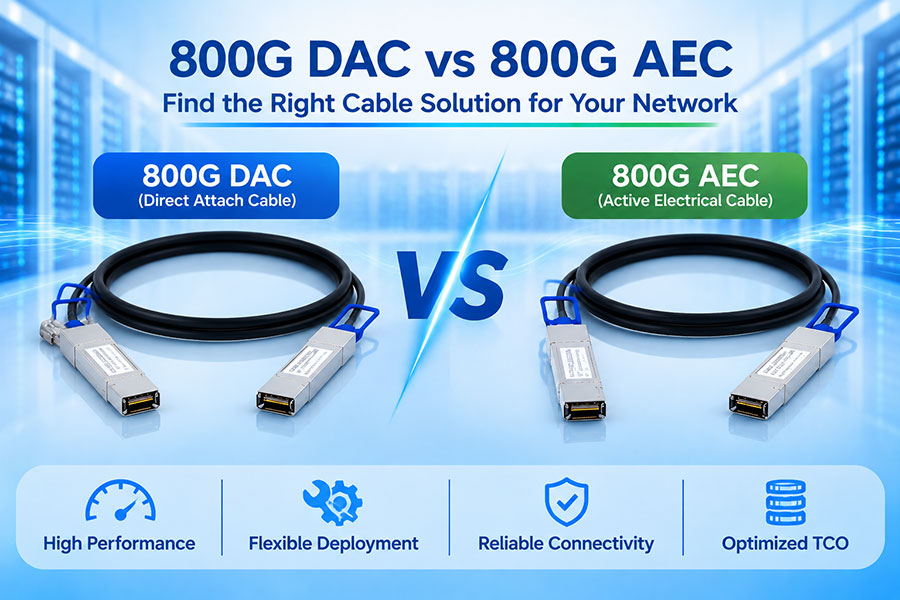
| DAC | Copper | None in the cable signal path | Simple passive electrical connection |
| ACC | Copper | Redriver / equalizer | Active analog signal conditioning |
| AEC | Copper | Retimer | Clock and data recovery with signal retransmission |
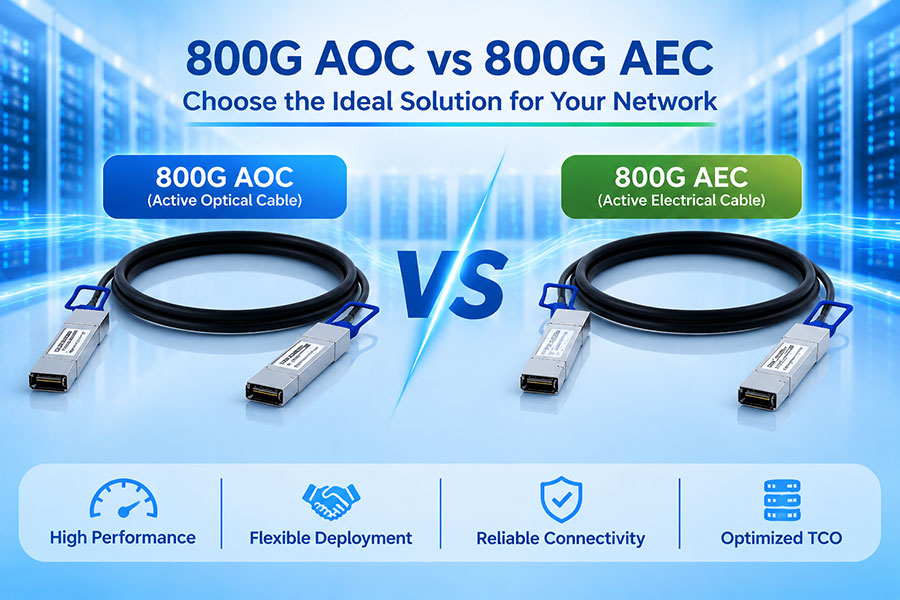
| AOC | Optical fiber | Optical transmitters and receivers | Optical transmission for longer connections |
In practical deployments, passive DAC is often considered first for very short and cost-sensitive links. ACC and AEC provide active copper alternatives when additional signal conditioning is necessary. AOC is more suitable when the distance or electromagnetic environment favors optical transmission.
11. C-LIGHT 800G Active Copper Connectivity Solutions
As AI computing infrastructure moves toward higher port speeds and greater network density, 800G active copper connectivity is becoming an important part of high-performance data center cabling. Choosing between AEC and ACC requires matching the cable architecture with the electrical channel, equipment platform, and deployment requirements.
C-LIGHT 800G AEC Cable
The C-LIGHT 800G AEC Cable provides active copper connectivity for high-bandwidth connections between compatible switches, servers, and AI infrastructure.
Its retimer-based architecture is suitable for applications requiring active electrical signal recovery beyond the practical reach of comparable passive DAC solutions. It can be considered for short-distance 800G Ethernet and InfiniBand connections, subject to host-platform compatibility and cable qualification.
C-LIGHT also provides high-speed interconnect options for different data center deployment requirements, including DAC, AEC, and AOC solutions.
800G ACC Cable Development and Configuration
ACC solutions can provide an alternative for short-reach copper connectivity where redriver-based signal conditioning meets the required electrical channel specifications.
When evaluating an 800G ACC solution, important parameters include redriver performance, insertion loss, equalization capability, power consumption, connector configuration, and host compatibility.
Contact C-LIGHT to discuss 800G active copper interconnect requirements, interface configurations, and potential project specifications.
For additional high-speed copper and optical interconnect options, visit the C-LIGHT AOC and DAC product category.
12. Conclusion: AEC or ACC for 800G Connectivity?
800G AEC and 800G ACC both use active copper technology, but their signal-conditioning architectures create important differences in performance and application. AEC commonly incorporates retimers that recover clock and data information before retransmitting the signal, making it suitable for more demanding electrical channels. ACC typically uses redrivers and active equalization to compensate for signal loss without full retiming, offering the potential for lower processing latency and power consumption.
AEC is generally more appropriate when stronger signal recovery and additional copper reach are important. ACC is worth considering when the electrical channel remains within the redriver's supported limits and lower processing complexity is a priority.
For AI data centers, GPU clusters, and 800G Ethernet or InfiniBand networks, the final decision should be based on actual cable specifications, signal-integrity measurements, power budgets, and equipment compatibility. A well-designed network may use DAC, ACC, AEC, and AOC together to achieve the right balance of performance, efficiency, and deployment cost.
Looking for 800G Active Copper Connectivity?
C-LIGHT provides high-speed data center interconnect solutions, including 800G AEC, DAC, AOC, and other connectivity options. Contact our engineering team to discuss interface configurations, equipment compatibility, cable specifications, and project requirements.
Contact C-LIGHT >

 >
 >
 >
 >
 >
 >
 >