TEL:+86 132 6656 7067





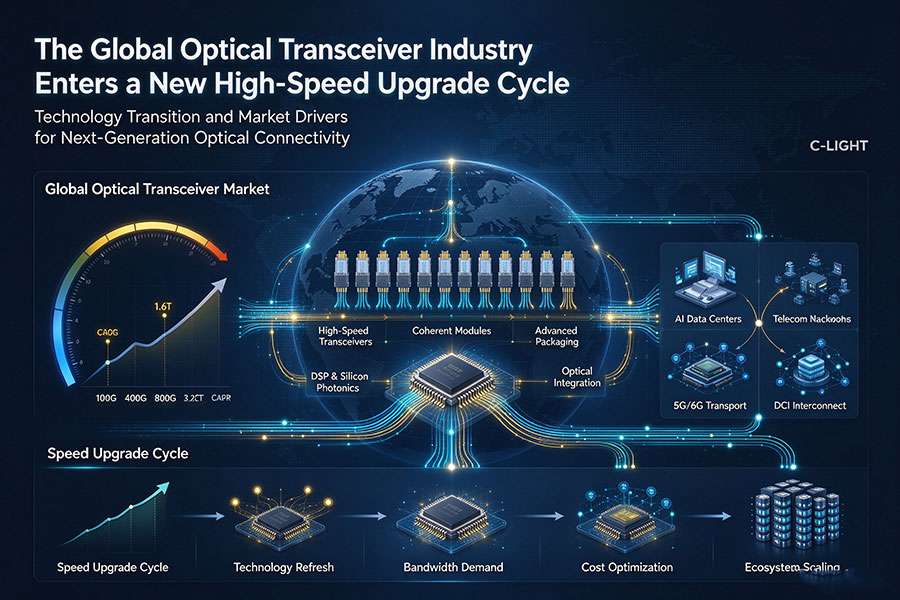
The global optical transceiver market is entering a major development phase as artificial intelligence infrastructure, hyperscale data centers, cloud computing, and high-capacity telecommunications networks reshape demand for optical connectivity. The transition from 400G to 800G, the commercialization of 1.6T modules, and the development of silicon photonics and advanced optical packaging are changing both the technical requirements and competitive structure of the industry.
Between 2026 and 2030, the market is expected to experience more than a conventional product upgrade cycle. Optical transceivers are becoming increasingly important to the performance, scalability, power efficiency, and cost structure of modern computing and communication infrastructure. At the same time, demand will continue across traditional Ethernet, enterprise networking, telecom transport, fiber access, and data center interconnect applications.
This outlook examines the market's major growth drivers, product segments, regional opportunities, technology transitions, supply-chain developments, and business challenges from 2026 through 2030.
1. Global Optical Transceiver Market Overview
1.1 Market Size and Growth Outlook
Optical transceivers convert electrical signals into optical signals for transmission through fiber and convert received optical signals back into electrical signals. They are essential components in data centers, enterprise networks, telecommunications infrastructure, cloud platforms, and high-capacity optical transport systems.
Published market estimates indicate a substantial growth opportunity over the coming years. Grand View Research estimated the global optical transceiver market at approximately USD 15.4 billion in 2025 and USD 17.4 billion in 2026, with a projected compound annual growth rate of 11.3% from 2026 to 2033.
However, market-size estimates should be interpreted carefully. Research providers may use different definitions of optical transceivers, including different combinations of Ethernet modules, telecom optics, coherent products, and other optical communication components. These figures are therefore not necessarily directly comparable.
| Market Indicator | Reference Data | Market Implication |
|---|---|---|
| 2025 global optical transceiver market | Approximately USD 15.4 billion | Establishes the baseline for the broader transceiver market estimate. |
| 2026 global optical transceiver market | Approximately USD 17.4 billion | Reflects continued demand from data centers, telecom networks, and enterprise infrastructure. |
| 2026–2033 projected CAGR | 11.3% | Indicates sustained long-term market expansion under the research provider's market definition. |
| 2026 Ethernet transceiver growth | 65% forecast by LightCounting | Highlights the exceptional growth of data center Ethernet optics during the AI infrastructure investment cycle. |
The global market estimates and Ethernet growth forecast above come from different research providers and cover different market categories. They should not be combined into a single market-size calculation.
The distinction between the broader optical transceiver market and the AI-focused segment is particularly important. TrendForce, for example, projected the AI-focused optical transceiver market to reach USD 26 billion in 2026, compared with USD 16.5 billion in 2025. This is a separate market definition and should not be treated as directly equivalent to the broader optical transceiver market estimate.
1.2 The Market Is Moving from General Network Expansion to Bandwidth-Density Upgrades
Historically, optical transceiver demand was closely connected to telecom network construction, enterprise network upgrades, broadband expansion, and cloud data center growth. These applications remain important, but AI infrastructure has introduced a new source of demand with different performance requirements.
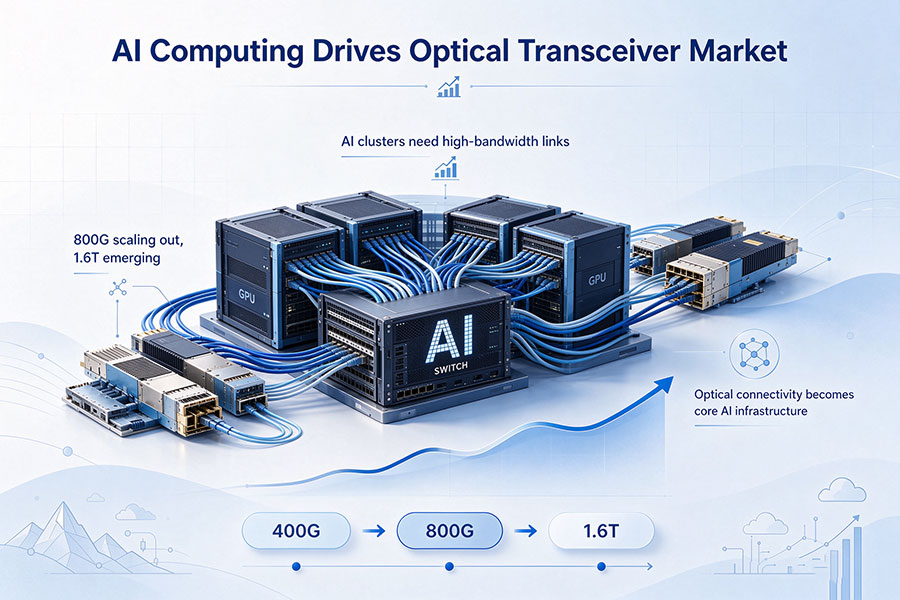
Large AI clusters connect thousands of GPUs and other accelerators through high-speed switching systems. Their network infrastructure must support substantial east-west traffic, high aggregate bandwidth, predictable latency, and increasingly dense optical connections.
As a result, market growth is becoming more concentrated in high-speed products. The commercial importance of 400G, 800G, and 1.6T modules is increasing, while traditional 10G, 25G, 40G, and 100G products continue to serve established network applications and replacement markets.
2. Major Drivers of Optical Transceiver Market Growth
2.1 AI Data Centers and GPU Cluster Expansion
AI training and inference workloads require large numbers of processors to exchange data through high-performance networks. As GPU clusters grow, network bandwidth becomes a critical factor in overall system performance.
Optical transceivers support connections between servers, switches, racks, and distributed data center facilities. Their importance increases as electrical connections encounter limitations related to transmission distance, signal integrity, power consumption, and routing density.
Several developments are strengthening optical demand:
Increasing numbers of GPUs and AI accelerators in hyperscale facilities.
Higher switch bandwidth and greater network port density.
More extensive use of high-speed optical connections between racks and network tiers.
Growing requirements for optical links between geographically distributed AI facilities.
Higher bandwidth per fiber and improved power efficiency.
These requirements are supporting the adoption of 800G and 1.6T optical transceivers, together with active optical cables and other optical interconnect solutions.
2.2 Hyperscale Cloud and Data Center Infrastructure
Cloud service providers continue to expand computing capacity, storage infrastructure, and network connectivity. Large data centers require high port counts and flexible network architectures that can accommodate increasing traffic without repeatedly rebuilding their physical infrastructure.
The transition to higher-speed Ethernet allows operators to increase network capacity while managing switch-port availability, cabling density, and infrastructure costs.
Demand is therefore supported by both new data center construction and upgrades to existing facilities. These two sources of demand can follow different investment cycles, making the overall market broader than AI-related deployments alone.
2.3 Data Center Interconnect and Distributed Computing
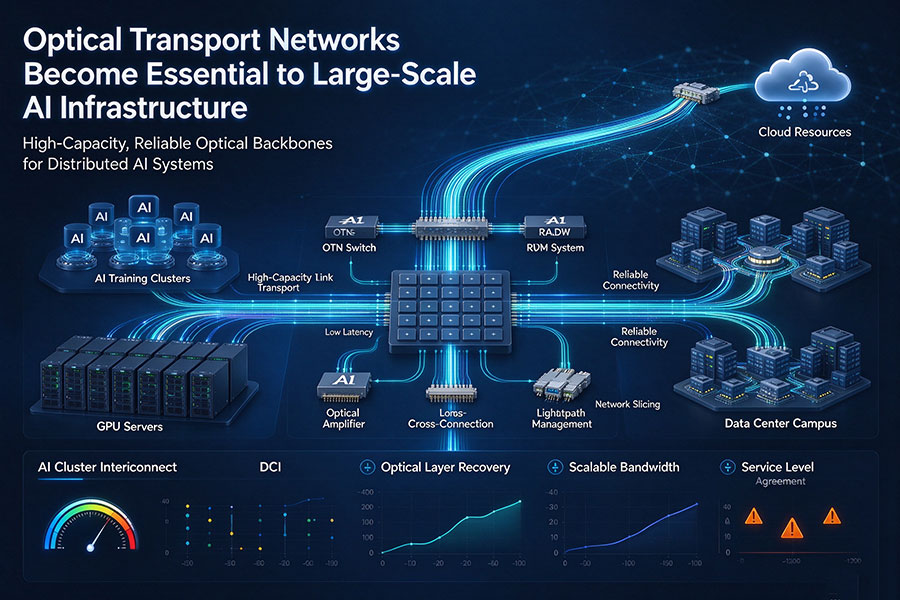
AI and cloud workloads are increasingly distributed across multiple buildings, campuses, and geographic locations. Data center interconnect (DCI) networks provide the high-capacity links required to connect these facilities.
Traditional short-reach Ethernet optics are not sufficient for every DCI application. Longer-distance connections require technologies such as coherent optical transceivers, DWDM systems, optical amplification, and appropriate fiber infrastructure.
Pluggable coherent modules such as 400ZR and 800ZR are helping bring high-capacity optical transport capabilities closer to router and switch platforms. Future 1.6T coherent solutions may further expand the capacity of distributed computing networks as their technical and commercial maturity improves.
2.4 5G, Fiber Access, and Telecom Network Modernization
Although AI data centers are receiving considerable attention, telecommunications remains an important part of the optical transceiver market.
Mobile backhaul, fronthaul, metro transport, fiber-to-the-home, and broadband access networks continue to require optical modules across different speeds and transmission distances.
Network modernization creates demand for 10G, 25G, 50G, 100G, and higher-speed optical interfaces, depending on network architecture and deployment requirements. In the longer term, 50G PON deployments and the preparation of transport infrastructure for future mobile generations may support additional demand.
2.5 Higher Network Capacity and Fiber Efficiency
Network operators increasingly seek to improve the amount of traffic transmitted over existing fiber infrastructure. Wavelength division multiplexing technologies, including CWDM and DWDM, allow multiple optical channels to share a fiber pair or fiber infrastructure.
These technologies are particularly relevant to metro networks, long-haul transport, telecom backbones, and DCI applications where installing new fiber may be expensive or operationally difficult.
3. Optical Transceiver Market Segmentation by Data Rate
Data rate is one of the most important factors shaping product demand, manufacturing requirements, and pricing. The market is gradually shifting toward higher-speed modules, but different generations will coexist throughout the forecast period.
| Data Rate | Typical Form Factors | Major Applications | Market Position |
|---|---|---|---|
| 10G–25G | SFP+, SFP28 | Enterprise networks, access networks, telecom infrastructure | Established market with replacement and infrastructure demand. |
| 40G–100G | QSFP+, QSFP28 | Enterprise aggregation, legacy data centers, telecom networks | Continued deployment in installed infrastructure and cost-sensitive applications. |
| 200G–400G | QSFP56, QSFP-DD, OSFP | Data center switching, cloud networks, high-capacity transport | Important capacity tier for current-generation networks. |
| 800G | QSFP-DD, OSFP | AI clusters, hyperscale data centers, high-performance Ethernet | Major growth segment during the 2026–2028 transition. |
| 1.6T | OSFP and emerging platform designs | Next-generation AI networks and high-density switching | Commercial expansion expected during the forecast period. |
| 3.2T | Future-generation optical interfaces | Future high-capacity AI and data center networks | Emerging development area toward the end of the decade. |
3.1 The Continuing Role of 400G Optical Transceivers
400G modules remain important because they provide a balance between bandwidth, power consumption, reach, and deployment cost. They are used in data center switching, enterprise network aggregation, and various high-capacity network applications.
Common product configurations include 400G QSFP-DD and 400G OSFP modules. Depending on the optical interface, available implementations may include SR8, DR4, FR4, LR4, and other application-specific designs.
400G products will not disappear when 800G adoption increases. Existing switch platforms, network upgrade schedules, and different bandwidth requirements will support continued demand for 400G modules throughout much of the 2026–2030 period.
For product information, see C-LIGHT 400G QSFP-DD Optical Transceivers and 400G OSFP Optical Transceivers.
3.2 800G as a Major Market Growth Segment
800G is becoming a key optical interface generation for large-scale AI and hyperscale data center networks. It doubles the aggregate bandwidth of 400G while supporting higher-capacity switch architectures and increasingly demanding network connections.
The 800G product ecosystem includes QSFP-DD and OSFP form factors, with different optical interfaces designed for different distances and fiber configurations.
Examples include:
800G SR8 for short-reach multimode fiber applications.
800G DR8 for parallel single-mode fiber connections.
800G 2×FR4 and other wavelength-multiplexed configurations for selected single-mode fiber applications.
800G coherent and ZR/ZR+ solutions for appropriate DCI and optical transport environments.
Not every 800G module has the same transmission distance, optical architecture, or host compatibility. Product selection must be based on the actual interface specification and network requirements.
For more information, see 800G QSFP-DD and 800G OSFP optical transceivers.
3.3 1.6T Optical Transceivers and the Next Upgrade Cycle
1.6T optical transceivers represent the next major bandwidth step for high-performance data center networks. Their development is closely related to next-generation switch ASICs, higher-speed SerDes interfaces, advanced modulation, and improved optical integration.
One important implementation approach uses eight 200G-class optical lanes to provide an aggregate bandwidth of 1.6T. Other interface architectures may also be developed depending on platform requirements and industry standardization.
The 1.6T generation introduces additional engineering challenges:
Higher electrical signaling speeds and more demanding signal-integrity requirements.
Increased optical alignment and packaging precision.
More demanding thermal management and power budgets.
Advanced DSP, laser, photonic integration, and high-speed electrical components.
Host-platform compatibility and manufacturing yield requirements.
The transition will not happen uniformly across all network environments. Large AI data centers are likely to lead initial deployment, while broader adoption will depend on platform availability, power efficiency, pricing, and interoperability validation.
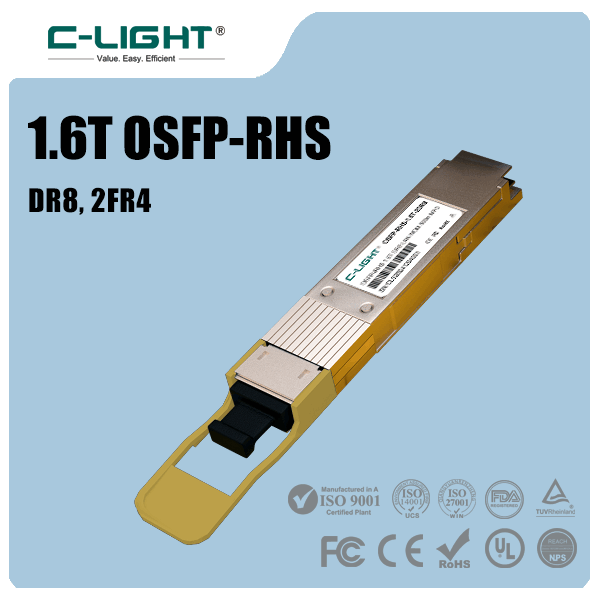
See C-LIGHT 1.6T OSFP-RHS Optical Transceivers for an example of next-generation high-speed optical connectivity.
4. Technology Trends Reshaping the Market
4.1 100G and 200G Per-Lane Technology
Higher aggregate module speeds require improvements in the bandwidth of individual electrical and optical lanes. The transition from 100G-class to 200G-class lanes is therefore a major technical development in the optical transceiver industry.
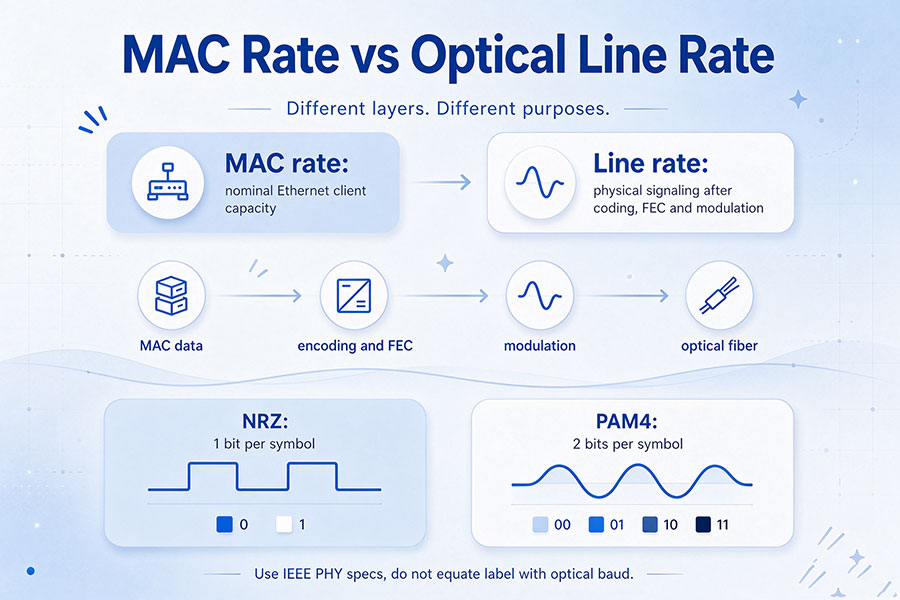
Representative 100G-per-lane PAM4 signaling operates at approximately 53.125 GBd, while 200G-per-lane PAM4 signaling operates at approximately 106.25 GBd. The raw bit rate and nominal lane rate should be distinguished from the effective data rate after coding and protocol overhead.
Higher lane speeds can reduce the number of parallel channels required for a given aggregate bandwidth, but they also increase demands on DSP performance, laser technology, electrical interfaces, packaging, and signal integrity.
4.2 Silicon Photonics Integration
Silicon photonics is becoming an increasingly important technology in high-speed optical communication. It uses silicon-based photonic integrated circuits to combine multiple optical functions on a compact platform.
Potential advantages include higher integration density, improved manufacturing scalability, and opportunities for more efficient optical packaging. Silicon photonics can also support the development of advanced optical engines and co-packaged optical architectures.
However, silicon photonics does not eliminate all optical component requirements. External laser sources, optical coupling, packaging, thermal control, and testing remain important parts of the system.
4.3 LPO and LRO Optical Architectures
Linear Pluggable Optics (LPO) and Linear Receive Optics (LRO) are being developed to reduce some of the power consumption associated with conventional DSP-based optical modules.
Traditional retimed modules use digital signal processing to compensate for signal impairments and support reliable transmission. Linear optical architectures reduce or modify some of these processing functions, potentially lowering power consumption and latency.
These architectures also introduce greater dependence on host electrical signal quality, system-level channel design, and interoperability. They are not universal replacements for conventional DSP-based modules.
4.4 Co-Packaged Optics and Near-Packaged Optics
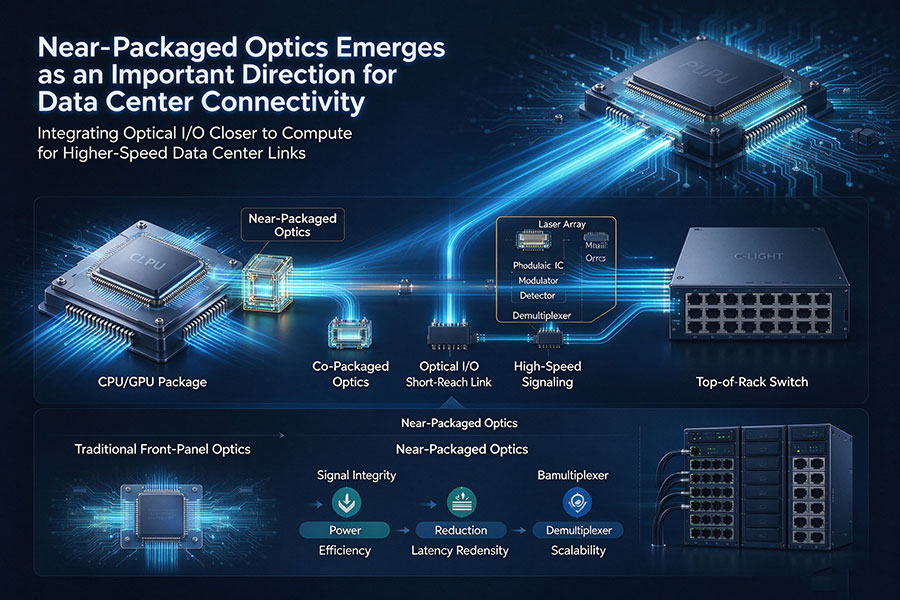
As switch ASIC bandwidth increases, the electrical connections between the switch chip and front-panel optical modules become more challenging. Co-Packaged Optics (CPO) and Near-Packaged Optics (NPO) are being developed to bring optical engines closer to the switching silicon.
CPO integrates optical engines within the same package environment as the switch ASIC, while NPO places optical components closer to the host chip without using the same package-level integration approach.
Both approaches aim to improve bandwidth density and reduce electrical interconnect challenges. However, their deployment depends on manufacturing maturity, field serviceability, optical packaging, reliability, and ecosystem development.
Pluggable optical transceivers are expected to remain important throughout the forecast period because of their established ecosystem, replaceability, and operational flexibility.
4.5 Coherent Pluggable Optics
Coherent optical technology enables high-capacity transmission over longer distances by using advanced modulation and digital signal processing. Coherent pluggable modules are increasingly important for metro networks, DCI, and selected long-haul applications.
400ZR established an important foundation for pluggable coherent optics. 800ZR and 800ZR+ extend this approach to higher bandwidth requirements, while future 1.6T coherent products may support more demanding distributed network architectures.
Actual reach depends on the optical link budget, fiber characteristics, amplification, dispersion, modulation format, and system configuration. A product's nominal reach should not be assumed to apply to every network environment.
5. Market Segmentation by Application
5.1 Data Center and Cloud Networking
Data center and cloud networking are expected to remain among the most important growth areas for optical transceivers through 2030. Hyperscale facilities require high-density connections between servers, switches, storage systems, and network infrastructure.
The increasing use of AI accelerators further strengthens demand for high-speed optical connections. 400G and 800G modules support current network upgrades, while 1.6T solutions are expected to become increasingly relevant as switch capacity and AI cluster sizes increase.
5.2 AI Cluster Interconnect
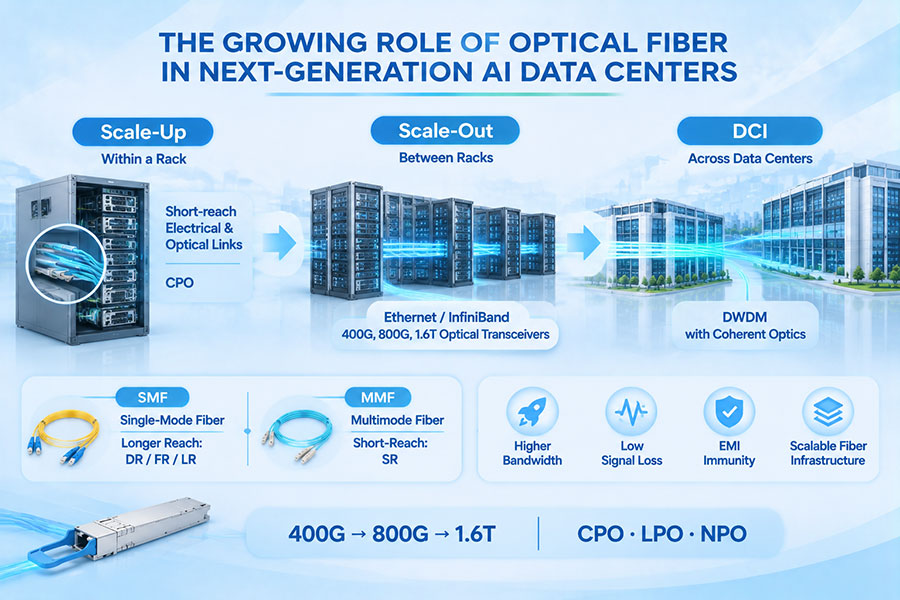
AI clusters place particularly demanding requirements on network architecture. Scale-up networks connect processors within tightly integrated computing systems, while scale-out networks connect servers and accelerator groups across larger facilities. Scale-across networks extend connectivity between geographically distributed data center resources.
Each architecture has different requirements for bandwidth, reach, latency, topology, and optical connection density. This creates demand for a combination of pluggable transceivers, DACs, AOCs, AECs, and emerging optical integration technologies.
5.3 Data Center Interconnect
DCI connects separate data center facilities and supports distributed cloud infrastructure, disaster recovery, data replication, and AI workload distribution.
Shorter links may use direct-detect optical modules, while longer and higher-capacity links often require coherent optics and DWDM systems. The expansion of multi-site computing is expected to increase demand for 400ZR, 800ZR, and future higher-speed coherent solutions.
5.4 Telecommunications and Metro Networks
Telecom operators continue to deploy optical transceivers in mobile backhaul, fronthaul, metro aggregation, and backbone networks. These applications require a range of transmission distances, wavelengths, and data rates.
DWDM technology is particularly important where operators need to increase capacity over existing fiber infrastructure. Coherent pluggable modules can also help integrate optical transport functions into routers and other network equipment.
5.5 Enterprise and Industrial Networks
Enterprise networks, campus infrastructure, industrial Ethernet, and transportation systems continue to support demand for conventional optical modules.
These applications often prioritize reliability, compatibility, operating temperature, transmission distance, and total deployment cost rather than the highest available bandwidth.
Industrial optical transceivers are designed for environments with wider temperature ranges and more demanding operating conditions. Their selection should consider the actual environmental requirements and equipment specifications.
6. Regional Optical Transceiver Market Outlook
6.1 North America
North America is a major market for optical transceivers because of its concentration of hyperscale cloud providers, AI infrastructure investment, large data center operators, and advanced telecommunications networks.
AI computing expansion is a particularly important source of demand. The region is expected to remain a major destination for 800G and 1.6T optical modules, high-speed Ethernet infrastructure, and coherent DCI solutions.
Grand View Research estimated that North America accounted for 37.1% of global optical transceiver market revenue in 2025. This reflects the region's strong data center and network infrastructure base.
6.2 Asia-Pacific
Asia-Pacific is an important manufacturing and consumption region for optical communication products. China, Japan, South Korea, Taiwan, and other markets contribute to different parts of the optical supply chain.
Regional demand is supported by cloud infrastructure, telecom network expansion, data center construction, fiber broadband deployment, and the development of advanced optical components.
The region also plays an important role in optical module assembly, laser and photonic components, passive optical devices, and precision manufacturing.
6.3 Europe
European demand is supported by enterprise network modernization, cloud infrastructure, telecom transport, data center interconnect, and fiber broadband deployment.
Energy efficiency, network reliability, interoperability, and regulatory requirements are important purchasing considerations. Metro and long-haul optical transport also remain relevant as operators improve network capacity.
6.4 Other Emerging Markets
Latin America, the Middle East, and Africa offer opportunities through broadband expansion, mobile network development, cloud infrastructure investment, and new data center construction.
In these markets, demand may be distributed across different speed generations. 10G, 25G, 100G, and 400G products can remain commercially relevant as operators balance network capacity with infrastructure investment.
| Region | Major Demand Drivers | Relevant Product Categories |
|---|---|---|
| North America | AI infrastructure, hyperscale cloud, DCI | 400G, 800G, 1.6T, coherent optics |
| Asia-Pacific | Manufacturing, cloud, telecom, data center expansion | 25G, 100G, 400G, 800G, optical components |
| Europe | Network modernization, metro transport, enterprise infrastructure | 100G, 400G, DWDM, coherent modules |
| Latin America | Broadband expansion, mobile backhaul, cloud infrastructure | 10G, 25G, 100G, CWDM/DWDM |
| Middle East and Africa | New data centers, telecom investment, fiber connectivity | 25G, 100G, 400G, long-reach optics |
7. Optical Transceiver Market Forecast: 2026–2030
The next five years are likely to bring several overlapping technology and investment cycles. The speed of adoption will depend on hyperscaler capital expenditure, GPU and switch availability, optical component capacity, product qualification, and the economics of each network architecture.
| Year | Expected Market Development | Key Technologies |
|---|---|---|
| 2026 | Strong expansion of AI-related optical connectivity and accelerated 800G deployment. | 400G, 800G, early 1.6T, SiPh, LPO development |
| 2027 | Broader 1.6T deployment, continued 800G demand, and more diversified optical supply chains. | 800G, 1.6T, 200G/lane, coherent pluggables |
| 2028 | Higher-speed optical architectures become more established, with emerging 3.2T platforms and expanded DCI requirements. | 1.6T, early 3.2T, 800ZR, CPO/NPO development |
| 2029 | Increasing focus on optical integration, power efficiency, and large-scale AI network optimization. | 1.6T, 3.2T development, silicon photonics, CPO |
| 2030 | A more mature high-speed optical ecosystem with multiple coexisting generations and greater architectural diversity. | 1.6T, 3.2T, coherent optics, integrated optical engines |
7.1 2026: 800G Becomes a Major Volume Driver
2026 is an important year for the optical transceiver market because AI infrastructure investment is accelerating demand for high-speed Ethernet connectivity.
LightCounting's April 2026 forecast projected 65% growth in the Ethernet transceiver market for the year. It also highlighted strong demand for 800G products and capacity constraints involving InP EML and laser chips.
During this period, 800G modules are expected to gain importance in hyperscale switching and AI cluster deployments. At the same time, 400G remains relevant across existing infrastructure and network platforms that have not yet transitioned to 800G.
The market will also see growing attention to 1.6T module qualification, silicon photonics, and low-power optical architectures.
7.2 2027: 1.6T Adoption Expands
By 2027, 1.6T optical transceivers are expected to move beyond initial deployments as compatible switch platforms and optical components become more widely available.
However, the transition will depend on the availability of high-speed DSPs, lasers, optical engines, packaging capacity, and qualified host systems. Demand forecasts and actual shipments may differ significantly when component supply is constrained.
800G is also expected to remain an important product generation. Its continued deployment will be supported by network upgrades, different data center architectures, and customers seeking a balance between bandwidth and system cost.
7.3 2028: Higher-Speed Interfaces and Coherent DCI Gain Importance
In 2028, the market may begin to show a more diversified technology structure. 1.6T modules are expected to become more established in advanced data center platforms, while early 3.2T development may attract attention as next-generation switching systems evolve.
Coherent optics will also become increasingly important for distributed AI infrastructure. LightCounting has identified 1.6T ZR/ZR+ demand in the 2028–2029 period as a potential development area for scale-across networks.
Actual commercial deployment will depend on standards, host-platform readiness, optical link budgets, and the economics of coherent solutions.
7.4 2029: Optical Integration and Power Efficiency Become More Important
As network bandwidth increases, the power consumption and physical density of optical connectivity become increasingly important design considerations.
Silicon photonics, optical engines, LPO, NPO, and CPO may take on larger roles in selected high-density network architectures. These technologies are not necessarily competing solutions for every application. Their adoption will depend on the distance, serviceability, power, and integration requirements of individual systems.
The industry may also experience greater segmentation between conventional pluggable products, high-performance AI interconnects, and integrated optical solutions.
7.5 2030: A More Diverse Optical Connectivity Ecosystem
By 2030, the optical transceiver industry is likely to support several generations of technology at the same time. 100G and 400G products may remain in established networks, 800G and 1.6T may serve different generations of data center infrastructure, and 3.2T-class interfaces may begin to gain commercial relevance in selected platforms.
The broader market will not be defined by bandwidth alone. Power efficiency, optical integration, supply-chain resilience, reliability, compatibility, and total cost of ownership will become increasingly important factors in product selection.
8. Optical Transceiver Supply Chain and Competitive Landscape
8.1 Key Supply Chain Layers
The optical transceiver industry depends on a complex supply chain involving semiconductor manufacturing, photonic components, optical packaging, module assembly, testing, and system integration.
| Supply Chain Layer | Key Components or Activities | Industry Importance |
|---|---|---|
| Optical semiconductor components | EML lasers, CW lasers, VCSELs, photodetectors | Determine key optical performance and influence production capacity. |
| Photonic integration | Silicon photonics, PICs, optical engines | Support integration, density, and next-generation optical architectures. |
| Electronic components | DSPs, drivers, TIAs, retimers | Manage electrical and optical signal conversion and processing. |
| Passive optical components | Optical filters, isolators, lenses, connectors | Support optical routing, coupling, and signal quality. |
| Module manufacturing | Optical alignment, assembly, packaging | Determines manufacturing yield, consistency, and scalability. |
| Testing and qualification | BER, optical power, eye diagrams, temperature testing | Verifies product performance and host-system compatibility. |
8.2 Major Industry Participants
The competitive landscape includes optical component manufacturers, transceiver suppliers, semiconductor companies, contract manufacturers, and network equipment vendors.
Companies such as Coherent, Lumentum, Applied Optoelectronics, Innolight, Eoptolink, Accelink, and other regional suppliers participate in different parts of the optical communication ecosystem.
The competitive environment varies by product category. Some companies have strong positions in laser and photonic components, while others focus on high-volume optical module manufacturing, advanced packaging, or complete optical networking solutions.
As 800G and 1.6T adoption expands, the ability to secure critical components, maintain manufacturing yield, qualify products with major customers, and scale production will become increasingly important.
8.3 Manufacturing Capacity and Component Availability
Optical transceiver production requires more than access to electronic components. High-speed modules depend on specialized lasers, photodetectors, optical filters, precision alignment equipment, advanced packaging, and extensive testing.
LightCounting identified InP EML and laser chip capacity as important constraints during the 2026 demand expansion. TrendForce also highlighted EMLs, continuous-wave laser sources, optical alignment, and thermal management as supply-side challenges.
These constraints can affect delivery schedules, module pricing, and the speed of customer qualification. Long-term supply agreements and diversified sourcing strategies are therefore becoming more relevant to the industry.
9. Key Challenges Facing the Optical Transceiver Market
9.1 Increasing Power Consumption
Higher transmission speeds generally increase the complexity of signal processing and optical integration. Without improvements in efficiency, the power consumption of high-speed optical modules can become a significant operating cost for large data centers.
Manufacturers are working on lower-power DSPs, improved optical engines, silicon photonics, LPO, and advanced packaging to address these requirements.
9.2 Thermal Management
Higher port density creates additional heat inside switches and optical modules. Thermal management becomes especially important in 800G and 1.6T systems, where module performance can be affected by operating temperature and airflow conditions.
Thermal design must be considered at both the module and system levels. A transceiver that meets its standalone specifications may still require careful host-platform validation under actual operating conditions.
9.3 Manufacturing Yield and Optical Alignment
High-speed optical modules require precise alignment between lasers, photonic integrated circuits, fibers, and other optical components.
As optical integration increases, manufacturing processes become more demanding. Yield improvement, automation, packaging precision, and production consistency will influence the industry's ability to meet rising demand.
9.4 Interoperability and Compatibility
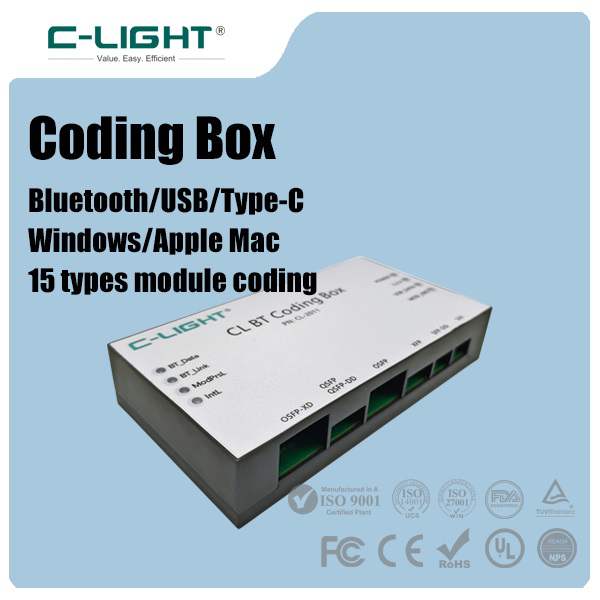
Optical module compatibility depends on more than the connector and nominal data rate. Host equipment, firmware, module coding, electrical interfaces, optical specifications, power requirements, and thermal conditions all influence successful operation.
Multi-vendor interoperability and system-level validation will remain important as network operators adopt higher-speed products and more complex optical architectures.
9.5 Pricing Pressure and Technology Transition
Rapid market growth does not guarantee stable pricing or consistent profitability. When manufacturing capacity expands, component shortages ease, or customers adjust procurement plans, optical module prices may change.
New product generations also require investment in research, development, qualification, and production equipment. Manufacturers must balance the cost of technology transitions with the commercial requirements of customers.
10. Strategic Opportunities for Optical Transceiver Suppliers
The 2026–2030 market outlook creates opportunities across several product and technology categories.
10.1 Expanding High-Speed Product Portfolios
Suppliers can strengthen their product portfolios by supporting multiple speed generations and optical interfaces. A portfolio covering 100G, 200G, 400G, 800G, and emerging 1.6T products can address customers with different infrastructure requirements.
10.2 Developing Application-Specific Solutions
Customers increasingly require products designed for specific applications rather than only nominal data rates. Short-reach AI cluster connections, long-reach DCI, telecom transport, and industrial networks have different optical, environmental, and operational requirements.
Suppliers that can provide clear application specifications, accurate compatibility information, and appropriate product options can improve their position in these markets.
10.3 Strengthening Product Testing and Quality Assurance
As module speeds increase, product testing becomes more important. Testing should cover optical performance, electrical behavior, temperature stability, power consumption, error performance, and host compatibility.
Reliable qualification processes help reduce deployment risks and improve confidence in multi-vendor optical environments.
10.4 Building Supply Chain Resilience
Manufacturers and module suppliers need to manage component sourcing, production capacity, lead times, and quality consistency. Diversified suppliers and long-term component planning can help reduce exposure to shortages and sudden changes in demand.
11. What the 2026–2030 Outlook Means for Optical Network Buyers
For network operators, data center owners, system integrators, and enterprise customers, the market's rapid development creates both opportunities and procurement challenges.
Product selection should consider the complete network environment rather than focusing only on the highest available data rate.
Check host compatibility: Verify that the optical module is supported by the intended switch, router, or network platform.
Confirm the optical interface: Check the wavelength, fiber type, connector, lane configuration, and transmission distance.
Evaluate power and thermal requirements: Confirm that the module operates within the host system's power and cooling limits.
Consider the upgrade path: Plan for future bandwidth requirements while avoiding unnecessary early replacement of functional infrastructure.
Validate performance: Use appropriate optical and electrical testing to confirm operation under real deployment conditions.
Assess supply reliability: Consider product availability, lead times, quality consistency, and long-term support.
For additional guidance, see the Optical Transceiver Testing and Validation Guide.
12. Conclusion: The Optical Transceiver Market Through 2030
The global optical transceiver market is expected to experience sustained growth between 2026 and 2030, supported by AI infrastructure, hyperscale data centers, cloud networking, DCI, and continued telecommunications modernization.
800G is becoming a major growth segment, while 1.6T is establishing the foundation for the next generation of high-bandwidth data center connectivity. Beyond these speed transitions, silicon photonics, coherent pluggable optics, LPO, NPO, and CPO are expanding the industry's technology options.
However, the market's long-term development will depend on more than bandwidth demand. Component availability, manufacturing yield, power efficiency, thermal performance, interoperability, and production economics will influence how quickly new technologies achieve commercial adoption.
By 2030, optical connectivity is likely to become more diverse, with conventional pluggable modules, coherent optics, active cables, and integrated optical architectures serving different network requirements. Suppliers that combine reliable products, broad application coverage, strong quality control, and supply-chain flexibility will be better positioned to participate in this evolving market.
 >

 >
 >
 >
 >
 >
 >
 >