TEL:+86 132 6656 7067





As artificial intelligence workloads expand across hundreds or thousands of GPUs, network performance has become a critical factor in distributed computing. GPU clusters must exchange model parameters, gradients, activations, and other data at extremely high speeds. Network latency, bandwidth utilization, congestion, and communication efficiency can directly affect training performance and overall infrastructure utilization.
Two technologies are widely used to support high-performance communication between servers: InfiniBand and RDMA over Converged Ethernet version 2 (RoCEv2). Both provide Remote Direct Memory Access (RDMA), allowing data to move between system memories with minimal CPU involvement. However, they use different network architectures and approaches to traffic management.
InfiniBand is a native high-performance switched fabric designed for low-latency communication and high-throughput computing environments. RoCEv2 carries RDMA transport over routable UDP/IP Ethernet, allowing organizations to build RDMA networks using Ethernet infrastructure.
The choice between them involves more than theoretical bandwidth or latency. Congestion control, routing, switch configuration, network management, hardware compatibility, optical connectivity, and total deployment cost all influence the suitability of each technology for AI data centers.
1. What Is InfiniBand?
1.1 InfiniBand Architecture
InfiniBand is a high-performance networking architecture designed for communication between servers, computing systems, and storage devices. It uses a switched fabric with dedicated point-to-point links and a native protocol stack optimized for efficient data transfer.
Unlike conventional Ethernet networking, InfiniBand provides RDMA capabilities as part of its native architecture. Host Channel Adapters (HCAs) communicate through InfiniBand switches, allowing applications to exchange data with low protocol-processing overhead.
An InfiniBand fabric typically includes:
Host Channel Adapters (HCAs): Network adapters that connect servers and GPUs to the InfiniBand fabric.
InfiniBand switches: Forward traffic between connected nodes and provide fabric connectivity.
Subnet Manager (SM): Discovers devices, configures the fabric, and manages routing and related network settings.
InfiniBand cables and optical links: Provide high-speed physical connections using copper or fiber.
Fabric management software: Supports monitoring, configuration, topology management, and troubleshooting.
InfiniBand is widely deployed in high-performance computing (HPC), scientific computing, and large-scale AI training clusters, where communication performance is a major system requirement.
1.2 Native RDMA Support
Remote Direct Memory Access enables one system to access memory on another system without requiring the remote CPU to process every data movement operation. The network adapter handles important transport functions in hardware, reducing CPU overhead and improving communication efficiency.
RDMA supports several communication operations, including:
RDMA Read: Reads data directly from remote memory.
RDMA Write: Transfers data directly into remote memory.
Send/Receive: Exchanges messages between connected endpoints.
Atomic operations: Performs supported remote memory operations without requiring a conventional CPU-mediated exchange.
These capabilities are particularly useful in distributed AI training, where GPUs and servers frequently exchange large amounts of data during collective communication operations.
1.3 InfiniBand Fabric Management
InfiniBand uses a Subnet Manager to discover fabric devices and configure network connectivity. The Subnet Manager establishes routes, assigns network parameters, and manages functions such as quality of service and fabric partitioning.
This centralized management model provides a structured way to configure a dedicated high-performance fabric. Network operators can define topologies, traffic priorities, and routing behavior according to the requirements of the computing environment.
Depending on the switch platform and software configuration, InfiniBand deployments can also use adaptive routing to distribute traffic across available paths and respond to changing network conditions.
2. What Is RoCEv2?
2.1 RDMA over Converged Ethernet
RoCEv2 stands for RDMA over Converged Ethernet version 2. It enables RDMA communication over standard Ethernet infrastructure by encapsulating RDMA transport packets in UDP/IP.
RoCEv2 retains important RDMA transport functionality while using Ethernet for link-layer communication and IP for network-layer routing. This allows RDMA traffic to operate across Layer 3 networks rather than being restricted to a single Ethernet broadcast domain.
RoCEv2 uses UDP destination port 4791. Its packet structure enables Ethernet switches and IP routers to forward RDMA traffic using conventional network-layer addressing and forwarding mechanisms.
Unlike traditional TCP-based communication, RoCEv2 does not simply send application data through the conventional TCP/IP stack. The RDMA transport is handled by the network adapter, which performs communication operations in hardware.
2.2 RoCEv2 Network Components
A typical RoCEv2 network contains several interconnected components:
RDMA-capable Network Interface Cards (RNICs): Provide hardware RDMA processing and connect servers to Ethernet switches.
Ethernet switches: Forward UDP/IP packets and provide QoS, buffering, and congestion-management functions.
IP routing infrastructure: Enables Layer 3 connectivity across different network segments.
Congestion control mechanisms: Use technologies such as ECN and DCQCN to manage congestion.
Traffic management: Applies priority mapping, PFC policies, routing, and load balancing.
The performance of RoCEv2 depends on the capabilities of the NICs and switches, together with how the Ethernet fabric is designed and configured.
2.3 RoCEv1 vs RoCEv2
RoCEv1 and RoCEv2 both support RDMA over Ethernet, but they use different network-layer approaches.
| Feature | RoCEv1 | RoCEv2 |
|---|---|---|
| Network layer | Ethernet Layer 2 | IP Layer 3 |
| Encapsulation | Ethernet with a dedicated RoCE EtherType | UDP/IP over Ethernet |
| UDP destination port | Not used | 4791 |
| Routability | Limited to the same Layer 2 domain | Supports Layer 3 routing |
| Network scalability | More limited by Layer 2 domain boundaries | Can use routed Ethernet architectures |
| Common deployment | Smaller or legacy RoCE environments | Modern data center and AI networking |
RoCEv2 is generally more suitable for large-scale environments because it can operate across routed IP networks. Its routability, however, does not automatically eliminate congestion or packet-loss concerns. Ethernet switches, routing paths, and RDMA congestion-control mechanisms must still be configured appropriately.
3. InfiniBand vs RoCEv2: Protocol Architecture
3.1 Different Network Foundations
The fundamental difference between InfiniBand and RoCEv2 is the underlying network architecture. InfiniBand uses a native switched fabric, whereas RoCEv2 uses Ethernet and IP to transport RDMA traffic.
| Architecture Layer | InfiniBand | RoCEv2 |
|---|---|---|
| Application | RDMA applications, MPI, NCCL and other workloads | RDMA applications, MPI, NCCL and other workloads |
| RDMA transport | Native InfiniBand transport | InfiniBand-derived RDMA transport |
| Network layer | InfiniBand network layer | UDP/IP |
| Data link | InfiniBand link layer | Ethernet |
| Switching infrastructure | InfiniBand switches | Ethernet switches and IP routers |
| Network management | Subnet Manager and fabric tools | IP routing, Ethernet management, QoS and telemetry tools |
Although their network stacks differ, both technologies provide RDMA services to applications. The application software can use RDMA interfaces and communication libraries without treating RoCEv2 as ordinary TCP networking.
3.2 Does RoCEv2 Use InfiniBand Technology?
RoCEv2 is based on the RDMA transport defined within the InfiniBand architecture specification. It carries that transport over UDP/IP and Ethernet instead of using the native InfiniBand network and link layers.
This means that InfiniBand and RoCEv2 share important RDMA concepts, but they do not use identical network fabrics. Their switching technologies, addressing, routing, flow control, and management requirements remain different.
Both technologies are covered by the InfiniBand Trade Association (IBTA) specification framework, which defines the relevant RDMA and physical-layer technologies.
4. RDMA Performance: Bandwidth, Latency, and CPU Overhead
4.1 Bandwidth
Bandwidth determines how much data a network can transfer over a given period. In AI clusters, high aggregate bandwidth is important because distributed training frequently requires GPUs to exchange large data blocks across multiple servers.
InfiniBand and RoCEv2 both support high-speed networking. Their practical throughput depends on link speed, network topology, switch capacity, NIC capability, congestion, packet distribution, and application behavior.
InfiniBand provides a dedicated high-performance fabric, while RoCEv2 can use the Ethernet bandwidth roadmap and a wider range of Ethernet switching platforms. Neither architecture guarantees higher application throughput simply because of its protocol name.
4.2 Latency
Latency measures the time required for data to travel between endpoints. Low latency is important for synchronization-intensive applications and distributed workloads that require frequent communication between GPUs.
Both InfiniBand and RoCEv2 can deliver low-latency RDMA communication. Actual results depend on adapter processing, switch forwarding, network congestion, packet size, queueing, routing, and software configuration.
InfiniBand's native fabric and integrated flow-control mechanisms are designed for predictable high-performance communication. RoCEv2 can also achieve excellent latency when its Ethernet fabric is appropriately engineered, but poorly configured congestion management may increase queueing delays and performance variability.
4.3 CPU Utilization
Both technologies use RDMA hardware offload to reduce the CPU involvement associated with data movement. This allows host processors to spend more resources on application execution, data preparation, and computation.
For distributed AI workloads, reducing communication overhead can help improve GPU utilization. The benefits depend on correct RDMA driver installation, supported NIC features, memory registration, and application integration.
5. Congestion Management: Credit-Based Flow Control vs PFC and ECN
Congestion management is one of the most important differences between InfiniBand and RoCEv2. AI training generates large bursts of synchronized traffic, and multiple GPUs may send data toward the same destination or switch port at the same time.
When traffic arrives faster than a network interface can transmit it, queues build up inside switches. If congestion is not managed, buffer exhaustion and packet loss can interrupt RDMA communication and reduce application performance.
5.1 InfiniBand Credit-Based Flow Control
InfiniBand uses credit-based link-level flow control. Before transmitting data, a sending port must have sufficient credits indicating that the receiving side has available buffer capacity.
This mechanism coordinates transmission between adjacent devices and helps prevent buffer overflow during normal operation. It provides a foundation for reliable traffic delivery across the fabric.
InfiniBand also supports Virtual Lanes (VLs), which separate traffic into logical channels over a physical link. This helps isolate traffic classes and reduces the risk of one traffic stream blocking unrelated traffic under certain conditions.
These link-level mechanisms are part of the InfiniBand architecture rather than additional Ethernet configuration features.
5.2 Priority Flow Control (PFC) in RoCEv2 Networks
Priority Flow Control is an Ethernet mechanism defined by IEEE 802.1Qbb. It allows a switch or network interface to pause traffic belonging to a specific priority class rather than stopping the entire physical link.
When a queue reaches a configured congestion threshold, the receiving device can send a pause message to the upstream device. The upstream device temporarily stops transmitting traffic in the affected priority class until buffer conditions improve.
PFC is commonly used in RoCEv2 deployments to help create a lossless Ethernet traffic class for RDMA communication.
However, PFC requires careful configuration. If pause frames propagate across multiple network devices, they can contribute to head-of-line blocking and congestion spreading. Poorly designed PFC configurations may also create difficult-to-diagnose performance problems.
5.3 Explicit Congestion Notification (ECN)
ECN provides a different congestion-management approach. Instead of immediately pausing upstream traffic, an Ethernet switch or router marks packets when congestion reaches a configured threshold.
The congestion indication is carried in the IP header and can travel through a routed network. The destination NIC interprets the marked packets and generates a congestion notification directed toward the original sender.
The sender then adjusts its transmission rate to reduce the load on the congested path.
For RoCEv2, ECN enables congestion feedback to travel across Layer 3 network paths. Its effectiveness depends on consistent configuration of switch marking thresholds, NIC behavior, traffic priorities, and endpoint congestion-control algorithms.
5.4 DCQCN: Data Center Quantized Congestion Notification
DCQCN is a congestion-control algorithm used in RoCE environments. It combines congestion signals from the network with rate adjustment at the sending endpoint.
A typical DCQCN feedback sequence includes:
A switch detects congestion and marks packets using ECN.
The receiving NIC detects the congestion-marked packets.
The receiver sends a Congestion Notification Packet (CNP) toward the original sender.
The sending NIC reduces its injection rate according to the congestion-control algorithm.
The sending rate is gradually adjusted as network conditions improve.
This end-to-end feedback mechanism is designed to manage congestion without relying exclusively on hop-by-hop pause behavior.
5.5 PFC vs ECN: Different Functions
PFC and ECN are often discussed together, but they perform different functions. PFC applies local link-level pause control, while ECN provides congestion feedback that can influence the sending endpoint's rate.
| Feature | PFC | ECN |
|---|---|---|
| Main function | Pauses traffic for a specific priority class. | Marks packets to signal congestion. |
| Control method | Hop-by-hop link-level flow control. | End-to-end congestion notification. |
| Where it operates | Ethernet link layer. | IP network layer through ECN marking. |
| Traffic response | Temporarily stops transmission for the affected priority. | Encourages the sender to reduce its transmission rate. |
| Primary benefit | Helps prevent buffer overflow on a link. | Provides congestion visibility and rate adaptation. |
| Potential concern | Pause propagation and head-of-line blocking. | Requires appropriate thresholds and endpoint response. |
Many RoCEv2 deployments combine PFC and ECN, but the exact congestion-management design varies by NIC, switch platform, network architecture, and supported transport features. PFC should not be treated as a universal substitute for congestion control, and ECN alone does not guarantee that packet drops cannot occur.
6. Routing and Load Balancing
6.1 InfiniBand Routing
InfiniBand fabrics use a Subnet Manager to configure device connectivity and routing information. Network administrators can define routes and traffic-management policies based on the physical topology and expected workload requirements.
Some InfiniBand platforms support adaptive routing, which can dynamically distribute traffic among available paths based on changing network conditions. This can help reduce congestion on heavily utilized links when the topology provides multiple suitable paths.
Adaptive routing is platform- and configuration-dependent. It should not be assumed to work identically across all InfiniBand switches.
6.2 RoCEv2 Routing Through IP and ECMP
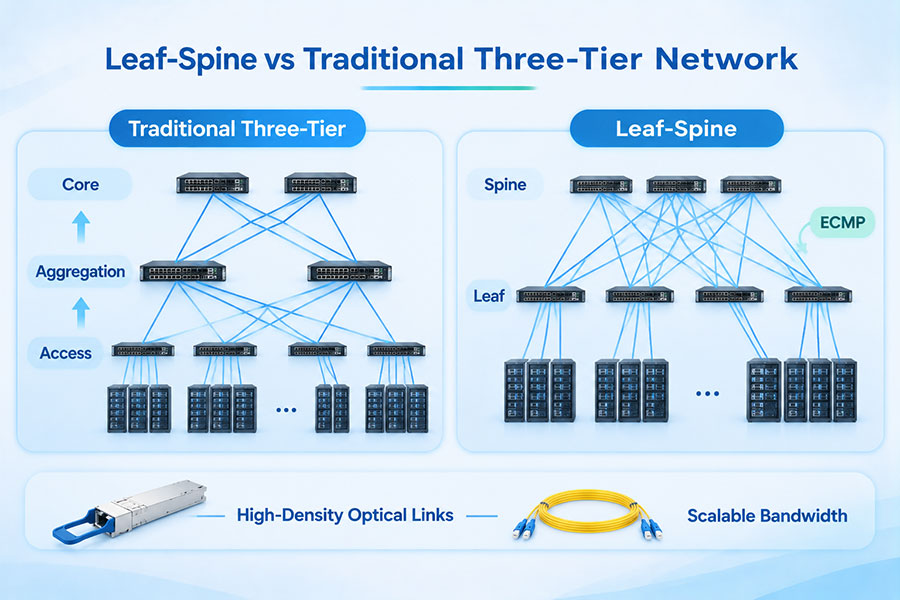
RoCEv2 uses UDP/IP encapsulation, allowing network traffic to be routed through Layer 3 Ethernet fabrics. This enables common data center routing approaches such as Equal-Cost Multi-Path (ECMP).
ECMP distributes traffic across multiple paths using a hash of packet fields. This can improve link utilization and provide path redundancy.
However, AI workloads often generate a relatively small number of large flows with synchronized traffic patterns. If multiple large flows are assigned to the same path, some links may become congested while others remain underutilized.
Network designers may therefore need to tune ECMP hashing, use multiple Queue Pairs (QPs), optimize traffic placement, or introduce additional load-balancing mechanisms.
6.3 Why Network Topology Matters
Both technologies can use topologies such as leaf-spine, Clos, and fat-tree architectures. The network topology determines the number of switching stages, available paths, oversubscription, and the amount of bandwidth available between endpoints.
A non-blocking fabric aims to provide sufficient network capacity for expected simultaneous traffic. An oversubscribed design provides less uplink bandwidth than the aggregate downlink bandwidth, which can reduce deployment costs but may create bottlenecks under heavy traffic.
For AI training, topology planning should consider how GPUs are distributed across racks, how collective communication groups are formed, and how frequently traffic crosses network tiers.
7. InfiniBand vs RoCEv2: Detailed Comparison
The following table summarizes the major differences between the two networking technologies.
| Comparison Factor | InfiniBand | RoCEv2 |
|---|---|---|
| Network architecture | Native high-performance switched fabric | RDMA over Ethernet and UDP/IP |
| RDMA support | Native | Supported through RDMA transport over Ethernet |
| Network layer | InfiniBand network layer | IP Layer 3 |
| Link layer | InfiniBand | Ethernet |
| Routing | Subnet Manager and platform-specific routing features | IP routing and Ethernet-based load balancing |
| Flow control | Credit-based link-level flow control | Commonly uses PFC in lossless Ethernet designs |
| Congestion management | Fabric-level and endpoint mechanisms | ECN, CNP, DCQCN and platform-specific mechanisms |
| Traffic management | Virtual Lanes and Service Levels | Ethernet QoS, traffic classes and DSCP/PCP mapping |
| Network scalability | Designed for large high-performance fabrics | Supports routed Ethernet architectures |
| Management model | Dedicated fabric management and Subnet Manager | Ethernet, IP routing, QoS and network telemetry tools |
| Hardware ecosystem | Specialized InfiniBand adapters and switches | Ethernet switches and RDMA-capable NICs |
| Operational focus | High-performance dedicated fabric management | RDMA-aware Ethernet design and configuration |
| Typical applications | HPC, large AI clusters, scientific computing | AI data centers, cloud infrastructure, storage and converged networks |
8. InfiniBand vs RoCEv2 in AI Data Centers
8.1 GPU-to-GPU Communication
AI training requires frequent communication between GPUs distributed across different servers. Collective operations such as AllReduce, AllGather, ReduceScatter, and AlltoAll are widely used to exchange data during model training.
AllReduce is particularly important for synchronizing gradients across multiple GPUs. The operation may generate substantial network traffic, making bandwidth and congestion management critical to training efficiency.
InfiniBand and RoCEv2 can both support these operations through RDMA and GPU communication software such as NVIDIA Collective Communications Library (NCCL).
8.2 InfiniBand for Large-Scale AI Training
InfiniBand is widely used in high-performance GPU cluster environments because of its dedicated architecture, native RDMA support, and integrated fabric-management capabilities.
Its credit-based flow control and specialized switching environment provide a strong foundation for predictable high-performance communication. Dedicated InfiniBand fabrics can also simplify the separation of training traffic from general-purpose data center traffic.
For tightly coupled training workloads, InfiniBand can be an attractive choice when consistent performance, specialized fabric management, and an established HPC networking environment are priorities.
8.3 RoCEv2 for Large-Scale AI Training
RoCEv2 enables AI clusters to use Ethernet-based network infrastructure while retaining RDMA communication capabilities. It is particularly attractive for organizations that already operate large Ethernet environments or want greater flexibility in switch and network hardware selection.
However, large-scale RoCEv2 deployments require careful coordination among switch configuration, NIC settings, congestion control, routing, traffic priorities, and workload scheduling.
Meta has described its deployment of RoCEv2 for distributed AI training across clusters containing thousands of GPUs. Its engineering work highlights the importance of topology design, ECMP behavior, Queue Pair scaling, and congestion-control tuning in production environments.
This demonstrates that RoCEv2 can support very large AI training networks, although the results depend on substantial network engineering and application-level optimization.
8.4 Which Network Is Better for AI Training?
Neither InfiniBand nor RoCEv2 is universally superior for every AI training workload.
InfiniBand offers a dedicated high-performance fabric with native flow control and integrated management. RoCEv2 offers RDMA over routed Ethernet, providing greater flexibility for organizations with Ethernet infrastructure and multi-vendor networking requirements.
The actual choice should be based on GPU communication patterns, cluster size, topology, congestion characteristics, software stack, operational expertise, and total cost of ownership.
9. Network Hardware, Switches, and Optical Connectivity
9.1 Network Adapters and Switches
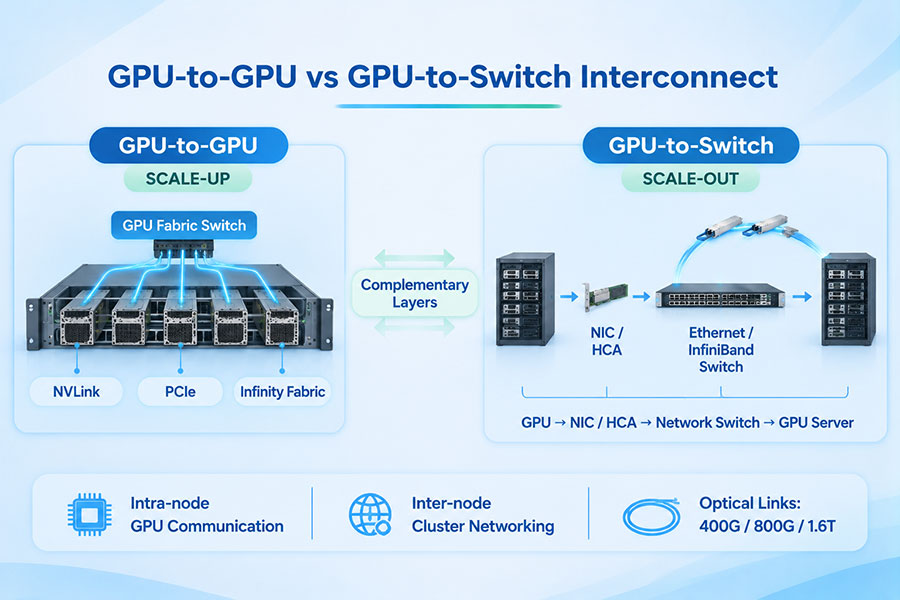
InfiniBand and RoCEv2 require different network interfaces and switching modes. An InfiniBand HCA connects to an InfiniBand fabric, while a RoCEv2-capable Ethernet NIC connects to an appropriately configured Ethernet network.
Some adapter product families support both InfiniBand and Ethernet operation, but this does not mean that every network port can operate both protocols simultaneously or that the surrounding switches are interchangeable. Hardware mode, firmware, drivers, and host configuration must all be verified.
9.2 DAC and AOC Connections
Both InfiniBand and RoCEv2 networks can use copper and optical interconnects depending on transmission distance, data rate, and system design.
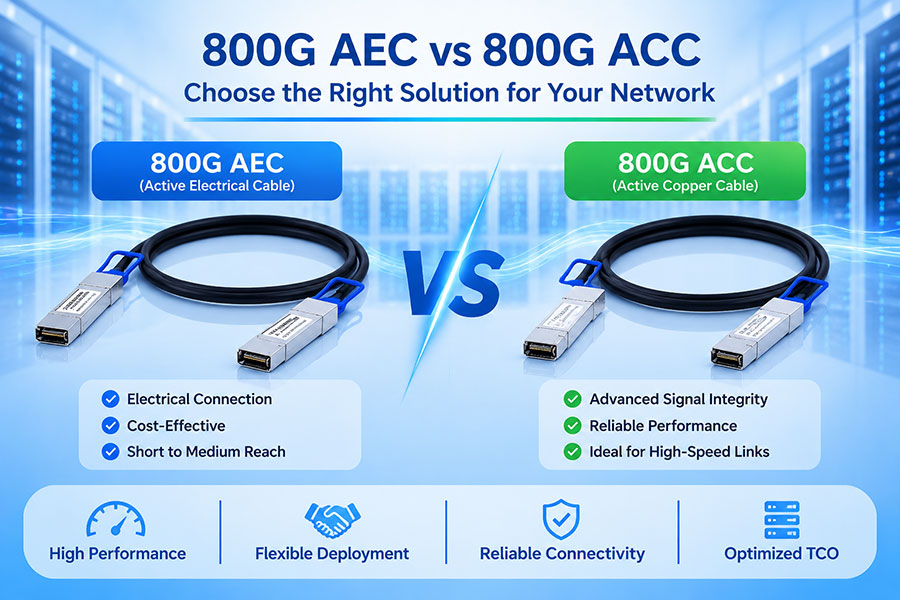
Direct Attach Copper (DAC) cables provide short-reach electrical connections between compatible network ports. They are commonly used for server-to-switch connections within racks or between nearby devices.
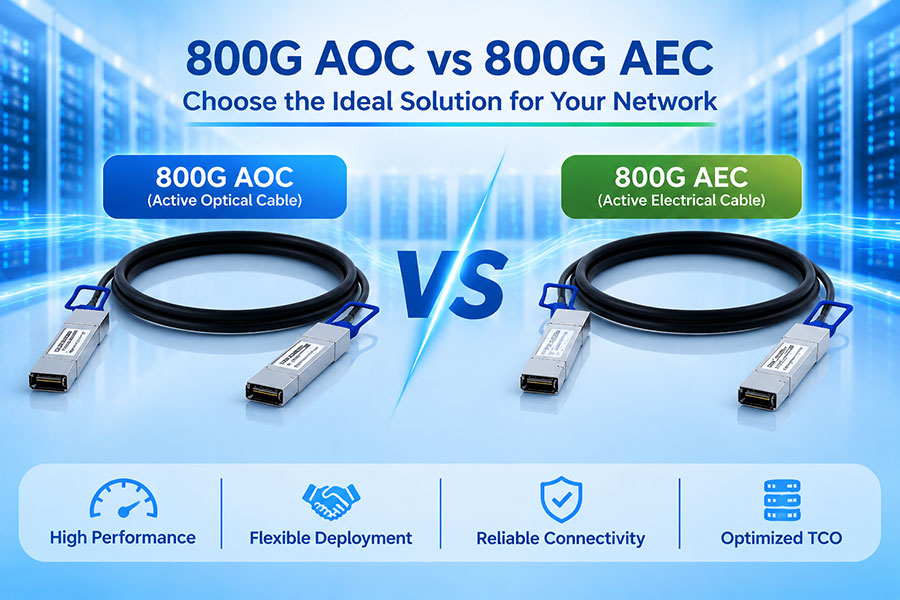
Active Optical Cables (AOCs) integrate optical transmitters and receivers into cable assemblies. They provide an alternative for connections that require optical transmission without separately installing optical transceivers and fiber patch cables.
These options can help address different port-density, distance, and cable-management requirements in GPU clusters.
9.3 Optical Transceivers for High-Speed RDMA Networks
As AI network bandwidth increases, optical transceivers become increasingly important for connections between switches, racks, and network tiers.
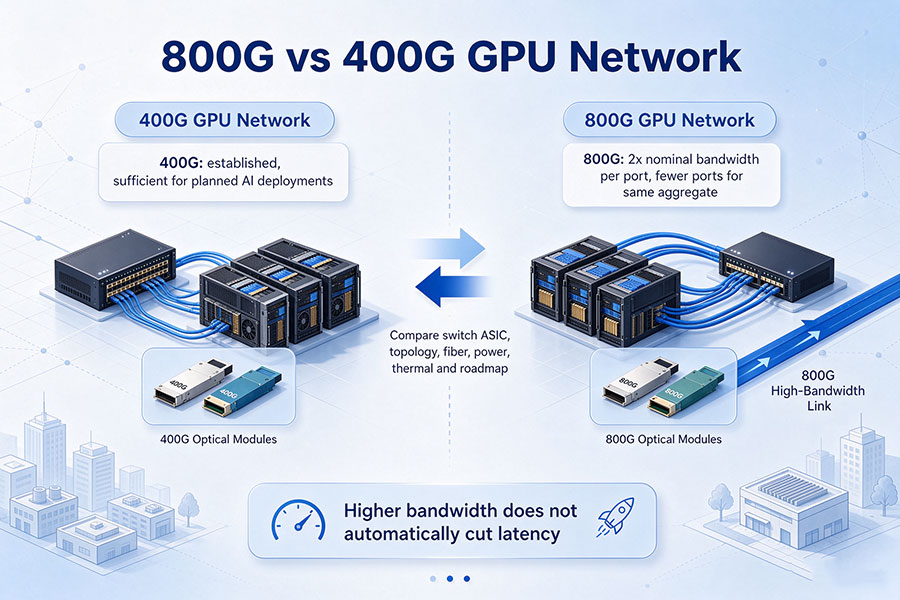
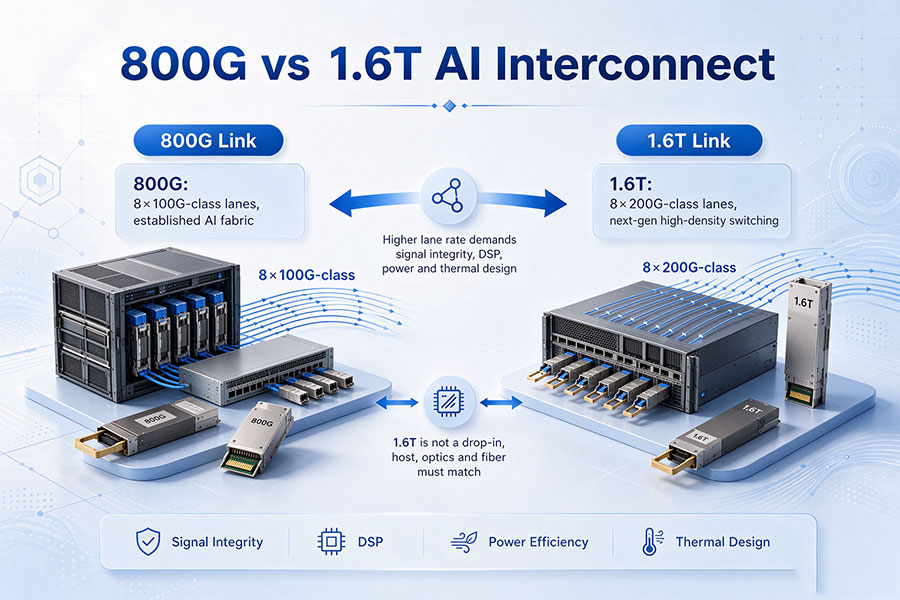
400G and 800G optical interfaces support high-capacity switching environments, while emerging 1.6T connectivity is being developed for future network platforms. The exact optical specification depends on the supported speed, reach, wavelength, fiber type, connector, and host interface.
InfiniBand and RoCEv2 may use optical connectivity products with similar physical form factors, but optical module selection cannot be based on data rate and connector alone. Buyers should verify the relevant switch and NIC support, physical-layer specification, FEC behavior, cable or transceiver compatibility, and vendor qualification requirements.
For high-speed network deployments, C-LIGHT provides product options including:
400G QSFP-DD Optical Transceivers for compatible 400G network platforms.
400G OSFP Optical Transceivers for supported OSFP systems.
800G QSFP-DD Optical Transceivers for high-bandwidth Ethernet and data center applications.
800G OSFP Optical Transceivers for compatible high-density switching platforms.
DAC Cables and AOC Cables for short- and medium-reach interconnect applications.
The selected product must be validated against the actual host platform and supported InfiniBand or Ethernet interface specification. A mechanically compatible module is not automatically protocol-compatible.
10. Cost, Scalability, and Network Operations
10.1 InfiniBand Deployment Costs
InfiniBand generally requires dedicated adapters, switches, cabling, and fabric-management infrastructure. Organizations must also consider software support, monitoring, maintenance, and the availability of qualified engineering resources.
For large HPC and AI clusters, a dedicated InfiniBand fabric can provide a well-integrated environment for high-performance communication. Its value should be evaluated against application throughput, GPU utilization, and the cost of downtime or inconsistent network performance.
10.2 RoCEv2 Deployment Costs
RoCEv2 can benefit from the broader Ethernet hardware ecosystem and may allow organizations to use familiar Ethernet management practices. Depending on the architecture, it can also support network convergence and provide greater flexibility in supplier selection.
However, building a reliable RoCEv2 fabric is not simply a matter of purchasing Ethernet switches and enabling RDMA on the NICs.
Additional engineering may be required for:
Consistent PFC and ECN configuration across the network.
Switch buffer allocation and traffic-class mapping.
ECMP path distribution and load-balancing optimization.
NIC congestion-control and rate-adaptation settings.
Network telemetry and congestion troubleshooting.
Validation under real AI collective communication workloads.
These requirements can increase engineering and operational costs, particularly when the organization has limited experience with RDMA networking.
10.3 Total Cost of Ownership
The total cost of an AI network includes more than switches and adapters. A meaningful comparison should include cabling, optical transceivers, installation, power, cooling, software, maintenance, network engineering, and the cost of supporting future bandwidth upgrades.
Most importantly, network performance affects the productivity of expensive GPU resources. A network with a higher initial purchase price may still offer better overall value if it enables more consistent training performance and better accelerator utilization.
| Cost Factor | InfiniBand | RoCEv2 |
|---|---|---|
| Switch infrastructure | Requires InfiniBand switches | Uses compatible Ethernet switches |
| Network adapters | InfiniBand HCAs | RoCEv2-capable Ethernet NICs |
| Configuration | Dedicated fabric configuration and management | Ethernet QoS, routing and RDMA congestion tuning |
| Supplier flexibility | Depends on available InfiniBand ecosystem and platform compatibility | Can access a broader Ethernet hardware ecosystem |
| Operational expertise | Requires InfiniBand fabric knowledge | Requires both Ethernet and RDMA expertise |
| Expansion | Depends on compatible fabric capacity and product availability | Depends on Ethernet topology, port density and congestion design |
| Overall cost | Workload and deployment dependent | Workload and deployment dependent |
11. InfiniBand vs RoCEv2: Which Should You Choose?
11.1 When InfiniBand Is a Suitable Choice
InfiniBand may be appropriate for organizations building dedicated high-performance computing and AI training environments where low latency, predictable communication, and specialized fabric management are priorities.
It is particularly attractive when:
The network primarily serves tightly coupled HPC or distributed AI training workloads.
Consistent RDMA performance is a major infrastructure requirement.
The organization can operate a dedicated InfiniBand fabric.
Existing infrastructure and technical expertise support InfiniBand deployment.
The hardware and software ecosystem meets the required scale and performance targets.
11.2 When RoCEv2 Is a Suitable Choice
RoCEv2 may be a better fit when an organization wants to use Ethernet-based RDMA and maintain greater flexibility in network hardware and infrastructure management.
It is particularly attractive when:
The data center already has extensive Ethernet networking expertise.
The organization wants to integrate RDMA into an Ethernet-based network architecture.
Multi-vendor hardware options are important.
Layer 3 routing and Ethernet-based topology management are required.
The network engineering team can properly design and operate congestion control and traffic management.
11.3 Practical Selection Checklist
Before selecting either networking technology, operators should evaluate the following requirements:
| Evaluation Area | Questions to Consider |
|---|---|
| Application workload | Does the environment primarily use AllReduce, AllGather, AlltoAll, storage traffic, or mixed workloads? |
| GPU scale | How many GPUs, servers, racks, and network tiers must be connected? |
| Bandwidth | What are the required per-port speed and aggregate cluster bandwidth? |
| Latency | What are the acceptable average and tail latency requirements? |
| Congestion control | Which flow-control, ECN, and rate-control mechanisms are supported? |
| Topology | Is the fabric non-blocking, partially oversubscribed, or designed with multiple network tiers? |
| Management | Does the team have the expertise and tools to monitor and troubleshoot the selected fabric? |
| Physical connectivity | Which DAC, AOC, optical transceiver, fiber type, and transmission distance are required? |
| Scalability | Can the network expand without creating unacceptable congestion or operational complexity? |
| Total cost | What are the complete infrastructure, maintenance, power, and engineering costs? |
12. Future Development of InfiniBand and RoCEv2
The demand for AI infrastructure is pushing both InfiniBand and Ethernet-based RDMA toward higher bandwidth, improved congestion control, and more scalable network architectures.
12.1 Higher-Speed Network Interfaces
As GPU clusters increase in size, network interfaces must support higher aggregate bandwidth and improved port density. The move from 200G and 400G toward 800G and 1.6T connectivity is an important part of this development.
The IBTA's InfiniBand Architecture Specification Release 2.0, published in July 2025, introduced XDR support at up to 200 Gb/s per lane. The specification also includes improvements to physical-layer interfaces, forward error correction, and management capabilities for high-density networks.
The availability of these specifications does not mean every switch, adapter, or optical interface has already reached the same commercial deployment stage. Actual adoption depends on product implementation, qualification, and network-platform availability.
12.2 Ethernet Evolution for AI Networking
Ethernet continues to evolve to support high-performance computing and AI cluster requirements. Improvements in switching capacity, congestion management, packet processing, telemetry, and network-scale architecture are helping make Ethernet-based RDMA more practical for large deployments.
The Ultra Ethernet Consortium is also developing the Ultra Ethernet specification and transport technologies for next-generation AI and high-performance networking. These developments are related to the broader evolution of Ethernet-based AI fabrics but should not be confused with RoCEv2 itself. UET is a separate transport approach rather than simply another name for RoCEv2.
12.3 Co-Design of Network and Computing Infrastructure
Future AI clusters will increasingly require coordination between GPU architecture, network adapters, switches, collective communication libraries, schedulers, and optical connectivity.
Network performance cannot be optimized through hardware selection alone. Application-aware scheduling, topology-aware placement, adaptive routing, traffic engineering, and real-time telemetry will all influence the efficiency of distributed computing.
Both InfiniBand and RoCEv2 are likely to remain relevant as AI infrastructure continues to diversify. Their long-term roles will depend on performance, cost, interoperability, and operational requirements rather than a single universal networking standard.
Conclusion: InfiniBand and RoCEv2 Serve Different Network Strategies
InfiniBand and RoCEv2 are two important technologies for high-performance RDMA communication in AI data centers. Both reduce CPU involvement in data movement and support low-latency, high-bandwidth communication between servers and GPUs.
InfiniBand provides a native switched fabric with credit-based flow control, specialized routing, and dedicated fabric management. RoCEv2 transports RDMA over UDP/IP Ethernet, offering Layer 3 routability and the flexibility of Ethernet infrastructure.
Their main trade-offs involve congestion management, network configuration, routing, hardware ecosystems, operational expertise, and total cost of ownership. InfiniBand can be attractive for dedicated HPC and AI fabrics, while RoCEv2 can provide a flexible Ethernet-based approach when the network is properly designed and tuned.
For either technology, high-speed connectivity depends on selecting compatible adapters, switches, cables, and optical transceivers. As network speeds advance toward 800G and 1.6T, optical interconnect design and system-level validation will become increasingly important to maintaining reliable AI cluster performance.
 >

 >
 >
 >
 >
 >
 >
 >