TEL:+86 132 6656 7067





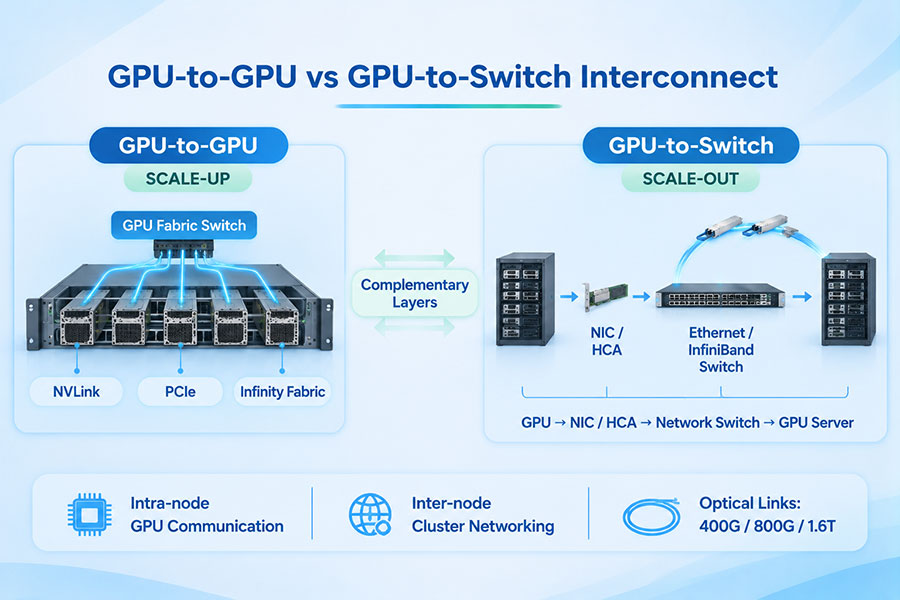
Modern AI systems depend on fast communication between GPUs, but not all GPU connections serve the same purpose. Within a server, accelerators exchange model parameters, activations, and intermediate results through high-bandwidth GPU interconnects. Across servers, network adapters and switching infrastructure connect individual GPU nodes into larger computing clusters.
GPU-to-GPU and GPU-to-switch interconnects therefore represent different levels of AI infrastructure. The first focuses on communication among accelerators, while the second extends connectivity across nodes and racks. Understanding how these layers work together is essential when designing AI training clusters, high-performance computing environments, and large-scale inference platforms.
1. What Is GPU-to-GPU Interconnect?
GPU-to-GPU interconnect refers to the communication path between two or more graphics processing units. It enables accelerators to exchange data directly or through a dedicated interconnect fabric without relying entirely on conventional CPU-mediated data transfers.
In multi-GPU systems, workloads are frequently divided across several accelerators. Each GPU processes part of the computation and exchanges information with other GPUs during operations such as distributed matrix calculations, tensor parallelism, and model training.
Common GPU communication technologies include:
NVLink: A high-speed GPU interconnect technology used in supported NVIDIA platforms to provide direct GPU communication and connectivity through compatible switching architectures.
PCI Express (PCIe): A general-purpose high-speed interface used to connect GPUs, CPUs, network adapters, and other system components.
AMD Infinity Fabric: An interconnect technology used in supported AMD computing platforms to facilitate communication among processors and accelerators.
Other accelerator interconnect fabrics: Platform-specific technologies designed to support high-bandwidth communication between computing devices.
GPU-to-GPU communication can take place over direct peer-to-peer links, shared interconnect fabrics, or other supported paths. The actual performance depends on the GPU architecture, system topology, software configuration, and supported communication protocols.
2. What Is GPU-to-Switch Interconnect?
GPU-to-switch interconnect generally describes how GPU servers connect to network switches so that accelerators in different servers can exchange data. In this architecture, the GPU communicates through a host interface and a network adapter, which forwards traffic into the external network fabric.
A typical communication path includes several components:
GPU: Generates or receives data required by the distributed workload.
Host interface: Provides the connection between the GPU system and its network adapter, commonly through PCIe or a platform-specific high-speed interface.
Network adapter: An Ethernet NIC or InfiniBand Host Channel Adapter (HCA) handles network communication.
Network switch: Connects multiple servers and forwards traffic toward the destination node.
Destination server: Receives the network traffic and makes the data available to its GPU or other computing components.
Depending on the platform, technologies such as RDMA and GPUDirect RDMA can reduce CPU involvement and enable more direct data movement between GPU memory and network adapters. These capabilities depend on hardware, drivers, firmware, and software support.
3. GPU-to-GPU vs GPU-to-Switch: Architecture Differences
The main difference is the communication scope. GPU-to-GPU interconnects primarily connect accelerators within a computing system or dedicated scale-up domain. GPU-to-network-switch connectivity links separate GPU servers into a distributed cluster.
| Comparison Factor | GPU-to-GPU Interconnect | GPU-to-Network-Switch Interconnect |
|---|---|---|
| Primary purpose | Communication between accelerators | Communication between GPU servers and network nodes |
| Typical scope | Within a server or scale-up domain | Across servers, racks, and data center networks |
| Common technologies | NVLink, PCIe, Infinity Fabric | InfiniBand, Ethernet, RoCEv2 |
| Switching components | Direct links or dedicated GPU fabric switches | Ethernet or InfiniBand network switches |
| Communication path | GPU-to-GPU through supported local interconnect paths | GPU to NIC/HCA, network switch, and destination node |
| Typical workload | Tensor parallelism and intra-node GPU communication | Multi-node distributed training and cluster communication |
| Bandwidth design | High-bandwidth accelerator links and fabric capacity | Network adapter speed, switch capacity, and link aggregation |
| Scaling method | Adding GPUs within a supported system or scale-up fabric | Adding GPU servers, network ports, and switching capacity |
| Key design concern | GPU topology and peer-to-peer communication efficiency | Network congestion, latency, routing, and fabric bandwidth |
These technologies are complementary rather than interchangeable. A large AI cluster generally needs both fast communication among GPUs within each node and high-performance networking between nodes.
4. Bandwidth and Latency Requirements
Bandwidth and latency affect how efficiently GPUs exchange data during parallel workloads. However, the requirements can differ significantly between intra-node and inter-node communication.
GPU-to-GPU Bandwidth
GPU-to-GPU links are designed to support frequent data exchange among accelerators. In tightly coupled workloads, GPUs may repeatedly transfer tensors, gradients, and intermediate results. Limited interconnect bandwidth can reduce accelerator utilization because GPUs may spend time waiting for data from other devices.
Important performance factors include:
Aggregate bandwidth available between GPUs.
Number and topology of GPU interconnect links.
Peer-to-peer communication support.
Memory access and data-transfer overhead.
Contention across shared links or switching resources.
GPU-to-Network-Switch Bandwidth
For multi-node communication, network performance depends on the combined capacity of GPU-facing network adapters, switch ports, and inter-switch links. A server with high-speed GPU interconnects can still become constrained if its external network connection cannot support the required traffic volume.
For example, if multiple GPUs share a limited number of network adapters, the available network bandwidth per GPU may be lower than the aggregate bandwidth of the local GPU fabric. This difference must be considered when planning distributed training performance.
Latency is also affected by network adapter processing, switch forwarding, congestion, routing, and physical link distance. A high-speed network does not automatically guarantee low application-level communication latency.
5. Scale-Up vs Scale-Out: Two Levels of AI Connectivity
Scale-up and scale-out are two important approaches to expanding AI computing capacity. They describe different dimensions of infrastructure growth and rely on different interconnect technologies.
Scale-Up Connectivity
Scale-up increases the number of accelerators working together within a tightly connected computing domain. High-speed GPU interconnects allow accelerators to communicate and share data efficiently.
Examples include multi-GPU servers and systems using dedicated GPU interconnect fabrics. The goal is to increase the computing resources available to a workload while maintaining efficient communication among the accelerators.
Scale-Out Connectivity
Scale-out expands computing capacity by connecting multiple GPU servers through an external network. Ethernet and InfiniBand switching technologies are commonly used to build these distributed environments.
Scale-out networking allows organizations to increase the number of GPU nodes and distribute workloads across racks or data center zones. It also introduces additional network design requirements, including routing, congestion control, redundancy, and optical connectivity.
| Feature | Scale-Up | Scale-Out |
|---|---|---|
| Expansion target | GPUs within a computing domain | GPU servers across a cluster |
| Primary interconnect | GPU links and dedicated fabric | Ethernet or InfiniBand network |
| Typical components | GPUs, GPU interconnects, GPU switches | GPUs, NICs/HCAs, network switches, optical links |
| Key challenge | Accelerator communication and topology | Network bandwidth, congestion, and scalability |
| Common applications | Multi-GPU processing and tightly coupled workloads | Distributed AI training and large GPU clusters |
6. The Role of NVLink and GPU Switches
NVLink is designed to provide high-bandwidth communication between supported NVIDIA GPUs and compatible platform components. It is used in systems where accelerators need to exchange large volumes of data with lower communication overhead than conventional general-purpose host connectivity may provide.
In some architectures, NVLink Switch technology creates a larger GPU communication domain. Instead of relying only on direct connections between pairs of GPUs, multiple accelerators can communicate through a dedicated switching fabric.
This approach supports larger scale-up configurations and provides more flexible GPU-to-GPU communication paths within the supported system architecture.
GPU switch fabrics should not be confused with conventional Ethernet or InfiniBand switches. Although both use switching concepts, they serve different network domains and may use different interfaces, protocols, and system designs.
When evaluating a GPU platform, engineers should examine the supported GPU count, interconnect topology, aggregate bandwidth, switch configuration, and software communication capabilities rather than relying on a single headline bandwidth figure.
7. Ethernet and InfiniBand in GPU-to-Switch Networks
Ethernet and InfiniBand are two major networking technologies used to connect GPU servers in distributed computing environments. Both can support high-performance cluster communication, but they have different protocol ecosystems, operational models, and deployment characteristics.
Ethernet
Ethernet is widely deployed in enterprise and cloud data centers. Modern high-speed Ethernet networks can support AI and HPC workloads through technologies such as RoCEv2, which enables Remote Direct Memory Access over Converged Ethernet.
RoCEv2 deployments require careful network configuration. Congestion management, traffic prioritization, loss behavior, and end-to-end compatibility can all influence performance.
InfiniBand
InfiniBand is a high-performance interconnect technology widely used in HPC and AI environments. It provides a specialized fabric designed for low-latency communication and RDMA-based data transfers.
InfiniBand systems use compatible Host Channel Adapters, switches, cables, and management infrastructure. Its deployment requires equipment and operational expertise aligned with the InfiniBand ecosystem.
| Feature | Ethernet with RoCEv2 | InfiniBand |
|---|---|---|
| Network foundation | Ethernet | InfiniBand fabric |
| RDMA support | RoCEv2 | Native RDMA capabilities |
| Infrastructure | Ethernet switches, NICs, and compatible optics | InfiniBand switches, HCAs, and compatible links |
| Deployment consideration | Congestion control and Ethernet configuration | Fabric management and InfiniBand compatibility |
| Common applications | Cloud data centers and AI clusters | HPC and large-scale AI systems |
The appropriate technology depends on workload characteristics, existing infrastructure, performance targets, management requirements, and total deployment cost. Neither solution should be selected solely on the basis of nominal link speed.
8. How Optical Interconnects Support GPU-to-Switch Connectivity
As GPU clusters expand beyond individual servers, optical connectivity becomes increasingly important. High-speed links between network adapters and switches must support the bandwidth and reach requirements of the cluster while maintaining reliable signal transmission.
Optical transceivers convert electrical signals from switching and network equipment into optical signals for transmission over fiber. At the receiving end, the transceiver converts optical signals back into electrical signals for the host device.
Common optical connectivity options include:
400G optical transceivers: Used for high-capacity connections between network switches and in suitable server-facing applications.
800G optical transceivers: Support higher-bandwidth links in next-generation AI and hyperscale data center networks.
1.6T optical transceivers: Emerging for future high-density switching platforms and larger AI infrastructure.
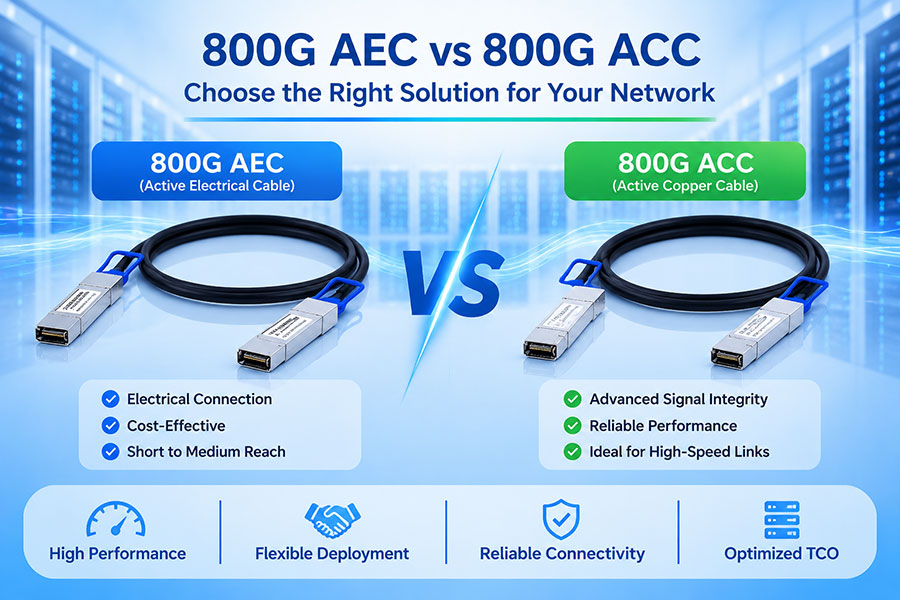
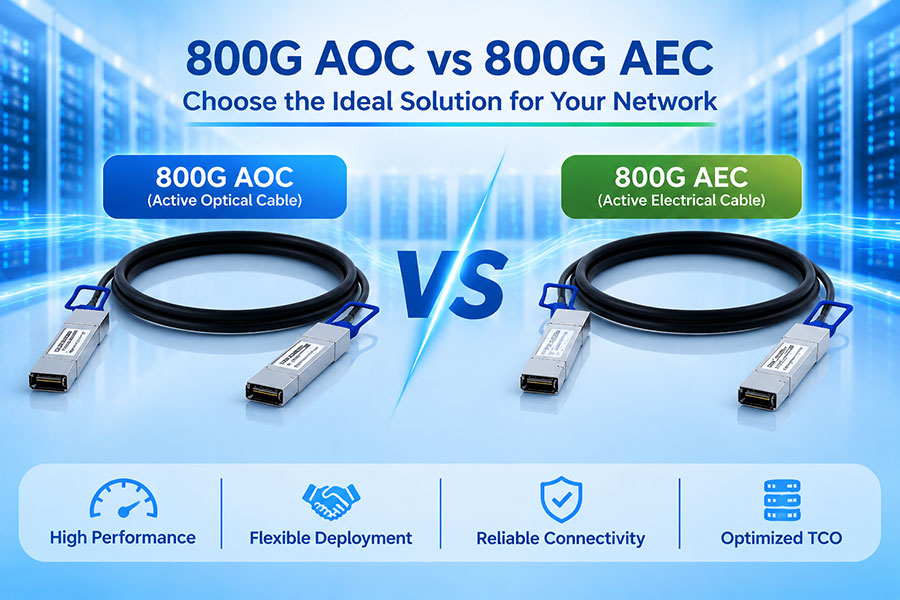
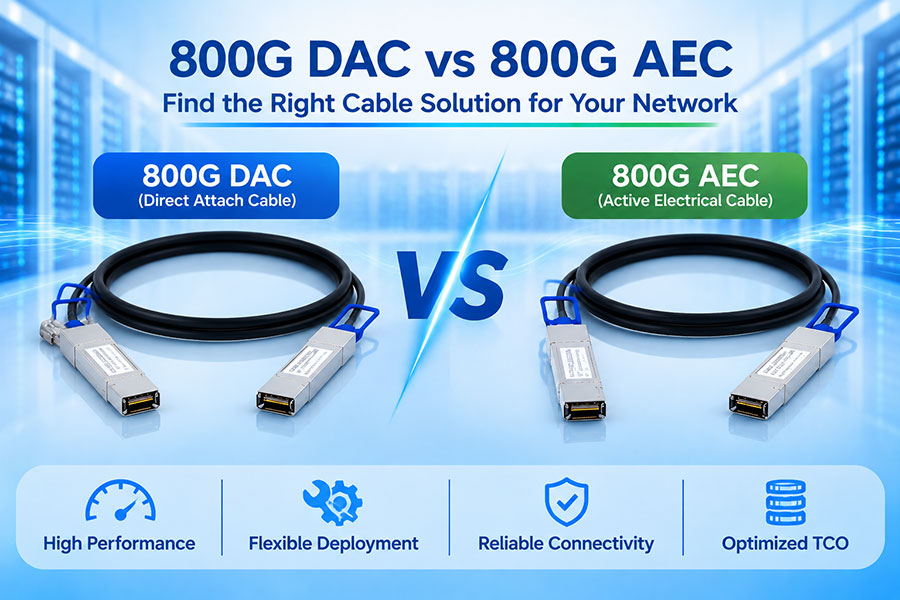
DAC and AEC cables: Provide short-reach electrical connectivity for suitable rack-level and equipment-level connections.
MPO/MTP fiber assemblies: Support high-density parallel optical connections and structured fiber distribution.
Optical link selection depends on the switch and NIC interface, transmission distance, fiber type, connector configuration, wavelength, optical budget, and supported data rate.
For example, a 400G or 800G network port may use different optical form factors and optical interfaces depending on the equipment design and reach requirements. Compatibility must be verified at both ends of the connection.
9. Optical Connectivity for 400G, 800G, and 1.6T AI Networks
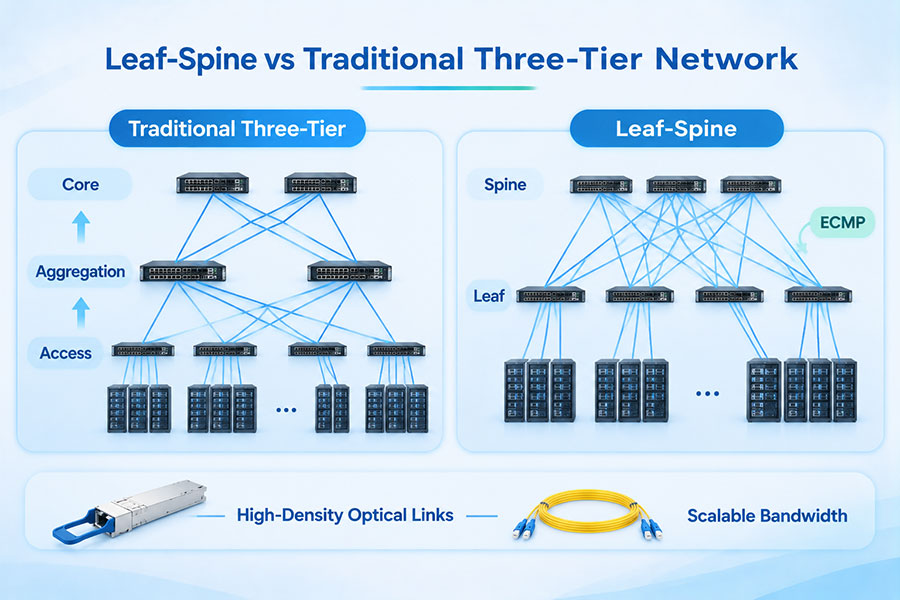
As AI clusters increase in size, network bandwidth requirements continue to grow. Higher-speed optical interfaces help network operators connect leaf and spine switches, distribute traffic across racks, and build larger fabrics without relying exclusively on short-reach electrical connections.
Typical product categories used in these environments include:
| Data Rate | Common Application | Connectivity Consideration |
|---|---|---|
| 400G | High-capacity leaf-to-spine and data center links | Optical reach, port form factor, and fiber configuration |
| 800G | High-density AI and hyperscale network fabrics | Parallel optics, breakout options, and power requirements |
| 1.6T | Emerging next-generation AI switching platforms | Host compatibility, thermal design, and optical interface maturity |
C-LIGHT offers optical connectivity products for high-speed data center applications, including:
400G OSFP optical transceivers: Solutions for high-speed data center interconnects and switching platforms. View 400G OSFP Products.
800G OSFP optical transceivers: Options for high-bandwidth AI and cloud data center connectivity. View 800G OSFP Products.
1.6T OSFP-RHS products: Designed for emerging high-density switching and next-generation optical connectivity applications. View 1.6T OSFP-RHS Products.
DAC and AOC connectivity: Short-reach interconnect solutions for compatible server and switching configurations. View DAC and AOC Products.
MPO/MTP fiber assemblies: High-density fiber connectivity for parallel optical interfaces. View MPO/MTP Products.
When choosing optical modules for GPU clusters, system designers should verify the host equipment's supported transceiver type, lane configuration, link reach, power consumption, thermal limits, and interoperability requirements.
10. Key Design Challenges in GPU Interconnect Architecture
Building a high-performance AI cluster requires more than selecting GPUs with high compute capability. The interconnect architecture must prevent communication bottlenecks and maintain sufficient bandwidth throughout the system.
Bandwidth Imbalance
If GPU-to-GPU bandwidth is significantly higher than the available external network capacity, distributed workloads may become constrained when communicating across servers. Network adapters and switch uplinks should be sized according to the expected communication demand.
Network Congestion
Multiple GPU servers may transmit data simultaneously during collective operations. Poorly managed congestion can increase latency and reduce effective throughput. Network topology, routing, traffic management, and link capacity must be evaluated together.
Topology and Communication Patterns
Different AI workloads use different communication patterns. Tensor parallelism, pipeline parallelism, and data parallelism place different demands on local GPU links and external network fabrics. A topology that works well for one workload may not be optimal for another.
Optical Power and Thermal Management
High-speed optical modules consume power and generate heat. Dense switch systems must account for airflow, cooling capacity, module temperature, and power budgets. These factors become increasingly important as port speeds and optical density increase.
Compatibility and Interoperability
GPU servers, network adapters, switches, and optical modules must work together within the selected architecture. Engineers should verify supported speeds, firmware, coding, connector types, and interoperability requirements before large-scale deployment.
11. How to Select the Right GPU Interconnect Architecture
The choice between GPU-to-GPU and GPU-to-switch connectivity is not an either-or decision. Most multi-node AI environments require both. The key is determining how much bandwidth and what communication capabilities are needed at each level.
Consider the following design priorities:
For multi-GPU servers: Evaluate direct GPU connectivity, GPU fabric topology, peer-to-peer support, and aggregate interconnect bandwidth.
For multi-node AI training: Evaluate Ethernet or InfiniBand, network adapter speed, RDMA capabilities, and switch capacity.
For large-scale clusters: Plan leaf-spine or other suitable network fabrics, redundancy, congestion control, and expansion capacity.
For optical links: Select transceivers and fiber assemblies based on port speed, distance, optical budget, and equipment compatibility.
For future expansion: Consider higher-speed network interfaces, additional GPU nodes, power consumption, cooling, and operational complexity.
A balanced architecture ensures that local GPU communication and external network communication can support the intended workload without creating avoidable bottlenecks.
12. Conclusion
GPU-to-GPU and GPU-to-switch interconnects perform complementary roles in AI infrastructure. GPU-to-GPU links enable high-bandwidth communication among accelerators within a server or scale-up domain. GPU-to-network-switch connectivity extends communication across servers and racks, allowing organizations to build large distributed AI clusters.
Technologies such as NVLink and PCIe support local accelerator connectivity, while Ethernet, RoCEv2, and InfiniBand provide important options for scale-out networking. Optical transceivers, DAC/AEC cables, and high-density fiber assemblies form the physical connectivity layer that supports these larger network fabrics.
As AI systems move toward 400G, 800G, and 1.6T network interfaces, successful deployment depends on balancing GPU interconnect bandwidth, network switching capacity, optical performance, and system-level compatibility. A well-designed combination of scale-up and scale-out connectivity helps build scalable infrastructure for increasingly demanding AI workloads.
C-LIGHT provides optical transceiver and fiber connectivity solutions for data center networks, including 400G, 800G, and next-generation 1.6T applications. Contact C-LIGHT to discuss optical connectivity requirements for your AI network deployment.
 >

 >
 >
 >
 >
 >
 >
 >