TEL:+86 132 6656 7067




1. Introduction
As AI clusters and high-performance data centers move toward 800G and 1.6T networking, optical interconnect power consumption has become an important factor in network design. Higher bandwidth increases the electrical and optical processing requirements of each port, while dense switch platforms create significant thermal challenges.
Co-Packaged Optics (CPO) addresses these challenges by moving optical engines closer to the switching ASIC. Instead of relying entirely on conventional front-panel pluggable transceivers and relatively long electrical connections, CPO shortens the electrical path between the switch ASIC and optical interface.
2. What Is Co-Packaged Optics?
Co-Packaged Optics integrates optical engines and a high-speed switching ASIC within the same package or closely integrated package environment. The optical engine performs electrical-to-optical and optical-to-electrical conversion near the switch silicon.
This architecture is different from conventional pluggable optics, where the optical transceiver is located at the front panel and connected to the switch ASIC through electrical traces, connectors, and other signal paths.
3. Why Optical Interconnect Power Consumption Matters
Optical interconnect power is not limited to the laser or optical components. A complete optical link can include DSPs, drivers, TIAs, clocking circuits, management components, electrical channels, connectors, and thermal-management infrastructure.
As port speeds increase, these components consume more power and create additional heat. At switch scale, even a small increase in power per optical interface can become significant across dozens of ports.
4. Conventional Pluggable Optics Architecture
In a conventional architecture, the switching ASIC communicates with a pluggable optical transceiver through a high-speed electrical channel.
The path can be represented as:
Switch ASIC → Package/PCB → Electrical Channel → Front-Panel Connector → Optical Transceiver → Fiber
At higher data rates, this electrical path becomes increasingly difficult to manage because channel loss, insertion loss, reflections, crosstalk, and signal distortion become more significant.
5. Electrical Reach and Signal Integrity
High-speed electrical signals experience loss as they travel across PCB traces, packages, connectors, and other interconnect structures. The longer the electrical path, the more challenging signal integrity becomes.
To compensate for these impairments, conventional architectures may require additional signal-processing functions. These functions can increase both power consumption and thermal density.
6. How CPO Changes the Electrical Path
CPO places the optical engine much closer to the switching ASIC. This substantially reduces the electrical distance between the switch silicon and optical conversion point.
The simplified architecture becomes:
Switch ASIC + Optical Engine → Fiber
Reducing the electrical path can lower channel loss and reduce the amount of electrical compensation required between the ASIC and optical interface.
7. Reducing Electrical Channel Loss
One of the fundamental advantages of CPO is the reduction of high-speed electrical channel length.
Shorter electrical connections generally provide a lower-loss environment and can reduce the signal-conditioning burden. This becomes increasingly important as lane rates move toward 100G-class and 200G-class electrical interfaces.
8. CPO and DSP Power
DSPs can represent a significant portion of optical transceiver power consumption in architectures that require substantial signal processing. Their functions may include equalization, modulation-related processing, clock recovery, FEC, and other signal-conditioning operations depending on the implementation.
CPO does not automatically eliminate DSP power. Instead, its primary architectural advantage is reducing the electrical channel between the switch ASIC and optical engine. The resulting signal-integrity improvement can reduce the need for some retiming or electrical compensation functions, depending on the system design.
9. CPO and Linear Optical Architectures
CPO can be combined with linear optical approaches. Linear-drive architectures reduce or bypass some signal-processing functions within the optical module and rely more heavily on the host ASIC and electrical channel.
Because CPO places the optical engine close to the host ASIC, the electrical channel can be optimized as part of the package architecture.
This creates an important relationship between CPO and LPO-style designs, although the two concepts are not identical. CPO describes physical integration, while LPO describes a signal-processing architecture.
10. CPO Versus Pluggable Optics
Pluggable optics provide flexibility because modules can be replaced, upgraded, and serviced independently of the switch ASIC. CPO takes a different approach by integrating optics more closely with the switching silicon.
The comparison can be summarized as follows:
| Architecture | Electrical Path | Optical Position | Serviceability |
|---|---|---|---|
| Pluggable Optics | Longer | Front Panel | High |
| Near-Packaged Optics | Shorter | Close to ASIC | Moderate |
| CPO | Very Short | Co-Packaged | Lower |
11. Power Consumption Across a Switch
The importance of CPO becomes clearer when considering a fully populated switch. A switch with dozens of high-speed optical ports can consume substantial power through optical interfaces alone.
For example, a 32-port system with an average optical-interface power of 25W would require approximately 800W for those interfaces. The actual value varies by optical technology, reach, DSP architecture, and implementation.
12. Power Per Bit
Power per bit is often more useful than absolute module power when comparing different generations of optical technology.
A higher-speed interface may consume more total power while delivering substantially more bandwidth. Therefore, evaluating energy efficiency as power per transmitted bit provides a better view of how effectively the architecture scales.
13. CPO and 800G Networking
800G networking commonly uses multiple 100G-class electrical and optical lanes. At these speeds, electrical-channel loss and signal integrity become increasingly important.
CPO can shorten the electrical path between the switching ASIC and optical engines, helping the system accommodate high-speed signaling while managing power and thermal constraints.
14. CPO and 1.6T Networking
1.6T networking further increases the pressure on electrical interconnects. Many 1.6T architectures use eight 200G-class lanes, although implementations vary.
At this level, package design, electrical channel loss, optical engine efficiency, thermal management, and signal integrity must be considered together.
15. Optical Engine Integration
A CPO optical engine can contain laser sources, modulators, photodetectors, drivers, TIAs, and other optical components required for transmission and reception.
Integrating these functions closer to the switching ASIC can allow the electrical and optical interfaces to be designed as a coordinated system rather than as independent components connected through a long front-panel electrical path.
16. Laser Efficiency
Laser power remains an important part of the total optical-engine power budget. CPO does not inherently make every laser more efficient, but the architecture can enable different laser-placement and optical-engine configurations.
Depending on the design, laser sources may be integrated with the optical engine or positioned using a separate optical coupling architecture.
17. Driver and TIA Power
Optical transmitters require drivers to control the optical source or modulator, while receivers use transimpedance amplifiers to convert photodetector output into electrical signals.
At high lane rates, driver and TIA performance directly affects power consumption, signal quality, and thermal behavior. CPO provides an opportunity to optimize these components within the short electrical environment surrounding the ASIC.
18. Thermal Advantages of CPO
Reducing electrical power can reduce the amount of heat that must be removed from the switch. This is especially important in high-density AI systems where switching ASICs and optical interfaces operate in a compact physical region.
However, CPO also concentrates optical components near a high-power ASIC. Thermal design therefore becomes a critical part of the architecture.
19. Thermal Coupling Between ASIC and Optics
One of the challenges of CPO is thermal coupling. Switching ASICs can generate substantial heat, and optical components such as lasers can be sensitive to temperature.
The CPO package must therefore maintain suitable thermal conditions for both the switching silicon and optical engine.
20. Cooling Requirements
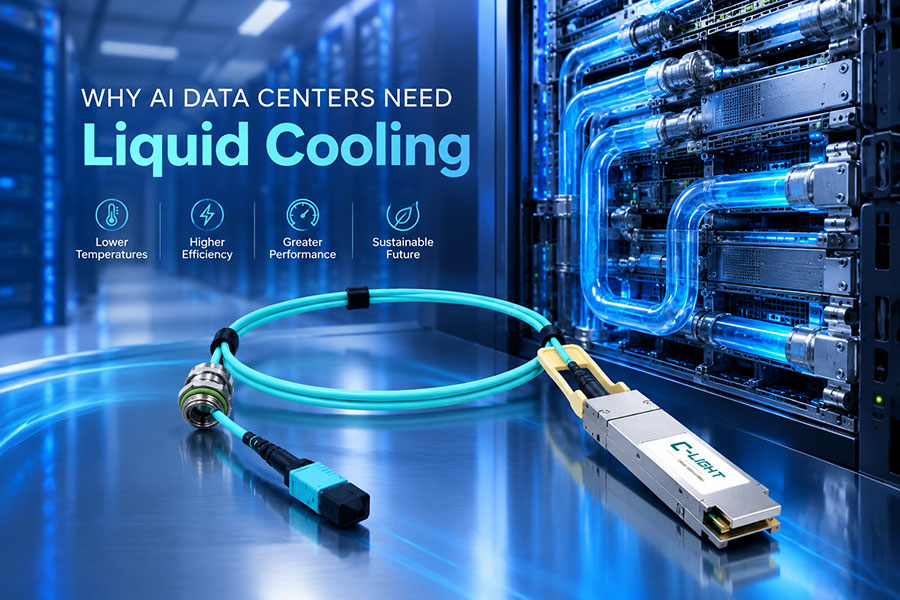
Air cooling can be used in some CPO platforms, but increasing switch power density may require more advanced thermal solutions.
Liquid cooling can provide higher heat-removal capability and may become increasingly relevant as AI switches combine high-power ASICs with dense optical engines.
21. CPO and Data Center Port Density
Higher port density allows a switch to provide more bandwidth within a given rack footprint. However, increasing port density also increases power and thermal density.
CPO can help address the electrical interconnect challenge associated with dense high-speed ports by integrating optical conversion closer to the switching silicon.
22. CPO for AI Data Centers
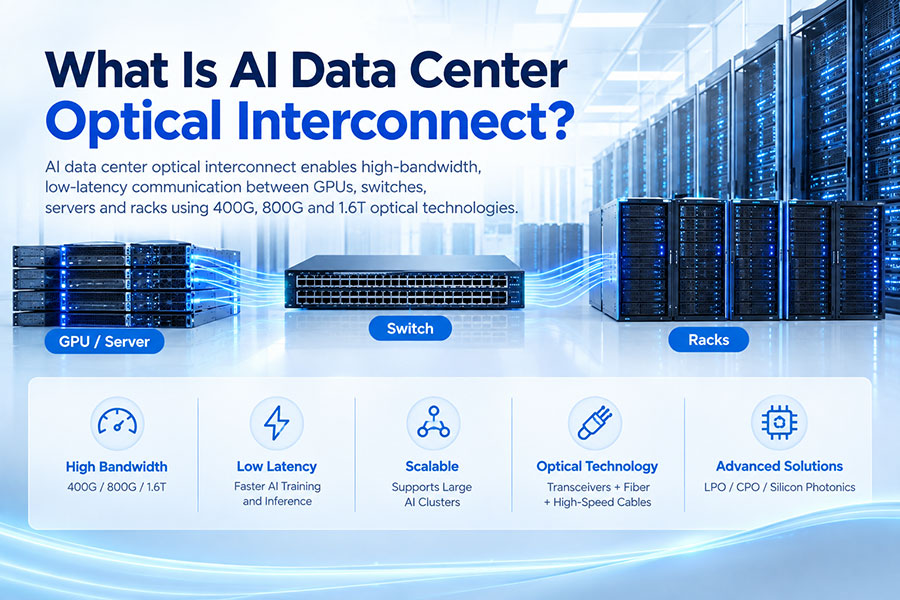
AI clusters generate large volumes of east-west traffic between GPUs, network adapters, switches, and storage systems. High-bandwidth optical connectivity is therefore essential for maintaining efficient cluster communication.
CPO is being considered for AI networking because future switches may require extremely high aggregate bandwidth while keeping power and thermal density under control.
23. CPO and GPU Cluster Networking
In large GPU clusters, switches can become critical aggregation points for thousands of high-speed connections.
As link speeds increase from 400G to 800G and beyond, reducing electrical losses between the switching ASIC and optical interfaces can help support the required bandwidth density.
24. CPO and Optical I/O
CPO is part of a broader movement toward optical I/O, where optical connectivity is brought progressively closer to compute and switching silicon.
The long-term objective is to reduce the electrical distance over which high-speed data must travel before being converted into optical signals.
25. CPO and Coherent Optics
CPO is not limited to a single optical modulation or reach technology. However, the power and integration requirements of coherent optics are different from those of short-reach datacom optics.
Coherent implementations generally require more sophisticated signal processing and optical components, so their power profile must be evaluated separately.
26. CPO and PAM4
PAM4 uses four signal levels to transmit two bits per symbol. It is widely used in high-speed data-center networking because it increases the amount of information carried by each symbol.
The smaller eye openings of PAM4 make signal integrity particularly important. Short electrical paths provided by CPO can help create a more controlled electrical environment.
27. CPO and Signal Integrity
Signal integrity includes insertion loss, return loss, crosstalk, reflections, jitter, inter-symbol interference, and other electrical impairments.
CPO enables the package, ASIC, optical engine, and electrical interfaces to be designed together, potentially improving control over these factors.
28. CPO and Latency
Removing unnecessary signal-processing stages can reduce latency in some architectures. CPO itself is not a guaranteed latency reduction mechanism, but the shorter electrical path and integrated architecture can support lower-latency implementations.
29. CPO and FEC
Forward Error Correction remains important in high-speed optical networking because PAM4 and high data rates increase sensitivity to link impairments.
CPO does not automatically eliminate FEC. The required FEC architecture depends on the Ethernet standard, host ASIC, optical engine, link design, and system implementation.
30. Manufacturing Considerations
CPO introduces different manufacturing requirements compared with pluggable optics. Optical alignment, fiber coupling, thermal interfaces, packaging, testing, and yield become closely connected to the switch manufacturing process.
This can increase manufacturing complexity even while reducing some system-level interconnect challenges.
31. Testing CPO Optical Engines
CPO optical engines require testing for optical power, wavelength, extinction ratio, eye quality, BER, temperature performance, electrical characteristics, and interoperability.
Testing can be more challenging because the optical engine is integrated into the switch package rather than being a standalone field-replaceable module.
32. Reliability Considerations
Reliability is a major consideration for CPO because optical engines operate close to high-power switching silicon.
Thermal cycling, optical coupling stability, laser lifetime, package stress, vibration, contamination, and manufacturing consistency can affect long-term reliability.
33. Serviceability and Upgrades
One important difference between CPO and pluggable optics is serviceability. A pluggable module can normally be replaced independently when it fails or when a network operator upgrades optical technology.
With CPO, the optical engine is more tightly integrated with the switch platform, which can make field replacement and technology upgrades more complex.
34. CPO and Network Flexibility
Pluggable optics provide broad flexibility for different reaches, wavelengths, fiber types, and network architectures. CPO trades some of this flexibility for tighter integration and potentially improved system-level efficiency.
The appropriate architecture therefore depends on the deployment requirements rather than power consumption alone.
35. CPO and Optical Interconnect Cost
CPO can potentially reduce certain system-level interconnect requirements, but the total cost depends on packaging, optical coupling, manufacturing yield, testing, cooling, laser architecture, and volume.
It is therefore not accurate to assume that CPO is universally less expensive than pluggable optics.
36. CPO and System-Level Power
The primary value of CPO is best evaluated at the system level. Optical engine power, ASIC power, electrical-channel power, cooling power, and thermal-management requirements all contribute to the total energy budget.
A reduction in optical-interface power is useful only when the complete system maintains the required bandwidth, reliability, and performance.
37. CPO Versus LPO
| Characteristic | CPO | LPO |
|---|---|---|
| Primary Concept | Physical/package integration | Linear optical signal architecture |
| Optical Position | Near or with ASIC | Usually pluggable |
| DSP | Depends on implementation | Reduced or bypassed in module |
| Electrical Path | Very short | Depends on host and module |
| Serviceability | Lower | Higher |
38. CPO Versus Conventional Pluggable Optics
Conventional pluggable optics remain attractive because they provide modularity, standardized interfaces, easier replacement, and support for multiple optical reaches.
CPO provides a different optimization path by focusing on integration, electrical-channel reduction, bandwidth density, and system-level power management.
39. Challenges of CPO
CPO must address several technical challenges:
Thermal coupling between optics and switching ASICs
Optical coupling and alignment
Manufacturing yield
Testing and qualification
Laser reliability
Field serviceability
Optical-engine replacement
System-level interoperability
40. CPO Deployment Considerations
Before adopting CPO, network designers should evaluate switch bandwidth, optical reach, lane rate, power budget, thermal design, cooling method, optical-engine architecture, fiber connectivity, reliability requirements, and maintenance strategy.
41. Measuring CPO Power Efficiency
A useful evaluation should consider:
Optical engine power per port
Total switch power
Power per transmitted bit
Cooling power
ASIC power
Electrical interconnect power
Thermal density
These metrics provide a more complete picture than comparing optical-engine power alone.
42. Future Development of CPO
As switch bandwidth continues to increase, the electrical connection between switching silicon and optical interfaces becomes a growing system constraint.
Future CPO development is expected to focus on higher lane rates, more efficient optical engines, improved thermal management, better optical coupling, scalable manufacturing, and integration with advanced switching ASICs.
43. CPO and 1.6T Optical Interconnects
At 1.6T and beyond, the combination of high lane rates, dense ports, and increasing switch power makes optical integration increasingly important.
CPO can provide a shorter electrical path and a more tightly optimized architecture for these interfaces. However, the final power advantage depends on the complete implementation.
44. Why CPO Can Address Optical Interconnect Power Consumption
CPO addresses optical interconnect power consumption primarily through architectural integration. By placing optical engines close to the switching ASIC, CPO can reduce electrical-channel loss, simplify high-speed electrical connectivity, and enable closer optimization of the ASIC, optical engine, package, and thermal system.
The result is not simply a lower-power optical module. It is an opportunity to optimize the complete high-bandwidth switch platform.
45. Frequently Asked Questions
Q1. How does CPO reduce optical interconnect power consumption?
Q2. Does CPO eliminate DSP?
Q3. Is CPO the same as LPO?
Q4. Why is CPO important for 800G and 1.6T?
Q5. Does CPO always consume less power than pluggable optics?
Q6. What is one major challenge of CPO?
Q7. Can CPO be used with PAM4?
Q8. Is CPO suitable for AI data centers?
46. Summary
Co-Packaged Optics provides an architectural approach to the power and signal-integrity challenges created by increasingly high-speed optical interconnects. By placing optical engines close to switching ASICs, CPO reduces the electrical distance between the switching silicon and optical conversion point.
This shorter path can reduce electrical-channel loss and create opportunities for lower signal-conditioning overhead, higher bandwidth density, and improved system-level power efficiency. CPO does not automatically eliminate DSP or guarantee lower power, but it provides a platform for optimizing optical engines, electrical interfaces, packaging, and thermal management together.
As data-center networking moves toward 800G, 1.6T, and higher bandwidth, CPO will remain an important architecture for evaluating the relationship between optical interconnect power consumption, signal integrity, thermal design, and system scalability.
 >
>

 >
>
 >
>
 >
>
 >
>
 >
>
 >
>
 >
>