TEL:+86 132 6656 7067




DML and DFB are frequently compared in optical communication, but they do not describe exactly the same layer of laser technology. DML stands for Directly Modulated Laser, which describes how the optical output is modulated. DFB stands for Distributed Feedback Laser, which describes the laser structure used to generate a stable optical carrier. A DML can therefore be built around a DFB laser, making “DML vs DFB” more accurately a comparison between direct modulation and the DFB laser architecture.
1. What Is a DML?
A Directly Modulated Laser (DML) is a laser whose optical output is modulated by directly changing the injection current of the laser. The electrical data signal is applied through a high-speed laser driver, and the laser converts current variations into optical intensity variations.
DML transmitters are attractive because the optical transmitter can be relatively compact, simple, and power efficient. They are widely used in short- and medium-reach optical links, including data center, access, aggregation, and 5G fronthaul applications.
2. What Is a DFB Laser?
A Distributed Feedback Laser (DFB) is a semiconductor laser architecture that uses a periodic grating structure to provide optical feedback and select a specific operating wavelength.
The DFB structure provides narrow spectral output, stable wavelength characteristics, and high side-mode suppression compared with many simpler laser structures. DFB lasers can be used as continuous-wave optical sources or can be directly modulated to create a DML transmitter.
3. Why DML and DFB Are Often Confused
The confusion mainly comes from the fact that many communication DML products use DFB lasers as their underlying laser source.
In a common configuration, the DFB structure determines the laser's wavelength and optical characteristics, while direct current modulation determines how the data signal is imposed on the optical carrier.
| Term | What It Describes | Typical Role |
|---|---|---|
| DML | Modulation method | Directly changes laser current to carry data |
| DFB | Laser architecture | Generates a wavelength-controlled optical carrier |
| DML based on DFB | Combined implementation | Uses a DFB laser with direct electrical modulation |
4. DML vs DFB: The Fundamental Difference
The most important difference is that DML answers the question “How is the laser modulated?” while DFB answers “How is the semiconductor laser designed to generate and stabilize the optical wavelength?”
Therefore, DML and DFB should not normally be treated as mutually exclusive alternatives. A communication transmitter can simultaneously be a DML transmitter and use a DFB laser.
5. Direct Modulation Principle of DML
In a DML transmitter, the driver changes the injection current of the semiconductor laser according to the electrical data waveform. The laser output power therefore follows the modulation signal.
This approach avoids the need for a separate external optical modulator, which helps reduce transmitter size, component count, and implementation complexity.
The main challenge is that changing the laser current can also affect the laser's carrier density, refractive index, optical frequency, and instantaneous wavelength. This produces wavelength variation known as chirp.
6. How DFB Generates a Stable Optical Carrier
A DFB laser incorporates a periodic grating that provides distributed optical feedback. The grating favors a specific optical mode, allowing the laser to operate with a narrow spectral output around its target wavelength.
This wavelength-selective structure is particularly useful for single-mode fiber systems operating around the 1310 nm or 1550 nm regions and for wavelength-specific applications such as CWDM, LAN-WDM, access networks, and telecommunications.
7. DML vs DFB on Chirp
Chirp is one of the most important performance characteristics associated with directly modulated semiconductor lasers.
Because DML changes the laser injection current directly, modulation can cause variations in optical frequency. When combined with fiber chromatic dispersion, this frequency variation can affect signal integrity and available transmission distance.
The DFB structure itself does not mean that the transmitter is highly chirped. Chirp is strongly related to the operating mode, laser design, modulation conditions, driver design, and device optimization.
8. DML vs DFB on Bandwidth
DML bandwidth depends on the dynamic response of the laser, driver, package, and electrical interconnect. The DFB structure provides the optical source, while the directly modulated implementation determines how rapidly the laser can respond to changing electrical current.
Traditional DML technologies have been widely used at 10G and 25G-class rates. Modern InP DML technologies also support higher-speed applications, including 50G PAM4 and selected high-speed optical transmitter implementations.
9. DML vs DFB on Optical Spectrum
A DFB laser is designed to provide controlled wavelength selection and strong side-mode suppression. This makes DFB technology suitable for applications requiring a relatively clean and well-controlled optical spectrum.
When the DFB is directly modulated, the optical spectrum is also influenced by modulation-induced chirp and dynamic behavior. Therefore, the final transmitted spectrum is determined by both the DFB design and the DML operating conditions.
10. DML vs DFB on Power Consumption
DML transmitters can achieve low power consumption because direct modulation eliminates the need for a separate external optical modulator. This makes DML attractive for compact optical modules where power and thermal budgets are important.
DFB is a laser architecture rather than a complete transmitter configuration, so its power consumption cannot be compared directly with a DML transmitter without defining the complete implementation.
11. DML vs DFB on Cost and Complexity
DML generally offers a simpler transmitter architecture than externally modulated approaches. Fewer optical components can help reduce package complexity, assembly requirements, and overall transmitter cost.
DFB lasers are commercially mature semiconductor devices and are available in many wavelength and performance configurations. When a DFB is used as the source in a DML transmitter, the resulting architecture can combine mature wavelength control with relatively simple direct modulation.
12. DML vs DFB for 25G Optical Transceivers
25G DML technology is widely used in single-mode optical transceivers such as 25G SFP28 modules. Common implementations include 1310 nm-class transmission for 10 km links and CWDM wavelength variants.
For example, current DML products are available for 25G operation at 1271, 1291, 1311, and 1331 nm, supporting applications such as 25G LR, BiDi, and 100G CWDM4-related transmitters.
The combination of DFB wavelength selection and direct modulation provides a practical balance of optical performance, power consumption, and transmitter complexity.
13. DML vs DFB for 50G PAM4
Higher-speed electrical interfaces have pushed DML technology beyond conventional NRZ operation. Current DML devices are also available for 50G PAM4 applications.
PAM4 uses four optical amplitude levels to transmit two bits per symbol, allowing higher bit rates without simply doubling the symbol rate. This places greater demands on laser linearity, bandwidth, extinction characteristics, and signal integrity.
Optimized DFB-based DML devices can support selected 50G PAM4 optical transmitter applications while maintaining a relatively compact architecture.
14. DML vs DFB for 100G Optical Transceivers
100G optical modules may use multiple optical lanes, and DML technology can be used on individual lanes depending on the module architecture and performance requirements.
DML-based transmitters have been applied in products associated with 100G DR, FR, LR4, CWDM4, and PSM4 architectures. In multi-lane systems, the total module rate is achieved by combining several optical channels rather than relying on a single 100G DML laser.
15. DML vs EML: An Important Comparison
DML is often compared directly with EML, and this is a more technically equivalent comparison than DML vs DFB.
An EML combines a DFB laser with an electro-absorption modulator. The DFB produces the continuous-wave optical carrier, while the EAM performs the high-speed optical modulation. This architecture separates carrier generation from modulation and can provide lower chirp and high signal fidelity at demanding data rates.
| Characteristic | DML | EML |
|---|---|---|
| Laser source | Commonly DFB | Typically DFB |
| Modulation | Direct current modulation | External electro-absorption modulation |
| Chirp | Higher sensitivity to direct-modulation chirp | Generally lower chirp |
| Architecture | Simpler | More integrated optical functionality |
| Typical advantage | Low power and cost-effective implementation | Higher signal fidelity at demanding rates |
16. DML vs Directly Modulated DFB
In practical optical communication terminology, “DML” and “directly modulated DFB” can sometimes refer to nearly the same transmitter implementation.
The phrase DML emphasizes the modulation method, while directly modulated DFB explicitly identifies the laser structure. This distinction is useful when comparing optical components because it prevents the false assumption that DML and DFB are competing technologies.
17. DML vs DFB for Data Center Applications
DML is particularly attractive for short- and medium-reach optical connectivity where low power, compact implementation, and cost efficiency are important.
DFB-based DML transmitters can be used in 25G, 50G, and selected 100G optical systems. Current industry portfolios include DML products for data center, access, aggregation, and 5G applications.
At higher per-lane speeds, however, the balance between direct modulation, chirp, dispersion, bandwidth, thermal performance, and optical budget becomes increasingly important.
18. DML vs DFB for Telecom and 5G
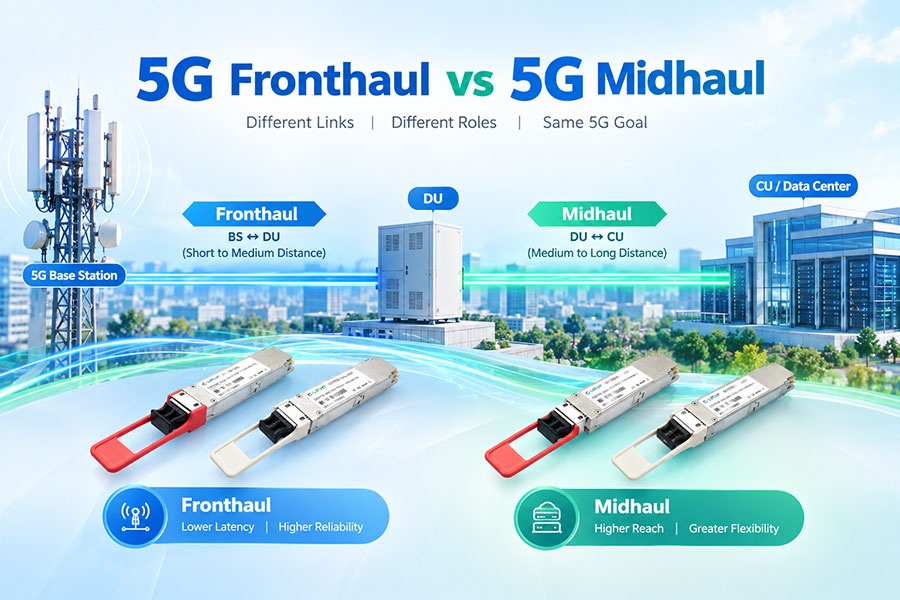
DML technology is widely used in access, aggregation, and 5G optical links because these applications often require a combination of moderate reach, controlled optical performance, low power, and high deployment volume.
DFB lasers provide the wavelength-controlled optical source required by these systems, while direct modulation provides the mechanism for transmitting the electrical data signal.
For 1310 nm-class 25G systems, DFB-based DML transmitters can provide a practical solution for single-mode links extending to approximately 10 km, depending on the complete optical module design.
19. How to Choose Between DML and DFB
The first step is to avoid treating DML and DFB as alternative choices at the same technical level.
If the requirement is to select a modulation architecture, compare DML with EML or other external-modulation technologies.
If the requirement is to select a laser source architecture, compare DFB with alternatives such as FP, VCSEL, tunable lasers, or other semiconductor laser structures.
| Requirement | Recommended Focus |
|---|---|
| Low-cost direct modulation | DML |
| Compact 25G single-mode transmitter | DFB-based DML |
| 50G PAM4 optical transmission | Optimized high-speed DML or EML depending on link requirements |
| Lower chirp and high signal fidelity | EML |
| Fixed wavelength optical carrier | DFB |
| Coherent optical source | Narrow-linewidth DFB or other coherent-grade laser architecture |
20. DML vs DFB: Which Is Better?
There is no universal winner because DML and DFB solve different technical problems.
DML is a modulation approach that can provide a simple, compact, and power-efficient optical transmitter. DFB is a laser architecture that provides wavelength-selective feedback and stable optical generation. In many practical optical transceivers, the two technologies are combined: a DFB laser is directly modulated to form a DML transmitter.
The more meaningful engineering comparison is therefore usually DML vs EML for modulation architecture, or DFB vs other laser architectures for optical source selection.
21.Conclusion
DML and DFB should not be viewed as two directly competing optical transmitter technologies. DML describes direct electrical modulation of the laser, while DFB describes the distributed-feedback laser structure used to generate and control the optical carrier.
Because DML transmitters are commonly built on DFB lasers, a DML can also be a DFB-based transmitter. This combination remains important for 25G, 50G, and selected 100G optical applications across data center, access, aggregation, and 5G networks.
 >
>

 >
>
 >
>
 >
>
 >
>
 >
>
 >
>
 >
>