TEL:+86 132 6656 7067




Distributed Feedback (DFB) lasers and Vertical-Cavity Surface-Emitting Lasers (VCSELs) are two important semiconductor laser technologies used in optical communication. Both convert electrical signals into optical signals, but their device structures, typical wavelengths, fiber environments, packaging approaches, and application ranges are different.
VCSEL technology is strongly associated with short-reach multimode optical links, especially 850 nm data center connectivity. DFB technology is widely used for single-mode optical communication at wavelengths such as 1310 nm and 1550 nm, including longer-reach data center, access, telecom, and high-speed optical links.
The choice between DFB and VCSEL is therefore mainly determined by transmission distance, fiber type, wavelength, optical architecture, data rate, power budget, and system cost rather than by the laser type alone.
1. What Is a DFB Laser?
A Distributed Feedback (DFB) laser is a semiconductor edge-emitting laser that uses a periodic grating structure to provide distributed optical feedback. The grating selects and stabilizes the desired optical mode, allowing the laser to produce a relatively narrow and controlled optical spectrum.
DFB lasers are commonly manufactured using III-V semiconductor materials such as indium phosphide (InP) for 1310 nm and 1550 nm optical communication applications. Depending on the implementation, a DFB can operate as a continuous-wave optical source or be directly modulated as a DML.
DFB technology is widely used where stable wavelength control, single-mode fiber transmission, higher optical power, or longer transmission distance is required.
2. What Is a VCSEL?
A Vertical-Cavity Surface-Emitting Laser (VCSEL) is a semiconductor laser that emits light vertically from the surface of the wafer rather than emitting light from the edge.
VCSELs typically use a vertical optical cavity formed between semiconductor distributed Bragg reflectors. The surface-emitting structure enables wafer-level testing and supports efficient production of laser arrays, making VCSELs particularly attractive for high-volume optical communication applications.
Datacom VCSELs commonly operate around the 850 nm wavelength region and are frequently paired with multimode fiber for short-reach applications.
3. DFB vs VCSEL: Basic Structural Difference
| Characteristic | DFB | VCSEL |
|---|---|---|
| Full Name | Distributed Feedback Laser | Vertical-Cavity Surface-Emitting Laser |
| Emission Direction | From the edge of the chip | Through the surface of the chip |
| Typical Material | Often InP for telecom/datacom wavelengths | Often GaAs for 850 nm-class datacom |
| Common Datacom Wavelength | 1310 nm class | 850 nm class |
| Typical Fiber | Single-mode fiber | Multimode fiber |
| Typical Application | Medium- and long-reach optical links | Short-reach data center links |
| Array Integration | Possible, but generally less associated with dense surface-emitting arrays | Highly suitable for compact arrays |
4. DFB vs VCSEL: Emission Principle
The emission direction is one of the fundamental differences between the two technologies.
A DFB laser emits optical power from the edge of the semiconductor chip. The optical cavity and feedback structure are arranged along the direction of propagation, producing the characteristic edge-emitting architecture.
A VCSEL emits vertically through the surface of the semiconductor wafer. Its short vertical cavity and surface-emission configuration make it especially suitable for arrays with multiple optical channels positioned closely together.
5. DFB vs VCSEL: Wavelength
DFB and VCSEL technologies can be designed for different wavelengths, so wavelength should not be treated as an absolute definition of either laser type. However, commercial optical communication applications commonly associate the two with different wavelength ranges.
VCSELs are widely used around 850 nm for multimode data center applications. Some advanced VCSEL platforms also extend toward other wavelength regions.
DFB lasers are extensively used around 1310 nm and 1550 nm for single-mode fiber communication. For example, 25G DFB transmitters can operate at CWDM wavelengths such as 1271, 1291, 1311, and 1331 nm.
6. DFB vs VCSEL: Fiber Compatibility
VCSEL-based optical transceivers are strongly associated with multimode fiber because 850 nm VCSEL transmission works efficiently with short-reach MMF links. OM3 and OM4 fiber are commonly used in data center environments where the required distance is limited.
DFB lasers are widely paired with single-mode fiber because their wavelength range and optical characteristics support longer transmission distances. Single-mode fiber systems using 1310 nm DFB transmitters are common in access, telecom, aggregation, and medium-reach data center applications.
The fiber type is therefore one of the first parameters to determine when selecting between a VCSEL-based and DFB-based optical solution.
7. DFB vs VCSEL: Transmission Distance
VCSELs are particularly effective for short-reach links. Traditional 850 nm VCSEL-based Ethernet transceivers are commonly used for distances ranging from tens of meters to several hundred meters, depending on data rate and multimode fiber type.
DFB-based solutions are commonly selected when the optical link must extend beyond the practical range of conventional multimode VCSEL links. 1310 nm DFB transmitters can support links of several kilometers and, depending on the transceiver design, can reach 10 km or more.
| Link Environment | Common Technology Direction |
|---|---|
| Very short data center links | VCSEL + MMF |
| Short-reach 100G/400G multimode links | VCSEL arrays + MMF |
| 500 m to 2 km single-mode links | DFB, EML, or other InP-based optical technologies depending on data rate |
| 2 km to 10 km single-mode links | DFB/EML and related technologies |
| Longer telecom transport | DFB and other specialized laser/modulator technologies |
8. DFB vs VCSEL: Modulation
Both DFB and VCSEL devices can be directly modulated. Therefore, the distinction between DFB and VCSEL should not be confused with the distinction between DML and EML.
A DFB laser can be directly modulated by changing its injection current, forming a DML transmitter. A VCSEL can also be directly modulated and is widely used with high-speed electrical drivers in datacom transceivers.
The actual modulation format can be NRZ, PAM4, or another format depending on the generation of the optical module and the required data rate.
9. DFB vs VCSEL: Bandwidth and Data Rate
The achievable data rate is determined by the complete laser, driver, packaging, optical path, receiver, DSP, and link architecture rather than the laser category alone.
Traditional VCSEL technology became widely established in 10G and 25G short-reach datacom applications. More advanced VCSEL platforms have since reached 100G per optical lane using PAM4, supporting 400G and 800G short-reach architectures.
DFB-based DML technology has also progressed to higher speeds. Current 25G DFB DML devices can support 25G operation and selected 50G PAM4 applications, while DFB-based optical architectures continue to be used in higher-speed systems together with external modulators and silicon photonics.
10. DFB vs VCSEL: Optical Power
DFB lasers are well suited to applications that require relatively high optical output power, particularly when combined with single-mode fiber and optical amplification or advanced transmitter architectures.
VCSELs offer efficient operation for short-reach applications and can provide favorable energy efficiency at the system level. Because the optical path is usually shorter and multimode fiber is used, the required transmitter power can be relatively modest.
It is important not to compare transmitter power using the laser type alone. The required optical power depends on fiber attenuation, connector loss, dispersion, receiver sensitivity, link length, modulation format, and the required bit-error performance.
11. DFB vs VCSEL: Chirp
Chirp is the change in instantaneous optical frequency caused by modulation or other changes in laser operation.
Direct modulation of a semiconductor laser can produce frequency chirp because changing the injection current affects both optical power and the internal refractive index. This behavior is relevant to DFB-based DML transmitters as well as directly modulated VCSELs.
The impact of chirp depends on the device design and the fiber link. It becomes increasingly important as transmission distance and chromatic-dispersion sensitivity increase.
For demanding longer-reach links, externally modulated architectures such as EML or DFB-MZ may be selected instead of a simple directly modulated laser.
12. DFB vs VCSEL: Power Consumption
VCSELs have a strong position in short-reach datacom because of their low power consumption, compact construction, and efficient integration into multi-channel arrays.
DFB transmitters can also be highly power efficient, particularly with optimized DML designs. However, single-mode long-reach systems may require additional functions such as wavelength control, temperature management, stronger optical output, or more sophisticated modulation technology.
As data rates increase to 800G and 1.6T, power consumption must be considered on a per-bit basis rather than simply comparing the electrical power of individual lasers.
13. DFB vs VCSEL: Manufacturing and Cost
VCSELs have a manufacturing advantage from their surface-emitting architecture because devices can be tested at wafer level before being separated and packaged. The same architecture also supports dense laser arrays, which is valuable for multi-lane optical modules.
DFB lasers generally require edge-emitting device fabrication and more complex optical coupling and packaging. However, DFB technology is highly mature and supports a broad range of telecom and datacom wavelengths.
For short-reach high-volume data center applications, VCSEL-based solutions can provide a strong cost advantage. For longer single-mode applications, the additional capabilities of DFB-based transmitters can justify their higher optical complexity.
14. DFB vs VCSEL for 25G Optical Transceivers
25G optical transceivers provide a clear example of how application requirements determine the appropriate laser technology.
25G SR modules commonly use 850 nm VCSEL technology with multimode fiber for short-reach connections. For single-mode links around 10 km, 1310 nm-class DFB DML technology is a common approach.
| 25G Application | Typical Laser | Fiber | Typical Reach Class |
|---|---|---|---|
| 25G SR | 850 nm VCSEL | MMF | Short reach |
| 25G LR | 1310 nm DFB/DML | SMF | Up to 10 km class |
| 25G CWDM | 1310 nm-class DFB/DML | SMF | Several km to 10 km class depending on design |
15. DFB vs VCSEL for 100G Optical Transceivers
At 100G, the difference becomes clearer because transceiver architecture often separates into short-reach multimode solutions and longer-reach single-mode solutions.
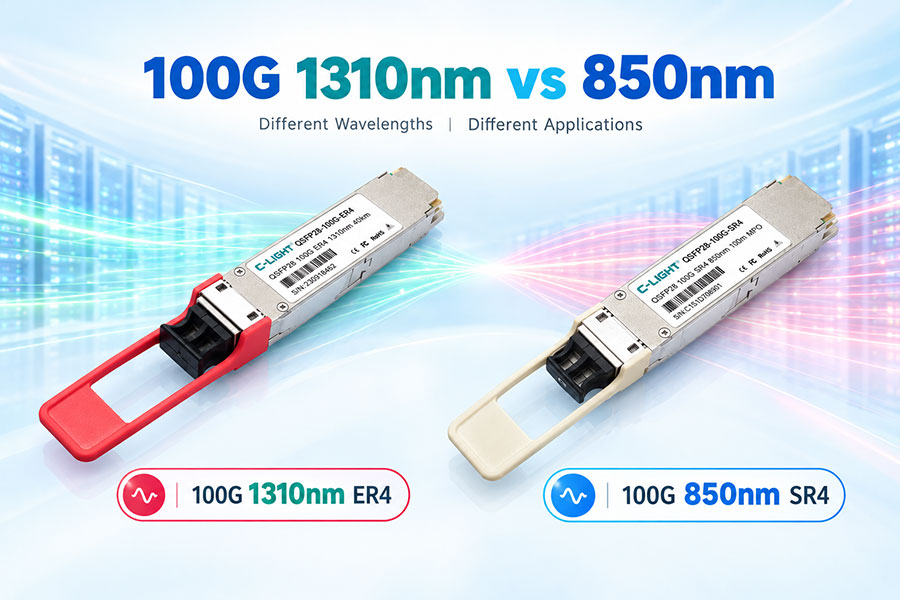
100G SR4 transceivers commonly use multiple 850 nm VCSEL channels over multimode fiber. In contrast, single-mode 100G implementations such as CWDM4, LR4, and other LAN-WDM architectures use longer-wavelength semiconductor lasers and may employ DFB, EML, or related transmitter technologies depending on the design.
This shows why “100G” alone does not determine whether a module should use VCSEL or DFB. The optical lane structure and target reach are equally important.
16. DFB vs VCSEL for 400G and 800G
Higher-speed data center optics are increasingly using multiple optical lanes to achieve aggregate rates such as 400G and 800G.
VCSEL arrays remain highly relevant to short-reach multimode architectures. For example, 800G SR8 designs can use eight 100G-class optical lanes based on VCSEL technology.
For 400G and 800G single-mode applications, the industry uses several optical technologies, including DFB-based architectures, EML, silicon photonics, and other integrated transmitter designs. The appropriate technology depends on reach, lane rate, optical power, linearity, thermal limits, and cost targets.
17. DFB vs VCSEL in AI Data Centers
AI data centers are increasing the demand for high-density and power-efficient optical interconnects. This is creating opportunities for both VCSEL and DFB-based technologies, but in different parts of the network.
VCSELs are particularly attractive for short-reach scale-up and high-density parallel optical connections where large numbers of optical lanes are required in a compact footprint.
DFB and other InP-based technologies remain important for longer single-mode connections between switches, racks, pods, and data center network layers where greater reach is required.
Current industry development is also moving VCSEL technology toward 200G-per-lane operation and advanced array architectures for future AI interconnects, while InP-based DFB, EML, and related technologies continue to develop for 200G-per-lane and beyond applications.
18. DFB vs VCSEL: Beam and Optical Coupling
Because DFB lasers emit from the edge while VCSELs emit through the surface, the optical coupling and packaging approach are different.
DFB transmitters typically use coupling optics to efficiently launch the edge-emitted beam into single-mode fiber. Alignment requirements can be demanding because the optical mode of the laser must match the small core and mode-field characteristics of the fiber.
VCSELs naturally support compact vertical packaging and array arrangements. Their beam can be coupled efficiently into multimode fiber or other optical structures used in parallel interconnect systems.
19. How to Choose Between DFB and VCSEL
The selection should begin with the complete optical link rather than the semiconductor laser itself.
| Requirement | Preferred Technology Direction |
|---|---|
| Very short data center connection | VCSEL |
| 850 nm multimode optical link | VCSEL |
| High-density parallel multimode optics | VCSEL arrays |
| 1310 nm single-mode connection | DFB-based solution |
| Several-kilometer single-mode link | DFB, EML, or related InP technology |
| Longer-reach telecom optical transmission | DFB or more advanced coherent/external-modulation technologies |
| Lowest-cost short-reach architecture | Usually VCSEL-based, subject to link requirements |
| Stable narrow-linewidth optical source | DFB or another appropriate narrow-linewidth laser |
For a C-LIGHT optical transceiver, the practical decision should consider the module form factor, transmission rate, optical lane count, connector type, fiber type, required reach, optical power budget, temperature range, and host-system compatibility. A 25G SFP28 SR design and a 25G SFP28 LR design, for example, may use fundamentally different laser technologies even though both transmit at 25 Gb/s.
20. DFB vs VCSEL: Which Is Better?
Neither DFB nor VCSEL is universally better. Each is optimized for a different class of optical communication applications.
VCSEL is particularly strong for short-reach, high-volume, low-power, high-density multimode connectivity. Its surface-emitting architecture supports efficient manufacturing and multi-channel arrays, making it highly relevant to data center and AI interconnects.
DFB is particularly strong for controlled-wavelength single-mode transmission, medium and long reach, and applications requiring higher optical performance across kilometer-scale links. DFB technology also serves as the optical source for many DML, EML, and integrated photonic transmitter architectures.
The correct choice should therefore be based on the required optical link rather than assuming that one laser technology is inherently superior.
21.Conclusion
DFB and VCSEL are fundamentally different semiconductor laser structures. DFB lasers use distributed optical feedback in an edge-emitting architecture, while VCSELs use a vertical optical cavity and emit light from the semiconductor surface.
In modern optical communication, VCSELs are strongly associated with 850 nm-class short-reach multimode data center links and high-density parallel optical arrays. DFB lasers are widely used for 1310 nm and 1550 nm-class single-mode transmission, including access, telecom, aggregation, and medium- to long-reach datacom applications.
As optical networks move toward 400G, 800G, 1.6T, and higher lane rates, both technologies continue to evolve. VCSELs are advancing toward higher-speed multi-lane and array-based AI interconnects, while DFB-based InP platforms remain important for single-mode transmission and integrated optical transmitter technologies.
 >
>

 >
>
 >
>
 >
>
 >
>
 >
>
 >
>
 >
>