TEL:+86 132 6656 7067




Coherent detection and direct detection are two major approaches used to transmit and receive optical signals in fiber-optic communication systems. Direct detection, commonly implemented as intensity modulation and direct detection (IM/DD), recovers information primarily from changes in optical power. Coherent detection uses a local oscillator and digital signal processing to recover information from the optical field, including amplitude, phase, and polarization.
The two technologies serve different network requirements. Direct detection is widely used where low power, compact design, cost efficiency, and relatively short transmission distances are important. Coherent optics is commonly selected for higher-capacity and longer-reach applications where spectral efficiency, receiver sensitivity, and compensation of transmission impairments become more important.
However, the boundary is no longer defined simply by data rate. Modern direct-detection systems use PAM4 and increasingly advanced DSP, while coherent technology is moving into smaller pluggable modules for data center interconnect and other applications previously dominated by dedicated optical transport equipment.
1. What Is Direct Detection?
Direct detection is an optical receiver architecture in which the photodetector directly measures variations in received optical power.
In a conventional IM/DD system, information is encoded into the intensity of the optical carrier. The photodetector converts the received optical power into an electrical signal, but the receiver does not directly recover the phase of the optical carrier.
A simplified direct-detection path is:
Electrical Data → Optical Modulator / Laser → Fiber → Photodetector → Electrical Signal → DSP / CDR
Traditional OOK and NRZ systems are examples of direct-detection transmission. Modern PAM4 optical links also use direct detection while providing more bits per symbol than NRZ.
2. What Is Coherent Detection?
Coherent detection is an optical receiver architecture that uses a local oscillator laser as a reference to recover information from the received optical field.
The receiver mixes the incoming optical signal with the local oscillator and uses the resulting electrical signals to recover amplitude and phase information. Dual-polarization coherent systems can also recover information carried on two orthogonal polarization states.
A simplified coherent path is:
Electrical Data → DSP → Coherent Modulator → Fiber → Coherent Receiver + Local Oscillator → ADC → DSP → Electrical Data
This additional information dimension allows coherent systems to use advanced modulation formats and digitally compensate for many transmission impairments.
3. What Is the Main Difference Between Coherent and Direct Detection?
| Feature | Direct Detection | Coherent Detection |
|---|---|---|
| Detection Principle | Measures optical power | Uses a local oscillator to recover optical field information |
| Phase Recovery | No direct phase recovery | Yes |
| Polarization Recovery | Not normally available | Yes in dual-polarization systems |
| Typical Modulation | NRZ, PAM4 | QPSK, 8QAM, 16QAM and other coherent formats |
| DSP Complexity | Lower to moderate | High |
| Spectral Efficiency | Lower | Higher |
| Typical Reach | Short to medium reach | Metro, regional, long-haul, DCI and other longer-reach applications |
| Power | Generally lower | Generally higher |
| Cost | Generally lower | Generally higher |
The fundamental difference is how much information the receiver extracts from the optical signal. Direct detection primarily uses intensity, while coherent detection can use amplitude, phase, and polarization.
4. How Does Direct Detection Work?
In a basic direct-detection system, the transmitter changes the optical intensity according to the electrical data.
The photodetector at the receiving end measures the optical power and produces a corresponding electrical signal.
For NRZ OOK, the optical signal can be conceptually represented as:
High Optical Power = 1
Low Optical Power = 0
Modern PAM4 direct-detection systems use four amplitude levels instead of two. PAM4 carries two bits per symbol, allowing higher data rates without doubling the symbol rate.
Direct detection therefore ranges from relatively simple OOK/NRZ systems to sophisticated PAM4 systems with electrical equalization and DSP.
5. How Does Coherent Detection Work?
Coherent detection uses the received optical signal together with a local oscillator.
The incoming signal is mixed with the local oscillator in the coherent receiver. Balanced photodetectors generate electrical signals containing information related to the amplitude and phase of the received optical field.
High-speed ADCs then convert the analog signals into digital data for DSP processing.
The DSP can recover the transmitted symbols and compensate for channel impairments such as chromatic dispersion, polarization effects, frequency offset, and phase variation.
6. Why Does Coherent Detection Recover More Information?
Optical signals have several physical dimensions that can carry information, including amplitude, phase, and polarization.
Direct detection normally recovers information from optical intensity and therefore does not directly preserve the phase information needed for full coherent signal reconstruction.
Coherent detection uses a local optical reference to recover phase information and can also separate the two orthogonal polarization states in dual-polarization systems.
This provides more signal dimensions for encoding information and is one of the main reasons coherent transmission can achieve high spectral efficiency.
7. How Do Modulation Formats Differ?
| Technology | Typical Modulation | Bits per Symbol |
|---|---|---|
| Direct Detection NRZ | NRZ / OOK | 1 |
| Direct Detection PAM4 | PAM4 | 2 |
| Coherent QPSK | QPSK | 2 per polarization dimension |
| Coherent 8QAM | 8QAM | 3 per polarization dimension |
| Coherent 16QAM | 16QAM | 4 per polarization dimension |
The actual achievable line rate is also determined by baud rate, polarization multiplexing, FEC overhead, implementation losses, and other system parameters.
Higher-order coherent modulation increases spectral efficiency but generally requires better optical signal quality and more sophisticated signal processing.
8. How Do PAM4 Direct Detection and Coherent Differ?
PAM4 has become an important direct-detection technology for modern high-speed data center optics. It increases the amount of information per symbol while keeping the receiver architecture fundamentally simpler than a conventional coherent receiver.
| Parameter | PAM4 Direct Detection | Coherent Detection |
|---|---|---|
| Signal Levels | 4 amplitude levels | Amplitude and phase states |
| Phase Recovery | No | Yes |
| Polarization | Normally not used as an information dimension | Can use dual polarization |
| Receiver | Direct photodetection | Coherent receiver with local oscillator |
| DSP | Lower complexity | Higher complexity |
| Typical Environment | Data center and shorter-reach links | DCI, metro and long-reach links |
Google research comparing IM-DD PAM and coherent technology for future high-speed interconnects shows that the two approaches continue to coexist because they provide different trade-offs between reach, power, implementation complexity, and bandwidth scaling.
9. How Do They Differ in DSP Requirements?
DSP is used by both technologies, but coherent systems generally require substantially more digital processing.
Direct-detection DSP can perform functions such as equalization, clock recovery, feed-forward equalization, decision feedback, signal conditioning, and diagnostics. PAM4 links may also use DSP to compensate for bandwidth limitations and electrical or optical distortion.
Coherent DSP performs a broader set of functions, which can include chromatic dispersion compensation, polarization demultiplexing, carrier recovery, frequency-offset compensation, phase recovery, equalization, symbol detection, and FEC processing.
The higher DSP complexity is a major factor in coherent module power consumption and thermal design.
10. How Do They Differ in Chromatic Dispersion Tolerance?
Chromatic dispersion affects both direct-detection and coherent systems, but the two architectures handle it differently.
In direct-detection systems, chromatic dispersion can cause optical power fading and signal distortion because phase information is not directly recovered at the receiver. The resulting penalty can significantly constrain reach as symbol rates increase.
Coherent receivers preserve phase information and use DSP to digitally compensate for accumulated chromatic dispersion.
This compensation capability is one of the major reasons coherent systems are suitable for much longer optical paths.
11. How Do They Differ in Polarization Handling?
Optical fiber supports two orthogonal polarization states. Fiber birefringence can cause polarization changes during transmission.
Direct-detection systems normally do not recover polarization as a separate information dimension.
Coherent systems can use dual-polarization transmission and DSP-based polarization demultiplexing to recover both polarization channels after transmission.
Dual-polarization is therefore an important part of the capacity scaling used by modern coherent optical systems.
12. How Do They Differ in Receiver Sensitivity?
Coherent receivers can achieve high sensitivity because the incoming signal is detected relative to a local oscillator. The optical reference provides additional detection capability and allows the receiver to extract more information from weak signals.
Direct-detection receivers measure the received optical power directly and therefore use a simpler detection architecture.
Higher coherent sensitivity does not automatically mean that every coherent module can operate over a longer distance. Actual reach depends on OSNR, transmitter power, modulation format, FEC, baud rate, fiber characteristics, amplifier configuration, and the complete optical line system.
13. How Do They Differ in Transmission Distance?
Reach is one of the clearest practical differences between the two technologies, although there is considerable overlap.
| Application | Typical Technology Direction |
|---|---|
| 100 m-class data center links | Direct detection |
| 500 m-class data center links | Direct detection |
| 2 km data center links | Direct detection |
| 10 km Ethernet links | Direct detection or coherent depending on system requirements |
| 40 km-class links | Direct detection in selected systems or coherent |
| 80–120 km DCI | Coherent |
| Metro / regional transport | Coherent |
| Long-haul transport | Coherent |
The boundary between the technologies changes with data rate. As transmission rates and baud rates increase, direct-detection reach becomes more difficult to extend, while coherent techniques remain attractive for longer links.
14. How Do They Differ in Spectral Efficiency?
Spectral efficiency measures how much information can be transmitted within a given amount of optical spectrum.
Coherent systems generally achieve higher spectral efficiency because they can use amplitude, phase, polarization, and higher-order modulation formats.
Direct-detection PAM4 improves spectral efficiency compared with NRZ, but it does not use the same combination of phase and polarization dimensions as a conventional dual-polarization coherent system.
Higher spectral efficiency is particularly valuable in DWDM networks where many optical channels share a limited amount of spectrum.
15. How Do They Differ in Optical Spectrum and DWDM?
Direct-detection systems can operate over WDM networks, including CWDM and DWDM. However, coherent technology is especially well suited to dense DWDM systems where high spectral efficiency and long reach are important.
Coherent pluggables can transmit high-capacity wavelengths over DWDM line systems and can be remotely routed through ROADM networks in suitable architectures.
400ZR is a well-known example of coherent technology being integrated into a pluggable module for high-capacity DCI over DWDM.
Direct-detection optics remain common on client-side data center links, while coherent optics is frequently used on the longer optical line side of the network.
16. How Do They Differ in Power Consumption?
Direct-detection modules generally have lower power consumption because their optical receiver and signal-processing architecture is simpler.
Coherent modules typically require a local oscillator, coherent optical front end, high-speed ADC/DAC functions, complex DSP, and additional thermal management.
As a result, coherent modules commonly have higher absolute power consumption than comparable short-reach direct-detection modules.
However, modern coherent pluggables have reduced power substantially compared with earlier dedicated coherent transport equipment. The relevant engineering metric can therefore be power per transmitted bit rather than module power alone.
17. How Do They Differ in Cost and Complexity?
| Factor | Direct Detection | Coherent |
|---|---|---|
| Optical Components | Fewer and simpler | More complex |
| DSP | Lower complexity | High complexity |
| Local Oscillator | Not required | Required |
| Module Cost | Generally lower | Generally higher |
| Thermal Design | Simpler | More demanding |
| Deployment Complexity | Lower for short-reach applications | Higher, especially with optical line systems |
For a link that can be supported by direct detection, using a coherent module may add unnecessary complexity and cost. Coherent becomes more attractive when the network needs capabilities that direct detection cannot provide efficiently.
18. How Do They Differ in Network Applications?
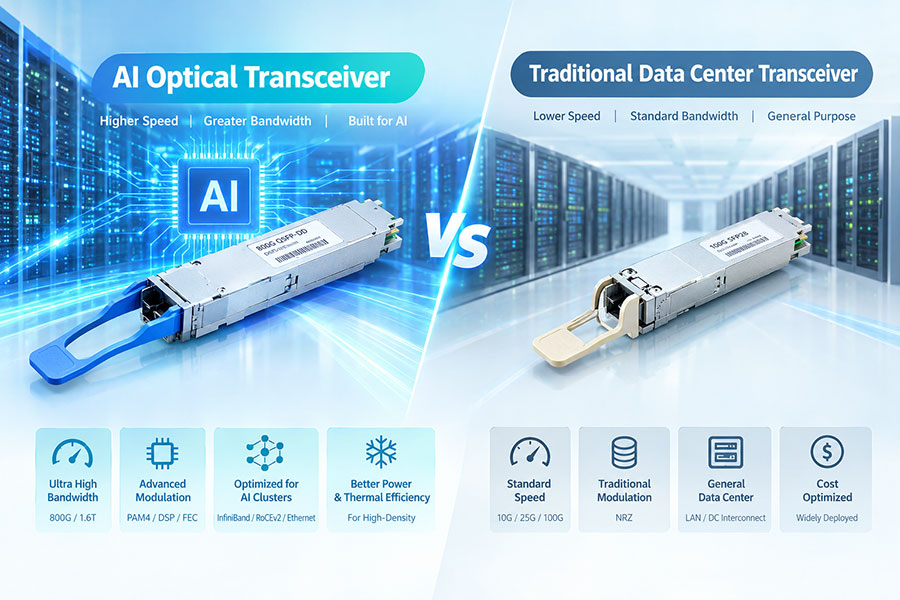
Direct Detection: Commonly used for short and medium data center connections, including 100G, 200G, 400G, and 800G Ethernet optics based on NRZ or PAM4 technologies.
Coherent: Commonly used for data center interconnect, metro transport, regional networks, long-haul networks, and other applications requiring high spectral efficiency and longer reach.
400ZR and 800ZR are examples of coherent technologies designed to bring very high-capacity optical transmission into compact pluggable modules for DCI and related DWDM applications.
The two technologies can also coexist in one network. A data center can use direct-detection client optics for short switch-to-server links and coherent optics for the longer DCI connection between facilities.
19. How Does 400G Compare Between Direct Detection and Coherent?
400G is an important example because it can be implemented using both direct-detection and coherent technologies.
| 400G Solution | Detection | Typical Application |
|---|---|---|
| 400G-SR8 | Direct Detection | Short data center links |
| 400G-DR4 | Direct Detection | Data center single-mode links |
| 400G-FR4 | Direct Detection | 2 km-class data center links |
| 400G-LR4 | Direct Detection | 10 km-class links |
| 400ZR | Coherent | DCI and DWDM |
| 400G ZR+ class | Coherent | Extended DCI and transport |
This demonstrates why "400G" alone does not identify the transmission technology. The optical architecture and target reach determine whether direct detection or coherent transmission is more appropriate.
20. How Should You Choose Between Coherent and Direct Detection?
| Requirement | Typical Direction |
|---|---|
| Lowest power and cost for a short link | Direct Detection |
| Simple data center optical connection | Direct Detection |
| 100G / 400G short-reach Ethernet | Direct Detection |
| PAM4-based high-speed data center connectivity | Direct Detection |
| Longer 40 km-class transport | Depends on optical budget and architecture |
| 80–120 km DCI | Coherent |
| High spectral efficiency | Coherent |
| DWDM long-distance transport | Coherent |
| ROADM-based optical network | Coherent |
| Metro / regional / long-haul | Coherent |
The decision should consider transmission distance, data rate, baud rate, optical power budget, OSNR, fiber type, DWDM channel spacing, FEC, DSP requirements, power consumption, equipment compatibility, and total system cost.
21.Conclusion
Coherent and direct detection are two different optical transmission architectures with different strengths.
Direct detection measures optical power and generally provides a simpler, lower-power, and more cost-efficient solution. Modern PAM4 direct-detection technology has extended this architecture to much higher data rates and remains central to short- and medium-reach data center networking.
Coherent detection uses a local oscillator and advanced DSP to recover amplitude, phase, and polarization information. This enables higher spectral efficiency, stronger impairment compensation, and much longer transmission distances.
The choice is therefore not simply a matter of which technology is more advanced. Direct detection is highly effective when the optical path is short enough for its simpler architecture to provide the required performance. Coherent optics becomes more valuable when reach, spectral efficiency, DWDM integration, and optical transport flexibility become dominant requirements.
Modern networks frequently use both technologies together. Direct-detection modules can handle high-volume short-reach data center connectivity, while coherent pluggables can provide high-capacity DCI, metro, and long-distance optical transport.
 >
>

 >
>
 >
>
 >
>
 >
>
 >
>
 >
>
 >
>