TEL:+86 132 6656 7067




Every generation of mobile technology has demanded more from the transport network that connects radio sites to the core. But the jump from 4G to 5G is not a linear increase in bandwidth. It is a structural change in what the transport network must do, how it is organized, and what performance guarantees it must deliver.
A traditional mobile transport network had a straightforward job: carry backhaul traffic between a base station and a centralized core. The base station was a monolithic unit—a remote radio head (RRH) connected by a short CPRI link to a baseband unit (BBU), and the BBU connected to the core through an IP/MPLS backhaul network. The transport network was optimized for bandwidth and availability. Latency mattered, but it was measured in milliseconds, not microseconds. Synchronization was needed, but at a level that existing SDH or packet-based timing could provide.
5G breaks this model in three ways. First, the radio access network itself disaggregates: the base station splits into centralized, distributed, and radio units, creating three distinct transport segments—fronthaul, midhaul, and backhaul—each with its own bandwidth, latency, and synchronization requirements. Second, the service mix expands to include ultra-reliable low-latency communication (URLLC) and massive machine-type communication (mMTC), demanding deterministic performance that a best-effort packet network cannot guarantee. Third, network slicing requires the transport network to partition a single physical infrastructure into multiple logically isolated networks, each with its own service-level agreement.
The result is that 5G transport is not simply a faster version of traditional backhaul. It is a different kind of network: one that must be deterministic, sliceable, and synchronized to a degree that previous mobile transport generations never required. This guide examines the architectural, protocol, and performance differences between the two.
1. The Traditional Mobile Transport Model
To understand what changed, it helps to be precise about what came before.
In a traditional 4G network, the base station—an eNodeB—consisted of two main parts. The Remote Radio Head (RRH) sat at the top of the tower or on the rooftop, performing radio frequency processing. The Baseband Unit (BBU) sat at the bottom of the tower or in an equipment cabinet, performing baseband processing. The RRH and BBU were connected by a CPRI link—a constant-bit-rate, point-to-point optical interface carrying digitized radio samples.
The BBU connected to the mobile core through a backhaul network. In most deployments, this was an IP/MPLS network running over optical transport. The backhaul carried user-plane traffic, control-plane signaling, and operations and maintenance data between the base station and the core. Bandwidth requirements were modest by 5G standards: a typical 4G sector might be served by a 100 Mb/s backhaul link, scaling to a few hundred Mb/s for higher-capacity sites.
Latency requirements were similarly modest. The 3GPP specification for 4G backhaul allowed round-trip latency in the range of tens of milliseconds, and the transport network was designed to meet that budget with comfortable margin. Synchronization was required for TDD and for coordinated multipoint operation, but frequency accuracy on the order of 50 parts per billion and phase accuracy of a few microseconds were sufficient.
The transport network was therefore optimized for three things: bandwidth efficiency, availability, and cost. It was a packet network, relying on statistical multiplexing and best-effort forwarding, with QoS mechanisms to prioritize real-time traffic when congestion occurred. Deterministic latency was not a design goal because the applications did not demand it.
2. Why 5G Changes the Transport Equation
5G introduces three architectural changes that collectively transform the transport network's role.
2.1 RAN Disaggregation
The monolithic base station is replaced by a disaggregated architecture. The functions of the base station are split across three logical entities:
Radio Unit (RU): Handles radio frequency processing, analog-to-digital conversion, and the lower part of the physical layer. Located at the antenna site.
Distributed Unit (DU): Handles the upper physical layer and real-time baseband processing. May be located at the cell site, a nearby aggregation point, or a regional hub.
Centralized Unit (CU): Handles non-real-time functions such as packet data convergence protocol, radio resource control, and service data adaptation protocol. Located at a regional data center or central office.
This disaggregation creates three transport segments, each connecting two of these entities.
| Segment | Connects | Interface | Characteristics |
|---|---|---|---|
| Fronthaul | RU to DU | eCPRI, RoE | Point-to-point, strict latency, high bandwidth |
| Midhaul | DU to CU | F1 (IP-encapsulated) | Tree or ring topology, moderate latency, flexible |
| Backhaul | CU to 5G Core | N2/N3 (IP-encapsulated) | Any topology, IP routing, service-aware |
The traditional model had only one segment: backhaul. The 5G model has three, each with distinct requirements.
2.2 New Service Classes
5G defines three broad service categories, each with different transport implications.
Enhanced Mobile Broadband (eMBB): High-bandwidth applications—video streaming, AR/VR, fixed wireless access. The transport requirement is primarily capacity: a 200 MHz 5G sector may require 1 Gb/s of backhaul, compared with 100 Mb/s for a typical 4G sector.
Ultra-Reliable Low-Latency Communication (URLLC): Industrial automation, remote control, autonomous vehicles. The transport requirement is deterministic latency—typically 1 to 10 milliseconds end-to-end, with jitter measured in microseconds, and reliability of 99.999 percent or better.
Massive Machine-Type Communication (mMTC): IoT sensors, metering, asset tracking. The transport requirement is connection density and efficiency rather than bandwidth or latency. Millions of devices per square kilometer must be supported, with low signaling overhead.
These service classes are not orthogonal. A single transport network must support all three simultaneously, which means it must be capable of both statistical multiplexing for efficiency and hard isolation for deterministic services.
2.3 Network Slicing
Network slicing allows a single physical network to be partitioned into multiple logical networks, each serving a different service class or tenant. A slice includes radio, transport, and core resources, and it is managed end-to-end with its own SLA.
From the transport perspective, slicing requires:
Hard isolation: Traffic in one slice must not be affected by congestion or failures in another slice.
Guaranteed bandwidth: Each slice receives a committed bandwidth allocation that cannot be preempted.
Deterministic latency: Each slice has a latency budget that must be met under all conditions, including congestion and failover.
Programmable provisioning: Slices must be created, modified, and deleted dynamically, without affecting existing traffic.
These requirements are difficult to meet with a traditional best-effort packet transport network. They demand new transport technologies.
3. Fronthaul: The New Bandwidth and Latency Challenge
The fronthaul segment is the most demanding part of 5G transport, and it has no real equivalent in traditional mobile networks.
In a traditional network, the CPRI link between RRH and BBU was a short, point-to-point connection—typically a few hundred meters to a few kilometers of dark fiber. It carried a constant bit rate proportional to the number of antenna carriers, and its latency budget was generous because the link was short and the protocol was simple.
In 5G, the fronthaul connects the RU to the DU, and both may be located farther apart. The split point may be higher or lower in the protocol stack, depending on the functional split option chosen by the operator. Lower splits (closer to the radio) require more bandwidth but simpler RUs; higher splits (closer to the baseband) require less bandwidth but more complex RUs.
| Split Option | Location | Fronthaul Bandwidth (per 100 MHz sector) | Latency Requirement |
|---|---|---|---|
| Option 8 (CPRI) | Between PHY and RF | ~25 Gb/s | < 100 µs |
| Option 7-2 (eCPRI) | Within PHY (low/high split) | ~10–25 Gb/s | < 100 µs |
| Option 6 | Between MAC and PHY | ~2–5 Gb/s | < 250 µs |
| Option 2 (Midhaul) | Between RLC and PDCP | ~100 Mb/s–1 Gb/s | 1–10 ms |
The latency requirement for fronthaul is extreme: less than 100 microseconds one-way for the most demanding split options. This is roughly one-hundredth of the latency budget that a traditional backhaul network was designed to meet. It is also well below the queuing delays that can occur in a packet-switched network under congestion, which is why fronthaul has traditionally been deployed as a point-to-point or point-to-multipoint optical link rather than a switched packet network.
Bandwidth is equally demanding. A single 100 MHz 5G sector with massive MIMO may require 25 Gb/s of fronthaul capacity—roughly 250 times the backhaul requirement of a typical 4G sector. A site with three sectors would require 75 Gb/s of fronthaul, and a high-capacity site with additional carriers could require 150 Gb/s or more.
This combination of high bandwidth and ultra-low latency is why fronthaul is the segment where OTN and dedicated optical transport remain most relevant, and where packet-based approaches must be carefully engineered to meet the latency budget.
4. Fronthaul Protocols: eCPRI and Radio over Ethernet
Traditional CPRI is a constant-bit-rate interface. It carries digitized radio samples at a fixed rate regardless of whether user traffic is present. This makes it simple and deterministic, but bandwidth-inefficient: during periods of low traffic, the CPRI link still carries full-rate samples.
5G fronthaul moves to packet-based protocols that allow statistical multiplexing and more flexible bandwidth allocation.
4.1 eCPRI
Enhanced CPRI (eCPRI) is defined by the CPRI Forum and is the primary fronthaul protocol for 5G. Unlike CPRI, eCPRI is packet-based and supports Ethernet or IP encapsulation. It defines several message types for different functional splits, and it allows the fronthaul bandwidth to scale with actual traffic rather than being fixed by the number of antenna carriers.
eCPRI is typically carried over Ethernet at 10 GbE or 25 GbE, with 25 GbE becoming the mainstream interface for high-capacity 5G radios. The protocol supports synchronization through IEEE 1588 Precision Time Protocol (PTP) and SyncE, which are required to maintain the phase alignment between RU and DU.
4.2 Radio over Ethernet
Radio over Ethernet (RoE), defined in IEEE 1914.3, addresses a different problem: how to transport existing CPRI traffic over an Ethernet network. RoE specifies encapsulation formats that map CPRI streams into Ethernet frames, allowing operators to converge 4G CPRI-based radios and 5G eCPRI-based radios onto a single packet-based fronthaul network.
The benefit of RoE is convergence. An operator with a large installed base of 4G CPRI radios can migrate to a packet-based fronthaul network without replacing those radios. The CPRI streams are packetized at a fronthaul gateway, transported over Ethernet, and de-packetized at the far end. This allows a single transport network to serve both 4G and 5G traffic, reducing cost and simplifying operations.
| Protocol | Standard | Encapsulation | Primary Use |
|---|---|---|---|
| CPRI | CPRI Forum | TDM, constant bit rate | 4G and legacy fronthaul |
| eCPRI | CPRI Forum | Ethernet / IP | 5G fronthaul, packet-based |
| RoE | IEEE 1914.3 | Ethernet | CPRI over Ethernet convergence |
5. Midhaul and Backhaul: IP-Based but with New Constraints
The midhaul and backhaul segments are more similar to traditional backhaul than the fronthaul segment, but they carry new requirements.
Both midhaul and backhaul are IP-encapsulated. The F1 interface between DU and CU carries control-plane and user-plane traffic over IP; the N2 and N3 interfaces between CU and the 5G core are also IP-based. This means that midhaul and backhaul can be carried over standard IP/MPLS or segment-routed networks, using the same routing and forwarding technologies that have been deployed for decades.
What changes is the performance envelope. The midhaul latency budget is typically 1 to 10 milliseconds, which is tighter than traditional backhaul but not as extreme as fronthaul. The bandwidth requirement scales with the number of DUs aggregated to a CU, which can range from a few hundred Mb/s to several Gb/s per DU. And the backhaul must support the full service mix of the 5G core, including network slicing, URLLC, and edge computing traffic.
The key architectural insight is that midhaul and backhaul are similar enough in their requirements that they can be carried over a converged transport solution. The ITU-T notes that "using one universal transport solution for both midhaul and backhaul is desired" because their bandwidth requirements and packet-based flexibility needs are similar. Fronthaul, by contrast, requires a separate treatment because its bandwidth is much higher and its latency budget much tighter.
6. Deterministic Transport: FlexE and SPN
Standard Ethernet is a best-effort technology. It provides no guarantee that a packet will arrive within a specified latency, and its queuing behavior under congestion can introduce jitter that violates URLLC requirements. To meet 5G's deterministic requirements, the industry has developed new transport technologies that add deterministic behavior to Ethernet.
6.1 Flexible Ethernet (FlexE)
FlexE, standardized by OIF and adopted by ITU-T as part of the MTN (Metro Transport Network) framework, decouples the Ethernet MAC rate from the physical layer rate. It allows a physical Ethernet link to be partitioned into multiple sub-rate channels, each of which can be allocated to a different service or slice.
FlexE provides several capabilities that are essential for 5G transport:
Hard bandwidth isolation: Each FlexE channel is allocated a fixed timeslot within the physical link. Traffic in one channel cannot consume bandwidth allocated to another channel, even if the first channel is congested.
Deterministic latency: Because bandwidth is allocated by timeslot rather than by packet scheduling, the queuing delay in each channel is bounded and predictable.
Flexible bandwidth granularity: Channels can be sized in increments of 5 Gb/s, allowing fine-grained allocation that matches the actual traffic demand.
Multi-link bonding: Multiple physical links can be bonded into a FlexE group, and channels can be allocated across the group, enabling flexible capacity scaling.
FlexE is the foundational technology for transport network slicing in 5G. It allows a single physical network to carry multiple slices, each with its own guaranteed bandwidth and deterministic latency, without the slices interfering with each other.
6.2 Slicing Packet Network (SPN)
SPN, standardized by ITU-T as G.8312, is a transport architecture built on FlexE. It was developed by China Mobile and has been widely deployed in China's 5G networks. SPN combines FlexE for hard isolation at the forwarding layer with segment routing for flexible service routing at the control layer.
SPN provides:
N × 5 Gb/s hard pipes for deterministic slice isolation, building on FlexE's timeslot allocation.
Segment routing for flexible, programmable path selection across the transport network.
Integrated synchronization for frequency and phase alignment required by 5G TDD and CoMP.
OAM mechanisms for carrier-grade fault management and performance monitoring.
SPN is one of several approaches to 5G transport slicing. The common thread across all of them is that standard Ethernet alone cannot provide the determinism that 5G requires; additional mechanisms are needed to guarantee bandwidth, bound latency, and isolate slices.
7. Synchronization: A Requirement That Tightens Dramatically
Synchronization is a requirement that exists in all mobile transport networks, but 5G tightens it substantially.
In a traditional 4G network, frequency synchronization was required to maintain the carrier frequency within the accuracy specified by 3GPP—typically 50 parts per billion. Phase synchronization was needed for TDD operation and for coordinated multipoint (CoMP), but the accuracy requirement was on the order of a few microseconds.
In 5G, the requirements are tighter for three reasons:
Higher carrier frequencies: cmWave and mmWave spectrum requires more precise frequency accuracy to maintain orthogonality between subcarriers.
Larger antenna arrays: Massive MIMO requires phase alignment across many antenna elements, which demands tighter phase synchronization between RU and DU.
New applications: URLLC and industrial IoT applications require phase alignment on the order of 1 microsecond or better, and some applications require sub-microsecond accuracy.
| Parameter | Traditional 4G | 5G |
|---|---|---|
| Frequency accuracy | 50 ppb | 50 ppb (baseline); tighter for some bands |
| Phase accuracy | ~1.5–5 µs | ~1.5 µs (baseline); <1 µs for URLLC/CoMP |
| Primary protocol | SyncE, IEEE 1588 | SyncE, IEEE 1588v2, PTP telecom profile |
| Where needed | Backhaul | Fronthaul, midhaul, and backhaul |
The critical difference is not just the accuracy target but where synchronization must be delivered. In a traditional network, synchronization was needed at the base station. In 5G, it is needed at the RU, the DU, and the CU—across all three transport segments. This means that the transport network must carry synchronization information end-to-end, from the core to the radio, with the accuracy required at the radio interface.
OTN-based transport has an advantage in this area because it is inherently transparent to synchronization. An OTN link introduces latency variance below 100 nanoseconds, compared with microsecond-level jitter in packet-based transport under load. This makes OTN well-suited for fronthaul and for any segment where phase synchronization must be preserved with high accuracy.
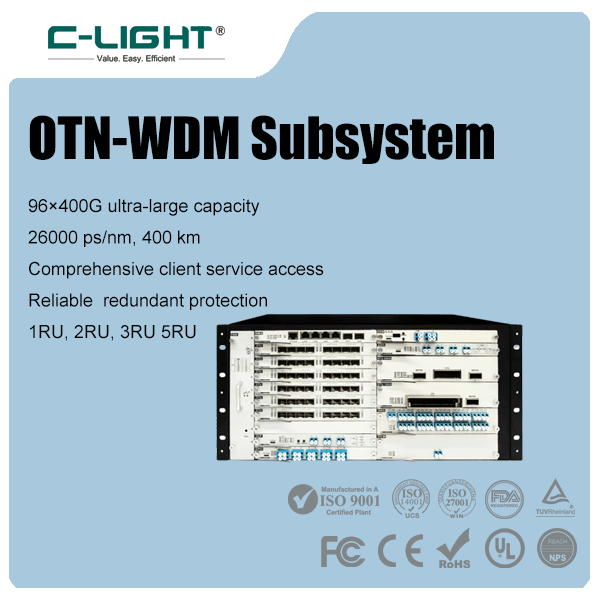
8. OTN in 5G Transport
OTN—Optical Transport Network—was originally designed for telecom backbone transport, carrying SONET/SDH and Ethernet services over long distances with carrier-grade operations, administration, and maintenance. It has been adapted for 5G transport because it offers several properties that packet-based transport cannot match.
8.1 Protocol Transparency
OTN carries client signals transparently. It does not inspect packet headers or make forwarding decisions based on packet content. This means it can carry CPRI, eCPRI, Ethernet, or IP traffic without modification, and it can carry synchronization information without introducing jitter. For fronthaul, where the client signal is a time-sensitive radio stream, this transparency is essential.
8.2 Deterministic Latency
OTN uses time-division multiplexing with fixed-size frames. The queuing behavior is deterministic: a frame occupies a known timeslot, and its latency through the network is bounded and predictable. OTN latency variance is below 100 nanoseconds, which is orders of magnitude lower than the microsecond-level jitter that packet-based transport can exhibit under load.
8.3 Hierarchical Grooming
OTN supports ODUflex, a flexible container that can be sized in increments of approximately 1.25 Gb/s. This allows the transport network to groom traffic at fine granularity, matching the bandwidth of individual services or slices without over-provisioning. It also allows different client signals to be mapped into different ODU containers, providing the isolation that network slicing requires.
8.4 Carrier-Grade Protection
OTN provides protection switching at the optical layer, with switching times typically below 50 milliseconds. This protection is independent of the client signal and does not require packet-level rerouting, which makes it faster and more deterministic than packet-based protection.
The trade-off is complexity and cost. OTN equipment has historically been more expensive than packet-based equipment, and it requires optical engineering expertise that many operators do not have in-house. For these reasons, OTN is most commonly deployed in the fronthaul and aggregation segments, where its performance advantages justify the cost, while midhaul and backhaul use packet-based transport with FlexE or SPN for determinism.
9. Comparing the Two Architectures
| Dimension | Traditional Mobile Transport | 5G Transport |
|---|---|---|
| RAN Architecture | Monolithic base station (RRH + BBU) | Disaggregated (RU + DU + CU) |
| Transport Segments | Backhaul only | Fronthaul, midhaul, backhaul |
| Fronthaul Protocol | CPRI (constant bit rate) | eCPRI, RoE (packet-based) |
| Backhaul Bandwidth | 100 Mb/s–1 Gb/s per sector | 1–25 Gb/s per sector (fronthaul); 1–10 Gb/s (backhaul) |
| Latency Requirement | Milliseconds (backhaul) | <100 µs (fronthaul); 1–10 ms (midhaul/backhaul) |
| Latency Determinism | Best-effort, statistical QoS | Deterministic, bounded jitter |
| Dimension | Traditional Mobile Transport | 5G Transport |
|---|---|---|
| Synchronization | Frequency + phase (µs) | Frequency + phase (sub-µs for URLLC/CoMP) |
| Slice Isolation | Not supported | Hard isolation via FlexE/SPN |
| Transport Technologies | IP/MPLS, SDH, OTN | FlexE, SPN, OTN, segment routing, SRv6 |
| Service Classes | Mobile broadband | eMBB, URLLC, mMTC |
| Deployment Model | Silo-based, vertically integrated | Converged, slice-aware, programmable |
The comparison reveals the fundamental shift. Traditional transport was a single-segment, best-effort network optimized for bandwidth and availability. 5G transport is a multi-segment, deterministic network optimized for latency, synchronization, and isolation—in addition to bandwidth.
10. Deployment Implications
The architectural differences between traditional and 5G transport have practical implications for how networks are designed, deployed, and operated.
10.1 Fronthaul Requires a Different Physical Layer
The latency and synchronization requirements of fronthaul cannot be met with a standard packet-switched network under congestion. This means fronthaul is typically deployed as a point-to-point or point-to-multipoint optical link, using OTN or dedicated Ethernet with FlexE for determinism. The physical layer may be dark fiber, passive optical network, or WDM, depending on distance and capacity requirements.
10.2 Midhaul and Backhaul Can Be Converged
Midhaul and backhaul have similar bandwidth and latency requirements, and both are IP-encapsulated. This allows them to be carried over a converged packet transport network, using FlexE or SPN for slice isolation and segment routing for flexible path selection. The converged network reduces cost and simplifies operations compared with maintaining separate transport networks for each segment.
10.3 Synchronization Must Be Delivered End-to-End
5G requires synchronization at the RU, DU, and CU. This means the transport network must carry synchronization information from the core to the radio edge, with the accuracy required at the radio interface. SyncE and IEEE 1588 PTP are the primary protocols, and OTN's transparency to synchronization makes it well-suited for fronthaul segments where phase accuracy is critical.
10.4 Slicing Requires New Operational Capabilities
Network slicing is not just a transport technology; it is an operational model. Creating, managing, and monitoring slices requires orchestration across radio, transport, and core domains. The transport network must expose slice-level APIs, provide per-slice performance monitoring, and support dynamic slice creation and modification without affecting existing traffic. This is a significant change from traditional transport operations, which were focused on static circuit provisioning and fault management.
11. Emerging Trends
11.1 Segment Routing and SRv6
Segment routing is increasingly used in 5G transport for its scalability and programmability. SRv6, in particular, allows the transport network to encode path and service information in IPv6 headers, enabling flexible routing and service chaining without maintaining per-flow state in the network. This simplifies slice provisioning and supports the dynamic path selection that 5G services require.
11.2 Converged Packet-Optical Transport
The boundary between packet transport and optical transport is blurring. Converged platforms integrate packet switching and OTN switching in a single chassis, allowing operators to provision both packet-based and optical-based services from the same network element. This reduces cost and simplifies operations, and it supports the mix of fronthaul (OTN), midhaul (packet), and backhaul (packet) that 5G requires.
11.3 Time-Sensitive Networking for 5G
IEEE 802.1 Time-Sensitive Networking (TSN) provides deterministic Ethernet forwarding with bounded latency and jitter. The integration of TSN with 5G transport is an active area of development, particularly for industrial applications where URLLC and TSN must work together. TSN provides the deterministic Ethernet layer that 5G URLLC requires, and it complements FlexE by providing per-flow determinism in addition to per-slice bandwidth isolation.
11.4 Toward 6G Transport
Research into 6G transport is already underway. The requirements are expected to be even more demanding than 5G: higher bandwidth (100 Gb/s per radio site), lower latency (sub-100 µs end-to-end), tighter synchronization (sub-nanosecond for some applications), and more flexible slicing. The transport technologies being developed for 5G—FlexE, OTN, segment routing, TSN—will form the foundation for 6G transport, but further innovation will be required to meet the tighter requirements.
12.Conclusion
The difference between a 5G transport network and a traditional mobile transport network is not a matter of degree. It is a difference in kind.
Traditional transport was a single-segment backhaul network connecting a monolithic base station to a centralized core. It was optimized for bandwidth and availability, using best-effort packet forwarding with QoS for prioritization. Latency was measured in milliseconds, synchronization in microseconds, and network slicing did not exist.
5G transport is a multi-segment network connecting disaggregated radio functions across fronthaul, midhaul, and backhaul. It must deliver deterministic latency measured in microseconds for fronthaul, synchronization accurate to sub-microsecond levels for URLLC and CoMP, and hard slice isolation that guarantees bandwidth and latency for each service class independently. These requirements cannot be met with standard Ethernet alone; they demand FlexE, SPN, OTN, and segment routing working together.
The practical consequence is that 5G transport is more complex, more capable, and more expensive than its predecessor. It requires new technologies, new operational capabilities, and new engineering disciplines. But it is also the foundation for the service diversity that 5G promises: the ability to carry enhanced mobile broadband, ultra-reliable low-latency communication, and massive machine-type communication on a single physical infrastructure, each with its own performance guarantee.
Understanding this difference—not just that 5G transport is faster, but that it is architecturally different—is essential for anyone designing, deploying, or operating the networks that will carry the next generation of mobile services.
 >
>

 >
>
 >
>
 >
>
 >
>
 >
>
 >
>
 >
>