TEL:+86 132 6656 7067





High-performance computing clusters and AI data centers require network fabrics capable of moving large volumes of data between servers, accelerators, and storage systems. At 200Gbps, both Ethernet and InfiniBand provide high-bandwidth connectivity, but they use different networking architectures and transport mechanisms.
200G Ethernet is part of the IEEE 802.3 Ethernet family. It uses Ethernet framing and can operate through different physical interfaces, including copper and optical fiber. 200G InfiniBand generally refers to HDR (High Data Rate) InfiniBand, a high-performance fabric designed around native InfiniBand communication and Remote Direct Memory Access (RDMA).
200G Ethernet provides a widely deployed networking foundation for enterprise, cloud, storage, and data center environments. 200G InfiniBand HDR is designed for high-performance interconnects where low communication overhead, RDMA, and coordinated fabric management are important. Their nominal bandwidth is similar, but the network protocols and operating models are different.
1. What Is 200G Ethernet?
200 Gigabit Ethernet is an Ethernet data rate defined within the IEEE 802.3 standards. It uses the Ethernet Media Access Control (MAC) layer together with a compatible 200G Physical Layer (PHY). The Ethernet MAC handles Ethernet frames, while the PHY defines how data is transmitted across the selected physical medium.
A 200GbE connection can use different physical interfaces according to the required distance and cabling environment. Examples include 200GBASE-SR4 for multimode fiber, 200GBASE-DR4 for single-mode fiber, and 200GBASE-FR4 or 200GBASE-LR4 for longer single-mode links. Copper and backplane interfaces are also defined within the 200G Ethernet PHY family.
Common optical implementations use four lanes operating at approximately 50Gbps each with PAM4 signaling. The optical interface determines the wavelength, fiber type, connector, and supported transmission distance.
Ethernet is widely used in enterprise networks, cloud platforms, storage networks, and data center switching. Its broad equipment ecosystem allows organizations to build networks using products from different vendors, provided that the interfaces and interoperability requirements are supported.
2. What Is 200G InfiniBand HDR?
InfiniBand is a high-performance networking architecture designed for communication between servers, processors, storage systems, and accelerators. Its HDR generation is commonly referred to as 200G InfiniBand because a standard four-lane HDR port provides approximately 200Gbps of aggregate bandwidth in each direction.
HDR uses PAM4 signaling across four lanes. Its physical connection can be implemented through supported copper cables, active optical cables, or optical transceiver and fiber combinations. The exact cable and optical interface depend on the InfiniBand adapter, switch, and link specification.
InfiniBand uses Host Channel Adapters (HCAs) to connect servers to the fabric. These adapters provide the host-side interface for InfiniBand communication and RDMA operations. InfiniBand switches forward traffic within the fabric, while a Subnet Manager discovers and configures the subnet, assigns addressing information, and establishes routing information.
RDMA is a central part of the InfiniBand architecture. It allows supported applications to transfer data between the memory of different systems with reduced involvement from host CPUs. This is particularly useful for tightly coupled workloads that exchange data frequently across multiple compute nodes.
3. Network Architecture and Protocol Operation
The most important distinction between Ethernet and InfiniBand is not the nominal port speed. It is the way each technology organizes communication across the network.
Ethernet architecture
Ethernet networks use MAC addresses and Ethernet frames for local communication. When IP networking is used, routers and Layer 3 switches can forward traffic between different IP subnets. Network services such as VLANs, routing protocols, access controls, and quality-of-service policies can be incorporated into the network design.
For conventional applications, Ethernet carries traffic using familiar protocols such as IP, TCP, and UDP. For high-performance applications, Remote Direct Memory Access can also be implemented over Ethernet through RoCE.
InfiniBand architecture
InfiniBand uses its own link, network, and transport mechanisms. Its fabric is managed through InfiniBand-specific addressing, routing, and subnet-management functions rather than ordinary Ethernet MAC forwarding and IP routing.
The Subnet Manager is responsible for configuring the fabric. It discovers connected devices, assigns local identifiers, calculates routing information, and helps bring links into operation. This centralized fabric-management model is an important part of InfiniBand network operation.
| Architecture element | 200G Ethernet | 200G InfiniBand HDR |
|---|---|---|
| Network foundation | IEEE 802.3 Ethernet | InfiniBand architecture |
| Frame or packet handling | Ethernet frames, with IP where configured | InfiniBand packets and transport mechanisms |
| Host interface | Ethernet Network Interface Card (NIC) | Host Channel Adapter (HCA) |
| Switching infrastructure | Ethernet switches | InfiniBand switches |
| Fabric management | Ethernet management and routing protocols | Subnet Manager |
| RDMA support | Through technologies such as RoCE | Native InfiniBand RDMA |
| Common deployment areas | Enterprise, cloud, storage, and data centers | HPC, AI clusters, and tightly coupled compute systems |
4. RDMA and Data Transfer Efficiency
Remote Direct Memory Access is important in high-performance computing because it allows one system to access data in another system's memory without requiring the remote host CPU to process every data movement operation in the conventional way.
InfiniBand provides native RDMA capabilities within its architecture. Applications and communication libraries can use these mechanisms to transfer data between nodes with reduced host processing overhead. This is useful for workloads involving frequent synchronization, distributed memory access, and large-scale parallel computation.
Ethernet can also support RDMA through RDMA over Converged Ethernet. RoCE carries RDMA traffic over Ethernet rather than requiring a native InfiniBand fabric. RoCEv2 encapsulates the InfiniBand transport protocol over UDP/IP, allowing RDMA communication to operate across routed Ethernet networks when the endpoints and infrastructure support it.
RoCE deployments require careful network engineering. Congestion control, queue management, traffic classification, and suitable use of Explicit Congestion Notification (ECN) and Priority Flow Control (PFC) can affect performance. These mechanisms help manage congestion and reduce packet loss, but they must be configured according to the network design.
Therefore, Ethernet should not be regarded as incapable of RDMA. The practical distinction is that InfiniBand provides RDMA as part of its native fabric architecture, while Ethernet deployments generally add RDMA through RoCE and require compatible host adapters and network configuration.
5. Latency and Network Performance
Both 200G Ethernet and InfiniBand HDR can deliver high throughput, but application performance depends on more than the nominal link bandwidth. Packet processing, host adapter design, switch architecture, congestion, routing, and software configuration all contribute to end-to-end latency.
InfiniBand is designed for high-performance communication and provides a native RDMA transport model. This can reduce host-side processing overhead and support efficient communication between compute nodes. Its performance characteristics make it suitable for workloads that are sensitive to communication delay and synchronization overhead.
Ethernet latency varies according to the network architecture and equipment. A conventional Ethernet network carrying TCP/IP traffic has a different processing path from an Ethernet fabric optimized for RoCE. With suitable NICs, switches, congestion management, and software, RoCE can support demanding distributed workloads.
It is not technically accurate to assign one universal latency value to either 200G Ethernet or 200G InfiniBand. Results depend on the exact hardware, traffic pattern, packet size, network topology, and measurement method. Tail latency and congestion behavior are particularly important in large AI clusters, where communication delays can affect the progress of an entire distributed job.
6. Congestion Management and Traffic Control
In a large data center fabric, many servers may send traffic toward the same destination at the same time. This can create congestion at switch ports and internal queues. How the network detects and responds to congestion is important for maintaining predictable performance.
Ethernet networks use several mechanisms to manage congestion. These can include queue scheduling, traffic shaping, ECN, and PFC. For RoCE environments, the configuration of congestion notification and flow control is especially important because RDMA applications can be sensitive to packet loss and prolonged congestion.
InfiniBand includes fabric-specific flow-control and congestion-management mechanisms. Its link-level flow control and transport features are designed to support reliable communication across the fabric. Switch routing and subnet configuration also influence how traffic is distributed through the network.
Neither technology eliminates congestion under every traffic condition. Oversubscribed links, poorly distributed traffic, insufficient buffering, or unsuitable routing can still reduce throughput and increase latency. Effective network design must account for the communication patterns of the applications being deployed.
7. Physical Interfaces, Cables, and Optical Connectivity
Although Ethernet and InfiniBand use different network protocols, both can use high-speed physical connectivity based on copper or optical technology. The physical medium does not by itself determine whether a connection is Ethernet or InfiniBand. The host adapter, switch port, signaling specification, and supported cable or transceiver determine the actual interface.
For 200G Ethernet, common physical interfaces include:
200GBASE-SR4: 850nm multimode optical transmission, commonly using MPO connectivity.
200GBASE-DR4: 1310nm single-mode parallel transmission, with a standardized reach of at least 500m.
200GBASE-FR4: Four wavelength channels over single-mode fiber, with a reach of at least 2km.
200GBASE-LR4: Four wavelength channels over single-mode fiber, with a reach of at least 10km.
200GBASE-CR4: A 200G electrical interface over twinaxial copper cable for short connections.
InfiniBand HDR also supports different physical cable arrangements. Depending on the equipment and link design, connections may use passive copper cables, active optical cables, or optical transceiver modules with separate fiber cabling.
For optical connections, the wavelength, fiber type, connector, lane arrangement, and transmission distance must match the supported interface. For copper connections, cable length and electrical signal integrity must remain within the applicable specifications.
8. Network Topology and Fabric Management
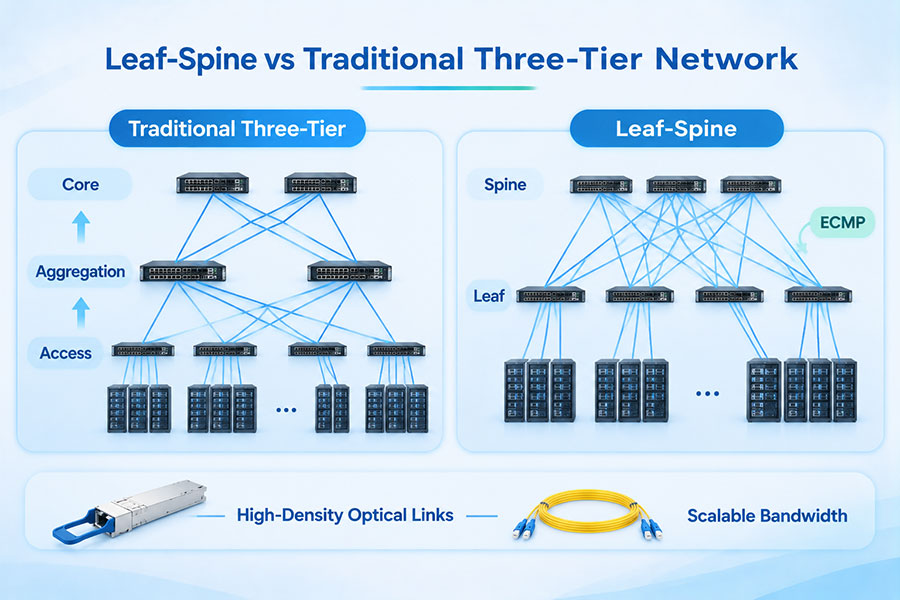
Ethernet networks can be designed around access, aggregation, and core layers, or implemented as leaf-spine fabrics in modern data centers. Layer 2 and Layer 3 technologies provide flexibility for connecting servers, storage, cloud services, and external networks. Routing protocols and multipath techniques can distribute traffic across available links.
InfiniBand networks are commonly built as high-performance switched fabrics. A Subnet Manager configures the fabric and establishes routing information. In larger deployments, fabric management tools can help monitor topology, link health, congestion, and device status.
Both architectures can use scalable multi-tier topologies. The difference lies in the protocols and management systems used to establish connectivity, distribute traffic, and maintain network operation.
When planning an AI cluster, engineers should consider the number of accelerator nodes, communication patterns, oversubscription, network diameter, fault domains, and the required bandwidth between compute groups. A network that performs well for ordinary client-server traffic may need a different topology and configuration for large distributed training jobs.
9. Application Scenarios in Data Centers
200G Ethernet applications
Ethernet is widely deployed across enterprise and cloud environments. Its broad ecosystem makes it suitable for networks that need to support different application types and connect equipment from multiple vendors.
Enterprise data center switching and server connectivity.
Cloud infrastructure and virtualized application environments.
Storage networks using supported Ethernet storage protocols.
AI infrastructure using Ethernet-based scale-out networks and RoCE.
Network connections between data center racks and distribution layers.
Where RDMA is required, RoCE-capable NICs and suitable Ethernet switches can provide a high-performance communication path while retaining Ethernet-based network infrastructure.
200G InfiniBand HDR applications
InfiniBand HDR is commonly associated with high-performance computing and accelerator clusters. Its native RDMA architecture is useful when applications require frequent, low-overhead communication between compute nodes.
GPU clusters for distributed AI model training.
High-performance computing and scientific simulations.
Parallel processing and distributed numerical workloads.
High-speed communication between accelerator servers.
Storage and data services designed for InfiniBand fabrics.
The application software must support the selected network architecture. For example, an AI training framework may use communication libraries that support both InfiniBand and RoCE, but the underlying adapters, switches, drivers, and network configuration still need to match the chosen transport.
10. Equipment Compatibility and Interoperability
Compatibility involves more than the nominal 200Gbps data rate. Ethernet and InfiniBand are separate network technologies, and their devices are designed to operate with the corresponding protocol and physical interface specifications.
An Ethernet switch port is not automatically an InfiniBand port, even if the physical connector looks similar. Likewise, an InfiniBand HDR HCA cannot be assumed to operate as a standard 200GbE NIC simply because both interfaces use a high-speed QSFP-family connector.
Some network adapters and platforms support more than one protocol mode, but this capability is hardware- and firmware-dependent. The device documentation must explicitly identify the supported modes and any required configuration.
Before deployment, verify the following:
Confirm whether the host adapter and switch support Ethernet, InfiniBand, or both in the intended operating mode.
Check the supported port speed, lane configuration, and signaling requirements.
Verify the exact cable or optical module specification for the selected protocol.
Confirm connector type, fiber type, wavelength, polarity, and transmission distance for optical links.
Check firmware, driver, and software compatibility between the host adapter and switch.
For RoCE, validate congestion management, traffic classification, and the required network settings.
For InfiniBand, confirm Subnet Manager operation and the supported fabric configuration.
11. 200G Connectivity for AI and High-Performance Computing
AI training workloads often require large amounts of data to move between GPUs across multiple servers. During distributed training, accelerators exchange model updates, gradients, and intermediate data through collective communication operations. The network can therefore become a significant factor in overall training performance.
InfiniBand HDR provides a dedicated high-performance fabric with native RDMA support. This architecture is commonly used in HPC and AI environments where predictable communication behavior and low host-processing overhead are important.
Ethernet-based AI networks can use RoCE to provide RDMA communication over an Ethernet fabric. This allows organizations to build high-performance networks while using Ethernet switching infrastructure and established Ethernet operational practices. However, achieving stable performance requires careful attention to congestion control, queue configuration, traffic distribution, and endpoint capabilities.
The choice depends on the scale of the cluster, application requirements, available hardware, operational expertise, and the broader data center network strategy. Neither architecture should be selected solely because its port is labeled 200G. End-to-end application performance depends on the complete fabric.
12. Conclusion
200G Ethernet and 200G InfiniBand HDR both provide high-bandwidth connectivity for modern data centers, but they are built around different networking architectures. Ethernet uses IEEE 802.3 framing and physical-layer standards, while InfiniBand uses a dedicated high-performance fabric with native RDMA and centralized subnet management.
Ethernet is widely used in enterprise, cloud, storage, and data center networks. With RoCE, it can also support RDMA-based applications and demanding AI workloads. InfiniBand HDR is designed for tightly coupled computing environments where native RDMA communication and specialized fabric operation are important.
Physical connectivity must be selected according to the actual protocol, host adapter, switch, and transmission requirements. Matching the network architecture with the application workload and verifying every component's compatibility are essential for reliable 200G deployment.
For 200G optical connectivity, high-speed cable selection, or transceiver compatibility requirements, contact our team.
Contact C-LIGHT >

 >
 >
 >
 >
 >
 >
 >