TEL:+86 132 6656 7067





1. AI Infrastructure Is Creating New Demands for Optical Transport Networks
The rapid expansion of artificial intelligence is transforming the architecture of global data center infrastructure. Large-scale AI training clusters, GPU computing platforms, and distributed cloud environments require continuous data exchange between geographically distributed computing resources. As these systems expand, the underlying transport network must deliver significantly greater bandwidth, predictable latency, and high operational reliability.
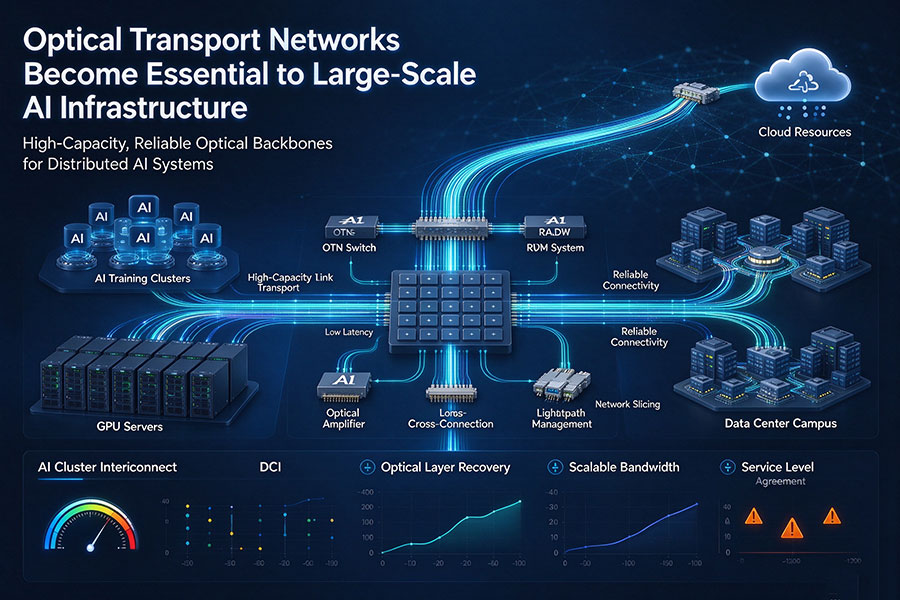
Within this environment, optical transport networks are becoming increasingly important. Unlike conventional data center connections designed primarily for communication between nearby servers and switches, optical transport infrastructure provides the high-capacity transmission foundation needed to connect data centers, metropolitan facilities, regional computing hubs, and long-distance network locations.
Technologies such as Dense Wavelength Division Multiplexing (DWDM), Optical Transport Network (OTN), Reconfigurable Optical Add-Drop Multiplexers (ROADM), and coherent optical transmission are helping network operators build scalable transport systems for AI workloads.
As AI infrastructure becomes more distributed, optical transport networks are evolving from traditional telecommunications infrastructure into an important part of large-scale computing connectivity.
2. What Is an Optical Transport Network?
An optical transport network is a communication infrastructure that uses optical fiber and advanced transmission technologies to carry large volumes of data across different network locations. It provides the physical and logical connectivity required to transport information between data centers, telecommunications facilities, enterprise networks, and cloud computing environments.
In practical deployments, optical transport networks combine several technologies to support high-capacity transmission, traffic management, protection, and network scalability.
One important distinction is that optical transport networks can refer broadly to fiber-based transmission infrastructure, while OTN (Optical Transport Network) also refers to a standardized digital transport technology defined by ITU-T recommendations.
ITU-T OTN provides digital framing, mapping, multiplexing, monitoring, and operational capabilities for transporting different client signals across optical networks. It is commonly used alongside DWDM systems to organize and manage high-capacity optical transmission.
The major components of an optical transport infrastructure include:
Optical Fiber: Provides the physical medium for transmitting optical signals over short, metropolitan, regional, and long-haul distances.
Optical Transceivers: Convert electrical signals into optical signals and perform the reverse conversion at receiving equipment.
DWDM Systems: Multiplex multiple optical wavelengths onto a single fiber pair to increase transmission capacity.
OTN Equipment: Provides digital transport framing, multiplexing, monitoring, and traffic management.
ROADM Systems: Enable flexible wavelength routing and switching within optical networks.
Optical Amplifiers: Compensate for optical signal attenuation across longer transmission distances.
3. Why Large-Scale AI Networks Require Optical Transport Infrastructure
AI computing environments generate substantial east-west traffic between servers, accelerators, storage platforms, and network switches. When computing resources are distributed across multiple facilities, these communication requirements extend beyond individual data center buildings.
Optical transport networks address several important requirements of distributed AI infrastructure.
High-Capacity Data Transmission
Large AI models require substantial computing resources and frequent data exchange. Training datasets, model parameters, checkpoints, and distributed computing tasks can generate significant traffic between different facilities.
Optical transport technologies support high aggregate bandwidth through multiple wavelengths, high-speed optical interfaces, and advanced coherent transmission systems. This allows network operators to increase transmission capacity without requiring an entirely separate fiber for every traffic channel.
Long-Distance Connectivity
AI computing resources are not always located within the same building or campus. Large cloud operators may distribute workloads across metropolitan regions or separate data center facilities.
Optical fiber supports high-capacity transmission across these distances, while DWDM and coherent optics provide technologies for increasing bandwidth over existing fiber infrastructure.
Low and Predictable Latency
Distributed AI applications depend on communication efficiency between computing resources. Additional network delay can affect synchronization, workload scheduling, and the overall efficiency of distributed operations.
Optical transmission provides a high-speed physical communication medium. However, actual end-to-end latency also depends on fiber distance, routing, switching, forwarding, and network congestion. Optical transport engineering therefore focuses on both transmission capacity and predictable network performance.
Network Reliability and Protection
Large AI facilities represent substantial infrastructure investments. Network interruptions between computing locations can affect workload availability and operational efficiency.
Optical transport systems can incorporate redundant fiber routes, protection switching, equipment redundancy, and network monitoring to improve service continuity.
4. DWDM Technology Increases Optical Transport Capacity
Dense Wavelength Division Multiplexing is one of the most important technologies used in high-capacity optical transport networks. DWDM allows multiple optical signals at different wavelengths to travel simultaneously through the same fiber.
Instead of allocating a separate fiber pair for every connection, a DWDM system combines multiple wavelength channels into a shared optical transmission path. At the receiving end, demultiplexing equipment separates the individual wavelengths for their respective destinations.
This architecture is particularly useful for connecting AI data centers and cloud facilities where bandwidth requirements continue to increase.
Key DWDM system components include:
Transponders: Convert client signals into optical wavelengths suitable for the DWDM line system.
Mux/Demux Modules: Combine multiple wavelengths for transmission and separate them at the receiving side.
Optical Amplifiers: Boost optical signals to compensate for transmission losses.
ROADM: Provides flexible wavelength add, drop, and switching capabilities.
Optical Monitoring Systems: Monitor wavelength power, signal quality, and transmission performance.
For AI infrastructure, DWDM can support multiple high-capacity connections between data centers while making more efficient use of available fiber resources.
5. OTN Provides Efficient Digital Traffic Management
While DWDM focuses on transmitting multiple optical wavelengths through fiber, OTN provides a digital transport framework for organizing and managing client traffic.
OTN is standardized through the ITU-T G.709 family of recommendations. It introduces digital framing and overhead information that support signal mapping, multiplexing, performance monitoring, and fault management.
Different client signals can be mapped into OTN containers and transported through the optical network. This allows network operators to manage traffic from different services using a structured transport architecture.
| OTN Technology | Typical Application | Primary Function |
|---|---|---|
| OTU1 | Legacy lower-capacity transport | Approximately 2.7 Gbit/s line rate |
| OTU2 | 10G-class transport | Approximately 10.7 Gbit/s line rate |
| OTU3 | 40G-class transport | Approximately 43.0 Gbit/s line rate |
| OTU4 | 100G-class transport | Approximately 111.8 Gbit/s line rate |
| Higher-rate OTN | 400G and beyond | Higher-capacity standardized transport interfaces |
The table shows representative OTN line rates rather than client payload rates. Actual usable capacity depends on framing overhead, mapping configuration, and the applicable OTN interface standard.
OTN is particularly useful in environments where operators need structured bandwidth allocation, performance monitoring, and service management across complex optical transport networks.
6. Coherent Optical Technology Supports Long-Distance AI Connectivity
As AI data centers expand across metropolitan and regional locations, transmission distance becomes an increasingly important consideration. Conventional direct-detection optical interfaces are suitable for many short- and medium-reach applications, but longer-distance, high-capacity transport often requires more advanced optical technologies.
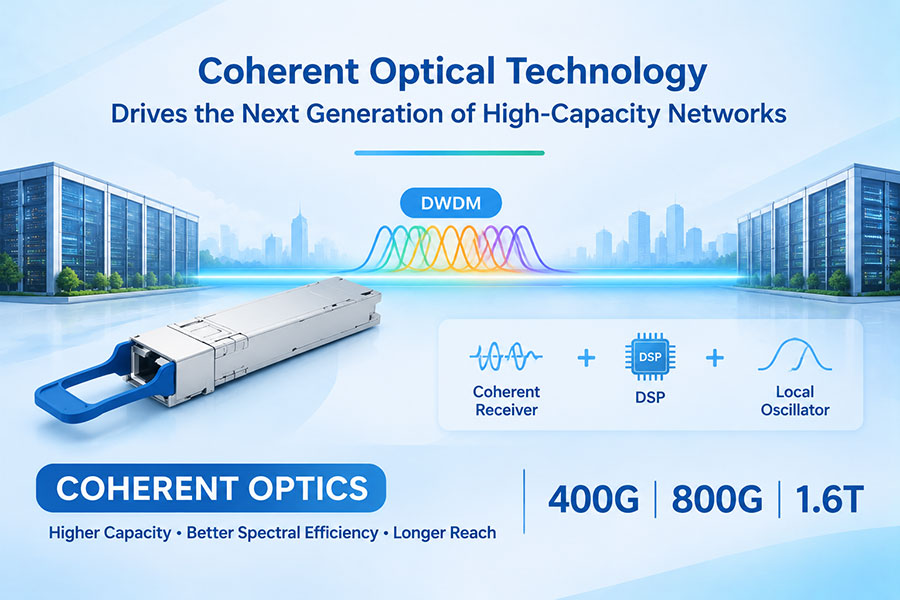
Coherent optical transmission uses information encoded in both the amplitude and phase of an optical carrier, together with advanced digital signal processing at the receiver. This allows high-capacity data transmission over longer distances while improving spectral efficiency.
Important coherent optical technologies include:
400G Coherent Optics: Supports high-capacity metropolitan and regional optical transport.
800G Coherent Optics: Provides higher aggregate bandwidth for next-generation transport and data center interconnect applications.
400G ZR and ZR+: Coherent pluggable technologies designed for different data center interconnect and metropolitan transmission requirements.
Digital Coherent Optics (DCO): Integrates coherent optical components and digital signal processing within a compact optical module.
Coherent optical modules are increasingly important for connecting large AI facilities where conventional short-reach optical connections cannot meet distance and capacity requirements.
7. ROADM and Flexible Optical Network Architectures
As optical transport networks become more complex, fixed wavelength routing can limit network flexibility. Reconfigurable Optical Add-Drop Multiplexers provide a way to dynamically route optical channels through different network paths.
ROADM systems allow individual wavelengths to be added, dropped, or passed through without requiring every signal to be converted back into an electrical format at each intermediate location.
This capability is important for large-scale AI infrastructure because computing resources may be distributed across multiple data centers and metropolitan facilities.
ROADM-based networks offer several operational advantages:
Flexible wavelength routing between network locations.
Improved utilization of existing optical fiber infrastructure.
Support for network expansion without redesigning every transmission path.
More flexible bandwidth allocation as traffic requirements change.
Integration with optical protection and network restoration mechanisms.
CDC-F ROADM architectures, supporting colorless, directionless, and contentionless operation with flexible spectrum allocation, provide additional flexibility for advanced optical transport deployments.
8. Data Center Interconnect Is Becoming a Critical AI Application
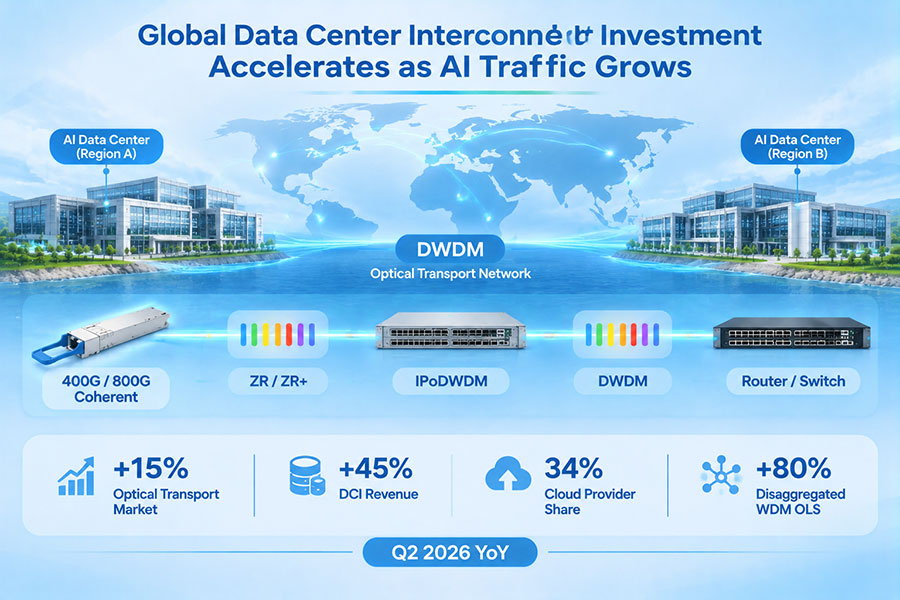
Data Center Interconnect (DCI) refers to the network infrastructure used to connect separate data center facilities. It is becoming increasingly important as hyperscale cloud operators and AI service providers distribute computing resources across multiple locations.
Unlike conventional connections inside a single data center, DCI links may span several kilometers or extend across metropolitan and regional distances. These connections require a combination of optical capacity, transmission reach, network protection, and efficient wavelength utilization.
Different technologies support different DCI deployment scenarios.
| DCI Technology | Typical Reach Category | Primary Application |
|---|---|---|
| 400G DR4 | Up to 500 m | Short-reach single-mode connections |
| 400G FR4 | Up to 2 km | Short data center interconnections |
| 400G LR4 | Up to 10 km | Metropolitan access and DCI links |
| 400G ZR | Approximately 80 km class | Coherent DCI applications |
| 400G ZR+ | Beyond typical ZR applications, depending on implementation | Extended-reach optical transport |
| 800G Coherent | Application-dependent | Higher-capacity metropolitan and regional transport |
These are representative application categories rather than guaranteed system distances. Actual reach depends on optical specifications, fiber characteristics, amplification, modulation format, and link engineering.
For large AI environments, DCI infrastructure provides the connectivity needed to distribute computing resources, support data replication, and connect separate AI facilities.
9. Optical Transport Network Design for Large AI Clusters
Building optical transport infrastructure for AI computing requires careful consideration of network topology, traffic patterns, transmission distance, and future expansion requirements.
A typical architecture may include several interconnected network layers.
| Network Layer | Connectivity Scope | Common Technologies |
|---|---|---|
| GPU and Server Connectivity | Within servers and racks | DAC, AEC, AOC, short-reach optics |
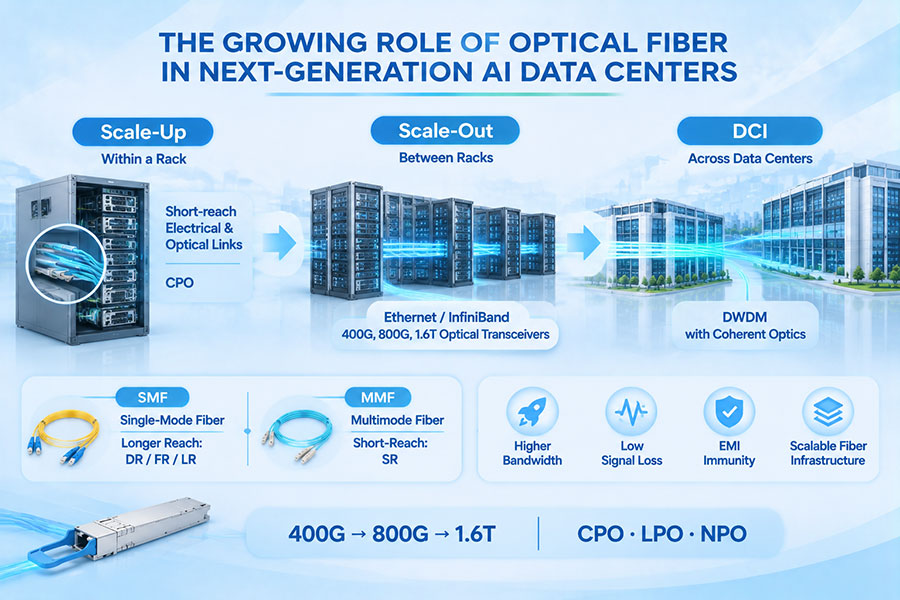
| Data Center Fabric | Between racks and switches | 400G, 800G, 1.6T optical transceivers |
| Campus Optical Network | Between buildings and nearby facilities | Single-mode fiber, high-speed Ethernet optics |
| Metropolitan Transport | Between data centers within a metropolitan area | DWDM, OTN, coherent optics, ROADM |
| Regional and Long-Haul Transport | Between geographically separated regions | DWDM, OTN, optical amplifiers, coherent transmission |
Not every AI deployment requires all these layers. Smaller facilities may use direct fiber connections, while hyperscale environments may require sophisticated DWDM and OTN infrastructure.
The most effective architecture depends on the geographical distribution of computing resources, traffic volume, service availability requirements, and long-term network expansion plans.
10. Power Efficiency and Reliability in Optical Transport Networks
As AI infrastructure consumes increasing amounts of electricity, optical transport network efficiency is becoming an important engineering consideration. Large-scale transmission systems must balance bandwidth capacity, optical reach, equipment power consumption, and operational reliability.
Several factors influence the efficiency of optical transport infrastructure:
Optical Transmission Efficiency: Selecting suitable modulation formats, wavelengths, and transmission technologies for each link.
Amplifier Optimization: Managing optical power levels and amplifier placement to maintain signal quality.
Wavelength Utilization: Using DWDM systems efficiently to maximize the capacity of existing fiber infrastructure.
Equipment Integration: Selecting suitable transponders, coherent modules, and transport platforms.
Thermal Management: Maintaining appropriate operating temperatures for optical and electronic equipment.
Network Protection: Implementing redundant routes and protection mechanisms to reduce service interruptions.
Reliability also depends on the physical fiber infrastructure. Connector cleanliness, insertion loss, fiber bending, optical power margins, and periodic testing all contribute to stable long-term transmission performance.
11. The Future of Optical Transport in AI Infrastructure
The development of AI infrastructure is expected to influence optical transport technologies over the coming years. As AI computing capacity expands, network operators will need to support higher transmission rates, more flexible optical routing, and improved utilization of existing fiber infrastructure.
Several technological developments are likely to shape this evolution.
Higher-Capacity Coherent Transmission
Advances in coherent DSP, photonic integration, and optical modulation will support higher-capacity transport systems. The progression toward 800G and future coherent interfaces will help address growing DCI bandwidth requirements.
More Efficient DWDM Systems
Flexible grid technology, advanced optical amplification, and improved wavelength management will help operators increase fiber capacity and optimize existing optical transmission infrastructure.
Integration with AI-Driven Network Management
AI-assisted network operations can help analyze traffic patterns, identify potential transmission problems, and improve capacity planning. Automated monitoring and predictive maintenance may also improve the operational efficiency of large optical transport networks.
Convergence of Computing and Optical Networking
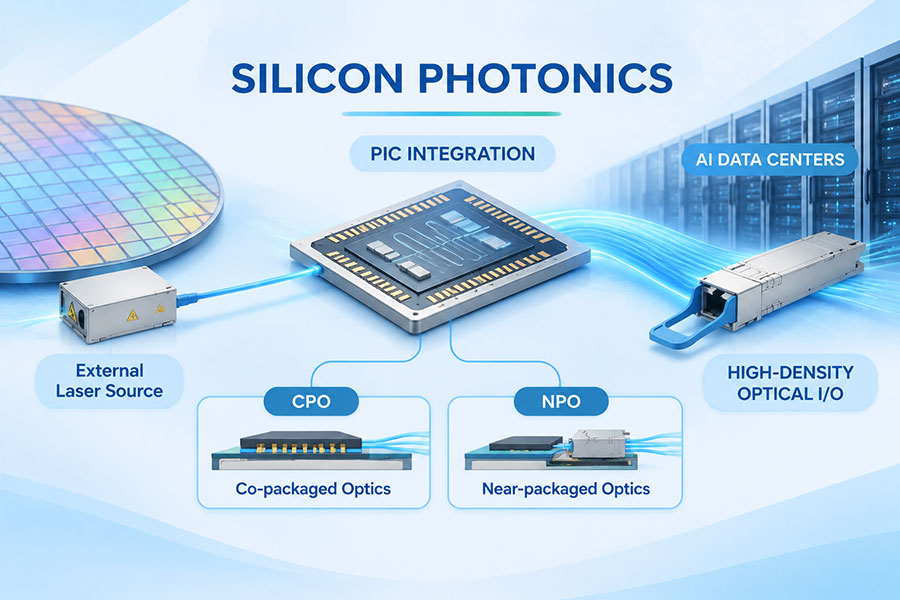
As data centers evolve toward increasingly distributed computing architectures, optical transport and data center networking will become more closely coordinated. High-speed pluggable optics, coherent modules, silicon photonics, and advanced optical switching technologies will contribute to this convergence.
12. C-LIGHT Optical Connectivity Solutions for AI Networks
Building reliable AI data center and optical transport infrastructure requires connectivity products that support different transmission speeds, distances, and network architectures. Optical transceivers and fiber assemblies play important roles in connecting switches, routers, transport equipment, and distributed computing facilities.
C-LIGHT provides a range of optical communication products for data center, telecommunications, and high-performance networking applications.
Relevant product categories include:
400G Optical Transceivers: QSFP-DD and OSFP modules for high-speed Ethernet and data center connectivity, including application-specific DR4, FR4, and ER4 solutions.
800G Optical Transceivers: SR8 and 2FR4 solutions for high-bandwidth data center networking.
1.6T Optical Transceivers: DR8 and 2DR4 technologies for next-generation high-capacity network connections.
400G DCO Modules: Digital coherent optical connectivity for suitable high-capacity transport and DCI applications.
DAC and AEC Cables: High-speed electrical connectivity for compatible short-reach network connections.
MPO/MTP Fiber Assemblies: High-density fiber connectivity for parallel optical transmission and structured cabling systems.
When selecting optical connectivity products for transport infrastructure, network engineers should consider transmission distance, wavelength, fiber type, optical power budget, connector configuration, equipment compatibility, and operating conditions.
As AI networks continue to expand, matching optical connectivity products to the requirements of each network layer will be essential for building scalable and reliable infrastructure.
For optical transceiver specifications, compatibility assistance, and customized connectivity requirements, Contact C-LIGHT.
13. Conclusion
Optical transport networks are becoming an essential part of large-scale AI infrastructure as computing resources expand across data centers, metropolitan facilities, and regional cloud environments. The increasing volume of AI-generated traffic is creating demand for higher-capacity transmission, flexible wavelength management, and reliable long-distance connectivity.
DWDM, OTN, ROADM, coherent optics, and advanced optical transceivers each contribute different capabilities to modern transport infrastructure. Together, these technologies enable network operators to increase fiber capacity, manage complex traffic requirements, and connect distributed computing facilities.
As the industry moves toward 800G, 1.6T, and higher-capacity optical interfaces, the relationship between data center networking and optical transport will become increasingly important. Scalable fiber infrastructure and reliable optical connectivity will remain fundamental to supporting the next generation of AI computing.
 >

 >
 >
 >
 >
 >
 >
 >