TEL:+86 132 6656 7067




1. Introduction
Driven by the explosive growth of artificial intelligence (AI) model training, high-performance computing (HPC), and cloud computing, bandwidth demand in modern data centers is increasing at an unprecedented pace. While 400G Ethernet has become the mainstream deployment for hyperscale networks, the adoption of 800G and even 1.6T Ethernet is accelerating rapidly.
However, real-world data centers are rarely homogeneous. Many existing servers continue to operate with 25G, 50G, or 100G network interfaces, while switch uplinks are rapidly transitioning to 400G and 800G. This coexistence of multiple interface speeds has created a critical networking technology known as Breakout.
The fundamental concept of Breakout is to physically divide one high-speed switch port into multiple lower-speed channels, allowing network operators to fully utilize high-bandwidth ports while maintaining compatibility with existing infrastructure. By combining 400G/800G optical transceivers, Direct Attach Copper (DAC) cables, Active Optical Cables (AOC), and MPO/MTP fiber breakout assemblies, enterprises can expand network capacity without replacing every switch and server simultaneously.
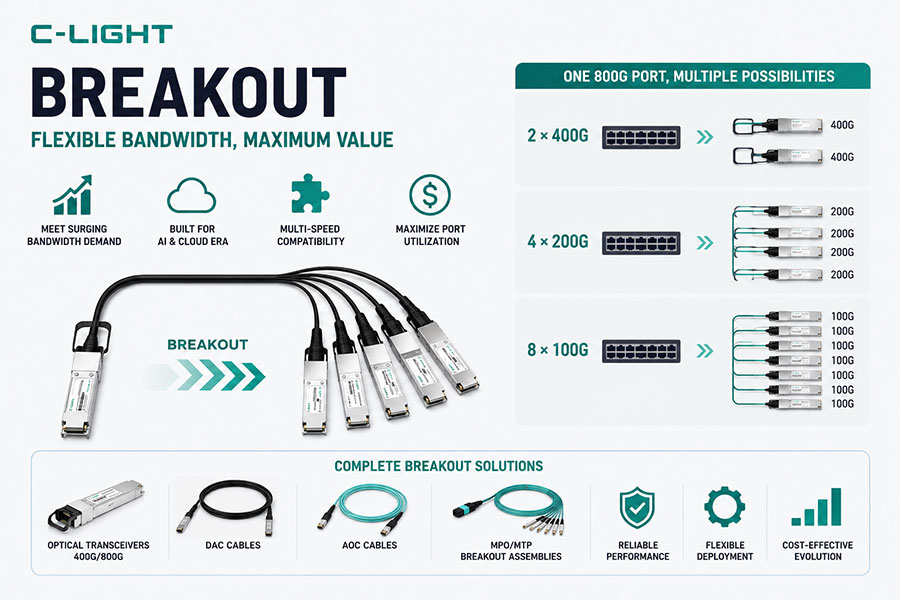
Especially in today's AI computing era, a single 800G port can be flexibly divided into 2 × 400G, 4 × 200G, or 8 × 100G links, providing unprecedented deployment flexibility for hyperscale AI clusters.
This article explains the working principles of Breakout technology, explores both optical module-based and cable-based implementations, and highlights C-LIGHT's technology portfolio and representative Breakout solutions.
2. Breakout Fundamentals and Network Architecture
2.1 Physical Lane Separation
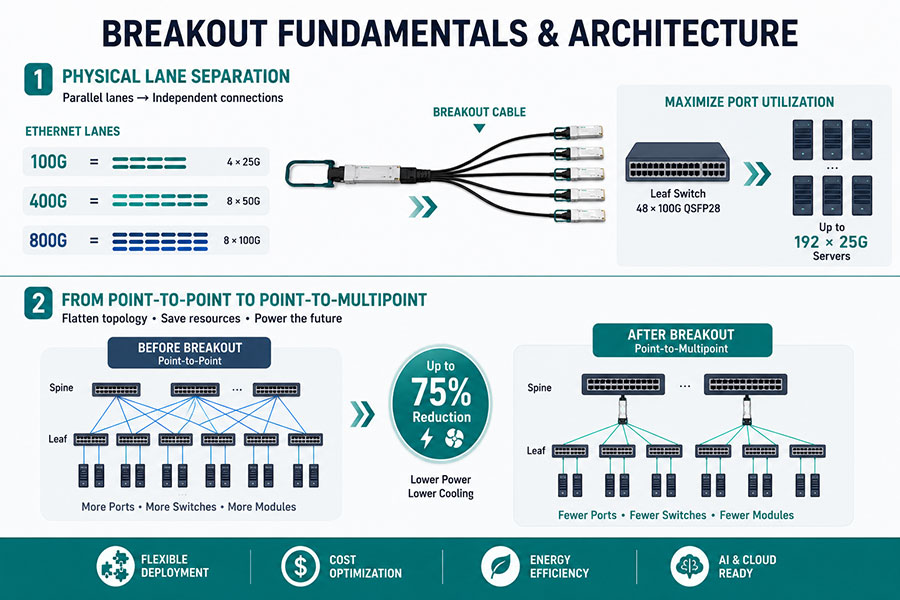
The theoretical foundation of Breakout technology originates from the parallel lane architecture defined by high-speed Ethernet standards.
For example, according to IEEE 802.3 standards, 100G Ethernet is not transmitted through one single electrical channel. Instead, it consists of four parallel 25G lanes.
Likewise:
400G Ethernet = 8 × 50G PAM4 electrical lanes
800G Ethernet = 8 × 100G PAM4 electrical lanes
In Breakout mode, these parallel lanes are logically detached and routed independently to different destination devices. Importantly, the optical transceiver itself requires no firmware modification or hardware reconfiguration. The only component that changes is the breakout cable assembly.
Consider a typical deployment:
A Leaf switch equipped with 48 QSFP28 100G ports can support Breakout mode, allowing each 100G interface to split into four independent 25G ports. Consequently, the switch can connect up to 192 servers with 25G NICs, significantly improving port utilization and rack density.
2.2 From Point-to-Point to Point-to-Multipoint Topology
Within modern Spine-Leaf architectures, Breakout technology plays a vital role in flattening network topology.
Instead of consuming multiple Spine ports, one high-speed uplink can be divided into several lower-speed connections that independently connect to multiple Leaf switches.
Industry deployment studies indicate that using high-speed optical transceivers together with Breakout cabling can reduce both the number of switches and optical modules by up to 75% while maintaining the same server scale. This approach also lowers overall power consumption and cooling requirements, making it highly attractive for AI and cloud data centers.
3. Breakout Technologies: Optical Modules and Cabling
3.1 Optical Module-Based Breakout Solutions
Pluggable optical transceivers provide the most common and flexible Breakout implementation.
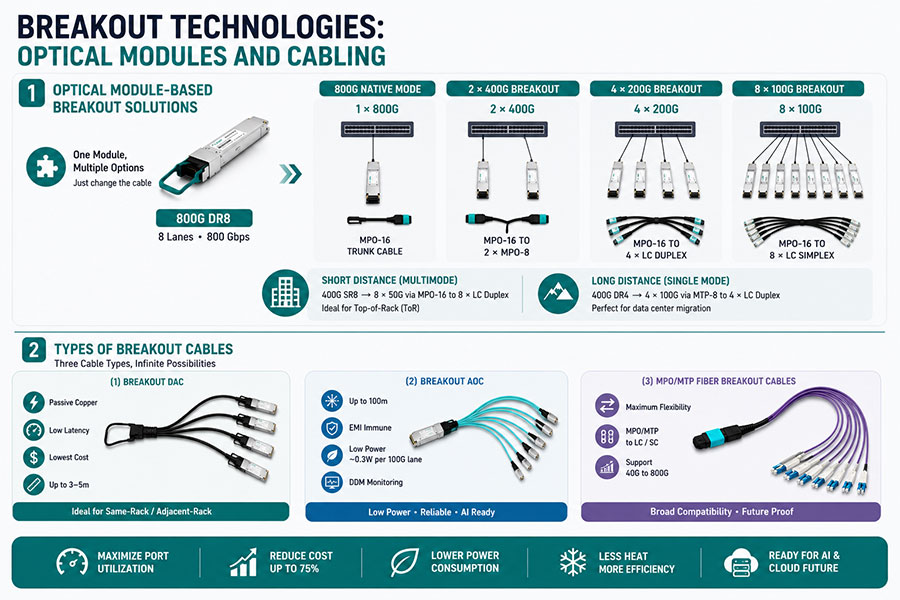
A key advantage is that one optical module supports multiple Breakout configurations simply by replacing the fiber breakout cable, eliminating the need to change the transceiver itself.
Taking the 800G DR8 optical transceiver as an example, it utilizes eight parallel electrical lanes to deliver an aggregate bandwidth of 800Gbps. Different breakout fiber assemblies enable multiple operating modes.
800G Native Mode
Using an MPO-16 trunk cable, all eight lanes remain combined and connect directly to another 800G port, providing the simplest full-bandwidth interconnection.
2 × 400G Breakout
An MPO-16 to dual MPO-8 breakout cable divides the eight lanes into two groups, allowing one 800G port to connect two independent 400G devices.
4 × 200G Breakout
Using an MPO-16 to 4 × LC duplex breakout cable, every two lanes form one 200G connection, supporting four independent 200G links.
8 × 100G Breakout
An MPO-16 to 8 × LC simplex breakout cable separates each individual 100G lane, maximizing switch port density for large-scale server deployments.
For short-distance multimode applications, a 400G SR8 optical module can connect to eight independent 50G servers through an MPO-16 to 8 × LC duplex harness, making it ideal for Top-of-Rack (ToR) switching.
In single-mode environments, the 400G DR4 transceiver paired with an MTP-8 to 4 × LC duplex breakout cable enables connectivity to four separate 100G devices, providing an economical migration path for medium-sized data centers.
3.2 Types of Breakout Cables
Breakout cables provide the physical infrastructure required to distribute high-speed ports into multiple lower-speed connections. They are generally categorized into three major types.
(1) Breakout DAC (Direct Attach Copper Cable)
Breakout DAC assemblies consist of multiple Twinax copper cables bundled together.
One end uses a high-density connector such as QSFP-DD or OSFP, while the opposite end branches into several lower-speed interfaces.
As passive copper cables, DACs consume virtually no additional power and offer the lowest latency and lowest overall cost.
They are typically deployed for same-rack or adjacent-rack connections, usually within 3 to 5 meters.
For example, an Amphenol QSFP-DD Breakout DAC allows a single 400G or 800G QSFP-DD port to split into four independent QSFP links, supporting 4 × 100G or 4 × 200G server connections using only one 3-meter cable.
(2) Breakout AOC (Active Optical Cable)
Unlike DACs, Active Optical Cables (AOCs) integrate electro-optical conversion circuits inside the cable connectors.
By replacing copper conductors with optical fibers, AOCs provide:
Transmission distances up to 100 meters
Superior electromagnetic interference (EMI) immunity
Lower overall power consumption
Compared with DAC solutions, an AOC typically consumes only approximately 0.3W per 100G lane, whereas DAC solutions may require around 1.5W per lane.
This significant reduction in heat generation makes AOCs especially suitable for dense AI GPU clusters.
Most AOCs also integrate Digital Diagnostic Monitoring (DDM), enabling real-time monitoring of:
Temperature
Supply voltage
Optical transmit power
Optical receive power
These monitoring capabilities support predictive maintenance and improve long-term network reliability.
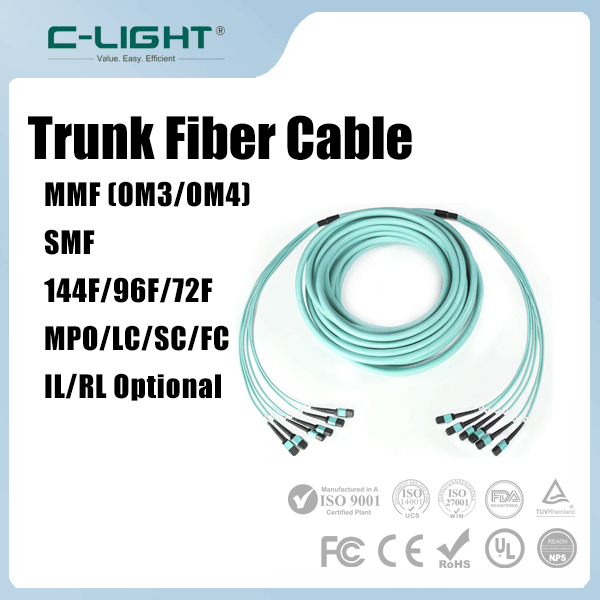
(3) MPO/MTP Fiber Breakout Cables
MPO/MTP breakout fiber assemblies provide the highest level of deployment flexibility.
One end uses a high-density MPO/MTP connector (such as MPO-12 or MPO-16), while the opposite end branches into multiple standard interfaces including LC or SC connectors.
When combined with pluggable optical transceivers, these breakout assemblies support virtually every Ethernet migration path from 40G through 800G.
4. C-LIGHT Breakout Solution Portfolio
Building upon the Breakout technologies discussed above, C-LIGHT, a professional optical communication manufacturer with more than 15 years of industry experience, has developed a comprehensive Breakout product portfolio covering both high-speed optical transceivers and interconnect cabling. Today, C-LIGHT delivers reliable optical networking solutions to data center customers in over 100 countries and regions worldwide.
4.1 Overview of C-LIGHT's Technical Capabilities
Founded in 2011, C-LIGHT has independently developed and mass-produced more than 1,000 optical transceiver solutions, covering eight major transmission rates including 800G, 400G, 200G, 100G, 50G, 25G, and 10G. Its products comply with multiple international industry standards and certifications.
Supported by a dedicated R&D team of more than 50 experienced optical communication engineers, many of whom previously worked for leading global telecommunications companies, C-LIGHT continues to innovate across a broad portfolio that includes:
Optical Transceivers
Active Optical Cables (AOC)
Active Copper Cables (ACC)
Direct Attach Copper Cables (DAC)
Fiber Patch Cords
MPO/MTP Cabling Solutions
Optical Connectors
These products are widely deployed in AI computing clusters, hyperscale data centers, cloud networking, telecom FTTx access networks, and DWDM optical transport systems.
4.2 C-LIGHT Breakout Product Portfolio
To better illustrate C-LIGHT's complete Breakout ecosystem, the product portfolio can be categorized into the following groups.
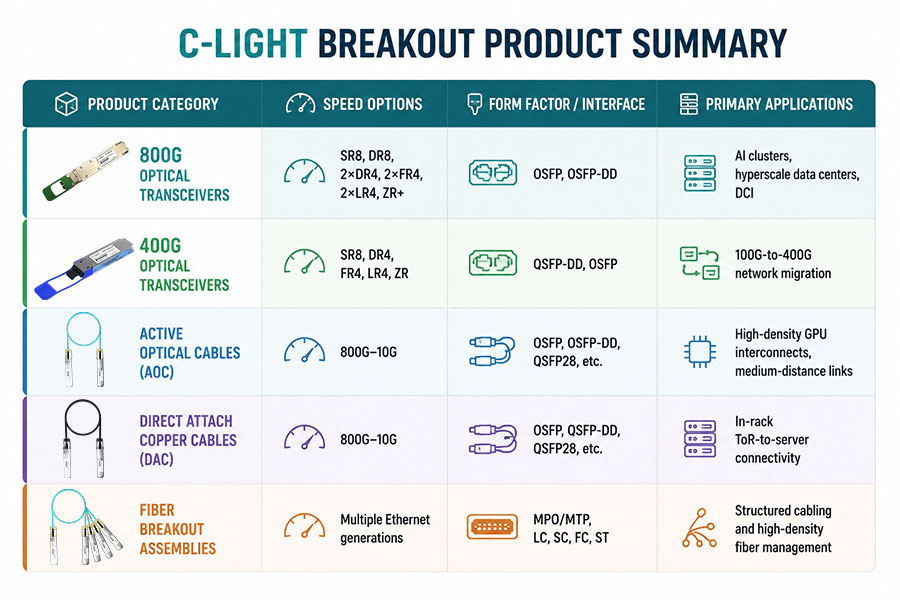
800G Optical Transceivers
The 800G optical transceiver family serves as the core of C-LIGHT's Breakout solutions for next-generation AI data centers.
Available in both OSFP and QSFP-DD form factors, these modules employ 8-lane electrical interfaces and PAM4 modulation to achieve an aggregate bandwidth of 800Gbps, while fully complying with IEEE 802.3 Ethernet standards and CMIS Rev.5.0 management specifications.
The product family includes:
800G SR8 (100 m MMF)
800G DR8 (500 m SMF)
800G 2×DR4
800G 2×FR4 (2 km)
800G 2×LR4 (10 km)
800G ZR+ Coherent (up to 450 km)
This comprehensive lineup supports applications ranging from intra-rack connectivity to long-distance Data Center Interconnect (DCI).
Among these products, the 800G SR8/VSR8 series utilizes optimized VCSEL arrays and advanced signal integrity design to achieve ultra-low latency below 1 μs, ensuring lossless full-duplex communication within large-scale AI GPU clusters while minimizing network bottlenecks.
The 800G 2×DR4 single-mode transceivers, including models such as CL800GOSFP2DR4-FLT and CL800GQDD2DR4, feature integrated native Breakout functionality. By utilizing dual MPO connectors, one 800G interface is directly divided into two independent 400G DR4 links, allowing direct connectivity to two 400G devices through MPO breakout fiber assemblies without requiring intermediate conversion modules.
For longer-distance campus and metro deployments, 800G 2×FR4 (2 km) and 2×LR4 (10 km) modules employ LC duplex interfaces to deliver high-performance optical interconnects.
Within the QSFP-DD platform, C-LIGHT additionally offers CS connector versions of the 2×FR4 and 2×LR4 products, providing higher front-panel density for next-generation switching systems.
Compared with traditional QSFP modules, the QSFP-DD architecture doubles the electrical contact rows from four lanes to eight lanes while maintaining backward compatibility with existing QSFP interfaces, enabling gradual infrastructure upgrades.
400G Optical Transceivers
C-LIGHT's 400G product family supports both QSFP-DD and OSFP packages using an 8 × 50G PAM4 electrical architecture.
The product portfolio spans every major transmission application, including:
SR8
DR4
XDR4
FR4
LR4
ZR+
Coherent DCI solutions
Among them, 400G DR4 and XDR4 single-mode modules utilize four independent 100G optical lanes, enabling native Breakout connectivity to four separate 100G devices. These products represent one of the most practical migration paths from existing 100G networks toward 400G infrastructure.
For metro-scale deployments, C-LIGHT also provides 400G ZR QSFP-DD coherent optical modules, supporting transmission distances of up to 120 km, extending Breakout applications beyond traditional data center boundaries into metro DCI networks.
Active Optical Cables (AOC) and DAC Solutions
C-LIGHT offers a complete portfolio of Active Optical Cables (AOC) covering:
800G
400G
200G
100G
50G
40G
25G
10G
All AOCs are factory-terminated with integrated optical modules and support standard Digital Diagnostic Monitoring (DDM), enabling rapid deployment and high operational reliability.
These products are particularly suitable for latency-sensitive AI environments such as GPU-to-GPU, GPU-to-storage, and high-density computing clusters, where non-blocking network performance is essential.
The company's DAC product family also covers transmission rates from 800G to 10G, supporting both standard direct-attach configurations and various Breakout topologies.
For example, C-LIGHT's 800G DAC supports passive OSFP-to-QSFP-DD direct connections, enabling full-rate 800Gbps transmission over distances up to 2 meters without external power consumption.
As the most economical solution for short-reach connectivity, DAC remains the preferred choice for Top-of-Rack (ToR) switch-to-server interconnections.
Fiber Breakout Assemblies
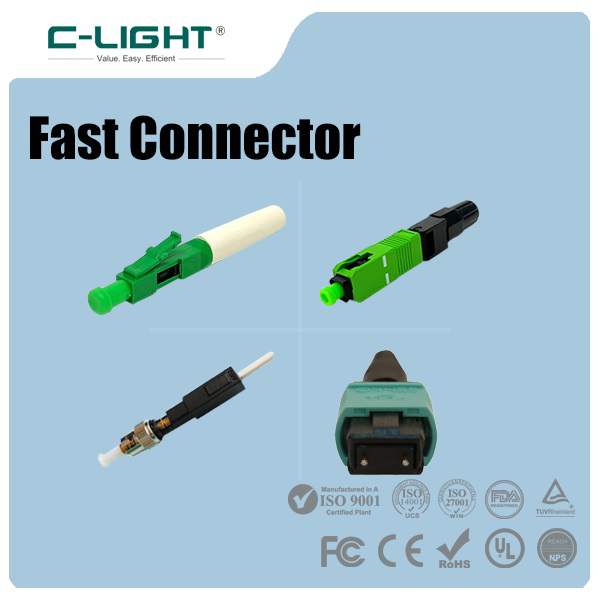
For structured optical cabling, C-LIGHT supplies a complete range of high-density MPO/MTP fiber assemblies supporting various connector combinations, including:
MTP to LC
MTP to SC
MTP to FC
MTP to ST
The MTP-to-LC breakout assemblies are specifically optimized for high-speed Ethernet interconnects, offering:
Typical insertion loss ≤ 0.5 dB
IEC-compliant manufacturing
Excellent cross-vendor compatibility
High-density fiber management
These products are widely deployed in:
Hyperscale data centers
Telecom backbone networks
Enterprise optical networks
Industrial communication systems
Every cable assembly undergoes 100% factory testing and is backed by a three-year warranty together with professional technical support.
C-LIGHT Breakout Product Summary
5. Market Outlook
The global data center interconnect market is entering a new phase of rapid expansion. Driven by AI, hybrid cloud architectures, and the continued evolution from edge computing to core data centers, deployments of 400G and 800G optical networking solutions are accelerating worldwide.
As a critical bridge between high-speed switching infrastructure and legacy lower-speed server interfaces, Breakout technology enables network operators to maximize existing infrastructure investments while providing one of the most cost-effective paths toward gradual bandwidth expansion.
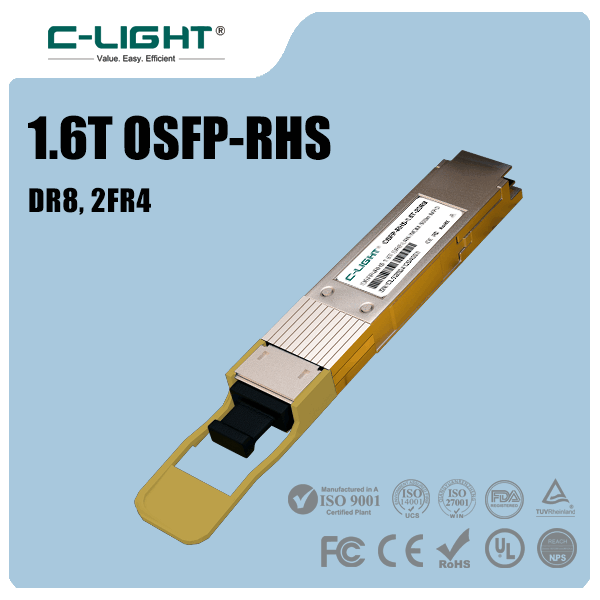
At the same time, the industry is actively exploring Breakout architectures beyond 800G, preparing for the arrival of 1.6T Ethernet, higher-density AI clusters, and increasingly complex chip-to-chip optical interconnects.
With more than 15 years of expertise in high-speed optical communications, C-LIGHT has established a comprehensive product ecosystem spanning 800G to 10G, supporting both OSFP and QSFP-DD platforms while offering a complete portfolio of optical transceivers, AOC, DAC, and fiber breakout assemblies.
This one-stop product strategy enables data center operators to simplify procurement, accelerate deployment, and reduce interoperability risks associated with multi-vendor environments.
Whether supporting enterprise network upgrades or building hyperscale AI computing infrastructure, Breakout technology combined with C-LIGHT's integrated optical interconnect portfolio provides a solid foundation for the next generation of high-performance data center networking.
 >
>

 >
>
 >
>
 >
>
 >
>
 >
>
 >
>
 >
>