TEL:+86 132 6656 7067




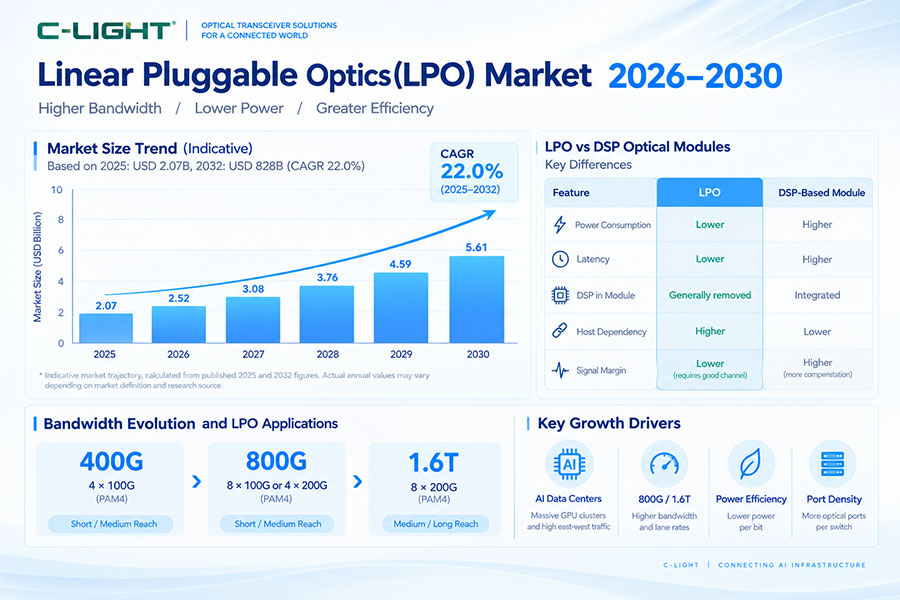
Linear Pluggable Optics (LPO) is becoming an important optical interconnect architecture for AI data centers, high-speed Ethernet, and short-reach GPU networking. The market is being driven by the transition from 400G to 800G and 1.6T, growing port density, and the need to reduce optical module power and latency. This article reviews the LPO market outlook for 2026–2030, including market data, technology trends, data-rate comparisons, applications, regional development, and the position of LPO compared with DSP-based optics, LRO, NPO, and CPO.
1. What Is Linear Pluggable Optics (LPO)?
Linear Pluggable Optics (LPO) is an optical transceiver architecture that uses a relatively linear electrical-to-optical and optical-to-electrical signal path. Unlike conventional retimed optical modules, LPO generally removes the full DSP and relies more heavily on the host switch ASIC, NIC, or other system-side SerDes for signal processing and equalization.
The main objective is to reduce power consumption, latency, and module complexity while maintaining the pluggable form factor used by modern data center networks.
2. Why Is the LPO Market Growing?
AI workloads are increasing the amount of traffic exchanged between GPUs, switches, servers, and storage systems. As Ethernet speeds move from 400G toward 800G and 1.6T, the power consumed by optical connectivity becomes increasingly important.
LPO addresses this requirement by moving more signal-processing functions to the host system and reducing processing inside the optical module.
3. LPO Market Size and 2026–2030 Outlook
Public market studies currently provide significantly different LPO market estimates because some reports define LPO narrowly as optical modules, while others include broader linear-drive optical products and related components.
One 2026 market study estimates the global LPO packaging optical module market at approximately USD 566 million in 2025 and USD 5.447 billion by 2032, with a CAGR of about 26.4%. Based on that published CAGR, the following 2026–2030 values can be calculated as an indicative market trajectory.
| Year | Indicative Market Size | YoY Growth |
|---|---|---|
| 2025 | USD 0.57B | — |
| 2026 | USD 0.72B | 26.4% |
| 2027 | USD 0.90B | 26.4% |
| 2028 | USD 1.14B | 26.4% |
| 2029 | USD 1.44B | 26.4% |
| 2030 | USD 1.83B | 26.4% |
These 2026–2030 figures are calculated from the published 2025 base value and CAGR rather than being separate independently published annual market figures. They should therefore be treated as an indicative trend rather than a definitive industry consensus.
4. LPO Market Growth Comparison
| Metric | 2025 | 2030 | Change |
|---|---|---|---|
| Indicative LPO Market | USD 0.57B | USD 1.83B | About 3.2× |
| Forecast CAGR | — | 26.4% | High-growth segment |
Under this forecast scenario, the market would increase by approximately USD 1.26 billion between 2025 and 2030. The strong growth reflects increasing adoption of linear optical architectures in high-bandwidth data center networks.
5. 400G, 800G and 1.6T LPO Comparison
| Data Rate | Typical Lane Architecture | Market Position | Main Application |
|---|---|---|---|
| 400G | 4 × 100G | Established | Data center and AI networking |
| 800G | 8 × 100G or 4 × 200G | Major growth stage | AI clusters and high-density Ethernet |
| 1.6T | 8 × 200G | Emerging | Next-generation AI and HPC |
800G is currently one of the most important transition points for LPO. The move to 200G-per-lane technology also creates a pathway toward 1.6T optical connectivity.
6. LPO vs DSP-Based Optical Modules
| Feature | LPO | DSP-Based Module |
|---|---|---|
| Module DSP | Generally removed | Integrated DSP |
| Signal Processing | More dependent on host ASIC | More processing inside module |
| Module Power | Potentially lower | Generally higher |
| Latency | Potentially lower | Higher due to additional processing |
| Host Dependency | High | Lower |
| Interoperability | Requires careful system validation | Generally easier |
| Signal Margin | More sensitive to electrical channel quality | DSP provides greater compensation |
7. Why 800G Is Important to the LPO Market
800G is a key market segment because AI clusters require high bandwidth between GPUs and Ethernet switches. An 800G interface can be implemented using eight 100G electrical lanes or four 200G lanes depending on the platform.
At higher data rates, reducing power per bit becomes increasingly important. This makes LPO attractive for controlled short-reach links where the host ASIC can provide sufficient signal processing and equalization.
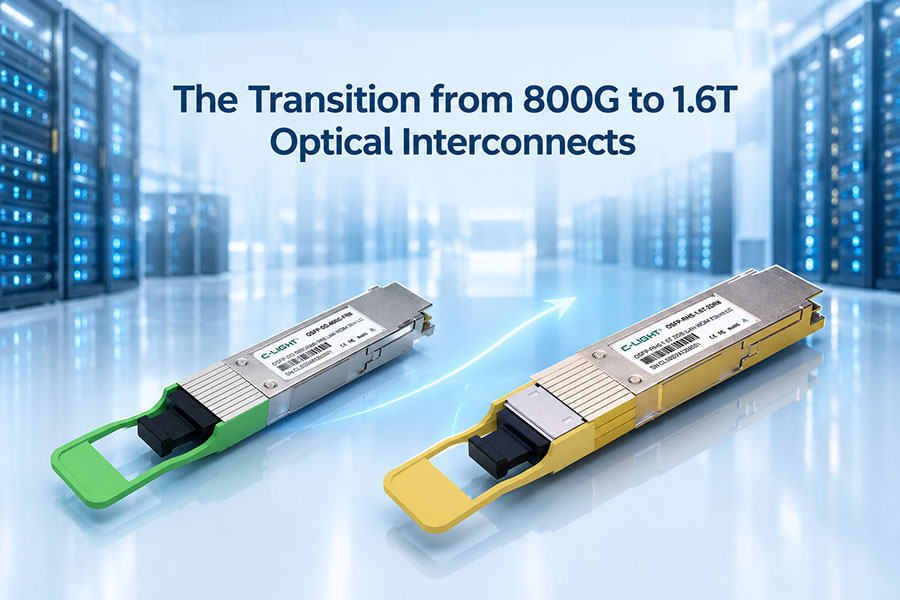
8. The Transition from 800G to 1.6T
The transition from 800G to 1.6T is closely related to the move from 100G-per-lane to 200G-per-lane signaling.
| Generation | Total Bandwidth | Example Lane Configuration |
|---|---|---|
| 400G | 400Gbps | 4 × 100G |
| 800G | 800Gbps | 8 × 100G / 4 × 200G |
| 1.6T | 1.6Tbps | 8 × 200G |
This evolution increases the importance of host electrical design, connector performance, PCB loss, equalization, thermal management, and optical component quality.
9. LPO and AI Data Centers
AI data centers are one of the strongest potential application areas for LPO. GPU clusters generate large volumes of east-west traffic, requiring high-speed links between compute nodes and network switches.
LPO is particularly suitable when link distances are relatively short and the network architecture is tightly controlled. These conditions allow the host ASIC and optical module to be optimized as a complete system.
10. LPO Power Efficiency
Power efficiency is one of the main reasons for LPO adoption. A conventional high-speed optical module may use a DSP for retiming, equalization, and signal conditioning. Removing these functions can reduce the power associated with module-level signal processing.
However, there is no single universal LPO power value. Actual consumption depends on data rate, optical engine, laser technology, driver and TIA design, host electrical interface, temperature, and implementation.
11. LPO and Latency
LPO can reduce latency by simplifying the signal path and eliminating some of the processing normally performed inside a retimed optical module.
This characteristic is particularly relevant to AI and HPC systems, where predictable communication latency can affect overall cluster performance.
12. LPO and Signal Integrity
The main trade-off is that LPO places greater responsibility on the host electrical channel. PCB traces, connectors, cages, package interfaces, insertion loss, crosstalk, reflections, and equalization all become important.
At 200G per lane and beyond, small electrical-channel impairments can have a significant effect on link margin. LPO therefore requires coordinated validation between the host ASIC, switch platform, optical module, and cabling system.
13. LPO vs LRO
| Feature | LPO | LRO |
|---|---|---|
| Architecture | Linear optical path | Linear architecture with additional receiver-side optimization depending on implementation |
| DSP | Generally DSP-less | Reduced or specialized processing |
| Power | Low-power target | Low-power target |
| System Dependency | High | High |
| Primary Goal | Low power and latency | Balance between linear operation and link performance |
14. LPO vs NPO
| Feature | LPO | NPO |
|---|---|---|
| Optical Location | Pluggable module | Closer to the ASIC/package |
| Serviceability | High | Lower than pluggables |
| Electrical Path | Shorter than traditional architectures but still external | Significantly shorter |
| Power Efficiency | High potential | Very high potential |
| Flexibility | High | Lower |
| Deployment Stage | Near-term pluggable solution | Emerging system architecture |
15. LPO vs CPO
| Feature | LPO | CPO |
|---|---|---|
| Optical Interface | Pluggable | Co-packaged with ASIC |
| Serviceability | High | Lower |
| System Flexibility | High | Lower |
| Electrical Path | Shortened through linear architecture | Extremely short |
| Power Potential | Lower than conventional DSP optics | Very low potential per bit |
| Technology Maturity | More deployable | More complex |
16. LPO Form Factors
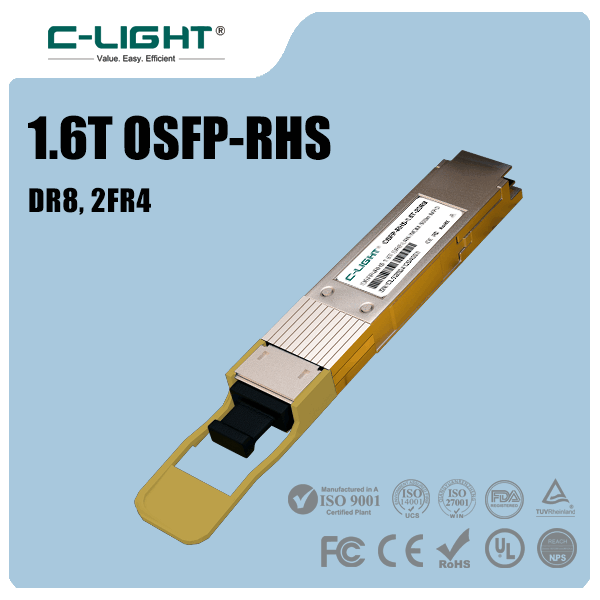
OSFP and QSFP-DD are important form factors for high-speed optical connectivity. OSFP provides a larger thermal envelope and is widely associated with high-density 800G systems, while QSFP-DD offers a compact form factor and strong ecosystem compatibility.
| Form Factor | Typical Position | Key Advantage |
|---|---|---|
| QSFP-DD | 400G / selected 800G | Compact and broad ecosystem |
| OSFP | 800G | Thermal capability and high-density AI networking |
| OSFP-XD | Future 1.6T+ | Higher lane density |
17. LPO Optical Technologies
LPO modules can use different optical technologies depending on data rate, reach, fiber type, and system requirements.
| Technology | Typical Strength | Potential Application |
|---|---|---|
| VCSEL | Low-cost short-reach optical transmission | Very short MMF links |
| EML | High-speed and longer-reach performance | 800G SMF links |
| Silicon Photonics | Integration and scaling potential | 800G / 1.6T and future systems |
18. LPO and Fiber Reach
LPO is primarily attractive for controlled data center links rather than every optical application. As distance increases, optical and electrical impairments become more difficult to manage without advanced signal processing.
| Application | Typical Reach Category | LPO Suitability |
|---|---|---|
| GPU-to-switch | Short reach | High |
| Intra-rack | Very short reach | High |
| Switch-to-switch | Short to medium reach | Application dependent |
| Data center interconnect | Several km or more | Generally less suitable |
19. Regional LPO Market Development
North America remains an important market because of its concentration of hyperscale cloud providers and AI data center investment. Asia Pacific is expected to show strong growth as cloud infrastructure, AI computing, and high-speed data center deployments expand.
| Region | Main Growth Driver | Market Outlook |
|---|---|---|
| North America | Hyperscale AI data centers | High |
| Asia Pacific | AI infrastructure and cloud expansion | Very High |
| Europe | Energy efficiency and data center modernization | Steady |
| Middle East | Sovereign AI and hyperscale investment | Emerging |
20. Key LPO Market Growth Drivers
AI infrastructure: Large GPU clusters require high-bandwidth optical interconnects.
800G adoption: 800G is becoming a major interface generation for AI and hyperscale networks.
1.6T development: Higher bandwidth creates additional demand for low-power optical architectures.
Power efficiency: Reducing optical module power helps manage overall data center energy consumption.
Port density: Higher switch bandwidth requires more efficient thermal and optical designs.
21. Major Challenges for LPO Adoption
The biggest challenge is the reduced signal-processing margin compared with DSP-based modules. LPO requires a high-quality host electrical channel and close coordination between the switch ASIC and optical module.
Other challenges include interoperability, reach limitations, system validation, thermal design, standards development, and the availability of LPO-compatible host platforms.
22. LPO Standards and Ecosystem Development
Industry standardization is important because LPO relies more heavily on the electrical characteristics of the complete host-to-module system. OIF and IEEE activities around higher-speed linear electrical interfaces are supporting the development of low-power optical architectures for next-generation Ethernet and AI/ML applications.
The move toward 224G-per-lane electrical interfaces is particularly important for future 1.6T and higher-speed optical systems.
23. LPO Market Data Comparison
| Market Factor | 2026 | 2030 Outlook | Trend |
|---|---|---|---|
| LPO Market Size | ~USD 0.72B* | ~USD 1.83B* | Strong growth |
| Primary Data Rate | 400G / 800G | 800G / 1.6T | Higher bandwidth |
| Lane Technology | 100G / 200G | 200G+ | Higher lane speed |
| Primary Application | AI / Data Center | AI / HPC / Hyperscale | Broader adoption |
| Architecture | LPO + DSP coexistence | LPO / NPO / CPO coexistence | Architecture diversification |
*Indicative values calculated from a published 2025 LPO packaging optical module market estimate of USD 566 million and a 26.4% CAGR. Market definitions vary between research providers.
24. LPO Market Outlook 2026–2030
From 2026 to 2030, LPO is expected to develop alongside rather than completely replace conventional DSP-based pluggable optics. The strongest opportunity is likely to remain in short-reach, high-density data center networks where lower power and latency provide clear system-level benefits.
800G is expected to remain a major deployment stage, while 1.6T will become increasingly important as 200G-per-lane electrical and optical technologies mature.
25. LPO, NPO and CPO: A Multi-Architecture Future
The optical interconnect market is moving toward multiple architectures rather than a single replacement technology. LPO preserves the flexibility and serviceability of pluggable modules. NPO moves optical connectivity closer to the ASIC, while CPO integrates optical engines directly with the switch package.
| Architecture | Power Efficiency | Flexibility | Serviceability | Near-Term Role |
|---|---|---|---|---|
| DSP Pluggable | Medium | High | High | Very Strong |
| LPO | High | High | High | Strong |
| NPO | Very High | Medium | Medium | Growing |
| CPO | Very High | Lower | Lower | Emerging |
26. Conclusion
The Linear Pluggable Optics market is entering an important growth stage as AI data centers move toward 800G and 1.6T networking. Lower module power, reduced latency, and simplified signal processing make LPO attractive for short-reach, high-density optical interconnects.
Based on currently published market estimates, the LPO market could expand substantially through 2030, although the exact market size varies considerably depending on how LPO products and related technologies are defined. The most important development areas will be 800G, 200G-per-lane signaling, 1.6T optical connectivity, silicon photonics, host electrical-channel optimization, and interoperability.
 >
>

 >
>
 >
>
 >
>
 >
>
 >
>
 >
>
 >
>