TEL:+86 132 6656 7067




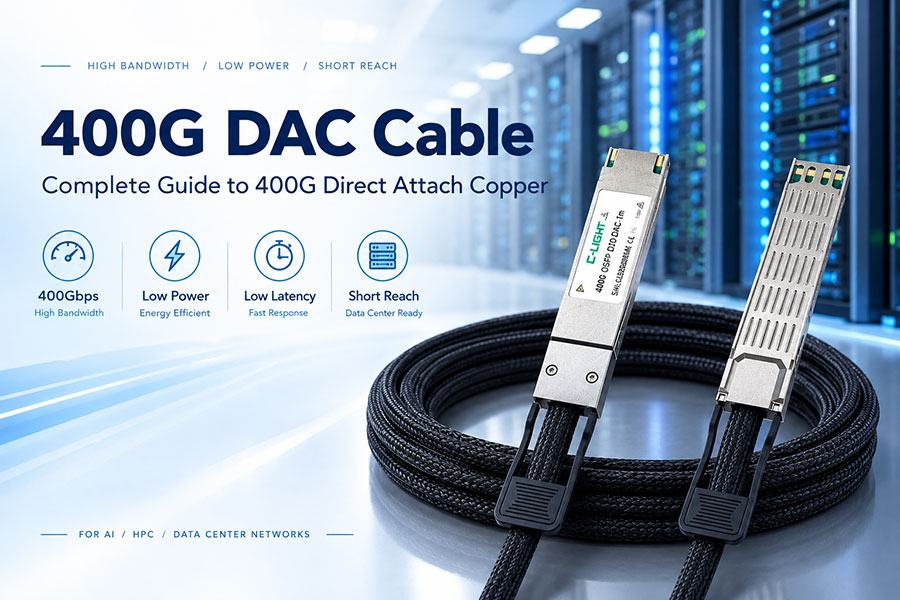
400G DAC cables provide a high-speed direct copper connection for short-reach data center networking. By connecting compatible ports without separate optical transceivers and fiber patch cables, 400G Direct Attach Copper solutions offer low latency, low power consumption, and a practical option for high-density infrastructure. They are widely used in AI computing, HPC, Ethernet, InfiniBand, server-to-switch, and switch-to-switch applications.
1. What Is a 400G DAC Cable?
400G DAC QSFP112/OSFP56/QSFP-DD Cable丨C-LIGHT
A 400G DAC cable, or 400G Direct Attach Copper cable, is a high-speed copper cable assembly designed to deliver 400Gbps connectivity between compatible network interfaces. The cable integrates the required connectors at both ends, eliminating the need for separate optical transceiver modules and fiber cables.
Passive DAC cables contain no active signal-conditioning electronics in the cable assembly. This simple architecture helps achieve very low power consumption and low latency, making DAC particularly suitable for short-distance connections.
2. How Does 400G DAC Work?
Unlike optical transceivers, which convert electrical signals into optical signals and transmit them through fiber, DAC cables maintain the connection in the electrical domain.
A typical 400G DAC link connects two compatible high-speed ports through a copper channel. Depending on the platform, 400G DAC can use PAM4 signaling and different connector configurations such as QSFP-DD, QSFP112, OSFP112, and OSFP56.
The electrical architecture is designed for short-reach transmission where the copper channel can maintain sufficient signal integrity. AMD notes that 400Gbps DAC can reach distances of up to 5m depending on the implementation, while actual supported lengths vary by cable design and host platform.
3. 400G DAC Key Features
| Feature | 400G DAC Characteristics |
|---|---|
| Transmission Medium | Copper |
| Data Rate | 400Gbps |
| Latency | Very low |
| Power Consumption | Very low for passive DAC |
| Optical Components | Not required |
| Typical Application | Short-reach data center connectivity |
| Common Form Factors | QSFP-DD, QSFP112, OSFP112, OSFP56 |
| Typical Cable Length | Approximately 0.5m to 3m for many configurations |
C-LIGHT's 400G DAC portfolio currently covers QSFP112, OSFP112, OSFP56, and QSFP-DD configurations, with many products available from 0.5m to 3m and selected configurations supporting shorter maximum lengths.
4. 400G DAC and PAM4 Signaling
400G networking commonly uses PAM4 signaling to increase the amount of data transmitted per electrical lane compared with traditional two-level signaling. This allows high aggregate bandwidth without requiring an impractical increase in the number of physical lanes.
For example, 400G QSFP-DD configurations commonly use 8 × 50G PAM4 lanes, while different 400G platforms may use other lane configurations depending on the host interface and architecture.
Because PAM4 introduces tighter electrical margins than lower-speed signaling, channel characteristics such as insertion loss, return loss, crosstalk, connector performance, and equalization become important design considerations.
5. 400G DAC Form Factors
There is no single connector format for every 400G DAC application. The appropriate connector depends on the networking equipment, SerDes architecture, protocol, and desired topology.
| Form Factor | Typical 400G DAC Application |
|---|---|
| QSFP-DD | 400GbE and selected high-speed data center platforms |
| QSFP112 | 400G high-performance networking and AI infrastructure |
| OSFP112 | 400G InfiniBand and high-performance networking |
| OSFP56 | 400G InfiniBand and compatible high-speed systems |
C-LIGHT's 400G DAC family includes all four of these platforms, allowing the cable architecture to be matched to different switch and network interface designs.
6. 400G DAC Straight-Through and Breakout Cables
400G DAC cables can be supplied as straight-through connections or breakout assemblies.
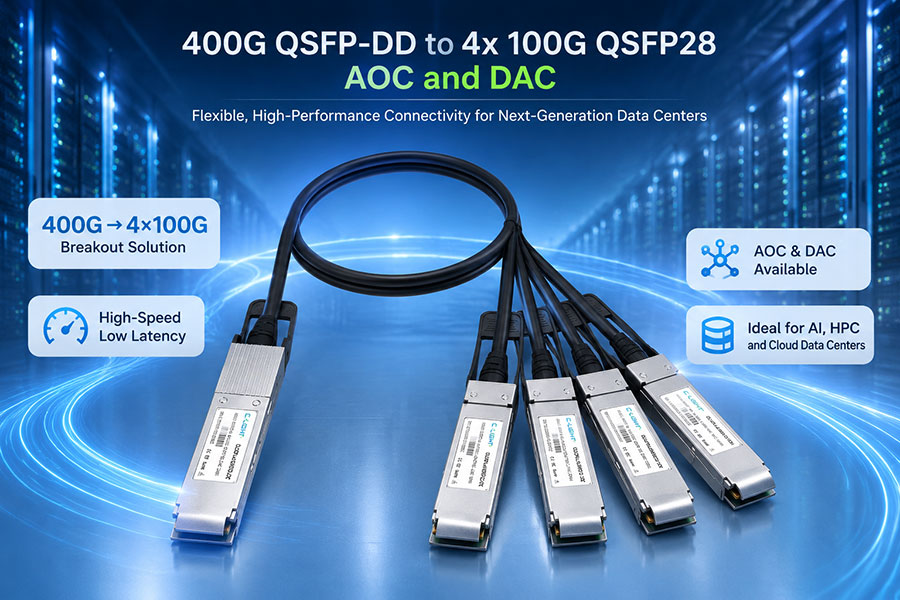
A straight-through cable provides a 400G-to-400G connection. A breakout cable divides a higher-speed port into multiple lower-speed connections, allowing different interface speeds to coexist within the same network architecture.
C-LIGHT offers 400G DAC configurations including 400G-to-200G, 400G-to-100G, and 400G-to-50G architectures in addition to direct 400G connections.
7. 400G DAC for AI Data Centers
AI data centers require large numbers of high-bandwidth connections between compute nodes, accelerators, network interface adapters, and switches. Short copper links can be attractive in tightly packed systems because they provide direct electrical connectivity with low power consumption and low latency.
400G DAC can therefore be used in rack-level AI infrastructure, especially where network equipment and computing nodes are physically close together. AMD's current AI NIC cable documentation includes dedicated DAC configurations for AI networking, while NVIDIA describes passive DAC as a short-reach option for switch-to-server, switch-to-switch, and top-of-rack deployment.
8. 400G DAC for GPU and HPC Networks
GPU clusters and high-performance computing systems rely on high-throughput, low-latency interconnects for distributed workloads. 400G DAC cables can provide short connections between compatible GPU networking interfaces, network adapters, and switches.
These applications are particularly suitable when the physical distance is limited and the installation benefits from a compact point-to-point cable structure.
9. 400G DAC for Switch-to-Server Connections
Switch-to-server connectivity is one of the most common applications for direct attach copper.
When servers and top-of-rack switches are installed within the same rack, a 400G DAC can provide a direct connection without requiring a separate optical transceiver and fiber patch cable. This can simplify deployment and reduce the power consumption associated with active optical components.
10. 400G DAC for Switch-to-Switch Connections
High-speed switches installed within the same rack or in closely positioned network cabinets can also use 400G DAC cables when the required distance is within the supported copper channel budget.
For longer connections, designers may move from passive DAC to active copper or optical solutions to maintain the required signal margin and reach.
11. 400G DAC for Top-of-Rack Networks
Top-of-rack switching concentrates network connections inside or around a single rack. This architecture is well suited to passive DAC because the distance between server interfaces and the switch is typically short.
Using DAC at this layer can reduce cable complexity and power consumption while maintaining a high-bandwidth electrical connection between the server and switch.
12. 400G DAC for InfiniBand Networks
400G DAC solutions are also used in high-performance InfiniBand environments. C-LIGHT provides 400G DAC configurations for InfiniBand using QSFP112, OSFP112, OSFP56, and QSFP-DD platforms.
InfiniBand deployments can benefit from DAC when the physical topology allows short electrical connections between compute nodes, adapters, and switches.
13. 400G DAC vs. 400G Optical Transceiver
| Feature | 400G DAC | 400G Optical Transceiver |
|---|---|---|
| Transmission Medium | Copper | Optical Fiber |
| Typical Reach | Short | Longer |
| Power Consumption | Very low for passive DAC | Higher |
| Latency | Very low | Low |
| Deployment | Simple point-to-point connection | Requires transceivers and fiber |
| Cost | Generally lower for short links | Generally higher |
| Best Use | Short-reach links | Longer-reach links |
DAC is mainly selected when the distance is short enough for copper, while optical transceivers become increasingly attractive as reach and cabling flexibility requirements increase.
14. 400G DAC vs. 400G AOC
| Feature | 400G DAC | 400G AOC |
|---|---|---|
| Medium | Copper | Optical Fiber |
| Power | Lower | Higher |
| Latency | Very low | Low |
| Reach | Shorter | Longer |
| Weight and Flexibility | Can become significant at higher gauges and lengths | Generally lighter for longer links |
| Typical Application | Rack-level interconnects | Longer short-reach connections |
The decision between DAC and AOC should be based on distance, power budget, cable routing, signal integrity, system compatibility, and total deployment cost.
15. 400G DAC vs. 400G AEC
Active Electrical Cable (AEC) adds active signal conditioning to the copper link. This allows active copper solutions to extend beyond the practical reach of a passive DAC in some system architectures.
AMD describes DAC as a low-power, short-range solution and AEC as a separate cable technology for applications where additional signal conditioning is required.
As a general rule, passive DAC is preferred when the shortest possible and most power-efficient copper connection is sufficient. AEC becomes more relevant when the required reach or electrical margin exceeds passive DAC capability.
16. 400G DAC Cable Length
Cable length has a direct relationship with electrical loss and signal integrity. Shorter cables generally provide more signal margin and are easier to manage in dense racks.
Many 400G DAC products are offered in lengths from approximately 0.5m to 3m, while specific platforms can support longer configurations depending on cable design and host requirements. C-LIGHT currently lists 400G DAC configurations covering 0.5m to 3m, with QSFP112 and OSFP112 configurations generally listed up to 2m.
17. 400G DAC Cable Gauge and Signal Integrity
Copper gauge affects electrical loss, flexibility, cable weight, and thermal characteristics. A larger conductor can help manage electrical loss but may increase cable diameter and reduce routing flexibility.
At 400G signaling speeds, cable performance should be evaluated together with the host platform rather than treated as an isolated component. Insertion loss, return loss, crosstalk, connector quality, lane skew, and equalization all contribute to link performance.
18. 400G DAC Cable Compatibility
Compatibility is a key consideration when selecting a 400G DAC cable. The connector type alone does not guarantee interoperability. The cable must match the host interface, lane architecture, supported protocol, firmware behavior, and electrical requirements of the connected devices.
For AI and HPC deployments, it is important to validate the complete link between the network adapter and switch rather than testing the cable independently.
19. 400G DAC Applications
Typical 400G DAC applications include:
AI data center networks
GPU cluster interconnects
HPC systems
InfiniBand networks
400GbE data center infrastructure
Switch-to-server connections
Switch-to-switch connections
Top-of-rack connectivity
Short-distance rack interconnects
400G breakout applications
Industry documentation from NVIDIA and Siemon similarly identifies top-of-rack, switch-to-server, switch-to-switch, server, storage, and accelerator connections as common applications for high-speed copper interconnects.
20. How to Choose the Right 400G DAC Cable
The first selection factor should be the interface type of the equipment. After that, evaluate cable length, protocol, lane configuration, connector type, electrical performance, and system compatibility.
| Selection Factor | Key Question |
|---|---|
| Port Type | Is the host QSFP-DD, QSFP112, OSFP112, or OSFP56? |
| Data Rate | Do both endpoints support 400Gbps? |
| Distance | Is the required length within the supported copper channel range? |
| Protocol | Is the application Ethernet, InfiniBand, or another supported protocol? |
| Breakout | Is a 400G-to-200G or other breakout configuration required? |
| Signal Integrity | Does the cable provide sufficient electrical margin for the host platform? |
| Mechanical Design | Are cable diameter, bend radius, weight, and routing suitable for the rack? |
21. C-LIGHT 400G DAC Cable Solutions
C-LIGHT provides a range of 400G Direct Attach Copper solutions designed for data center, AI, HPC, InfiniBand, and high-speed Ethernet applications.
The product family includes 400G QSFP112, 400G OSFP112, 400G OSFP56, and 400G QSFP-DD configurations, together with direct connections and multiple breakout architectures. The available cable range and connector combinations allow the same 400G network architecture to be adapted to different equipment platforms.
22. The Role of 400G DAC in AI Networking
As AI infrastructure continues to scale, network designers are increasingly combining different interconnect technologies according to link distance and bandwidth requirements.
400G DAC remains valuable for the shortest links because of its low power consumption, low latency, and simple deployment. AOC and optical transceivers can then be used where longer reach or greater cabling flexibility is required, while active copper can bridge some of the gap between passive copper and optical connectivity.
This multi-technology approach allows data center architects to optimize each connection instead of using a single cable technology across the entire network.
23. Conclusion
400G DAC cables are an important short-reach connectivity option for modern data centers, AI clusters, HPC systems, and high-speed networking environments. Their direct copper architecture provides a combination of low latency, low power consumption, and cost efficiency that is difficult to replace for very short connections.
The right 400G DAC solution depends on port type, cable length, protocol, breakout architecture, signal integrity, and system compatibility. For short rack-level connections, DAC can provide an efficient alternative to optical connectivity, while AEC, AOC, and optical transceivers provide additional options as distance and network requirements increase.
 >
>

 >
>
 >
>
 >
>
 >
>
 >
>
 >
>
 >
>