TEL:+86 132 6656 7067




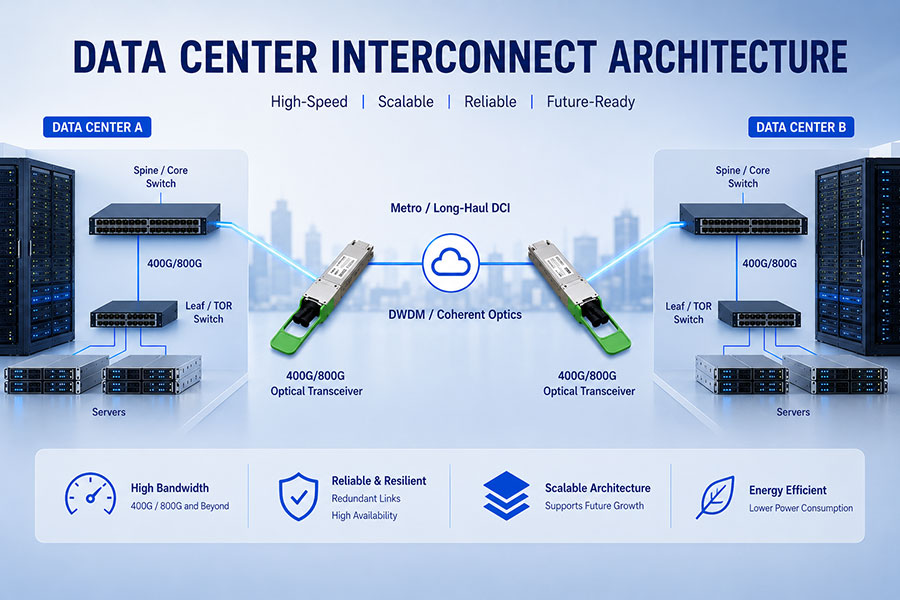
Data center interconnect (DCI) architecture defines how geographically distributed data centers, network facilities, and computing resources are connected to exchange data efficiently. As cloud computing, AI workloads, distributed applications, and large-scale storage continue to grow, DCI networks increasingly require higher bandwidth, lower latency, better scalability, and reliable optical connectivity.
Modern DCI architectures can range from short-reach connections between facilities within the same campus to long-distance links between regional and metropolitan data centers. Optical transceivers, coherent optics, AOC, DAC, and high-speed fiber infrastructure all play different roles depending on distance, bandwidth, and network design.
1. What Is Data Center Interconnect?
Data center interconnect is the networking infrastructure used to connect two or more data centers. The connection allows computing, storage, applications, and network services to operate across multiple facilities while maintaining communication between sites.
A DCI network may connect data centers within the same campus, across a metropolitan area, or over much longer regional and intercontinental distances. The required optical technology changes significantly as the transmission distance increases.
2. Basic Data Center Interconnect Architecture
A typical DCI architecture consists of data center switches, routers, optical transceivers, fiber links, and optical transport equipment. The architecture can be divided into several functional layers based on the distance and networking requirements.
| DCI Layer | Typical Connection | Common Technology |
|---|---|---|
| Intra-Rack | Server to switch | DAC, AOC, optical transceiver |
| Inter-Rack | Switch to switch | AOC, DAC, 400G/800G optics |
| Campus DCI | Building to building | 400G/800G optical transceivers |
| Metro DCI | Data center to data center | ZR/ZR+ and coherent optics |
| Long-Haul DCI | Regional data centers | Coherent optical transport |
3. Key Components of DCI Architecture
3.1 Data Center Switches
High-speed switches provide the network interfaces used to connect servers, storage systems, and external DCI links. As data center port speeds move from 400G toward 800G and beyond, the DCI architecture must support increasingly high-capacity optical interfaces.
3.2 Optical Transceivers
Optical transceivers convert electrical signals into optical signals and provide the physical interface between switches and fiber networks. Depending on the distance, applications can use SR, DR, FR, LR, ZR, or coherent optical technologies.
3.3 Fiber Infrastructure
Single-mode fiber is commonly used for longer DCI connections because of its low attenuation and suitability for high-speed optical transmission. Multimode fiber can remain useful for selected short-reach data center applications.
3.4 Optical Transport Equipment
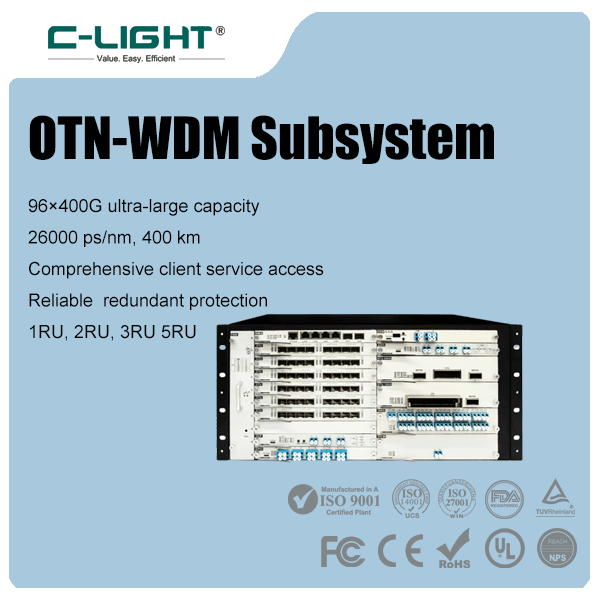
For longer DCI links, optical transport systems can provide wavelength multiplexing, amplification, dispersion management, and coherent transmission. DWDM technology can significantly increase the capacity of existing fiber infrastructure.
4. DCI Architecture by Distance
Short-Reach DCI
Short-reach connections are typically used between equipment located within the same data center, campus, or nearby facilities. 400G and 800G AOCs and optical transceivers can provide high-bandwidth connectivity for these environments.
Metro DCI
Metro DCI connects facilities across a metropolitan area. Optical modules designed for longer reaches, including 400ZR and related coherent technologies, can be used where higher optical performance is required.
Long-Distance DCI
Long-distance DCI connects data centers across regional or national networks. Coherent optical transmission and DWDM systems are generally better suited to these applications because they provide greater reach and spectral efficiency.
5. 400G and 800G in DCI Networks
400G has become an important bandwidth level for modern data center connectivity, while 800G is increasingly important for high-density cloud and AI infrastructure. Higher-speed interfaces allow more traffic to be carried through fewer physical ports and links.
For short-reach connections, 400G and 800G AOC or pluggable optical transceivers can simplify deployment. For longer DCI connections, higher-performance optical modules and coherent solutions become increasingly important.
6. DCI Architecture for AI Data Centers
AI infrastructure introduces substantially higher east-west traffic between GPU clusters, storage systems, and computing resources. As AI clusters scale, DCI architecture must provide sufficient bandwidth between geographically distributed computing facilities.
High-speed Ethernet networks using 400G and 800G optical connectivity can support connections between AI infrastructure and DCI networks. Future deployments are expected to require even higher-speed optical interfaces as GPU cluster sizes and network bandwidth continue to increase.
7. Optical Interconnect Choices for DCI
| Solution | Primary Advantage | Typical Use |
|---|---|---|
| DAC | Low-cost short connection | Rack-level links |
| AOC | Integrated optical connectivity | Short-reach high-bandwidth links |
| DR/FR/LR Optics | Flexible fiber connectivity | Data center and campus DCI |
| ZR/ZR+ Optics | Extended optical reach | Metro and regional DCI |
| Coherent Optics | Long reach and high spectral efficiency | Metro, regional, and long-haul DCI |
8. DCI Network Topologies
Point-to-Point
Point-to-point DCI directly connects two data centers. It is relatively simple to deploy and is suitable when traffic primarily flows between two facilities.
Hub-and-Spoke
A hub-and-spoke architecture connects multiple facilities through a central location. This approach can simplify centralized network management but may introduce dependency on the hub.
Mesh DCI
A mesh architecture provides multiple paths between data centers. It can improve redundancy and traffic distribution, making it useful for large-scale distributed infrastructure.
9. Important DCI Design Considerations
Bandwidth: Select 400G, 800G, or higher-speed interfaces according to current and expected traffic demand.
Distance: Optical modules should be selected according to the actual fiber distance and link budget.
Latency: Applications such as distributed computing and AI workloads may require low-latency paths.
Fiber availability: Existing fiber infrastructure can strongly influence DCI architecture and optical technology selection.
Redundancy: Multiple optical paths can improve network resilience and availability.
Power efficiency: Optical modules should balance transmission performance with power consumption, especially in high-density deployments.
Scalability: The architecture should support future bandwidth upgrades without requiring a complete infrastructure redesign.
10. Role of DWDM in DCI
Dense Wavelength Division Multiplexing (DWDM) allows multiple optical wavelengths to share the same fiber pair. This makes it possible to increase DCI capacity without installing a proportional amount of new fiber.
DWDM becomes particularly valuable when data centers are connected over metropolitan or regional distances and existing fiber resources need to support increasing traffic volumes.
11. DCI Architecture Evolution
Traditional DCI networks were often designed around lower-speed Ethernet interfaces and dedicated transport systems. The rapid growth of cloud computing and AI is changing this model toward higher-speed pluggable optics, open optical networking, and increasingly dense optical interconnects.
The evolution from 100G and 200G to 400G, 800G, and eventually higher-speed interfaces allows DCI networks to scale bandwidth while maintaining efficient port density. At the same time, coherent pluggable optics are expanding the role of compact optical modules in metro and regional DCI applications.
12. Why Optical Connectivity Matters for DCI
Optical connectivity provides the bandwidth, reach, and electromagnetic immunity required by modern data center networks. Compared with copper-based solutions, optical fiber is particularly advantageous when links become longer or when high port density creates challenging cabling conditions.
For short connections, AOC and high-speed pluggable optics can simplify deployment. For longer DCI links, ZR, ZR+, coherent, and DWDM technologies provide the additional optical performance needed to maintain reliable connectivity.
13. C-LIGHT Optical Solutions for Data Center Interconnect
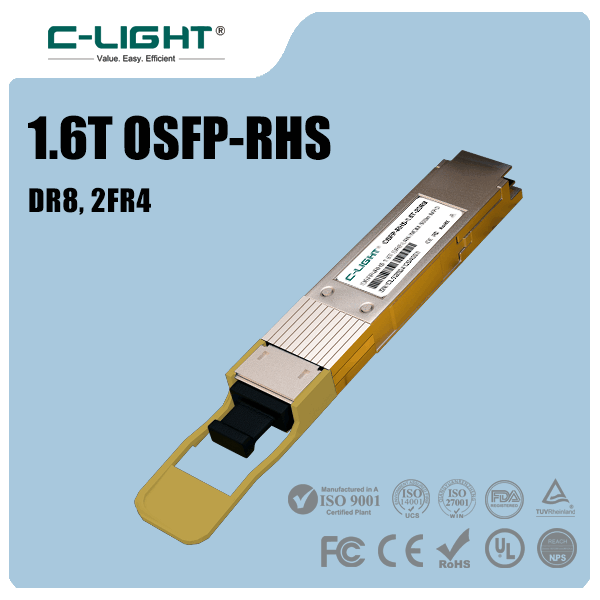
C-LIGHT provides optical transceivers and active optical connectivity solutions for data center and high-speed networking applications. Its portfolio covers different transmission rates, form factors, distances, and application requirements.
For modern DCI deployments, solutions such as 400G and 800G optical transceivers and AOC cables can support high-bandwidth short-reach connectivity, while longer-reach optical technologies can be selected according to network distance and architecture.
14. Frequently Asked Questions
Q1. What is data center interconnect architecture?
Answer: Data center interconnect architecture is the network design used to connect multiple data centers so that computing, storage, applications, and network resources can communicate across different facilities.
Q2. What optical technologies are used for DCI?
Answer: DCI can use DAC, AOC, 400G/800G optical transceivers, ZR/ZR+ optics, coherent pluggable optics, and DWDM systems depending on the distance and capacity requirements.
Q3. What is the difference between short-reach and long-distance DCI?
Answer: Short-reach DCI typically uses high-speed Ethernet optics or AOCs, while longer DCI connections generally require higher-performance optics such as ZR, ZR+, coherent, or DWDM solutions.
Q4. Is 400G suitable for data center interconnect?
Answer: Yes. 400G provides a practical bandwidth level for many modern DCI applications, including campus, cloud, and high-density data center networks.
Q5. Why is 800G important for DCI?
Answer: 800G increases bandwidth per optical port, helping data centers handle growing traffic from AI, cloud computing, distributed storage, and high-performance applications.
Q6. What fiber is commonly used for DCI?
Answer: Single-mode fiber is widely used for DCI because it supports high-speed transmission over longer distances with low optical attenuation.
Q7. How does DWDM improve DCI capacity?
Answer: DWDM allows multiple wavelengths to transmit over the same fiber, increasing the aggregate capacity of an existing fiber infrastructure.
Q8. What should be considered when designing a DCI network?
Answer: Key considerations include bandwidth, distance, latency, fiber availability, optical link budget, redundancy, power consumption, scalability, and compatibility with network equipment.
15.Conclusion
Data center interconnect architecture is becoming increasingly important as cloud platforms, AI infrastructure, and distributed computing generate more traffic between geographically separated facilities. A well-designed DCI network combines high-speed switching, optical transceivers, fiber infrastructure, and optical transport technologies according to distance and capacity requirements.
400G and 800G optical connectivity can provide efficient high-bandwidth links for modern data centers, while ZR, coherent optics, and DWDM extend DCI capabilities to metro and regional networks. Choosing the appropriate optical interconnect technology is therefore essential for building scalable, reliable, and efficient data center infrastructure.
 >
>

 >
>
 >
>
 >
>
 >
>
 >
>
 >
>
 >
>