TEL:+86 132 6656 7067




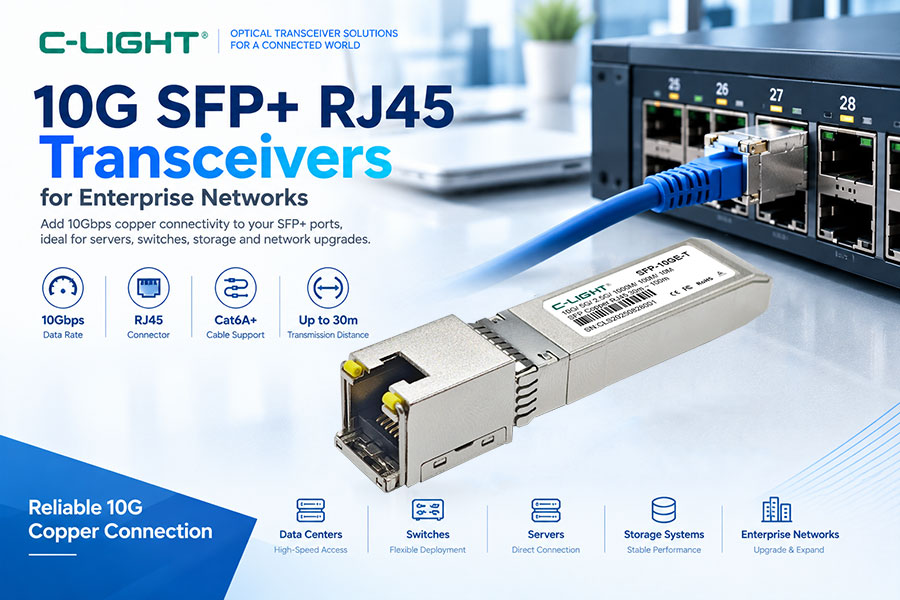
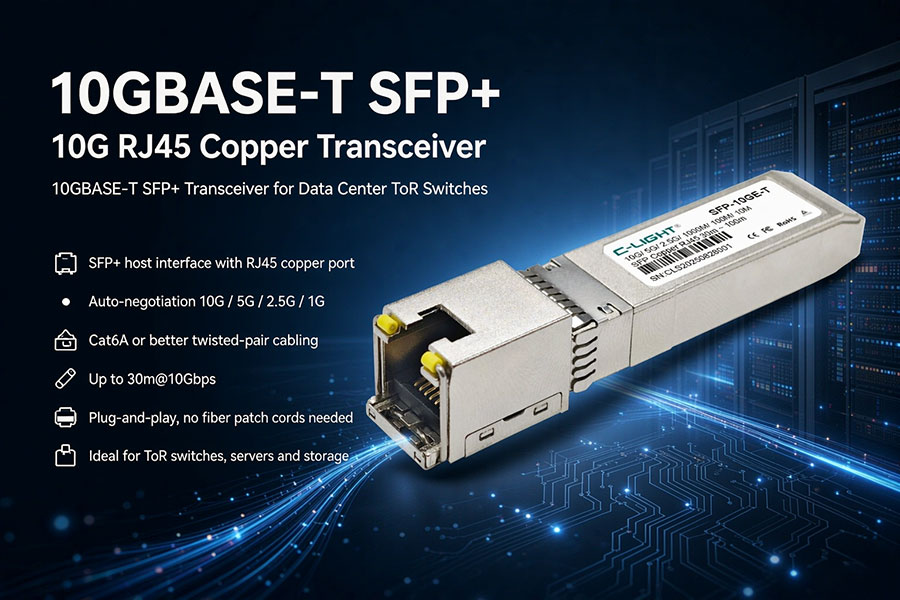
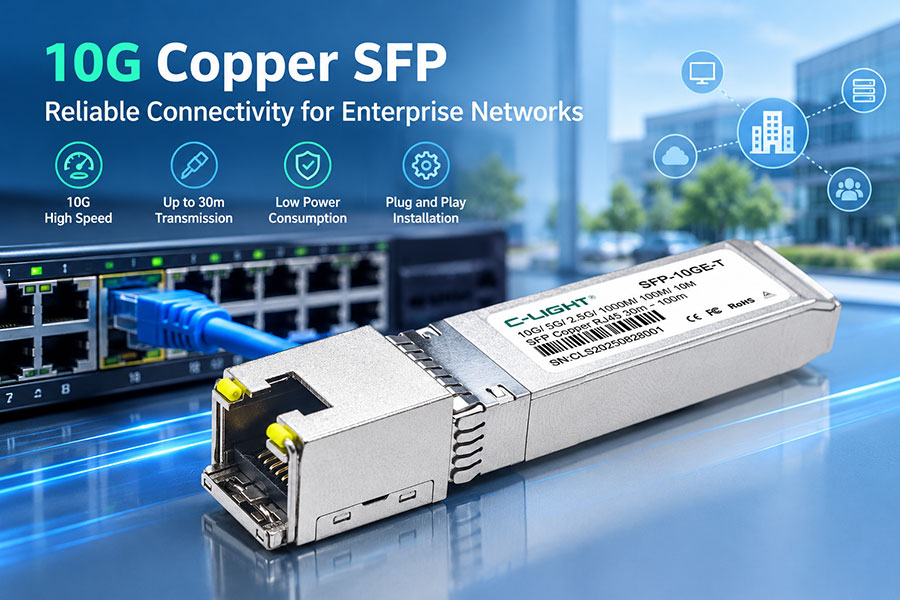
10G SFP+ RJ45 transceivers provide 10Gbps Ethernet connectivity through standard RJ45 copper cabling, making them useful for enterprise switches, servers, storage systems, and network upgrades. Using 10GBASE-T technology, these modules typically support Cat6A or better cabling for short-distance connections.
1. What Is a 10G SFP+ RJ45 Transceiver?
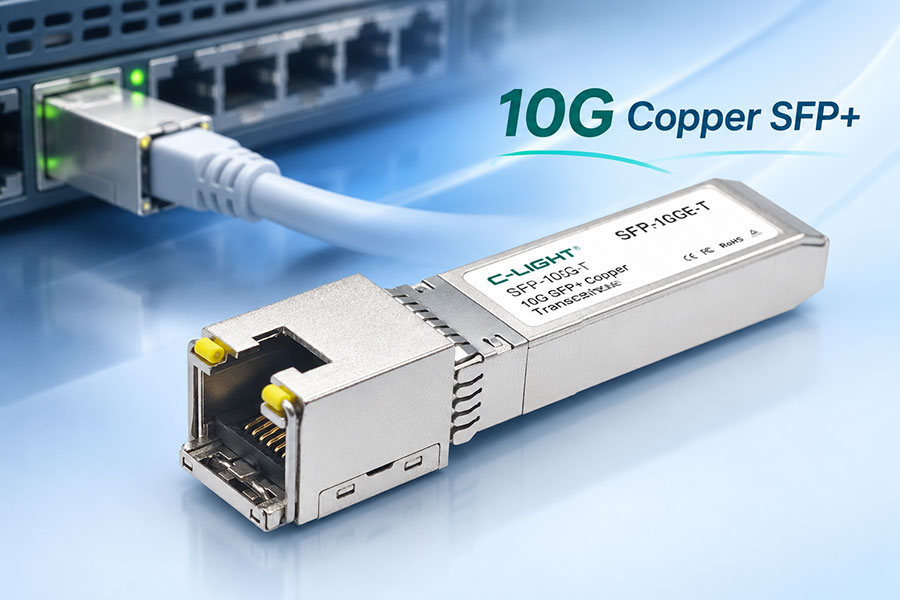
10G SFP+ RJ45 transceiver is a copper-based network module that plugs into an SFP+ port and provides an RJ45 interface. It converts the SFP+ electrical interface into 10GBASE-T copper connectivity, allowing compatible switches and routers to connect directly to Ethernet devices using twisted-pair cables.
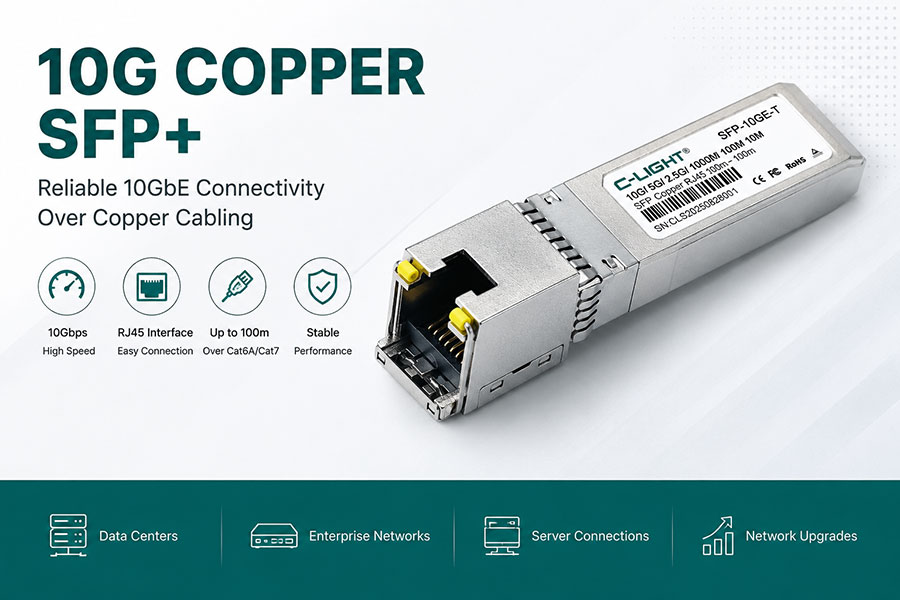
2. 10Gbps Ethernet for Enterprise Networks
Enterprise networks often include a mixture of fiber, copper, servers, storage devices, access switches, and legacy Ethernet equipment. A 10G SFP+ RJ45 transceiver adds copper connectivity to SFP+ network ports without requiring a dedicated 10GBASE-T switch.
This makes the module useful for network expansion, server connections, and migration from lower-speed Ethernet to 10Gbps connectivity.
3. 10GBASE-T and RJ45 Connectivity
10GBASE-T is the copper Ethernet technology used by these transceivers. Instead of using an optical fiber connection, the module communicates through balanced twisted-pair copper cabling and a standard RJ45 connector.
This provides a familiar physical interface for enterprise networks where structured copper cabling is already installed.
4. Transmission Distance
For 10Gbps operation, 10G SFP+ RJ45 transceivers are commonly designed for short-reach connections. With Cat6A or better cabling, a typical maximum reach is up to 30 meters for SFP+ 10GBASE-T modules.
The actual supported distance depends on the transceiver, cable category, host platform, and network configuration.
5. Supported Copper Cabling
Cat6A is a common choice for 10Gbps copper connections because it provides the bandwidth required by 10GBASE-T over short enterprise and data center links.
| Cable Type | Typical Use | 10G Application |
|---|---|---|
| Cat5e | Lower-speed Ethernet | Not generally preferred for 10Gbps deployment |
| Cat6 | Enterprise structured cabling | Distance depends on installation conditions |
| Cat6A | 10G enterprise networking | Common choice for 10GBASE-T |
| Cat7 | High-performance copper networks | Suitable for 10G applications |
6. SFP+ RJ45 vs. Optical SFP+
The main difference is the physical transmission medium. Optical SFP+ modules use fiber and are available for different distances, while RJ45 SFP+ transceivers use copper twisted-pair cabling.
| Feature | 10G SFP+ RJ45 | 10G Optical SFP+ |
|---|---|---|
| Medium | Copper | Optical Fiber |
| Connector | RJ45 | LC or other fiber connector |
| Typical Reach | Up to 30m for many 10GBASE-T SFP+ modules | Depends on module and fiber type |
| Infrastructure | Cat6A/Cat7 copper | MMF or SMF |
| Best Fit | Short enterprise and rack connections | Longer network links |
7. Enterprise Server Connectivity
Many enterprise servers still provide RJ45 10GBASE-T network interfaces. A 10G SFP+ RJ45 transceiver allows these servers to connect to switches equipped with SFP+ ports.
This is particularly useful when a network contains both SFP+ optical ports and embedded copper Ethernet ports.
8. Switch-to-Server Applications
A common deployment is a switch-to-server connection within the same rack or between adjacent racks. The SFP+ RJ45 module is installed in the switch, while the server uses its native RJ45 10GBASE-T port.
This approach avoids replacing existing server network adapters simply because a new switch uses SFP+ interfaces.
9. Storage and Network Appliance Connections
Enterprise storage systems, NAS platforms, backup appliances, and other network devices may use RJ45-based 10Gbps Ethernet interfaces. An SFP+ RJ45 transceiver can provide connectivity between these devices and SFP+ switches.
10. Network Upgrade and Migration
10G SFP+ RJ45 transceivers can simplify upgrades from 1Gbps to 10Gbps Ethernet when suitable copper cabling is already available. Enterprises can retain compatible network equipment and gradually upgrade selected links instead of replacing the complete infrastructure.
11. Multi-Speed Support
Some 10GBASE-T SFP+ copper transceivers support multiple Ethernet speeds, such as 100Mbps, 1Gbps, and 10Gbps. Multi-rate operation can be useful in mixed-speed enterprise environments, although supported speeds and auto-negotiation behavior depend on the transceiver and host platform.
12. Power and Thermal Considerations
Copper-based 10G SFP+ modules generally require more power than many short-reach optical SFP+ modules because 10GBASE-T performs high-speed signal processing over copper.
Power consumption and thermal limits should therefore be checked when deploying many RJ45 transceivers in a high-density switch.
13. Compatibility with Enterprise Switches
Compatibility is determined by both the SFP+ module and the host switch or router. Before deployment, engineers should verify supported transceiver types, data rates, coding requirements, firmware support, and power limits of the host platform.
For multi-vendor networks, interoperability testing is especially important before large-scale deployment.
14. Advantages of 10G SFP+ RJ45 Transceivers
10Gbps Ethernet connectivity
Standard RJ45 interface
Uses familiar copper cabling
Suitable for enterprise server and storage connections
Supports flexible SFP+ switch deployment
Useful for network migration and expansion
Compact hot-pluggable form factor
15. Typical Enterprise Network Applications
10G SFP+ RJ45 transceivers are suitable for a range of short-distance enterprise connections.
Switch-to-server connections
Switch-to-storage connections
Top-of-rack networking
Enterprise data centers
Network-attached storage
Backup and virtualization infrastructure
Campus network aggregation
Short-distance switch interconnects
16. How to Choose a 10G SFP+ RJ45 Transceiver
Selection should consider the host switch, required data rate, cable type, transmission distance, power consumption, operating temperature, and vendor compatibility.
For a typical short-distance 10Gbps enterprise connection, a module supporting 10GBASE-T over Cat6A or better cabling is a practical choice.
17. 10G SFP+ RJ45 vs. DAC Cable
DAC cables are often preferred for very short switch-to-server links because they integrate the cable and connectors into one assembly. An SFP+ RJ45 transceiver provides greater flexibility when the endpoint already uses an RJ45 Ethernet port or when structured copper cabling is required.
18. Why Use 10G SFP+ RJ45 in Enterprise Networks?
10G SFP+ RJ45 transceivers offer a practical bridge between SFP+ network equipment and existing copper Ethernet infrastructure. They are particularly valuable in enterprise environments where servers, storage appliances, and other endpoints already use RJ45-based 10GBASE-T connectivity.
19. Frequently Asked Questions
Q1. What is a 10G SFP+ RJ45 transceiver?
Q2. How far can a 10G SFP+ RJ45 transceiver reach?
Q3. What cable should be used with a 10G SFP+ RJ45 transceiver?
Q4. Can a 10G SFP+ RJ45 transceiver connect to a normal RJ45 server port?
Q5. Is 10G SFP+ RJ45 suitable for enterprise networks?
Q6. Does every SFP+ port support an RJ45 copper transceiver?
20. Summary
10G SFP+ RJ45 transceivers provide a flexible way to add 10GBASE-T copper connectivity to SFP+ switches and routers. With an RJ45 interface and support for short-distance Cat6A or better connections, they are a practical solution for enterprise servers, storage systems, data centers, and network migration projects.
 >
>

 >
>
 >
>
 >
>
 >
>
 >
>
 >
>
 >
>