TEL:+86 132 6656 7067




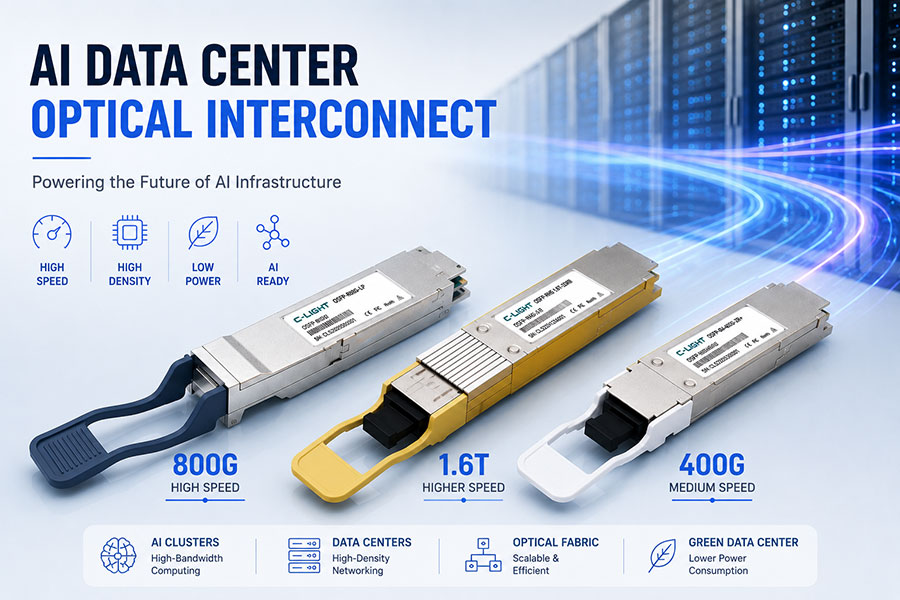
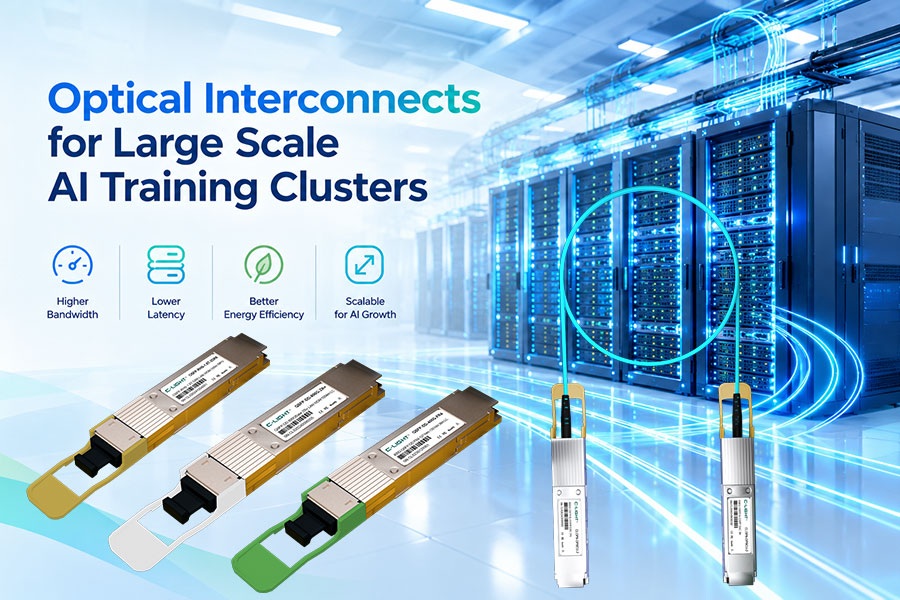
The AI Data Center Optical Interconnect Market is becoming an important part of next-generation data center infrastructure as AI training, inference, high-performance computing, and large-scale accelerator clusters place greater demands on network bandwidth, latency, power efficiency, and connectivity density.
Optical interconnects are no longer limited to conventional data center uplinks. They are increasingly used across switch-to-switch, server-to-switch, rack-to-rack, and accelerator networking environments. The transition from 100G and 200G toward 400G, 800G, and 1.6T is reshaping the architecture of AI data center networks and creating new opportunities for optical transceivers, active optical cables, linear pluggable optics, silicon photonics, and co-packaged optics.
1. AI Data Center Optical Interconnect Market Overview
AI workloads generate significantly different networking requirements compared with conventional enterprise applications. Large accelerator clusters need to exchange model parameters, training data, gradients, and intermediate results across a large number of computing nodes. As the number of accelerators increases, the network must provide sufficient bandwidth to prevent communication from becoming a bottleneck for the overall computing system.
This requirement is driving a broader transition toward high-speed optical connectivity. Instead of treating optical modules simply as network components, data center architects increasingly evaluate optical connectivity as part of the overall compute, network, power, and thermal design.
Market research firms are using different definitions and scopes for the optical interconnect market, so reported market values can vary considerably. Some studies cover the entire optical interconnect ecosystem, while others focus specifically on data center optical transceivers or AI cluster optics. For this reason, market size figures should be compared only when the scope and product definitions are consistent.
2. Why AI Data Centers Are Driving Optical Interconnect Demand
2.1 Increasing Accelerator Density
AI clusters are built around large numbers of GPUs, AI accelerators, CPUs, and high-performance switches. Increasing accelerator density creates significantly more east-west traffic inside the data center.
As cluster size grows, the network must move larger amounts of data between computing resources without introducing excessive latency or power consumption. Optical links provide a practical way to scale bandwidth over distances where traditional copper connections become increasingly difficult to optimize.
2.2 Higher Bandwidth Requirements
The optical transceiver industry has moved through several major bandwidth generations. 100G and 200G remain relevant in many existing networks, while 400G has become an important high-speed data center technology. 800G is now a major focus for AI infrastructure, while 1.6T is emerging as the next bandwidth-density upgrade.
100G: Established data center and network connectivity
200G: Intermediate high-speed deployment for selected applications
400G: Widely adopted high-speed data center connectivity
800G: Major platform for current AI and hyperscale network upgrades
1.6T: Emerging generation for higher-density AI networking
3.2T: Longer-term direction for future high-bandwidth network architectures
2.3 Power Efficiency Is Becoming More Important
Increasing network bandwidth also increases the importance of power consumption. Optical modules contain lasers, drivers, receivers, DSPs, thermal components, and other active devices. At large deployment volumes, even a small reduction in power per port can have a significant effect on the total power requirements of a data center.
This is one reason why the industry is investigating technologies such as LPO, LRO, silicon photonics, and CPO. These approaches aim to reduce electrical signal loss, simplify signal-processing paths, improve integration, or increase bandwidth density.
3. 400G, 800G and 1.6T Optical Interconnect Evolution
3.1 400G Optical Interconnects
400G represents an important transition point in data center networking. QSFP-DD and OSFP form factors provide different approaches to high-speed port deployment, while optical architectures such as 400G DR4, FR4, LR4, and SR4 address different reach and fiber requirements.
400G remains relevant because data center upgrades do not occur simultaneously. Existing 400G infrastructure can continue to serve many applications while newer AI clusters move toward 800G and 1.6T.
3.2 800G Optical Interconnects
800G has become one of the most important bandwidth classes in AI data center networking. The technology can be implemented using different optical architectures and form factors depending on reach, switch platform, fiber infrastructure, and system requirements.
OSFP and QSFP112 are two important form-factor approaches associated with high-speed optical networking. The selection between them depends on host platform compatibility, electrical interface requirements, thermal design, port density, and the intended network architecture.
800G optical modules can support applications ranging from short-reach connections inside data centers to longer-reach connections between network equipment. The actual optical architecture depends on the required distance, fiber type, wavelength configuration, and transceiver design.
3.3 1.6T Optical Interconnects
1.6T is the next major step in optical bandwidth density. Instead of simply increasing the number of ports, higher-speed interfaces allow network designers to transport more bandwidth through each individual port.
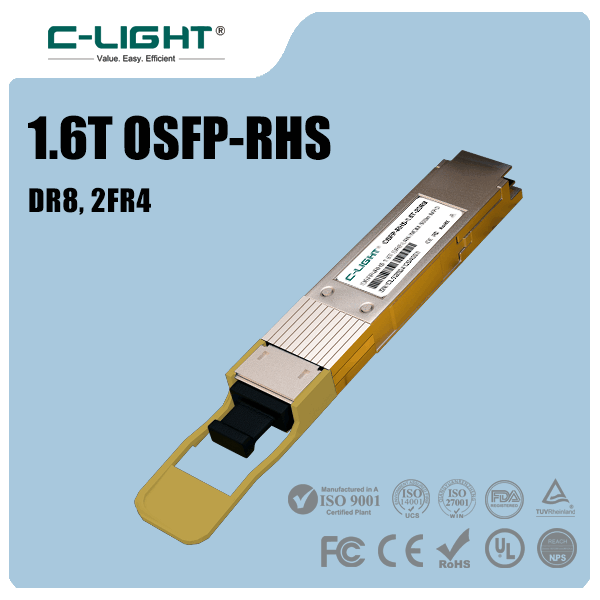
1.6T optical modules are particularly relevant to future AI clusters where switch ASIC bandwidth and accelerator connectivity continue to increase. Current 1.6T development includes OSFP-based solutions and multi-lane architectures designed to support the electrical and optical requirements of next-generation systems.
LightCounting reported in 2026 that 800G transceiver shipments were expected to more than double during the year, while 1.6T shipments were projected to grow from a relatively small 2025 base into the tens of millions of ports. These forecasts illustrate the accelerating transition toward higher-speed optical connectivity in AI infrastructure.
4. Key Optical Interconnect Technologies
4.1 Pluggable Optical Transceivers
Pluggable optical transceivers remain one of the most flexible approaches for data center networking. They can be installed and replaced independently from the switch or server platform, simplifying maintenance and allowing network operators to select different reach and optical configurations.
QSFP-DD, QSFP112, and OSFP are among the form factors used in high-speed networking. As bandwidth increases, thermal management and electrical signal integrity become increasingly important factors in module design.
4.2 Active Optical Cables
Active Optical Cables, or AOCs, integrate optical transceivers and fiber into a factory-assembled cable solution. AOCs can simplify installation and provide a practical solution for short and medium-distance data center connections.
For large AI clusters, AOCs can be considered alongside DAC and AEC solutions depending on distance, power consumption, signal integrity, cable management, and system requirements.
4.3 Linear Pluggable Optics
Linear Pluggable Optics, commonly referred to as LPO, is being investigated as an alternative architecture for reducing the power and complexity associated with traditional DSP-based optical modules.
LPO can shorten the electrical signal-processing path by removing or reducing the role of the traditional DSP in the optical module. This approach can potentially reduce power consumption and latency, but it also places greater requirements on host electrical interfaces, signal integrity, equalization, interoperability, and system-level design.
4.4 Co-Packaged Optics
Co-Packaged Optics, or CPO, moves optical engines closer to the switching ASIC instead of placing the complete optical interface at the front panel.
The fundamental objective is to shorten high-speed electrical paths and improve bandwidth density and energy efficiency. CPO is attracting significant attention for future AI networking, although its manufacturing, thermal management, serviceability, optical integration, and ecosystem requirements remain important considerations.
5. Silicon Photonics and AI Data Center Connectivity
Silicon photonics is becoming an important technology within the optical interconnect ecosystem. It combines optical functions with silicon-based manufacturing approaches and can support higher levels of integration.
Silicon photonics is particularly relevant to high-volume data center applications because integration can help address challenges associated with optical component size, manufacturing scalability, power consumption, and bandwidth density.
Its role is expected to extend beyond conventional pluggable modules into LPO, CPO, and other advanced optical architectures.
6. Form Factors: QSFP, QSFP112 and OSFP
Form factor selection becomes increasingly important as optical data rates increase.
QSFP-based solutions: Widely deployed and supported across multiple generations of data center networking.
QSFP112: Designed around 112G electrical signaling per lane and suitable for high-speed networking platforms.
OSFP: Provides a larger mechanical envelope that can offer additional thermal and power-handling capabilities for very high-speed optical modules.
There is no single form factor that is suitable for every AI data center. The appropriate choice depends on switch design, lane architecture, thermal requirements, module power, port density, optical reach, and system compatibility.
7. Optical Interconnects and AI Network Architecture
AI networking can generally be considered across scale-up and scale-out environments.
7.1 Scale-Up Connectivity
Scale-up networks connect computing resources within a tightly integrated AI system. These connections require very high bandwidth and low latency because communication performance can directly affect accelerator utilization.
Depending on the architecture, optical connectivity can become increasingly important as electrical link distances and bandwidth requirements increase.
7.2 Scale-Out Connectivity
Scale-out networks connect multiple servers, racks, switches, and accelerator systems. Optical transceivers, AOCs, and other optical interconnect solutions can provide the physical connectivity required to build large-scale AI fabrics.
As the number of nodes increases, network topology, link reach, fiber management, transceiver density, power consumption, and thermal design become important parts of the overall architecture.
8. Market Trends in AI Data Center Optical Interconnects
8.1 Shift Toward 800G and 1.6T
The market is moving toward higher-speed interfaces as AI cluster bandwidth requirements increase. 400G remains an important installed and deployment technology, while 800G is becoming a major high-speed platform and 1.6T is moving into the next stage of deployment.
8.2 Diversification of Optical Architectures
The future optical interconnect market will not depend on a single technology. Traditional pluggable transceivers, LPO, LRO, AOCs, silicon photonics, CPO, and optical switching technologies are being developed for different positions within the AI networking stack.
TrendForce's 2026 analysis identifies the transition from conventional pluggable optics toward LPO, CPO, and optical circuit switching as an important direction in AI data center optical infrastructure.
8.3 Increasing Importance of Thermal Management
Higher-speed optical modules generally create greater thermal design challenges. As module power increases, conventional air cooling may become more difficult to optimize in high-density systems.
This creates opportunities for improved heat sinks, advanced thermal interfaces, liquid cooling approaches, and other thermal-management technologies. Thermal design is becoming a system-level consideration rather than a module-only issue.
8.4 Growing Demand for Higher Integration
AI data centers require more bandwidth within increasingly constrained physical and power envelopes. This is encouraging the industry to increase integration at the optical engine, package, switch, and system levels.
The combination of silicon photonics, integrated optical engines, advanced packaging, and CPO could become increasingly important as networks move beyond 1.6T.
9. Key Challenges in the AI Optical Interconnect Market
9.1 Power Consumption
Power efficiency is one of the most important challenges for high-speed optical modules. Higher data rates require more advanced electrical and optical components, which can increase module power.
9.2 Thermal Management
High-density switch systems may contain a large number of optical ports within a limited front-panel area. Maintaining acceptable operating temperatures requires careful consideration of airflow, heat dissipation, module placement, and system-level cooling.
9.3 Signal Integrity
At 112G and higher electrical signaling rates, insertion loss, return loss, crosstalk, jitter, equalization, and channel characteristics become increasingly important. Optical module performance cannot be evaluated independently from the host system and electrical channel.
9.4 Supply Chain Complexity
High-speed optical modules depend on multiple specialized components, including lasers, photodetectors, optical engines, DSPs or retimers, drivers, packaging materials, connectors, and fiber assemblies. Capacity and qualification across the supply chain can therefore influence the pace of deployment.
9.5 Interoperability and Qualification
AI data center operators require predictable performance across switches, servers, accelerators, optical modules, and cabling systems. Compatibility testing and system-level validation are therefore becoming increasingly important as networking speeds increase.
10. AI Data Center Optical Interconnect Market Outlook
The AI data center optical interconnect market is moving toward a multi-generation technology environment rather than a simple replacement cycle.
400G will remain relevant across existing and expanding infrastructure. 800G is positioned as a major current-generation technology for AI and hyperscale networking, while 1.6T is emerging as the next major bandwidth step. Beyond 1.6T, the industry is exploring 3.2T Ethernet, advanced silicon photonics, CPO, optical switching, and other integrated architectures.
LightCounting's 2026 market research covers optical technologies from 10G through 1.6T DWDM and 3.2T Ethernet, together with LPO/LRO and CPO/NPO, reflecting the increasingly diversified technology landscape.
Market growth will therefore depend not only on the number of AI data centers being built, but also on the number of accelerators per cluster, switch bandwidth, optical port density, deployment distances, power constraints, and the transition between successive optical generations.
11. C-LIGHT and AI Data Center Optical Connectivity
C-LIGHT provides optical transceivers and high-speed interconnect products designed for data center and networking applications. Its product portfolio covers multiple generations of optical connectivity, including 400G, 800G, and 1.6T solutions, as well as DAC, AOC, and AEC technologies.
For AI data center applications, the selection of an optical interconnect should consider bandwidth, reach, form factor, fiber type, power consumption, thermal requirements, host compatibility, and deployment architecture.
C-LIGHT's high-speed optical product portfolio can support different stages of network evolution, allowing customers to select appropriate connectivity solutions according to their system requirements.
12. Conclusion
The AI Data Center Optical Interconnect Market is entering an important phase of technology transition. The combination of larger accelerator clusters, higher switch bandwidth, increasing rack density, and stricter power requirements is accelerating the development of high-speed optical connectivity.
400G, 800G, and 1.6T will coexist during the transition, while LPO, silicon photonics, CPO, and optical switching are expanding the range of possible architectures.
For data center operators and network equipment designers, the key consideration is not simply choosing the highest available data rate. Optical reach, form factor, power, thermal performance, signal integrity, interoperability, and total system cost must be evaluated together.
As AI infrastructure continues to scale, optical interconnects will remain an important enabling technology for building higher-bandwidth, higher-density, and more efficient data center networks.
13.AI Data Center Optical Interconnect Q&A
Q1: What is the AI Data Center Optical Interconnect Market?
Answer: The AI Data Center Optical Interconnect Market covers optical technologies used to connect accelerators, servers, switches, racks, and other network equipment in AI and high-performance data centers. It includes optical transceivers, AOCs, AECs, LPO, silicon photonics, CPO, and related technologies.
Q2: Why are optical interconnects important for AI data centers?
Answer: AI clusters generate large volumes of east-west traffic between computing and networking resources. Optical connectivity provides a scalable approach for high-bandwidth transmission across distances where conventional electrical connections become more challenging.
Q3: Is 800G the only important optical technology for AI data centers?
Answer: No. 400G remains important, particularly in existing and expanding data center networks. 800G is a major current-generation technology, while 1.6T represents the next bandwidth-density step. Future architectures are also expected to include 3.2T and advanced integrated optical technologies.
Q4: What is the role of 1.6T optical transceivers?
Answer: 1.6T optical transceivers provide higher bandwidth per port and are designed for next-generation switches and AI networking systems where 800G may no longer provide sufficient port bandwidth or density.
Q5: What are the differences between LPO and traditional pluggable optical modules?
Answer: Traditional high-speed pluggable modules commonly use DSP-based signal processing, while LPO architectures reduce or remove the conventional DSP function in the optical module. This can potentially reduce power and latency but increases the importance of host electrical signal quality and system-level optimization.
Q6: What is CPO in AI data center networking?
Answer: CPO, or Co-Packaged Optics, integrates optical engines much closer to the switching ASIC. The architecture is intended to reduce long high-speed electrical paths and improve bandwidth density and energy efficiency.
Q7: Will optical transceivers be replaced by CPO?
Answer: CPO is not expected to immediately replace all pluggable optical transceivers. Pluggable modules provide flexibility, serviceability, and easier field replacement, while CPO targets specific high-density and high-bandwidth system architectures. Both approaches can coexist.
Q8: What factors should be considered when selecting an AI data center optical module?
Answer: Key factors include data rate, optical reach, form factor, fiber type, wavelength, power consumption, thermal performance, electrical interface, host compatibility, signal integrity, interoperability, and total deployment cost.
Q9: What optical technologies are likely to shape future AI data centers?
Answer: High-speed pluggable optics, 800G and 1.6T transceivers, LPO, silicon photonics, CPO, optical switching, and future 3.2T-class technologies are among the major development directions being evaluated for next-generation AI infrastructure.
Q10: What products does C-LIGHT provide for AI data center connectivity?
Answer: C-LIGHT provides optical transceivers and high-speed interconnect products covering multiple generations and architectures, including 400G, 800G, 1.6T, DAC, AOC, and AEC solutions for data center networking applications.
 >
>

 >
>
 >
>
 >
>
 >
>
 >
>
 >
>
 >
>