TEL:+86 132 6656 7067





The rapid growth of artificial intelligence and large-scale GPU clusters is driving data center networks toward higher bandwidth and greater port density. As 800G optical connectivity becomes increasingly common, 1.6T optical modules are emerging as the next step for high-speed AI networking.
A 1.6T optical module provides an aggregate data rate of up to 1.6Tbps and is designed to support high-bandwidth connections between switches, GPUs, servers, and other network devices. Compared with 800G solutions, 1.6T optics can provide higher bandwidth per port and help data center operators scale network capacity without proportionally increasing the number of optical ports.
1. What Is a 1.6T Optical Module?
A 1.6T optical module is a high-speed optical transceiver designed to provide up to 1.6 terabits per second of aggregate data transmission.
It converts electrical signals from network equipment into optical signals for transmission over fiber and converts received optical signals back into electrical signals. The module integrates optical transmitters, receivers, high-speed electrical interfaces, control electronics, and thermal management components into a compact pluggable package.
As network speeds continue to increase, 1.6T optical modules are being developed for next-generation AI data centers, cloud infrastructure, and high-performance computing networks.
2. Why Do AI Data Centers Need 1.6T Optical Modules?
AI workloads generate large amounts of east-west traffic between GPUs, switches, storage systems, and computing nodes. Large GPU clusters also require high-speed communication networks to keep computing resources efficiently synchronized.
Moving from 800G to 1.6T doubles the bandwidth available from a single optical port. This can help reduce the number of ports and physical interconnections required to build high-capacity network fabrics.
Higher bandwidth per port can also support the continued evolution of AI network architectures as GPU clusters become larger and traffic patterns become increasingly demanding.
3. 1.6T Optical Module Architecture
Most next-generation 1.6T optical modules are based on multiple high-speed electrical and optical lanes rather than relying on a single extremely high-speed channel.
A common architecture uses 8 × 200G electrical and optical lanes to achieve an aggregate 1.6Tbps data rate. Each lane uses advanced modulation technology to carry approximately 200Gbps of data.
This multi-lane architecture allows module designers to scale bandwidth while using existing high-speed component technologies and established optical packaging concepts.
Depending on the specific product, 1.6T modules may use different optical architectures, form factors, wavelengths, and transmission distances.
4. 1.6T Optical Module Form Factors
The physical form factor is an important consideration for 1.6T deployment. OSFP is one of the major form factors being used for very high-speed optical networking because its larger thermal and mechanical envelope can provide additional space for high-power components and heat dissipation.
For example, a 1.6T OSFP optical module can integrate eight 200G lanes into a high-density pluggable package.
Compared with smaller optical packages, the larger mechanical envelope of OSFP can provide greater flexibility for thermal management, which becomes increasingly important as optical module bandwidth and power consumption increase.
5. Key Technologies Behind 1.6T Optical Modules
Several technologies are critical to achieving reliable 1.6T optical transmission.
200G-per-lane PAM4: 1.6T modules commonly use PAM4 signaling to increase the amount of data transmitted by each electrical and optical lane.
High-speed electrical interfaces: The host-side electrical interface must support very high aggregate bandwidth while maintaining signal integrity across the module and connector.
Advanced optical engines: High-performance lasers, photonic components, drivers, and receivers are required to support the target optical data rate.
DSP and FEC: Depending on the module architecture, digital signal processing and forward error correction may be used to compensate for link impairments and maintain the required bit-error performance.
Thermal management: As bandwidth increases, thermal design becomes increasingly important. Heat spreaders, optimized module construction, and improved airflow or cooling solutions may be required.
6. 1.6T Optical Modules vs 800G Optical Modules
| Feature | 800G Optical Module | 1.6T Optical Module |
|---|---|---|
| Aggregate Data Rate | 800Gbps | 1.6Tbps |
| Typical Lane Architecture | 8 × 100G or 4 × 200G | 8 × 200G |
| Modulation | PAM4 | PAM4 |
| Typical Form Factor | QSFP-DD / OSFP | OSFP and other high-speed form factors |
| Bandwidth per Port | 800G | 1.6T |
| Thermal Requirement | High | Very High |
| Main Application | AI and data center networks | Next-generation AI and high-performance networks |
The biggest advantage of 1.6T is the ability to provide twice the aggregate bandwidth of 800G through a single optical port.
7. 1.6T Optical Transceiver Reach Options
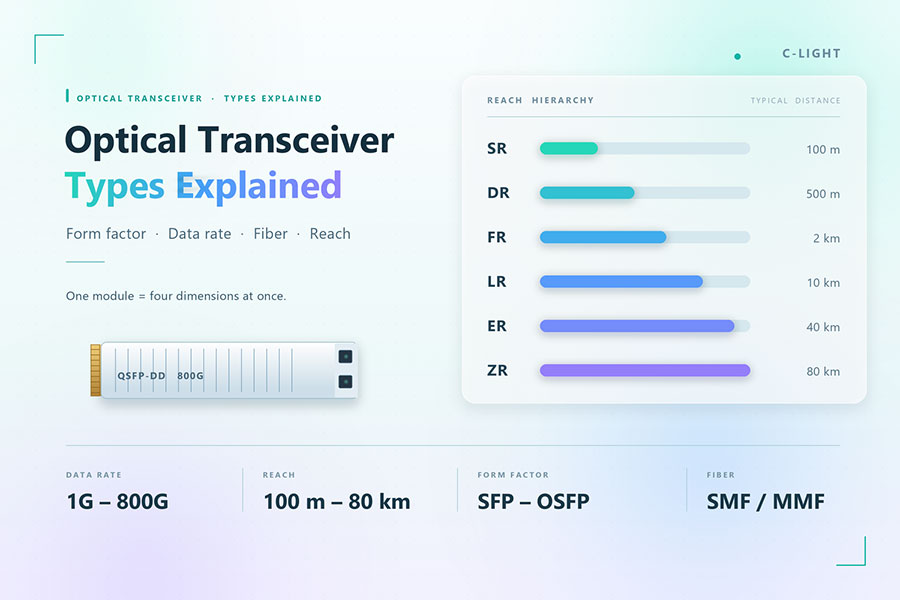
Different AI data center links require different transmission distances. A 1.6T optical module can therefore be developed in several optical configurations.
Short-reach solutions can be used for high-density connections within a local data center environment, while longer-reach solutions can support connections across larger facilities.
Depending on the design, 1.6T optical modules may use multimode or single-mode fiber and different optical technologies such as parallel optics or wavelength multiplexing.
The appropriate solution should be selected according to the physical network topology, installed fiber infrastructure, and required link distance.
8. 1.6T Optical Module for AI Network Fabrics
AI network fabrics require large numbers of high-speed connections between compute nodes and switching infrastructure. A higher-bandwidth optical module can simplify network scaling by increasing capacity per port.
For example, replacing an 800G link with a 1.6T connection can double the bandwidth available through the optical port. This can be particularly useful in high-density switch architectures and next-generation AI clusters.
1.6T optics can therefore become an important component of future AI Ethernet, InfiniBand, and other high-performance network architectures, depending on the requirements of the specific platform.
9. Thermal Challenges of 1.6T Optical Modules
Thermal management is one of the most important challenges in high-speed optical module development.
Higher electrical and optical bandwidth generally increases the complexity of power consumption and heat dissipation. The module must maintain stable performance while operating within the thermal limits of the host switch or network system.
This is especially important in AI data centers, where switch port density and rack power density are both increasing.
Advanced heatsink structures, improved thermal interfaces, optimized airflow, and system-level cooling strategies can all contribute to reliable 1.6T operation.
10. 1.6T Optical Modules and Liquid-Cooled AI Data Centers
Liquid cooling is becoming increasingly relevant as AI systems move toward higher power densities. Although optical modules remain part of the network system rather than the GPU itself, their thermal performance must still be considered as network switch power increases.
For future AI data centers, optical transceiver design may need to work together with rack-level thermal management, switch cooling, and system airflow to maintain stable high-speed operation.
This makes thermal design a key factor when evaluating 1.6T optical modules for large-scale AI deployments.
11. Applications of 1.6T Optical Modules
1.6T optical modules are primarily intended for environments where extremely high network bandwidth is required.
Typical applications include AI data centers, GPU clusters, hyperscale cloud infrastructure, high-performance computing, large-scale Ethernet fabrics, and next-generation data center interconnects.
They can be used for high-speed connections between network switches, AI servers, accelerator platforms, and other high-bandwidth network devices.
12. What to Consider When Selecting a 1.6T Optical Module?
Selecting a 1.6T optical module requires more than simply checking the nominal data rate.
Form factor: Confirm that the module is compatible with the target switch, NIC, or networking platform.
Transmission distance: Choose the optical architecture according to the actual link length.
Fiber type: Verify whether the module requires multimode or single-mode fiber.
Connector: Check the required MPO, CS, LC, or other optical interface.
Power consumption: Make sure the host platform can support the module's power requirements.
Thermal performance: Confirm that the switch and data center cooling system can maintain the required operating temperature.
Compatibility: Check host platform interoperability and management requirements before deployment.
13. C-LIGHT 1.6T Optical Module Solutions
C-LIGHT develops high-speed optical transceiver solutions for AI data centers, cloud networking, and high-performance computing applications.
The C-LIGHT 1.6T OSFP platform is designed around an 8 × 200G architecture and targets next-generation AI and high-speed network applications.
Different optical configurations can be used to address different transmission distances and network architectures. For specific deployments, the product datasheet should be checked for optical reach, wavelength, connector type, power consumption, host compatibility, and operating conditions.
14. Conclusion
1.6T optical modules are an important step in the evolution of high-speed AI data center connectivity. By providing up to 1.6Tbps of aggregate bandwidth, they can increase network capacity per port and help support the continued expansion of GPU clusters and high-performance network fabrics.
The transition from 800G to 1.6T also introduces new challenges, particularly in signal integrity, power consumption, thermal management, and optical integration. As AI data centers continue to scale, these factors will become increasingly important when selecting and deploying next-generation optical transceivers.
 >
>

 >
>
 >
>
 >
>
 >
>
 >
>
 >
>
 >
>