TEL:+86 132 6656 7067




1. Introduction: The Evolution of AI Data Center Infrastructure
The rapid growth of Artificial Intelligence (AI), Large Language Models (LLMs), and high-performance computing (HPC) is driving a fundamental transformation in data center infrastructure. Traditional data centers designed for general-purpose workloads are no longer sufficient for AI training and inference applications that require massive computing power, ultra-low latency, and extremely high bandwidth connectivity.
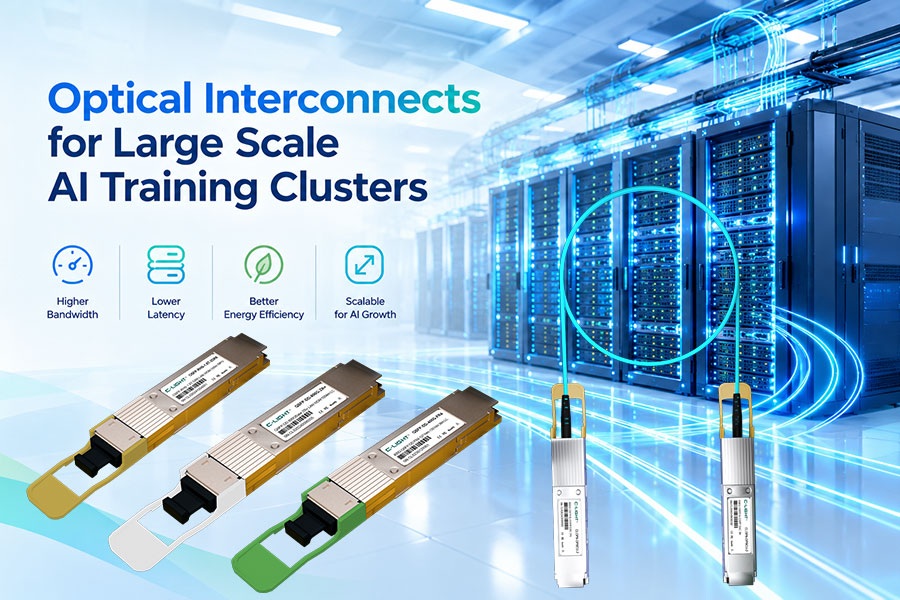
Modern AI data centers are evolving into highly interconnected computing platforms where thousands of GPUs, AI accelerators, storage systems, and network switches operate together as a unified computing fabric. In this environment, optical connectivity has become a critical technology to support higher bandwidth, longer transmission distances, and improved energy efficiency.
From 400G and 800G optical transceivers to next-generation 1.6T optical solutions, the optical communication industry is accelerating to meet the networking requirements of AI clusters and future data center architectures.
2. AI Data Center Network Architecture Overview
AI data center infrastructure typically consists of multiple layers, including compute nodes, AI network fabrics, storage networks, and optical interconnect systems.
2.1 AI Compute Layer
The compute layer is the foundation of AI data centers and includes:
GPU servers
AI accelerators
High-performance CPUs
Memory systems
Distributed computing platforms
AI training workloads require thousands of GPUs to exchange large volumes of data continuously. The communication efficiency between GPUs directly affects AI model training speed and overall data center performance.
2.2 AI Network Fabric Layer
The AI network fabric provides high-speed communication between compute nodes. Two major networking architectures are widely adopted:
Ethernet-Based AI Fabric
Ethernet-based AI networks use advanced technologies such as:
RoCEv2 (RDMA over Converged Ethernet)
High-speed Ethernet switches
400G/800G optical links
Congestion management technologies
This architecture provides scalability, interoperability, and compatibility with existing data center infrastructure.
InfiniBand AI Network
InfiniBand is widely used in large-scale AI training clusters because of:
Ultra-low latency
High throughput
Advanced RDMA capabilities
Efficient GPU communication
However, Ethernet solutions are gaining adoption due to their open ecosystem and cost advantages.
3. Optical Connectivity in AI Data Centers
Optical interconnects are essential components connecting servers, switches, and AI clusters.
As AI workloads increase, electrical interconnect solutions face limitations in:
Transmission distance
Signal integrity
Power consumption
Thermal management
Optical communication provides advantages including:
Higher bandwidth capacity
Lower transmission loss
Longer reach
Better scalability for future upgrades
4. Optical Transceiver Evolution: 400G to 1.6T
AI data center networks are rapidly transitioning to higher-speed optical technologies.
4.1 400G Optical Modules
400G optical modules have become a mainstream solution for AI clusters and data center backbone networks.
Common form factors include:
QSFP-DD
OSFP
QSFP112
Typical applications:
Leaf-spine network connections
AI cluster interconnects
Data center switching networks
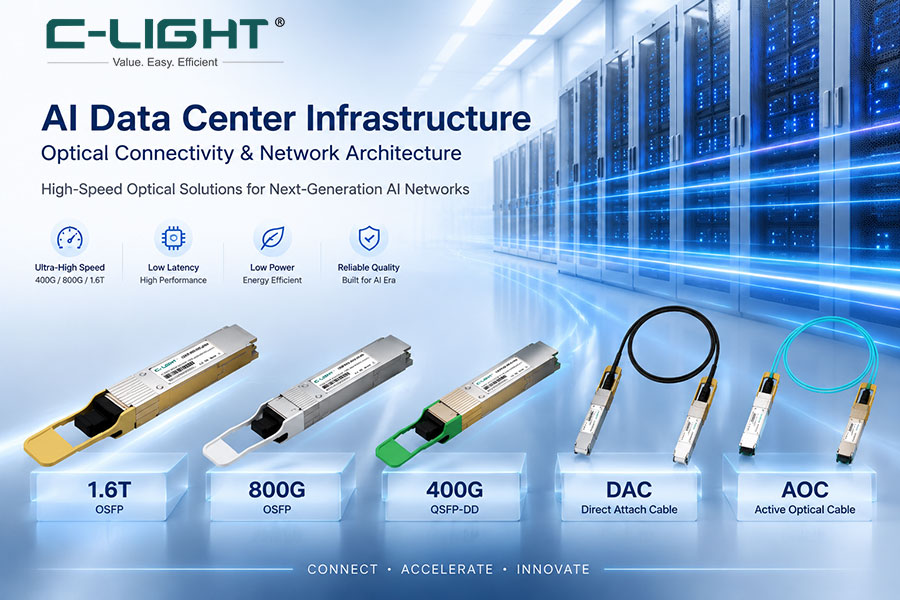
C-LIGHT provides high-performance 400G optical transceiver solutions designed for modern data center environments, including:
400G QSFP-DD optical modules
400G OSFP optical modules
400G QSFP112 DAC and AEC solutions
4.2 800G Optical Connectivity
With increasing GPU density and AI workload complexity, 800G optical connectivity has become a key technology for next-generation AI data centers.
800G optical solutions enable:
Higher switch capacity
Reduced port requirements
Improved rack-level bandwidth density
Typical 800G solutions include:
800G OSFP optical transceivers
800G OSFP DAC cables
800G OSFP AEC active electrical cables
C-LIGHT develops 800G optical interconnect products to support high-performance AI networking applications, helping customers build scalable and efficient AI infrastructure.
4.3 1.6T Optical Interconnect Technology
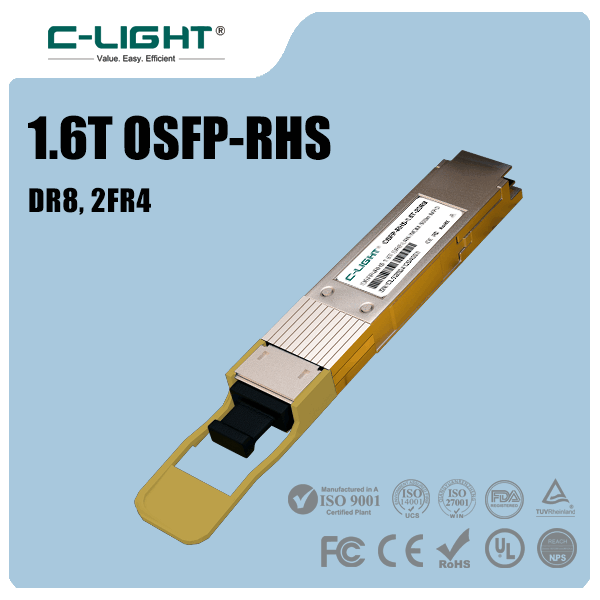
1.6T OSFP-RHS DR8 FR4 Optical Transceiver | AI Data Center丨C-LIGHT
As AI clusters continue expanding, 1.6T optical connectivity is becoming the next generation solution for large-scale AI networks.
1.6T optical modules provide:
Extremely high bandwidth
Higher switch port density
Improved network scalability
Main applications include:
AI supercomputing clusters
Hyperscale data centers
Next-generation Ethernet networks
C-LIGHT offers 1.6T optical interconnect solutions, including:
1.6T OSFP optical modules
1.6T OSFP DAC solutions
1.6T OSFP AEC solutions
These products are designed to meet future AI data center bandwidth requirements.
5. Optical Interconnect Technologies for AI Networks
5.1 DAC (Direct Attach Cable)
800G/400G/200G/100G/50G/40G/25G/10G DAC Cable丨C-LIGHT
DAC solutions use copper-based connections and are commonly used for short-distance links.
Advantages:
Low cost
Low power consumption
Simple deployment
Applications:
Rack-level connections
Short-distance switch-to-server links
5.2 AEC (Active Electrical Cable)
AEC integrates signal processing technology to extend transmission distance compared with traditional DAC.
Advantages:
Longer reach
Better signal integrity
Lower cost compared with optical modules
Applications:
AI rack interconnection
Data center switching systems
C-LIGHT provides high-speed DAC and AEC solutions supporting:
400G
800G
1.6T interconnect applications
5.3 Optical Transceivers
Optical transceivers remain essential for longer-distance AI network connections.
Key technologies include:
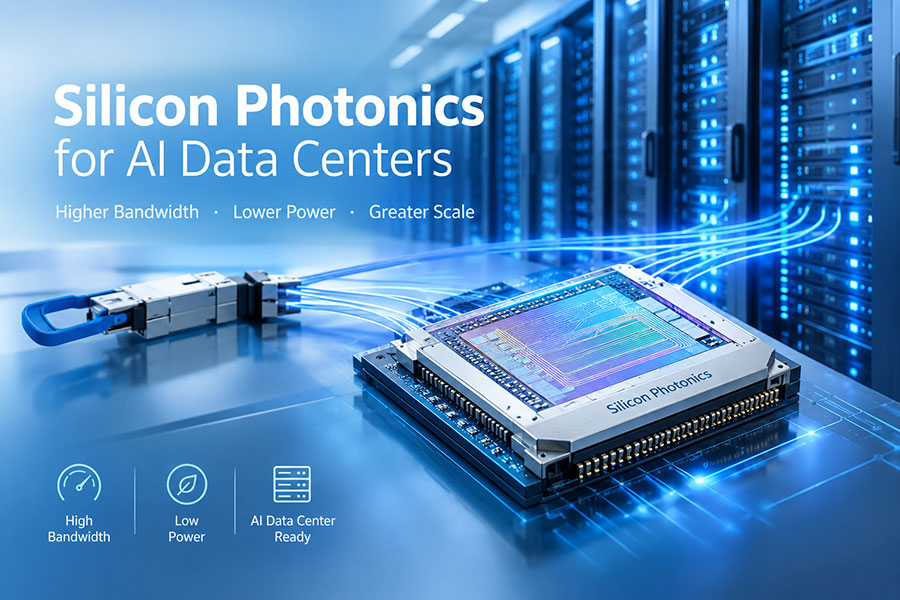
Silicon photonics
LPO (Linear-drive Pluggable Optics)
CPO (Co-Packaged Optics)
These technologies help reduce power consumption and improve bandwidth scalability.
6. Thermal Management and Optical Connectivity
AI servers generate significantly higher heat compared with traditional computing systems.
As GPU power increases from hundreds of watts toward 1000W-class processors, data centers require advanced cooling technologies:
Cold plate liquid cooling
Immersion cooling
Advanced thermal management systems
Optical modules are also evolving toward:
Higher thermal tolerance
Lower power consumption
Improved reliability in liquid-cooled environments
C-LIGHT develops optical connectivity solutions suitable for high-performance AI data center environments, supporting future liquid cooling and high-density computing architectures.
7. Future Trends of AI Data Center Optical Networking
The future AI data center network will continue moving toward:
Higher Bandwidth
Development roadmap:
400G
800G
1.6T
3.2T optical connectivity
Lower Power Consumption
Technologies such as:
LPO
CPO
Advanced silicon photonics
will help reduce networking energy consumption.
Higher Integration
Future AI networks will integrate:
Optical switching
Co-packaged optics
Advanced photonic solutions
to support increasingly complex AI workloads.
8. Why Choose C-LIGHT AI Data Center Optical Solutions
C-LIGHT focuses on high-speed optical communication solutions for modern data center and AI networking applications.
Key advantages include:
Advanced optical transceiver development capability
Support for 400G / 800G / 1.6T solutions
High-speed DAC and AEC interconnect products
Customized optical solutions for different network architectures
Reliable testing and quality control processes
C-LIGHT products help global customers build scalable, high-performance, and energy-efficient AI data center networks.
9.Conclusion
AI data center infrastructure is entering a new era driven by massive computing requirements and high-speed networking demands. Optical connectivity has become the foundation for scalable AI architectures, enabling faster data transmission, improved efficiency, and future network expansion.
With advanced solutions covering 400G, 800G, and 1.6T optical interconnect technologies, C-LIGHT is committed to supporting the global transition toward next-generation AI data center networks.
10.AI Data Center Infrastructure and Optical Connectivity Q&A
Q1: Why is optical connectivity important for AI data centers?
Answer: AI workloads require massive data exchange between GPUs, servers, and switches. Optical connectivity provides higher bandwidth, lower transmission loss, and longer reach compared with traditional electrical connections.
Q2: What optical speeds are commonly used in AI data centers?
Answer: Current AI data centers are adopting 400G and 800G optical solutions, while 1.6T optical connectivity is becoming the next-generation technology for large-scale AI clusters.
Q3: What products does C-LIGHT provide for AI data centers?
Answer: C-LIGHT provides high-speed optical connectivity products including:
400G QSFP-DD and QSFP112 optical modules
800G OSFP optical solutions
1.6T OSFP optical interconnect products
High-speed DAC and AEC cables
Q4: What is the difference between DAC and AEC cables?
Answer: DAC uses passive copper technology and is suitable for short distances. AEC integrates active signal processing to achieve longer reach and improved signal performance.
Q5: Why are 800G and 1.6T optical modules important for AI networks?
Answer: AI clusters require extremely high bandwidth between GPUs and switches. 800G and 1.6T optical modules increase network capacity while reducing port requirements and improving scalability.
Q6: What network technologies are used in AI data centers?
Answer: AI data centers commonly use Ethernet-based networks with RoCEv2 and InfiniBand architectures to provide high-speed GPU communication and low-latency data transfer.
Q7: How does C-LIGHT ensure optical product reliability?
Answer: C-LIGHT performs comprehensive testing including optical performance testing, signal integrity testing, BER testing, thermal testing, and compatibility verification to ensure reliable operation in data center environments.
Q8: What is the future trend of AI data center optical connectivity?
Answer: AI data centers will continue moving toward higher-speed optical technologies such as 1.6T and 3.2T, combined with LPO, CPO, and silicon photonics technologies to achieve higher bandwidth and lower power consumption.
 >
>

 >
>
 >
>
 >
>
 >
>
 >
>
 >
>
 >
>