TEL:+86 132 6656 7067





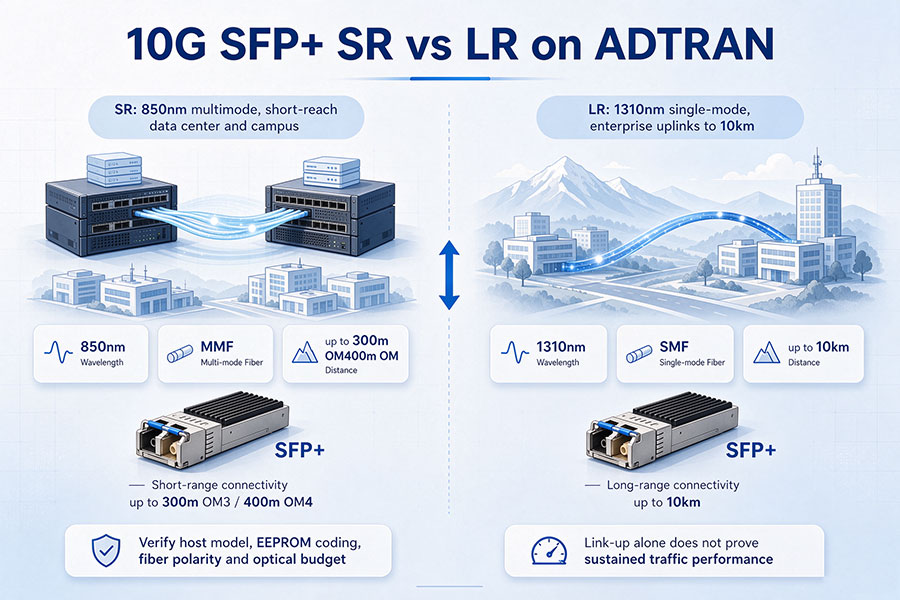
10G SFP+ optical transceivers are widely used in enterprise networks, fiber aggregation switches, telecommunications infrastructure, and data center connections. ADTRAN equipment supports different optical interfaces for short-reach and long-reach Gigabit Ethernet and 10 Gigabit Ethernet applications.
Among the most common options are 10GBASE-SR and 10GBASE-LR SFP+ modules. Although both provide a nominal data rate of 10 Gbps and use the SFP+ form factor, they are designed for different fiber types, wavelengths, and transmission distances.
When selecting an ADTRAN-compatible 10G SFP+ transceiver, network engineers need to verify more than the module's physical size and nominal speed. Host-device support, optical specifications, fiber infrastructure, and interoperability with the transceiver at the opposite end all affect successful link operation.
1. Understanding ADTRAN 10G SFP+ SR and LR Transceivers
ADTRAN offers 10G SFP+ optical modules for different network applications. Two representative product types are 10GBASE-SR and 10GBASE-LR.
ADTRAN product documentation identifies the following part numbers:
| ADTRAN Part Number | Optical Interface | Wavelength | Fiber Type |
|---|---|---|---|
| 1700485F1 | 10GBASE-SR SFP+ | 850 nm | Multimode fiber |
| 1700486F1 | 10GBASE-LR SFP+ | 1310 nm | Single-mode fiber |
These part numbers appear in ADTRAN documentation for equipment such as the NetVanta 1760 Series. The exact supported module list should always be checked against the target switch or platform documentation.
2. ADTRAN 10GBASE-SR SFP+ Compatibility
10GBASE-SR is a short-reach optical interface designed for 10 Gigabit Ethernet transmission over multimode fiber. It operates around 850 nm and is commonly used for connections within data centers, equipment rooms, and enterprise network environments.
2.1 10GBASE-SR Specifications
| Parameter | Typical Specification |
|---|---|
| Data rate | 10 Gbps |
| Form factor | SFP+ |
| Optical standard | 10GBASE-SR |
| Wavelength | 850 nm |
| Fiber type | Multimode fiber (MMF) |
| Connector | Duplex LC |
| Typical maximum reach | Up to 300 m on supported multimode fiber, depending on fiber grade |
ADTRAN's historical product listing specifies its 1700485F1 10GBASE-SR SFP+ as an 850 nm module supporting 10 Gbps transmission up to 300 meters over multimode fiber. It also lists 1 Gbps operation for this particular part number. This should not be interpreted as a universal dual-rate capability for all ADTRAN SFP+ ports or third-party SR modules.
2.2 Multimode Fiber Compatibility
10GBASE-SR modules are designed for multimode fiber, with transmission distance depending on the fiber grade and link conditions.
| Fiber Type | Typical 10GBASE-SR Reach | Application |
|---|---|---|
| OM1 | Up to 33 m | Legacy multimode installations |
| OM2 | Up to 82 m | Short-distance enterprise links |
| OM3 | Up to 300 m | Data center and enterprise connectivity |
| OM4 | Up to 400 m | Higher-performance multimode links |
| OM5 | Check the applicable SR interface and fiber specifications | Wideband multimode infrastructure |
Actual reach depends on the optical interface specification, fiber bandwidth, connector loss, and overall link budget. The fiber grade should be confirmed before selecting an SR transceiver.
2.3 Typical Applications of ADTRAN SR Modules
ADTRAN 10GBASE-SR SFP+ modules are suitable for supported short-distance connections, including:
Switch-to-switch links within the same equipment room.
Connections between data center switches and aggregation equipment.
Short-reach links between network racks.
Enterprise distribution and access network connections.
Multimode fiber infrastructure where 10GbE connectivity is required.
3. ADTRAN 10GBASE-LR SFP+ Compatibility
10GBASE-LR is designed for longer-distance 10 Gigabit Ethernet transmission over single-mode fiber. It commonly operates at 1310 nm and supports links up to 10 km under the applicable optical specifications.
3.1 10GBASE-LR Specifications
| Parameter | Typical Specification |
|---|---|
| Data rate | 10 Gbps |
| Form factor | SFP+ |
| Optical standard | 10GBASE-LR |
| Wavelength | 1310 nm |
| Fiber type | Single-mode fiber (SMF) |
| Connector | Duplex LC |
| Typical maximum reach | Up to 10 km |
ADTRAN's 1700486F1 is listed as a 1310 nm 10GBASE-LR SFP+ transceiver designed for single-mode fiber links up to 10 km. The product documentation also identifies 1 Gbps support for this specific module. Always verify whether the target host port supports the required operating speed.
3.2 Single-Mode Fiber Compatibility
10GBASE-LR is normally deployed over duplex single-mode fiber, commonly OS2 fiber in modern network installations.
Before connecting an LR module, verify the following:
The fiber plant is single-mode and suitable for the intended transmission distance.
The connectors are compatible with the module's LC interface.
TX and RX fiber polarity is correct.
End-to-end optical loss remains within the supported link budget.
The receiver input power stays within the module's operating range.
3.3 Typical Applications of ADTRAN LR Modules
10GBASE-LR is commonly used for:
Building-to-building fiber connections.
Campus network distribution links.
Longer-distance switch-to-switch connections.
Enterprise aggregation and backbone networks.
Single-mode fiber connections between telecommunications facilities.
4. ADTRAN 10G SFP+ SR vs LR: Key Differences
Although SR and LR modules share the SFP+ form factor and 10 Gbps nominal data rate, their optical interfaces are different. They should be selected according to the fiber infrastructure and transmission distance.
| Comparison | 10GBASE-SR | 10GBASE-LR |
|---|---|---|
| ADTRAN part number | 1700485F1 | 1700486F1 |
| Data rate | 10 Gbps | 10 Gbps |
| Form factor | SFP+ | SFP+ |
| Wavelength | 850 nm | 1310 nm |
| Fiber type | Multimode | Single-mode |
| Connector | Duplex LC | Duplex LC |
| Typical reach | Up to 300 m on supported MMF, depending on fiber grade | Up to 10 km |
| Primary application | Short-distance data center and enterprise links | Longer-distance enterprise and campus links |
5. ADTRAN 10G SFP+ Host Compatibility
Optical specifications are only one part of module compatibility. The ADTRAN host device must also support the SFP+ module and its operating mode.
ADTRAN documentation lists 1700485F1 and 1700486F1 among the supported SFP+ accessories for several NetVanta product families. For example, the NetVanta 1760 Series includes multi-rate 10G SFP+ ports and lists both 10GBASE-SR and 10GBASE-LR transceivers as accessories.
Other ADTRAN platforms may have different port capabilities, software requirements, or supported module lists. Compatibility should therefore be verified against the exact equipment model.
5.1 Host Compatibility Checklist
Before installing a third-party or replacement SFP+ module, confirm:
The device has an SFP+ port rather than a 1G-only SFP port.
The host supports the required 10G operating mode.
The transceiver's optical interface is supported by the platform.
The module identification and vendor coding are accepted by the device.
The software and firmware versions meet the equipment requirements.
The module's power consumption and temperature range are suitable for the host.
ADTRAN provides a Pluggable Optics Compatibility Matrix for checking supported optical modules. The official product documentation for the specific switch should also be reviewed before deployment.
6. Can ADTRAN 10G SFP+ SR and LR Modules Work with Third-Party Transceivers?
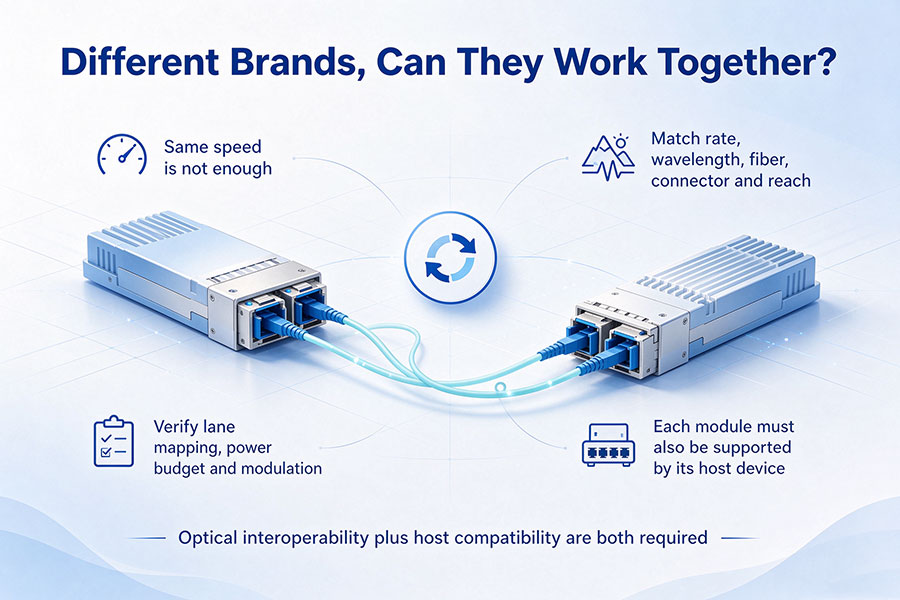
Yes, ADTRAN-compatible SR or LR modules can potentially establish optical links with third-party transceivers when both ends implement compatible optical interfaces and meet the required transmission specifications.
For example, an ADTRAN-compatible 10GBASE-SR module can communicate with a third-party 10GBASE-SR module when both support the same optical interface, wavelength range, and multimode fiber requirements.
Likewise, two 10GBASE-LR modules from different manufacturers can communicate over compatible single-mode fiber when their optical specifications are suitable for the link.
However, optical interoperability and host compatibility must be evaluated separately:
| Compatibility Layer | What Must Be Verified |
|---|---|
| ADTRAN switch to SFP+ | Module recognition, host support, port speed, firmware |
| SFP+ to SFP+ | Optical standard, wavelength, data rate, TX/RX compatibility |
| SFP+ to fiber | Fiber type, connector, polarity, link loss |
| Complete optical link | Optical power, link stability, error counters, traffic performance |
A module may have compatible optical specifications but still be rejected by the host device. Conversely, two modules may both be recognized by their switches but fail to establish a link because their optical interfaces do not match.
7. ADTRAN SR and LR Interoperability Scenarios
7.1 ADTRAN SR to Third-Party SR
An ADTRAN-compatible 10GBASE-SR module at one end can connect to a third-party 10GBASE-SR module at the other end when both modules support compatible 850 nm multimode optical interfaces.
The link should use the correct multimode fiber grade and duplex LC connectivity. Both host devices must also support their respective modules.
7.2 ADTRAN LR to Third-Party LR
An ADTRAN-compatible 10GBASE-LR module can interoperate with a third-party LR module when both support the corresponding 1310 nm single-mode interface.
For a link approaching the 10 km reach limit, engineers should evaluate the total optical loss, connector count, fiber attenuation, and receiver power range rather than relying only on the nominal distance rating.
7.3 ADTRAN SR to LR
A standard 10GBASE-SR module and a standard 10GBASE-LR module should not be directly paired as a normal Ethernet optical link. They use different wavelengths and fiber types.
For example, the 850 nm SR transmitter is not designed to operate as the matching optical counterpart of a 1310 nm LR receiver. A media conversion or another specifically engineered solution would be required if the network needs to connect different optical interface types.
8. How to Validate ADTRAN 10G SFP+ Compatibility
A structured validation process helps confirm that the selected module works with the ADTRAN host and establishes a reliable optical connection.
8.1 Step 1: Identify the ADTRAN Equipment
Record the exact switch model, hardware revision, SFP+ port number, and software version. Confirm whether the port supports 10G operation and whether the selected module type is documented for that platform.
8.2 Step 2: Confirm the Module Part Number
Check the original transceiver part number or the supported module list. For the ADTRAN examples discussed in this article, the relevant part numbers are:
1700485F1 — 10GBASE-SR, 850 nm, multimode fiber.
1700486F1 — 10GBASE-LR, 1310 nm, single-mode fiber.
Do not assume that every third-party module with the same SR or LR label is automatically accepted by every ADTRAN host.
8.3 Step 3: Verify the Fiber Infrastructure
Confirm whether the link uses multimode or single-mode fiber. Check the fiber grade, connector type, polarity, and transmission distance.
For SR links, verify that the multimode fiber supports the required reach. For LR links, check the single-mode fiber path and total optical loss.
8.4 Step 4: Check Module Recognition
Install the module in the target device and check whether the host recognizes it. Where supported, inspect the module information and digital diagnostic monitoring data.
Check the reported module type, vendor identification, temperature, supply voltage, transmitter power, and receiver power. The available diagnostic fields depend on the module and host platform.
8.5 Step 5: Establish the Optical Link
Connect the module to a compatible transceiver at the opposite end. Confirm that the fiber polarity is correct and that the interface reaches an operational state.
Verify that both devices are configured for compatible speed and interface settings. If the link does not come up, inspect connector cleanliness, optical power, and port configuration.
8.6 Step 6: Test Traffic and Link Stability
After the link becomes operational, verify traffic transmission and reception. Review interface counters for CRC errors, symbol errors, packet drops, and link flaps.
Where practical, perform a traffic test under representative operating conditions. A stable link should maintain the expected data rate without persistent errors or unexpected interruptions.
9. Common ADTRAN 10G SFP+ Compatibility Problems
| Potential Issue | Typical Symptom | Recommended Check |
|---|---|---|
| Unsupported SFP+ module | Module is not recognized or port remains inactive | Check the host compatibility list and module coding |
| SR/LR mismatch | No optical link | Verify both ends use compatible optical interfaces |
| Incorrect fiber type | Link fails or operates unreliably | Confirm MMF for SR and SMF for LR |
| Incorrect fiber polarity | Transmit and receive signals do not connect correctly | Check duplex LC TX/RX connections |
| Excessive insertion loss | Low receive power or intermittent link | Inspect connectors and measure link loss |
| Receiver overload | Optical input exceeds the receiver's operating range | Check receive-power limits and link design |
| Incorrect speed configuration | Port does not establish the expected link | Verify host port speed and operating mode |
| Dirty optical connectors | High loss or unstable optical readings | Inspect and clean connectors using approved procedures |
When troubleshooting, distinguish between a module recognition issue and an optical transmission issue. A host compatibility problem may occur before the optical link is activated, while an optical mismatch may prevent communication even when both modules are recognized.
10. Choosing Between ADTRAN 10GBASE-SR and 10GBASE-LR
The choice between SR and LR should be based primarily on the installed fiber infrastructure and the distance between network devices.
| Network Requirement | Recommended Interface |
|---|---|
| Short link over multimode fiber | 10GBASE-SR |
| Data center connection using OM3 or OM4 | 10GBASE-SR, subject to reach requirements |
| Campus link over single-mode fiber | 10GBASE-LR |
| Building-to-building connection within supported LR reach | 10GBASE-LR |
| Existing single-mode fiber infrastructure | 10GBASE-LR |
| Existing multimode fiber infrastructure | 10GBASE-SR |
For a new deployment, the selection should also consider future network expansion, switch port density, fiber availability, and the total cost of the optical infrastructure.
C-LIGHT provides optical transceiver solutions for enterprise and data center networks. Relevant product categories include optical transceivers and other high-speed connectivity products. For replacement applications, the exact host model, optical interface, wavelength, fiber type, and reach should be confirmed before selecting a compatible module.
11. Conclusion
ADTRAN 10GBASE-SR and 10GBASE-LR SFP+ transceivers provide different optical connectivity options for enterprise and fiber aggregation networks. SR operates at 850 nm over multimode fiber for short-distance links, while LR operates at 1310 nm over single-mode fiber for links up to 10 km under the specified conditions.
Although both modules use the SFP+ form factor and support 10 Gbps Ethernet, they are not interchangeable. Successful deployment requires matching the optical interface to the fiber infrastructure and confirming that the ADTRAN host supports the selected transceiver.
For third-party or multi-vendor connections, host recognition and end-to-end optical interoperability should be validated separately. Checking the official compatibility documentation, reviewing optical specifications, and testing the complete link can help ensure reliable 10G connectivity.
 >

 >
 >
 >
 >
 >
 >
 >