TEL:+86 132 6656 7067




1. What Is a 1Mbps Optical Transceiver?
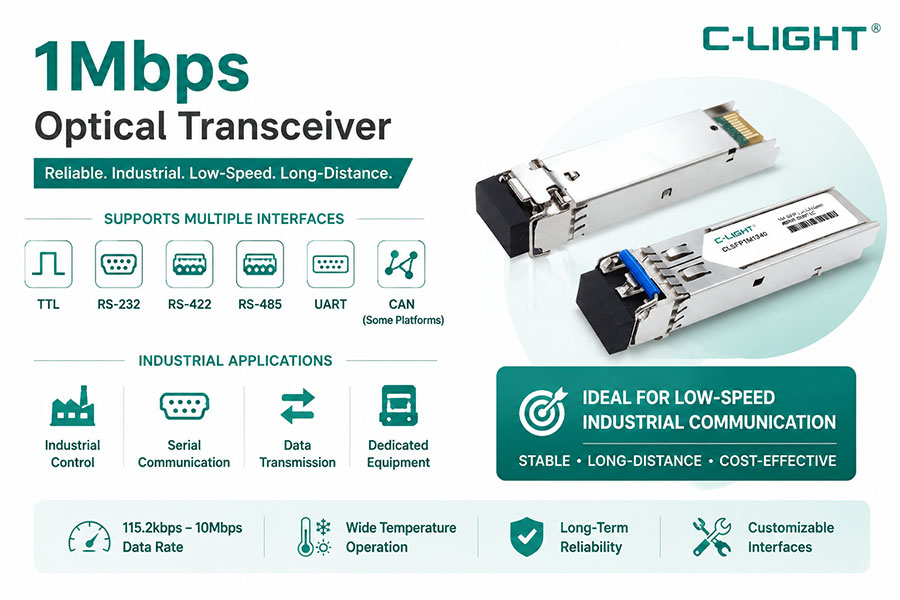
A 1Mbps optical transceiver is a type of low-speed industrial optical communication module designed not for high-speed Ethernet networks, but for various industrial control systems, serial communication applications, and dedicated equipment data transmission requirements.
1M/100M/155M/622M SFP Optical Transceiver | C-LIGHT
Current 1Mbps optical transceivers commonly use SFP or 1×9 package designs and can support:
TTL communication
RS-232
RS-422
RS-485
UART
CAN (some platforms)
Industrial serial communication
Since many industrial devices transmit relatively small amounts of data, high-speed interfaces such as 100Mbps or 1Gbps are often unnecessary. A 1Mbps optical module can provide sufficient performance for long-term stable operation.
Low-speed SFP modules are mainly used in industrial serial communication, RS-232/422/485 fiber converters, and other industrial communication scenarios.
C-LIGHT provides a variety of industrial low-speed optical transceivers from 115.2kbps to 10Mbps, supporting wide-temperature designs, long-term stable operation, and customized communication interfaces.
1M/100M/155M/622M BIDI SFP Optical Transceiver | Single Fiber SFP Module | C-LIGHT
2. What Is a 100Mbps Optical Transceiver?
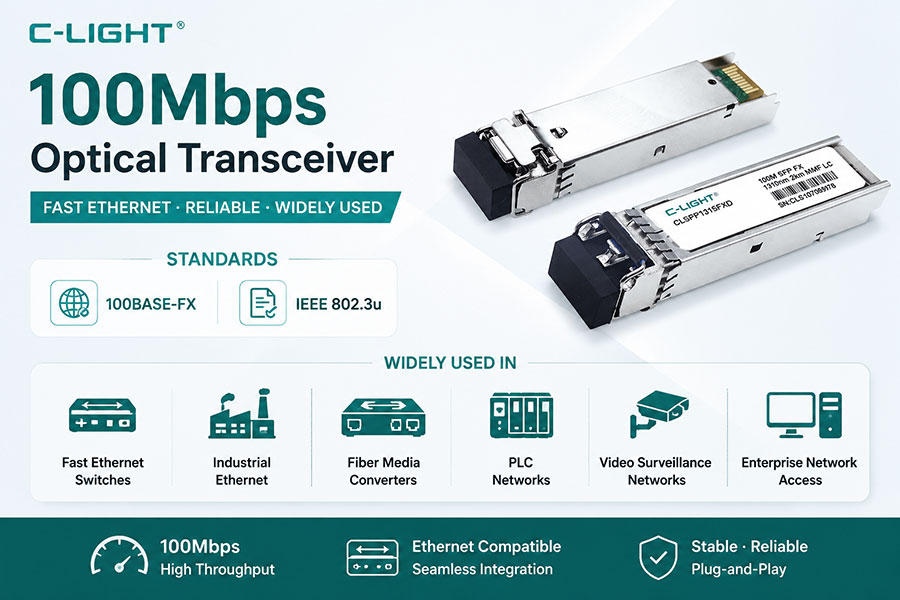
100Mbps optical transceivers mainly follow Fast Ethernet standards, with typical protocols including:
100BASE-FX
IEEE 802.3u
Compared with 1Mbps optical modules, 100Mbps optical transceivers are mainly used for:
Fast Ethernet switches
Industrial Ethernet
Fiber media converters
PLC networks
Video surveillance networks
Enterprise network access
100Mbps optical modules not only provide higher data throughput but also support compatibility with standard Ethernet switching equipment, making them widely used in industrial Ethernet deployments.
3. Main Differences Between C-LIGHT 1Mbps and 100Mbps Optical Transceivers
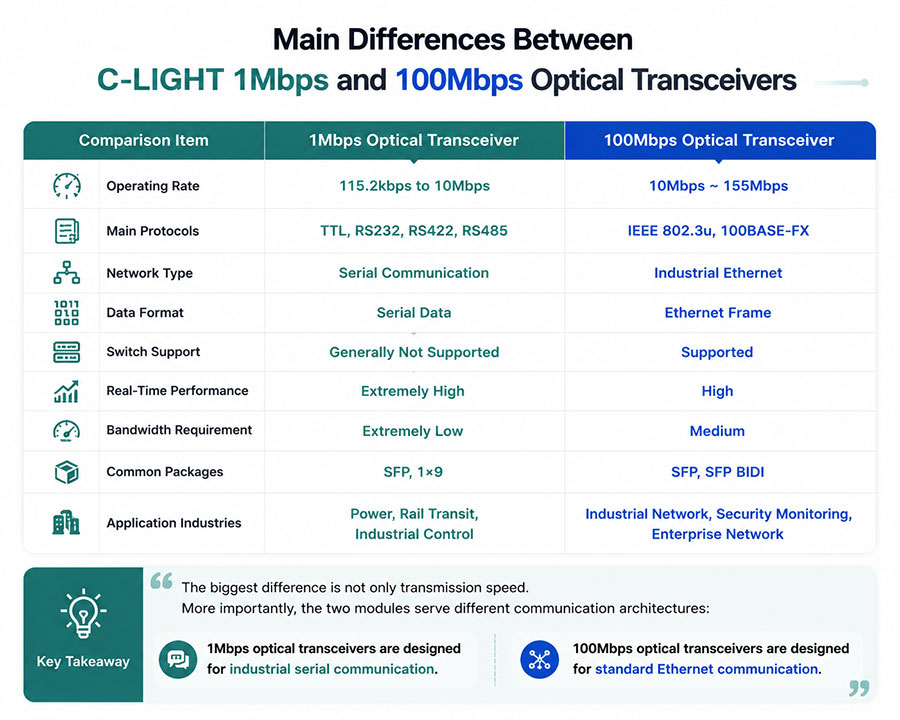
The biggest difference is not only transmission speed. More importantly, the two modules serve different communication architectures:
1Mbps optical transceivers are designed for industrial serial communication.
100Mbps optical transceivers are designed for standard Ethernet communication.
4. Why Are 1Mbps Optical Transceivers Still Widely Used in Industrial Equipment?
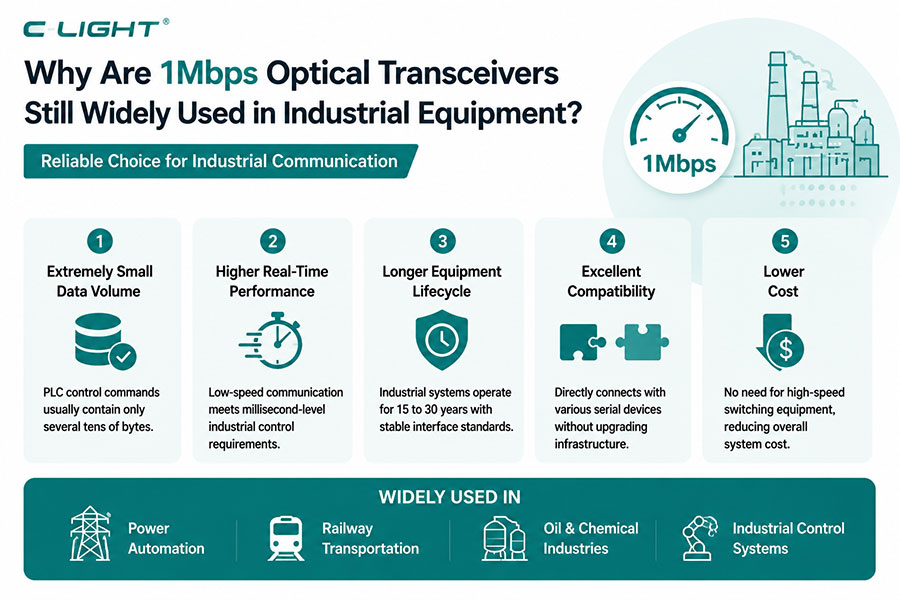
Although networks have entered the era of Gigabit Ethernet and even 400G communication, industrial control systems still widely use 1Mbps optical transceivers due to the following reasons:
① Extremely Small Industrial Control Data Volume
PLC control commands usually contain only several tens of bytes.
② Higher Real-Time Performance
Low-speed communication can meet millisecond-level industrial control requirements.
③ Longer Equipment Lifecycle
Many industrial systems operate for 15 to 30 years, and their interface standards remain stable for long periods.
④ Excellent Compatibility
They can directly connect with various serial devices without upgrading the entire network infrastructure.
⑤ Lower Cost
There is no need to deploy high-speed switching equipment, effectively reducing the overall system cost.
Therefore, 1Mbps optical transceivers still maintain important market value in:
Power automation
Railway transportation
Oil and chemical industries
Industrial control systems
5. What Applications Use 100Mbps Optical Transceivers?
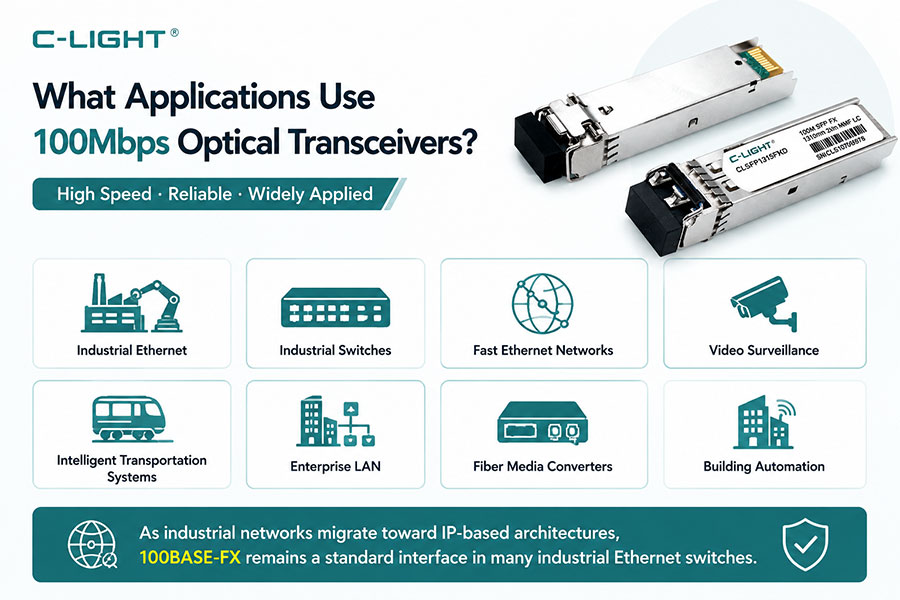
Compared with 1Mbps modules, 100Mbps optical transceivers are mainly used in:
Industrial Ethernet
Industrial switches
Fast Ethernet networks
Video surveillance
Intelligent transportation systems
Enterprise LAN
Fiber media converters
Building automation
As industrial networks gradually migrate toward IP-based architectures, 100BASE-FX remains one of the standard interfaces used in many industrial Ethernet switches.
6. How to Choose Between 1Mbps and 100Mbps Optical Transceivers?
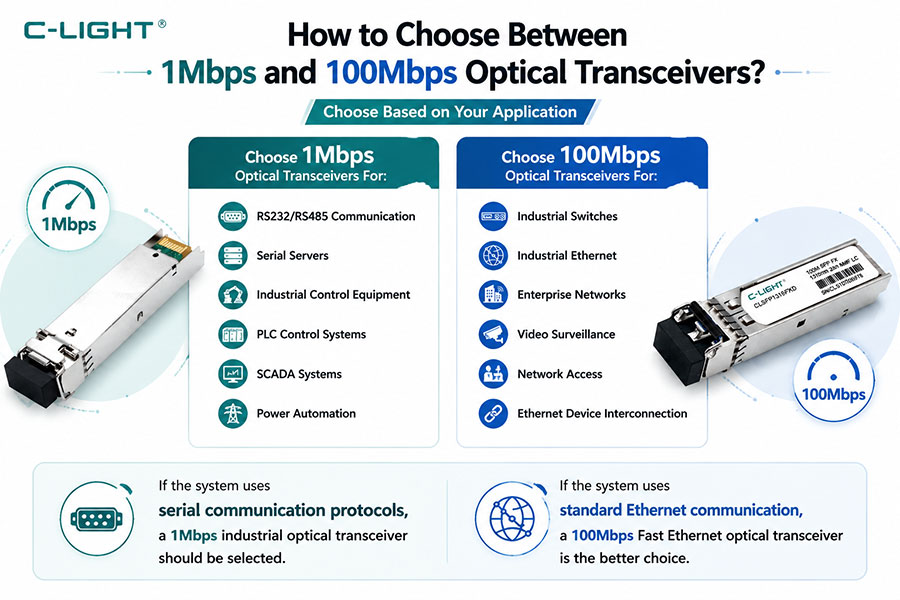
The selection can be based on the following applications:
Choose 1Mbps Optical Transceivers For:
RS232/RS485 communication
Serial servers
Industrial control equipment
PLC control systems
SCADA systems
Power automation
Choose 100Mbps Optical Transceivers For:
Industrial switches
Industrial Ethernet
Enterprise networks
Video surveillance
Network access
Ethernet device interconnection
If the system uses serial communication protocols, a 1Mbps industrial optical transceiver should be selected.
If the system uses standard Ethernet communication, a 100Mbps Fast Ethernet optical transceiver is the better choice.
7. C-LIGHT Industrial Low-Speed Optical Transceiver Solutions
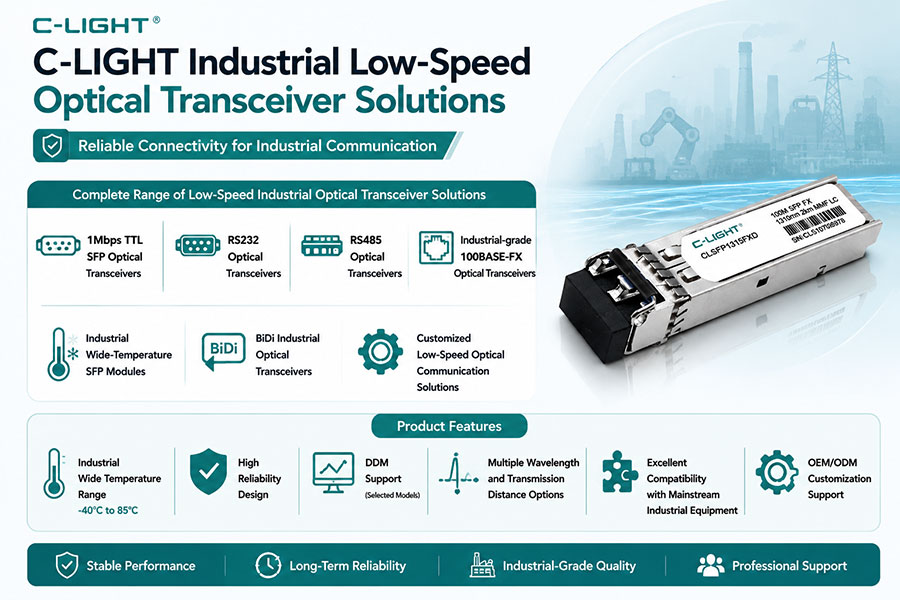
As a professional optical communication product manufacturer, C-LIGHT provides a complete range of low-speed industrial optical transceiver solutions, including:
1Mbps TTL SFP optical transceivers
RS232 optical transceivers
RS485 optical transceivers
Industrial-grade 100BASE-FX optical transceivers
Industrial wide-temperature SFP modules
BiDi industrial optical transceivers
Customized low-speed optical communication solutions
Product features include:
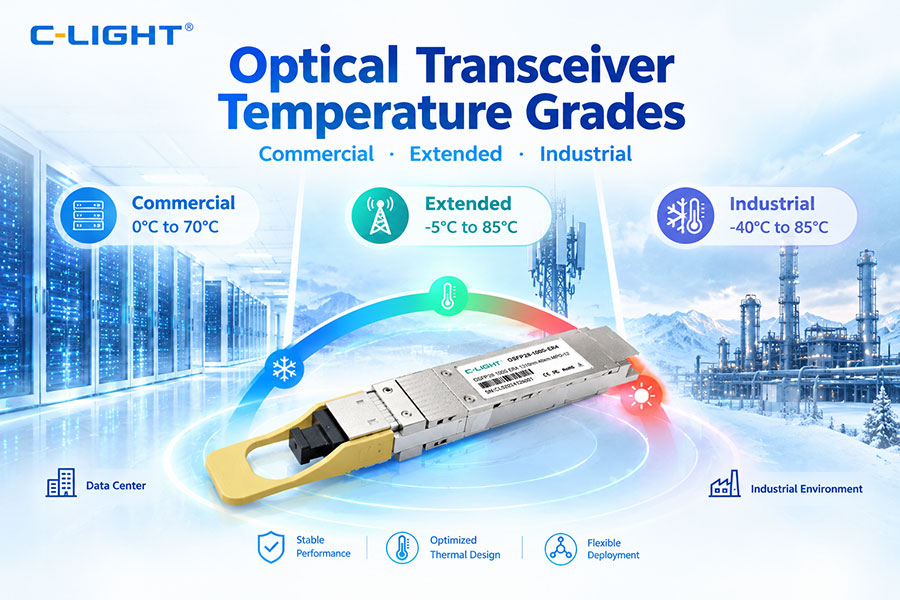
Industrial wide temperature range (-40℃ to 85℃)
High reliability design
DDM support (selected models)
Multiple wavelength and transmission distance options
Excellent compatibility with mainstream industrial equipment
OEM/ODM customization support
8. Summary
Although both 1Mbps optical transceivers and 100Mbps optical transceivers belong to low-speed optical communication products, they are designed for different network architectures and application requirements.
1Mbps optical transceivers are mainly used for industrial serial communication and control systems, focusing on stability, real-time performance, and compatibility.
100Mbps optical transceivers are designed for standard industrial Ethernet networks, providing higher bandwidth and broader network compatibility.
When selecting an optical module, enterprises should consider communication protocols, network architecture, and future expansion requirements to choose the most suitable optical communication solution.
9. Frequently Asked Questions (FAQ)
Q1. Can a 1Mbps optical transceiver connect to a 100Mbps switch?
Answer: C-LIGHT 1Mbps optical transceivers are mainly designed for serial communication. They can also support the 100BASE-FX Ethernet protocol, allowing use with Fast Ethernet switches. However, considering cost and delivery efficiency, this application is not recommended. A dedicated C-LIGHT 100Mbps optical transceiver is recommended instead.
Q2. Why do industrial systems still use 1Mbps optical transceivers?
Answer: Industrial control systems transmit small amounts of data and focus more on real-time performance, reliability, and long-term stable operation. Since serial communication standards have been widely implemented for many years and are difficult to completely replace, 1Mbps communication remains widely used in industrial control applications.
Q3. Can 100Mbps optical transceivers replace 1Mbps optical transceivers?
Answer: Generally, no. C-LIGHT 100Mbps and 1Mbps optical transceivers use different driver chips and line amplifier designs. They are designed separately for Fast Ethernet and serial communication protocols and interface standards, so they cannot simply replace each other.
Q4. Which communication protocols are supported by 1Mbps optical transceivers?
Answer: Common supported protocols include TTL, RS-232, RS-422, RS-485, UART, and other industrial serial communication protocols. Specific support depends on the module design.
Q5. Does C-LIGHT support customized low-speed industrial optical transceivers?
Answer: Yes. C-LIGHT provides OEM/ODM customization services covering different data rates, wavelengths, transmission distances, interface types, and industrial wide-temperature grades.
 >
>

 >
>
 >
>
 >
>
 >
>
 >
>
 >
>
 >
>