TEL:+86 132 6656 7067





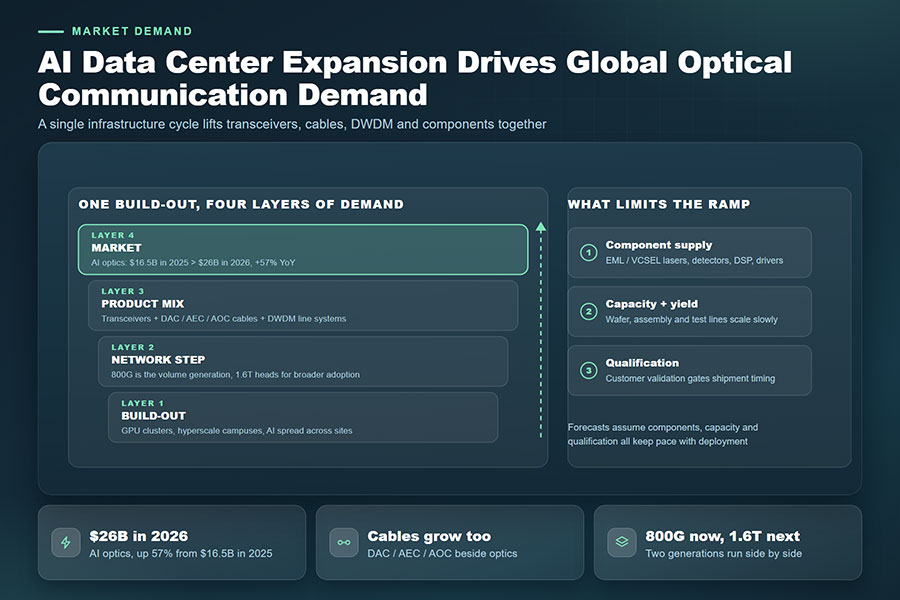
Artificial intelligence is changing the way modern data centers are designed, built, and operated. Large language models, generative AI, and increasingly complex machine learning workloads require thousands of accelerators to exchange enormous volumes of data within extremely short periods. As computing clusters expand across servers, racks, and geographically distributed facilities, the ability to move data efficiently is becoming just as important as the processing power of individual GPUs.
This shift is bringing optical connectivity into a more central position within AI infrastructure. Traditional electrical interconnects remain important for short-distance communication, but their limitations in bandwidth, transmission distance, signal integrity, and power consumption become increasingly significant as network speeds increase. Optical fiber and advanced photonic technologies provide the transmission capacity and scalability needed to connect next-generation AI computing systems.
Optical connectivity is therefore evolving beyond a conventional networking component. It is becoming a fundamental infrastructure layer that influences AI cluster performance, data center scalability, energy efficiency, and the economics of large-scale computing.
1. AI Computing Is Creating a New Demand for Data Transmission
Modern AI computing depends on the coordinated operation of multiple processing units rather than the performance of a single processor. During distributed training, GPUs exchange model parameters, gradients, activation data, and other information throughout the computing cluster. Inference workloads also generate substantial communication traffic, particularly when models are distributed across multiple accelerators or when processing tasks involve multiple stages.
As the number of accelerators increases, communication between computing resources becomes more demanding. A cluster containing hundreds or thousands of GPUs requires a network capable of maintaining high aggregate bandwidth while minimizing communication delays and congestion.
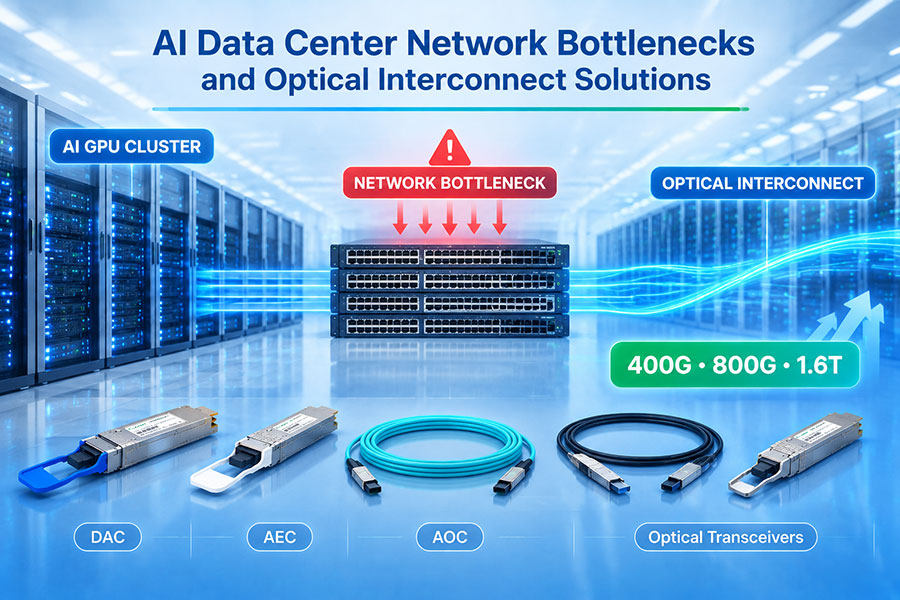
This creates an important engineering challenge: increasing processing capacity does not automatically increase overall computing performance. If the network cannot transfer data quickly enough, accelerators may spend valuable time waiting for information instead of performing calculations.
The growing importance of distributed AI workloads is changing data center network planning. High-speed optical connections are increasingly required to support communication between computing nodes, connect high-density server racks, and link separate AI facilities.
2. Why Traditional Electrical Interconnects Face Increasing Limitations
Copper-based electrical connections have been widely used in server systems, switch connections, and short-reach data center applications. They remain valuable because of their relatively low cost, straightforward implementation, and established manufacturing ecosystem.
However, higher transmission speeds introduce greater challenges for electrical signal integrity. As signaling rates increase, insertion loss, crosstalk, electromagnetic interference, and equalization requirements become more difficult to manage. The practical transmission distance of high-speed electrical connections can consequently become shorter.
These limitations are particularly relevant to AI clusters, where large numbers of accelerators and switches must communicate through increasingly dense network architectures.
| Technical Factor | Electrical Interconnects | Optical Interconnects |
|---|---|---|
| Transmission Medium | Electrical signals through copper conductors | Light signals transmitted through optical fiber |
| Signal Attenuation | Increasingly challenging at higher frequencies and longer distances | Low attenuation over suitable optical transmission distances |
| Electromagnetic Interference | Requires attention to crosstalk and electromagnetic compatibility | Immune to electromagnetic interference in the optical transmission path |
| Bandwidth Scaling | Constrained by electrical channel characteristics and signal processing requirements | Supports high aggregate bandwidth through multiple optical channels and wavelengths |
| Transmission Distance | Generally suited to shorter connections at very high data rates | Supports connections ranging from short-reach links to metropolitan and long-haul networks |
| Power Considerations | Signal conditioning and equalization can increase power requirements | Can improve transmission energy efficiency, although optical engines and conversion electronics also consume power |
| Typical Applications | Board-level connections, short server links, DAC and AEC connections | High-speed switch links, rack-to-rack connections, AI cluster networks, and DCI |
The transition to optical connectivity does not mean that copper will disappear from data centers. Instead, different transmission technologies will serve different distances and bandwidth requirements. Direct Attach Copper (DAC) and Active Electrical Cable (AEC) remain relevant for suitable short-reach connections, while optical transceivers and fiber links become increasingly important as network reach, port density, and aggregate bandwidth increase.
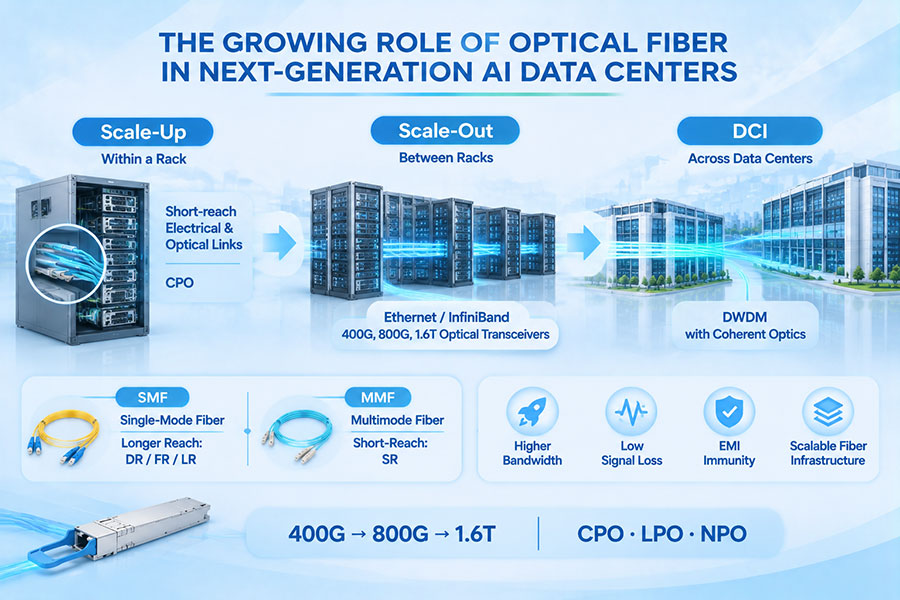
3. Optical Connectivity Supports Scale-Up, Scale-Out, and Scale-Across Architectures
AI infrastructure is developing across several networking dimensions. Each architecture introduces different communication requirements, making optical connectivity increasingly important at multiple levels of the computing environment.
Scale-Up Networking
Scale-up architecture connects processors within a tightly integrated computing system. Its objective is to allow multiple accelerators to operate as a coordinated computing resource with high-bandwidth, low-latency communication.
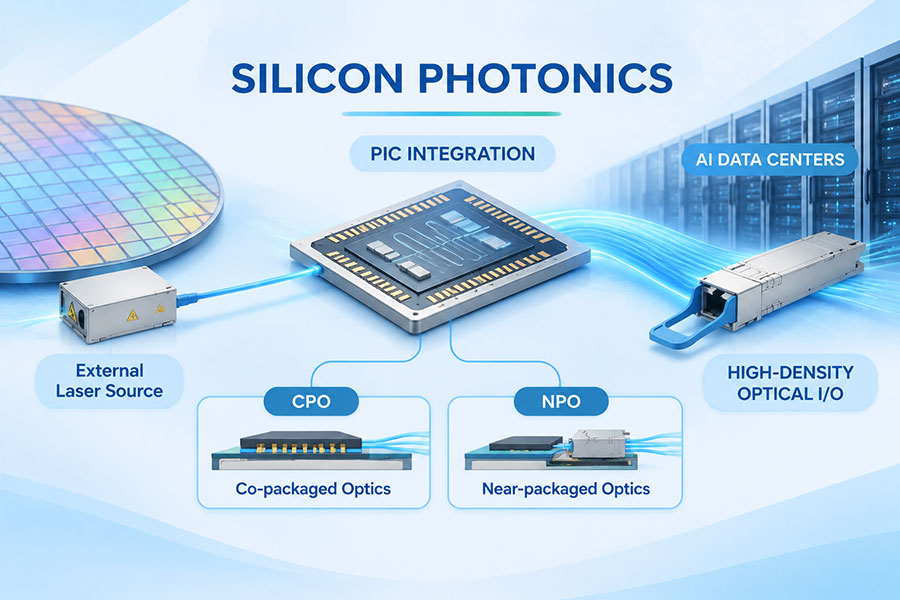
As scale-up systems expand beyond individual boards and servers, electrical transmission distance and bandwidth density become important design constraints. Optical I/O, near-package optics (NPO), and co-packaged optics (CPO) are emerging as potential approaches for extending high-bandwidth connectivity closer to processing devices.
Scale-Out Networking
Scale-out architecture connects multiple servers and racks to create larger AI computing clusters. Ethernet and InfiniBand networks are widely used in this environment, with RoCEv2 also supporting high-performance Ethernet-based communication.
Optical transceivers provide the physical connectivity between switches and servers, supporting higher transmission rates and longer distances than many conventional electrical connections. As AI clusters move toward 800G and 1.6T network interfaces, optical links become increasingly important for maintaining bandwidth across the network fabric.
Scale-Across Networking
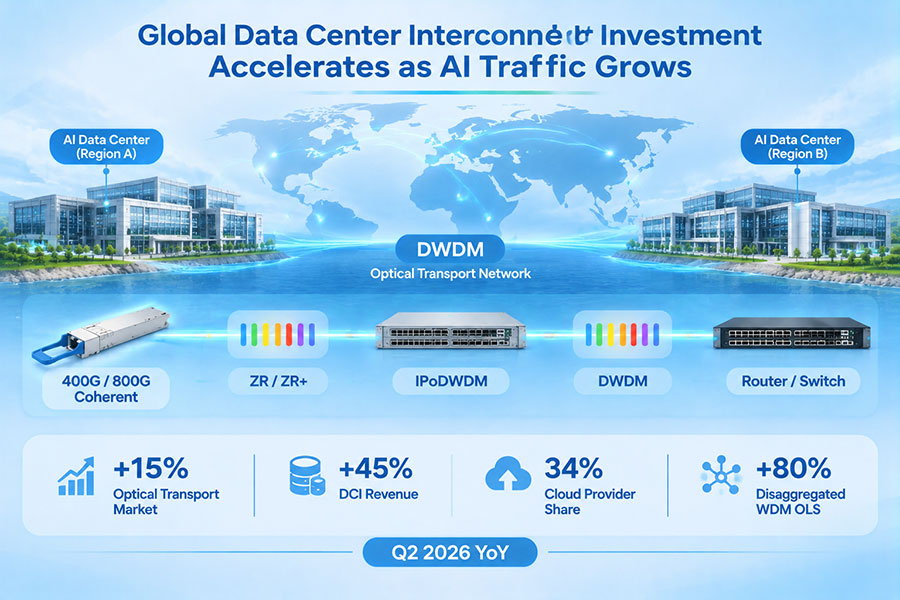
Scale-across extends AI computing beyond a single data center. Multiple facilities can cooperate through high-capacity data center interconnect (DCI) networks, allowing computing resources to be distributed across different locations.
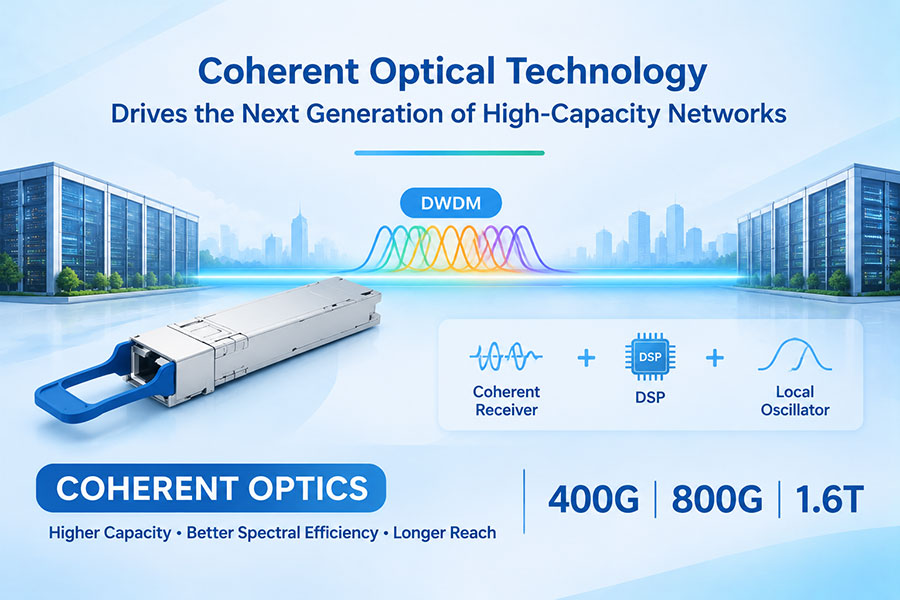
This architecture introduces additional requirements for optical transport capacity, transmission reliability, latency management, and network protection. Coherent optical technologies, DWDM systems, and optical line systems can support high-capacity communication between geographically separated computing facilities.
| Architecture | Primary Connectivity Scope | Key Network Requirements | Relevant Optical Technologies |
|---|---|---|---|
| Scale-Up | Processors, accelerators, and tightly integrated systems | High bandwidth density, low latency, short-reach connectivity | Optical I/O, NPO, CPO |
| Scale-Out | Servers, racks, and AI computing clusters | High throughput, low packet loss, scalable network fabrics | 400G, 800G, 1.6T optical transceivers, AOC |
| Scale-Across | Multiple data centers and geographically distributed clusters | High-capacity transport, reliability, and distance coverage | Coherent optics, DWDM, DCI, OLS |
These architectures are complementary rather than mutually exclusive. A large AI computing environment may use electrical and optical connections within individual systems, high-speed optical transceivers across racks, and coherent optical transport between data centers.
4. The Transition from 400G to 800G and 1.6T Optical Connectivity
Increasing AI network traffic is accelerating the migration toward higher-speed optical interfaces. Data center operators need more bandwidth per port to connect high-performance switches, accelerators, and network infrastructure without continuously increasing the number of physical connections.
400G optical connectivity established an important foundation for high-density data center networking. However, as AI clusters become larger and network fabrics require greater aggregate throughput, 800G and 1.6T technologies are becoming increasingly important.
| Optical Interface | Aggregate Data Rate | Typical Application Areas | Network Development Role |
|---|---|---|---|
| 400G | 400 Gbps | Data center switches, server connectivity, and high-speed network fabrics | Established high-speed infrastructure |
| 800G | 800 Gbps | AI clusters, high-capacity Ethernet, and InfiniBand networks | Higher bandwidth density for next-generation clusters |
| 1.6T | 1.6 Tbps | Next-generation AI switches and advanced data center interconnects | Further increases in port bandwidth and network capacity |
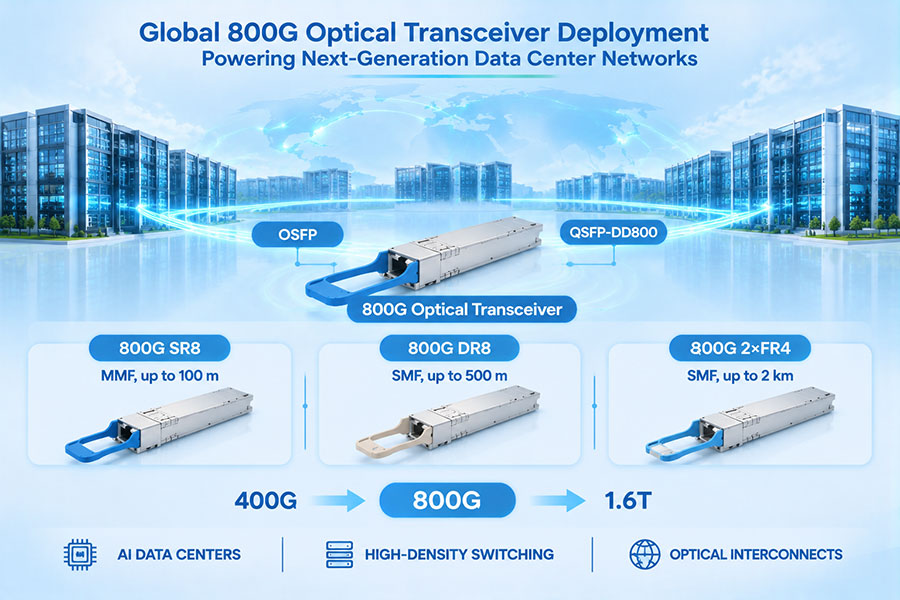
These interfaces can use different optical configurations depending on transmission distance, fiber type, wavelength arrangement, and network architecture. SR, DR, FR, and LR optical solutions address different application requirements, while multi-lane architectures and advanced modulation technologies enable higher aggregate data rates.
For example, 800G SR8 is designed for short-reach multimode fiber applications, while 800G 2FR4 provides a different optical configuration for longer-reach single-mode fiber connectivity. At the next bandwidth level, 1.6T optical solutions, including 2DR4 and DR8 architectures, are being developed for increasingly demanding AI data center environments.
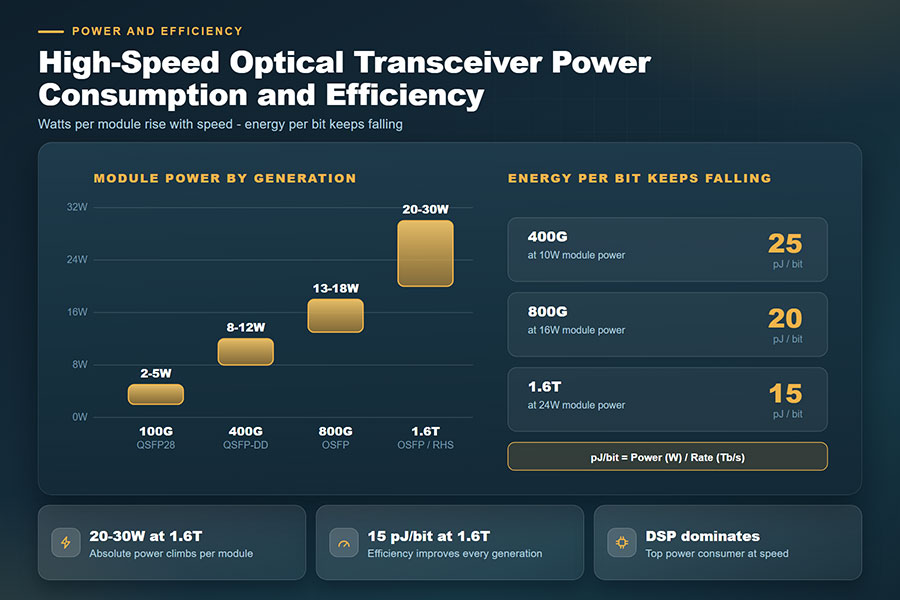
These developments also increase the importance of module compatibility, thermal management, power consumption, fiber infrastructure, and system-level testing. A higher data rate alone does not guarantee improved network performance unless the complete optical link is engineered to meet the application requirements.
5. Silicon Photonics, NPO, and CPO Are Reshaping Optical Integration
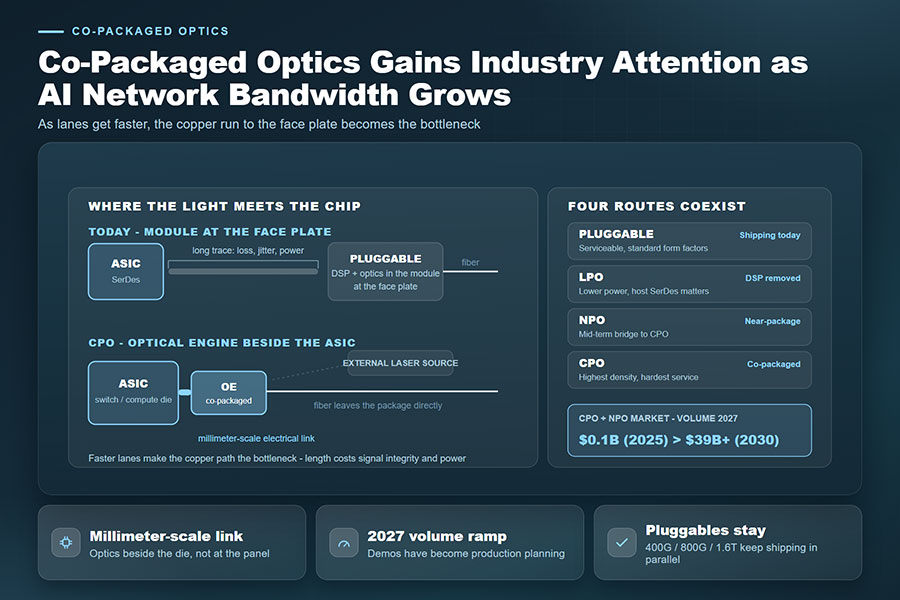
Traditional pluggable optical transceivers are installed at the front panels of switches and servers. This architecture offers convenient installation, replacement, maintenance, and interoperability. It remains an important foundation of current data center optical connectivity.
However, as bandwidth density increases, the electrical connections between switching ASICs and front-panel optical modules introduce additional challenges. The industry is therefore exploring optical integration approaches that move optical engines closer to the processing and switching chips.
Silicon Photonics (SiPh)
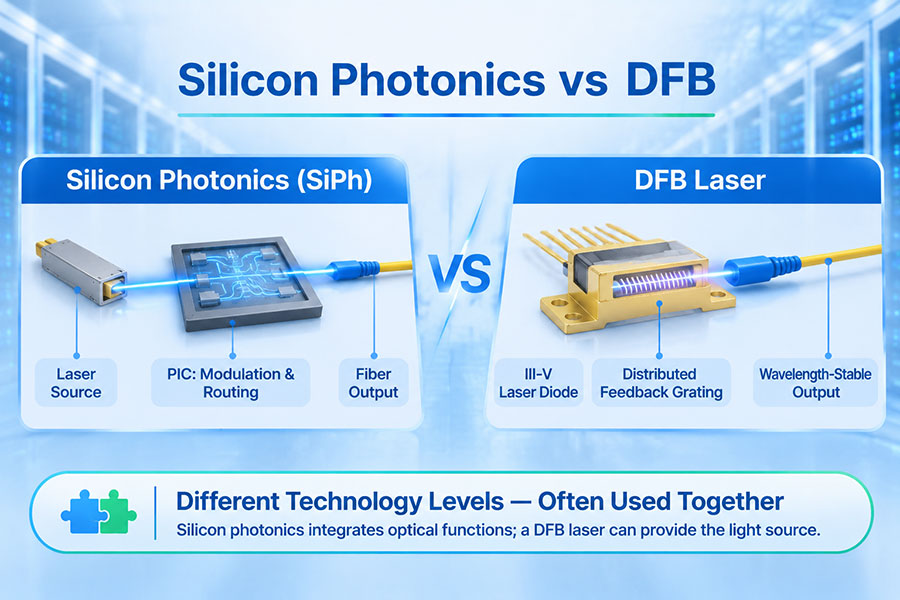
Silicon photonics integrates optical functions onto silicon-based photonic platforms. It enables the integration of components such as waveguides, modulators, and photodetectors, supporting compact optical engines with high bandwidth density.
Silicon photonics is becoming an important technology for high-speed optical transceivers, optical I/O, and advanced optical packaging.
Near-Packaged Optics (NPO)
NPO places optical engines close to the main processor or switching ASIC rather than relying entirely on conventional front-panel optical modules. This arrangement can shorten high-speed electrical paths and provide opportunities to improve bandwidth density and power efficiency.
Co-Packaged Optics (CPO)
CPO integrates optical engines within the same package or closely integrated package assembly as a switching ASIC or other high-performance processing device. By reducing the distance traveled by high-speed electrical signals, CPO aims to address electrical I/O limitations in increasingly bandwidth-intensive systems.
| Technology | Optical Integration Position | Primary Objective | Key Consideration |
|---|---|---|---|
| Pluggable Optics | Front panel of switches or servers | Flexible deployment and field replacement | Electrical reach between ASIC and module |
| NPO | Near the main processor or switching ASIC | Shorter electrical paths and higher integration density | Thermal design and serviceability |
| CPO | Integrated with the main chip package | High bandwidth density and reduced electrical I/O requirements | Packaging complexity, reliability, and maintenance |
These technologies are not simply interchangeable replacements for one another. Their adoption depends on system architecture, manufacturing maturity, thermal conditions, optical engine reliability, and operational requirements. Pluggable optics will continue to serve many applications, while NPO and CPO provide additional integration pathways for future AI computing platforms.
6. Optical Connectivity Is Becoming Important for AI Data Center Energy Efficiency
Power consumption is one of the most significant constraints in modern AI data center development. High-performance GPUs, memory systems, switching equipment, cooling infrastructure, and network connections all contribute to the overall energy requirements of an AI facility.
Moving data between computing devices also consumes energy. As network speeds increase, electrical signal conditioning, retiming, equalization, and other functions can contribute significantly to the power requirements of high-speed connectivity.
Optical transmission offers several potential advantages. Fiber links can transport high-bandwidth signals over longer distances without the same electrical channel losses encountered in copper connections. Advanced optical integration can also reduce the electrical transmission distance between processing chips and optical engines.
However, optical connectivity is not automatically more energy-efficient in every configuration. Laser sources, optical engines, digital signal processors, and electrical-to-optical conversion circuits all consume power. The actual energy efficiency depends on the complete link architecture, transmission distance, data rate, and system implementation.
For AI infrastructure designers, the objective is to optimize the entire data transmission path rather than focus on the power consumption of an individual optical module.
7. Optical Fiber and High-Density Connectivity Are Expanding Across Data Centers
As optical ports increase in speed and density, the physical fiber infrastructure must also evolve. Thousands of optical connections may be required within a large AI computing facility, creating challenges in cable routing, connector density, installation space, and maintenance.
Single-mode fiber is widely used for connections requiring greater transmission distances, while multimode fiber remains relevant for selected short-reach applications. Connector systems such as LC, MPO, and MTP support different port-density and fiber-count requirements.
High-density MPO/MTP cabling is particularly useful in environments where large numbers of optical fibers must be organized within limited rack and cabinet space. Proper polarity management, fiber inspection, insertion-loss testing, and connector cleanliness are essential for maintaining reliable high-speed links.
Optical infrastructure planning should consider not only current 400G and 800G deployments but also future migration toward 1.6T and higher-speed interfaces. Fiber capacity, cable pathways, connector selection, and patching arrangements can all influence the long-term scalability of an AI data center.
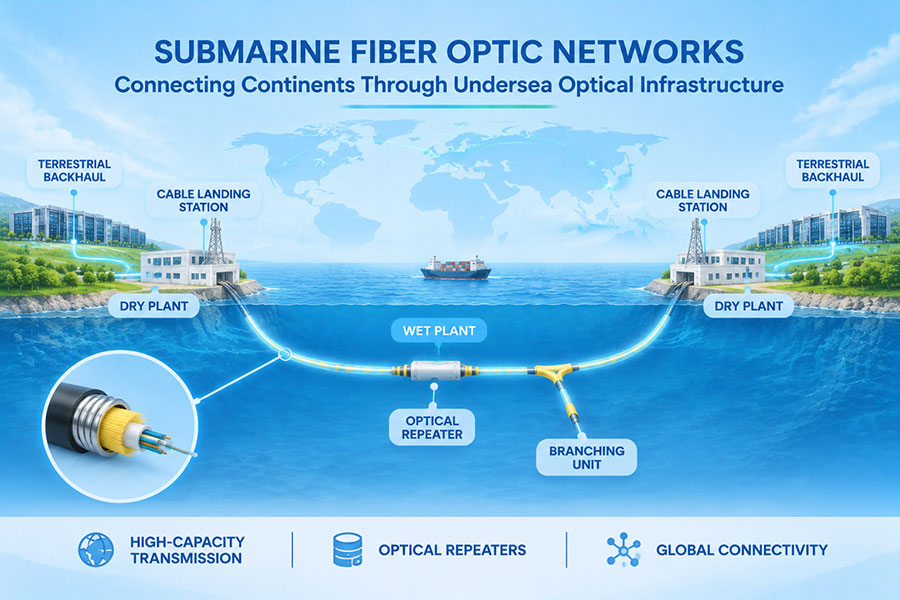
In addition, optical line systems and DWDM technologies can help increase transmission capacity between facilities by carrying multiple optical wavelengths over shared fiber infrastructure. This is particularly relevant for AI workloads distributed across multiple data centers.
8. Reliability and Compatibility Are Essential for Large-Scale AI Networks
AI computing environments are highly dependent on stable communication between processing devices. A failure affecting an individual optical connection can disrupt traffic flows, reduce available network capacity, or affect the performance of a distributed workload.
As network sizes increase, optical link reliability and compatibility become important operational considerations. Data center operators must verify that optical modules meet the requirements of their switches, servers, and network platforms.
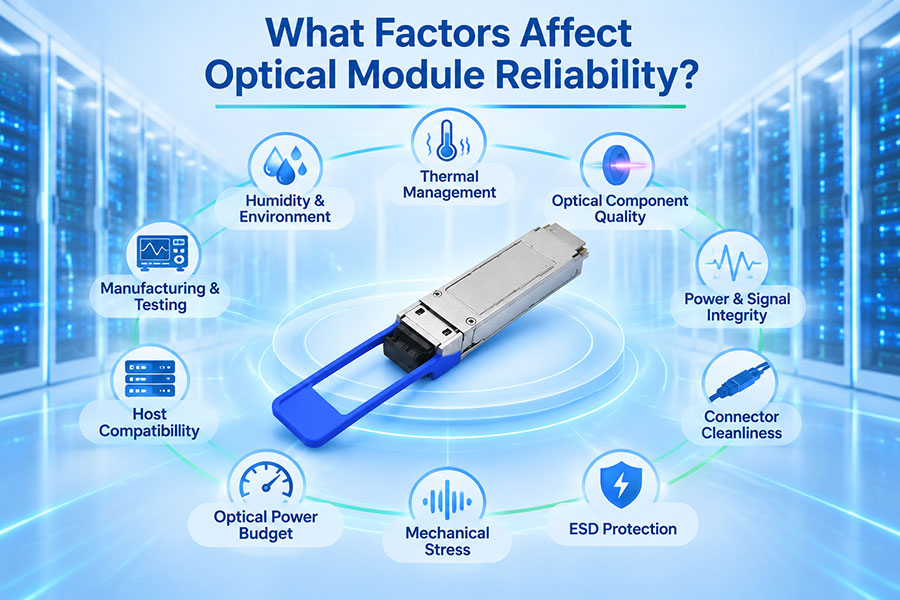
Several technical factors should be evaluated during optical deployment:
Host compatibility: Verify the supported optical module type, form factor, coding, and interface requirements of the host equipment.
Optical power budget: Ensure that transmitter output, receiver sensitivity, fiber attenuation, and connection losses satisfy the link requirements.
Digital diagnostics: Monitor temperature, supply voltage, laser bias current, transmit power, and receive power through DDM or DOM functions where supported.
Thermal management: Consider airflow, module operating temperature, switch power density, and cooling conditions.
Link performance: Evaluate BER, FEC behavior, signal integrity, and link stability under actual operating conditions.
Fiber infrastructure: Verify fiber type, connector compatibility, polarity, cleanliness, and insertion loss.
Multi-vendor optical environments also require careful compatibility validation. Standardized interfaces can improve interoperability, but host-specific firmware, coding requirements, and platform configurations may still affect deployment.
For large AI networks, consistent optical module quality and reliable supply are important for maintaining deployment schedules and supporting long-term infrastructure expansion.
9. The Role of High-Speed Optical Products in AI Infrastructure
The expansion of AI computing is creating opportunities across the optical connectivity supply chain. High-speed optical transceivers, active optical cables, direct attach cables, fiber assemblies, and optical transport equipment all contribute to different layers of AI network infrastructure.
For data center operators and system integrators, selecting the appropriate connectivity solution requires balancing bandwidth, transmission distance, power consumption, compatibility, and deployment cost.
Relevant optical connectivity product categories include:
| Product Category | Representative Solutions | Application in AI Infrastructure |
|---|---|---|
| High-Speed Optical Transceivers | 400G QSFP-DD, 800G OSFP, 800G QSFP-DD, 1.6T OSFP | High-bandwidth connections between switches, servers, and network equipment |
| Short-Reach Optical Connectivity | 800G SR8, 400G SR8, AOC | Short-distance connections within data center environments |
| Single-Mode Optical Connectivity | 800G 2FR4, 1.6T 2DR4, 1.6T DR8 | High-speed single-mode fiber connections across racks and network infrastructure |
| Direct Attach and Active Electrical Cables | 400G DAC/AEC, 800G DAC/AEC, 1.6T DAC/AEC | Suitable short-distance electrical connections within supported system architectures |
| High-Density Fiber Connectivity | MPO/MTP trunk cables, fiber patch cords, fiber assemblies | High-density optical distribution and structured fiber management |
| Optical Transport Solutions | DWDM, OLS, coherent optical modules, DCO | High-capacity interconnection between distributed data centers |
As an optical connectivity supplier, C-LIGHT provides high-speed optical transceiver and connectivity product solutions covering 400G, 800G, and emerging 1.6T applications. Its product portfolio includes QSFP-DD and OSFP optical transceivers, high-speed DAC and AEC cables, optical connectivity components, and fiber solutions for data center networking.
For AI infrastructure projects, product selection should be based on the target switch or server platform, transmission distance, optical interface, power budget, and operating environment. Compatibility verification and application-specific testing are essential before large-scale deployment.
10. The Future of AI Computing Will Depend on Optical Connectivity
The development of AI infrastructure is entering a stage in which computing performance, networking capacity, and energy efficiency must advance together. Larger models and distributed computing architectures are increasing the volume of data exchanged between accelerators, servers, racks, and data centers.
Optical connectivity is positioned to address several of these challenges through higher transmission bandwidth, longer reach, improved signal integrity, and increasingly integrated photonic technologies.
In the near term, 400G and 800G optical solutions will continue supporting high-speed data center networks, while 1.6T interfaces are becoming an important part of next-generation infrastructure planning. At the same time, silicon photonics, NPO, CPO, optical circuit switching, and coherent optical transport are expanding the possibilities for connecting AI computing resources.
The long-term development of AI infrastructure will not be determined by processor performance alone. The ability to move information efficiently across the entire computing system will play an equally important role. As AI clusters become larger and more distributed, optical connectivity will increasingly serve as one of the essential foundations of scalable, high-performance computing.
Building Optical Connectivity for Next-Generation AI Networks?
Explore C-LIGHT's high-speed optical transceivers, DAC and AEC cables, and fiber connectivity solutions for data center applications. For product specifications, compatibility requirements, or customized connectivity solutions, Contact C-LIGHT.
 >

 >
 >
 >
 >
 >
 >
 >