TEL:+86 132 6656 7067





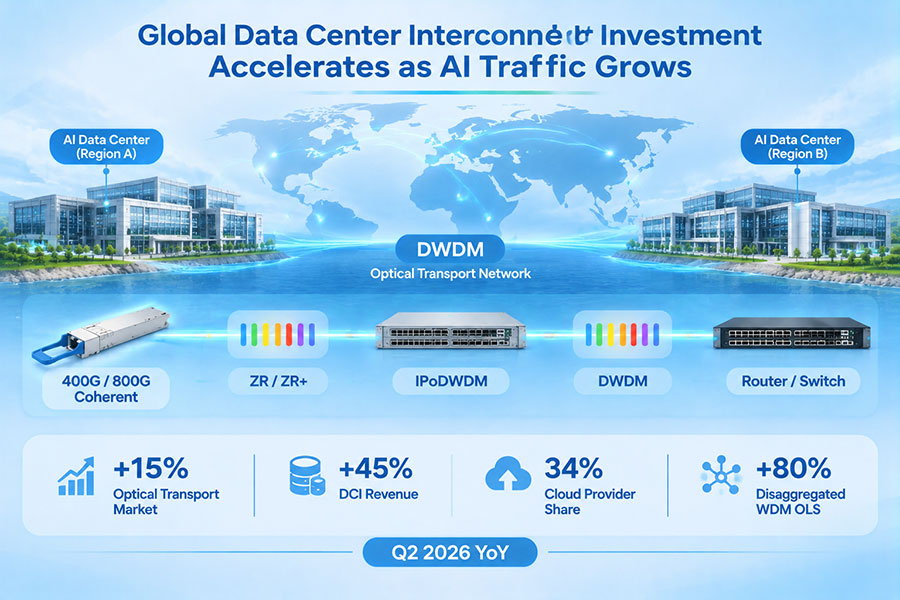
Artificial intelligence infrastructure is increasingly distributed across multiple data center locations. Large-scale AI operators are expanding beyond individual campuses to access additional power capacity, suitable land, cooling resources, network infrastructure, and regional computing resources. As these facilities become interconnected parts of a broader computing environment, the network between them becomes a critical component of AI infrastructure.
Data Center Interconnect (DCI) provides the optical transport foundation for connecting geographically separated facilities. It enables high-capacity data exchange between AI data centers, cloud regions, storage platforms, and network hubs. With traffic requirements moving toward 400G and 800G optical channels, DCI is evolving from a conventional site-to-site connection into a scalable, high-performance transport architecture.
The growing role of DCI is particularly significant for AI workloads that require coordinated access to distributed datasets, model repositories, inference services, and computing resources. Its value depends not only on bandwidth, but also on latency, reliability, optical reach, and the ability to scale network capacity as AI infrastructure expands.
1. Why AI Data Centers Are Becoming Geographically Distributed
Building every AI computing resource within one facility is not always practical. Large AI deployments face constraints involving electricity availability, cooling infrastructure, construction schedules, land, permitting, and regional network capacity. Operators may therefore distribute computing resources across multiple campuses or metropolitan regions.
This distributed approach creates opportunities for infrastructure expansion while introducing additional requirements for inter-site connectivity.
Power availability: Different locations may offer more suitable electricity capacity and power infrastructure for large GPU clusters.
Cooling requirements: Regional climate, water availability, and cooling infrastructure can influence data center placement.
Capacity expansion: Additional facilities allow operators to expand computing resources without relying on a single campus.
Regional service delivery: Distributed infrastructure can bring AI inference and cloud services closer to users and enterprise applications.
Operational resilience: Geographically separated facilities can support disaster recovery and business continuity strategies.
Resource allocation: Computing, storage, and network resources can be allocated across facilities according to workload requirements.
However, geographical distribution introduces a more demanding network environment. Data must travel between facilities over longer fiber routes, and the network must support high traffic volumes without creating unacceptable delays or service interruptions.
2. DCI as the Optical Foundation of Distributed AI Infrastructure
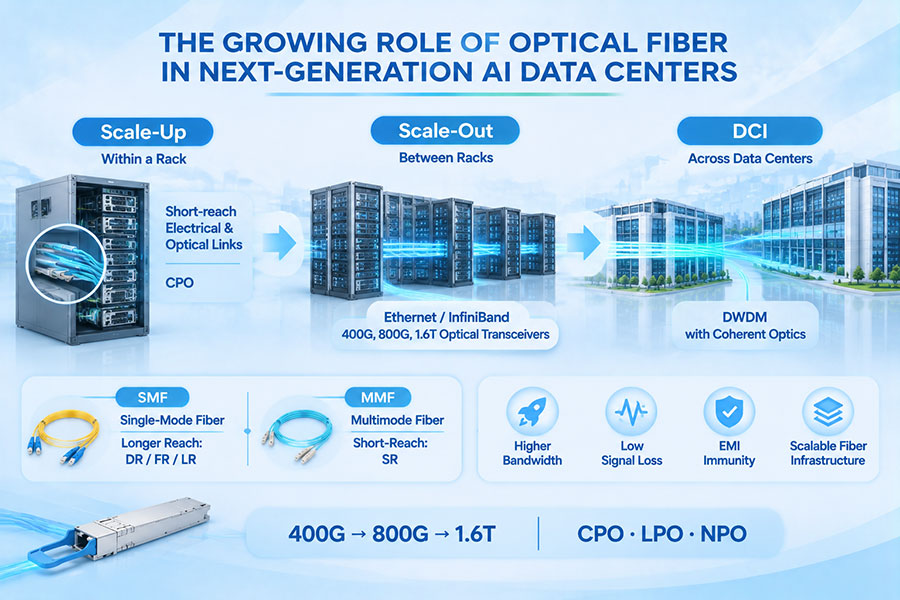
DCI refers to the network infrastructure that connects separate data centers. Depending on the deployment, these facilities may be located in the same metropolitan area, across a regional network, or hundreds of kilometers apart.
Unlike conventional short-reach optical connections inside a data center, DCI must account for external fiber routes, optical amplification, wavelength management, transmission loss, and more complex network protection requirements.
In AI infrastructure, DCI can connect several important network domains:
| Connected Infrastructure | DCI Function | Typical Traffic |
|---|---|---|
| AI computing campuses | Connects separate GPU and accelerator environments | Workload coordination, distributed computing traffic |
| Storage facilities | Provides high-capacity access to remote storage systems | Dataset access, model files, checkpoints, backups |
| Cloud regions | Connects geographically separated cloud infrastructure | Cloud service traffic, application data, replication |
| Inference facilities | Connects AI service platforms with regional computing resources | Inference requests, application data, model distribution |
| Network exchange hubs | Provides connectivity to external networks and service providers | Internet traffic, enterprise connectivity, cloud access |
For operators, DCI is not simply an extension of the internal data center network. It is a separate transport layer that must be engineered around the physical distance, traffic profile, optical budget, and service-level requirements of each inter-site connection.
3. How AI Workloads Increase DCI Bandwidth Requirements
AI infrastructure generates substantial traffic across computing, storage, and service delivery systems. The amount of inter-site traffic depends heavily on how workloads are distributed and where data is stored and processed.
Several workload categories can increase demand for high-capacity DCI:
Distributed training: When training resources are distributed across locations, communication between computing environments can require substantial network capacity. The architecture must account for the latency sensitivity of the workload.
Dataset movement: Large training datasets may need to be transferred or replicated between storage facilities and computing campuses.
Model distribution: Updated model weights, checkpoints, and related data may need to be delivered to multiple facilities.
Inference traffic: Distributed inference services exchange requests, responses, application data, and operational information across network locations.
Disaster recovery: Replication between geographically separated sites requires predictable bandwidth and reliable transport.
Not every AI workload requires the same network characteristics. Synchronous distributed training is especially sensitive to communication latency, while bulk dataset replication may prioritize throughput and transfer efficiency. Inference traffic can place greater emphasis on predictable response times and regional service availability.
4. The Evolution from 400G to 800G DCI
As inter-site traffic increases, network operators need more capacity per optical wavelength and more efficient use of available fiber infrastructure. The transition from 400G to 800G coherent optical technology provides a path toward higher-capacity DCI links.
400G coherent solutions established an important foundation for high-capacity data center interconnection. 800G coherent technology increases the capacity available from a single optical module, helping operators scale metro and regional networks while managing fiber utilization and equipment footprint.
| Technology | Typical Network Role | Optical Technology | Deployment Considerations |
|---|---|---|---|
| 100G DCI | Established inter-site connections and lower-capacity links | Coherent or direct-detect, depending on reach | Existing infrastructure and traffic requirements |
| 400G DCI | High-capacity metro and regional connectivity | 400ZR, ZR+, DCO | Fiber reach, optical line system, OSNR and interoperability |
| 800G DCI | Higher-capacity AI and hyperscale data center interconnection | 800ZR, 800ZR+, coherent DCO | Power, thermal design, line-system compatibility and optical performance |
| 1.6T DCI | Emerging next-generation high-capacity transport | Next-generation coherent optical technology | Standards maturity, module availability and system qualification |
The transition is not simply a matter of replacing every 400G module with an 800G module. Existing routers, switches, optical line systems, fiber routes, power budgets, and thermal limits all influence the upgrade strategy.
For organizations expanding AI infrastructure, a phased migration can help preserve existing network investments while introducing higher-capacity optical interfaces where traffic demand justifies them.
5. Coherent Optics and DWDM Enable Longer-Distance Connectivity
Long-distance DCI requires more than a high-speed Ethernet optical interface. Fiber attenuation, chromatic dispersion, optical signal-to-noise ratio, and accumulated transmission impairments become increasingly important as link distance and capacity increase.
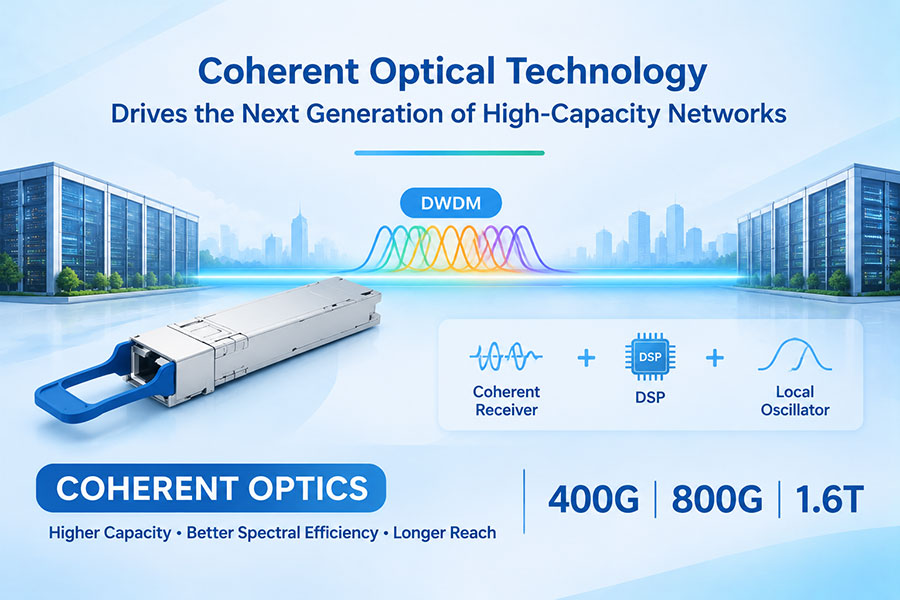
Coherent optical technology addresses these challenges through advanced modulation, coherent detection, and digital signal processing. A coherent transceiver can compensate for important transmission impairments and support high-capacity signals over optical transport networks.
DWDM (Dense Wavelength Division Multiplexing) further increases fiber capacity by transmitting multiple optical wavelengths through the same fiber pair. Instead of deploying a separate fiber pair for every high-capacity connection, operators can allocate multiple wavelengths across an existing optical route, subject to the available spectrum and system design.
Key technologies include:
Coherent DSP: Processes received optical signals and compensates for transmission impairments.
Tunable DWDM lasers: Allow modules to operate on selected wavelengths within a supported optical band.
Optical amplifiers: Compensate for accumulated fiber loss along suitable transmission paths.
ROADM systems: Enable wavelength routing and flexible optical network configuration.
Optical line systems: Provide the physical transport infrastructure for wavelength multiplexing, amplification, monitoring, and management.
For DCI deployments, the choice between a direct optical connection and a DWDM transport architecture depends on distance, fiber availability, required capacity, and operational requirements.
6. Selecting Optical Transceivers for Different DCI Distances
Optical transceiver selection should begin with the actual fiber route and required reach rather than the nominal data rate alone. Short campus connections may use direct-detect optical modules, while longer metro and regional links generally require coherent transmission and a suitable optical line system.
| Distance Range | Potential Optical Solution | Typical Application | Key Considerations |
|---|---|---|---|
| Up to 2 km | 400G FR4 / 800G 2×FR4 | Campus and nearby facility connections | Fiber type, connector, link budget |
| Up to 10 km | 400G LR4 / 800G 2×LR4 | Extended campus and metropolitan access | Optical loss and interface compatibility |
| Approximately 40 km | 400G ER4 | Longer facility-to-facility connections | Power budget and dispersion limits |
| Approximately 80–120 km | 400ZR / 800ZR | Metro DCI | Coherent performance and optical line conditions |
| Beyond 120 km | 400ZR+ / 800ZR+ and other DCO solutions | Extended metro and regional DCI | OSNR, amplification, modulation, FEC and route engineering |
These ranges are indicative application categories, not guaranteed reach values for every module. Actual transmission distance depends on the specific product specification, fiber characteristics, optical loss, amplifier configuration, channel loading, and required performance margin.
For example, C-LIGHT's 400G QSFP-DD optical transceiver portfolio includes direct-detect variants for different reaches as well as coherent DCO configurations. Its product matrix lists 400G ZR and ZR+ options for metro and extended-reach transport.
For higher-capacity deployments, the C-LIGHT DWDM DCO coherent transceiver portfolio includes QSFP-DD and OSFP solutions supporting 800ZR, 800ZR+, and 400ZR++ operating modes. The published product matrix lists specific 800G configurations with nominal reaches of 120 km, 340 km, and 500 km, and 400ZR++ configurations up to 2,400 km. These figures apply to the listed configurations and must be validated against the intended optical system.
7. Network Architecture for Geographically Distributed AI Data Centers
A scalable DCI network needs to connect facilities without creating unnecessary complexity or single points of failure. The architecture should reflect the number of sites, traffic demand, physical fiber routes, and the level of service continuity required.
Point-to-Point DCI
Point-to-point DCI provides a direct optical connection between two data centers. It is suitable for dedicated inter-site traffic, straightforward campus extensions, and applications where traffic flows are concentrated between a specific pair of facilities.
Hub-and-Spoke Architecture
In a hub-and-spoke design, multiple data centers connect to a central network location. This can simplify centralized traffic aggregation, storage access, and connectivity to cloud or external networks. However, the hub must have sufficient capacity and redundancy to avoid becoming a bottleneck.
Mesh DCI Architecture
A mesh architecture provides multiple interconnection paths between sites. It can improve route flexibility and resilience, particularly when facilities exchange traffic with several other locations. The trade-off is greater complexity in routing, capacity planning, optical engineering, and network operations.
| Architecture | Main Advantage | Potential Limitation | Suitable Environment |
|---|---|---|---|
| Point-to-Point | Simple and direct connectivity | Limited path flexibility | Two-site DCI |
| Hub-and-Spoke | Centralized traffic aggregation | Hub capacity and availability become critical | Multi-site networks with centralized services |
| Mesh | Multiple inter-site paths and flexible routing | Higher design and operational complexity | Large distributed AI and cloud infrastructure |
For large AI operators, the most effective architecture may combine these models. Dedicated high-capacity links can connect major computing campuses, while regional hubs and mesh connections provide access to storage, cloud regions, and external networks.
8. Latency, Reliability, and Fiber Diversity in AI DCI
Bandwidth is only one part of DCI performance. When AI applications depend on communication between geographically separated facilities, latency and network stability can directly influence application efficiency.
Fiber propagation delay increases with physical distance. Network equipment, switching, optical transport processing, and route selection add further delay. For this reason, a network with sufficient nominal bandwidth may still be unsuitable for workloads that require tightly synchronized communication.
DCI engineering should evaluate several performance factors:
Round-trip latency: Measure the actual delay between sites, including the physical route and network processing.
Jitter: Evaluate variations in packet delay that may affect time-sensitive applications.
Packet loss: Monitor loss under normal and congested operating conditions.
Fiber route diversity: Use physically diverse paths where service continuity requirements justify the additional infrastructure.
Protection switching: Define how traffic is restored after a fiber cut or equipment failure.
Optical monitoring: Track receive power, transmit power, temperature, pre-FEC BER, post-FEC performance, and other supported diagnostics.
Physical route diversity is especially important. Two logical connections do not necessarily provide meaningful protection if both travel through the same underground conduit or share a common vulnerable network segment.
For AI infrastructure, operators should also distinguish between traffic that requires low latency and traffic that can tolerate longer transfer times. Keeping latency-sensitive communication within a local cluster while using DCI for suitable inter-site workloads can help maintain predictable application performance.
9. Power Efficiency and Operational Costs of High-Capacity DCI
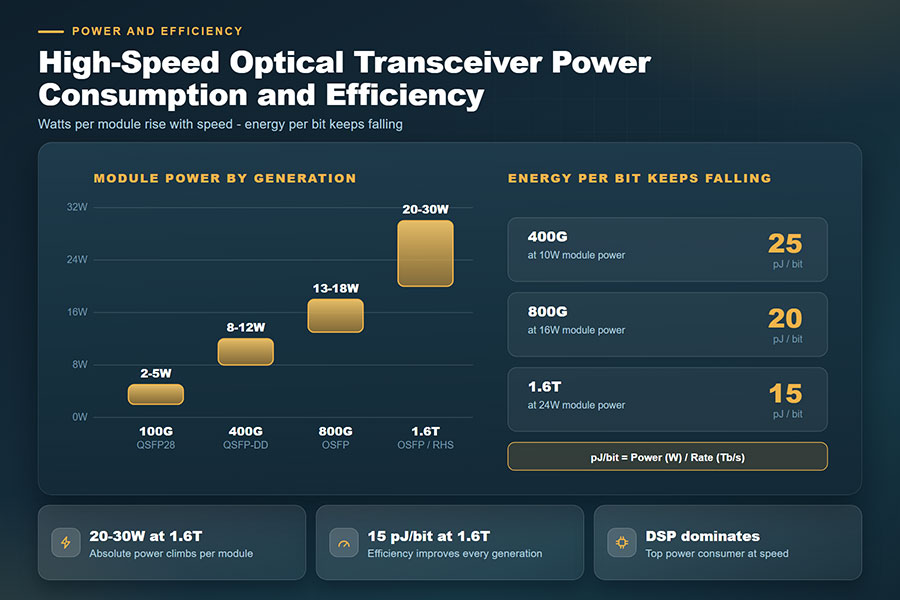
As optical capacity increases, transceiver power consumption and thermal management become important parts of DCI planning. Coherent modules integrate more complex signal processing and optical components than many short-reach direct-detect modules. Their power and cooling requirements must be considered at both the port and system levels.
Network operators should evaluate the total cost of delivering capacity rather than focusing only on the cost of an individual transceiver.
| Cost Factor | Impact on DCI Deployment |
|---|---|
| Optical transceiver power | Influences switch or router power consumption and rack-level energy requirements |
| Optical line system | Introduces costs associated with amplifiers, ROADMs, monitoring, and supporting equipment |
| Fiber infrastructure | New routes, leased fiber, and physical diversity can significantly affect deployment cost |
| Cooling requirements | High-power coherent modules may require careful airflow and thermal qualification |
| Maintenance and monitoring | Testing, diagnostics, spares, and fault management influence long-term operating expenses |
| Capacity utilization | Efficient wavelength allocation and traffic engineering can improve the economics of existing fiber assets |
Higher-capacity optical channels can reduce the number of interfaces needed for a given traffic volume, but they do not automatically reduce total network cost. The result depends on equipment pricing, power consumption, fiber availability, optical reach, and how efficiently the network uses each wavelength.
10. C-LIGHT Optical Solutions for High-Capacity DCI
As AI data centers expand across campuses and regions, optical connectivity providers need to support different transmission distances, network architectures, and capacity requirements. C-LIGHT's optical portfolio covers direct-detect and coherent solutions for data center, metro, and regional optical networks.
Relevant product families include:
400G QSFP-DD optical transceivers: The 400G QSFP-DD series includes SR8, DR4, FR4, LR4, ER4, ZR, and ZR+ configurations for different network distances. The published product matrix includes 400G DCO variants at 120 km, 300 km, and 450 km.
800G coherent DCO transceivers: The DWDM DCO series includes QSFP-DD and OSFP coherent modules for high-capacity DWDM transport, with supported operating modes depending on the specific model.
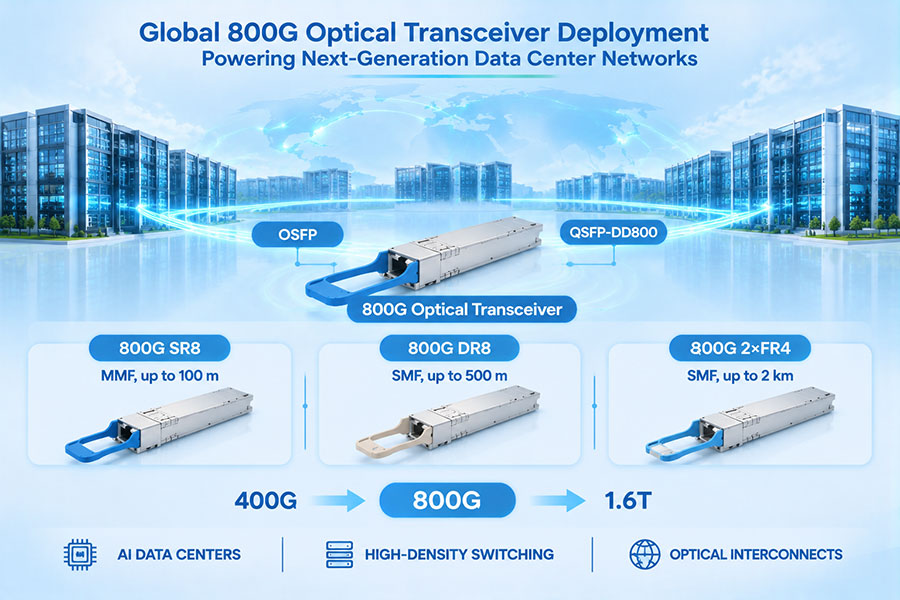
800G OSFP optical transceivers: The 800G OSFP series covers short-reach and data center campus applications, including SR8, DR8, 2×FR4, and other configurations.
800G QSFP-DD optical transceivers: The 800G QSFP-DD series provides additional form-factor options for high-density data center networking.
For DCI projects, selecting the correct optical module requires more than matching the data rate and connector. Host compatibility, coherent operating mode, wavelength plan, optical line system, fiber characteristics, power consumption, and management interface should all be checked before deployment.
C-LIGHT supports optical transceiver requirements across different data rates and application environments, helping network operators identify suitable optical connectivity options for evolving data center infrastructure.
11. The Future of DCI in the AI Networking Era
The role of DCI will continue to expand as AI computing becomes more geographically distributed. Higher-capacity optical interfaces, coherent transmission, and flexible DWDM systems will help operators connect more computing and storage resources across multiple locations.
Several technology directions are likely to influence future DCI development:
Higher-capacity coherent interfaces: 800G and emerging 1.6T coherent technologies will increase the capacity available per optical channel.
More flexible optical transport: Tunable transceivers, flexible-grid DWDM, and reconfigurable optical networks will support more adaptable wavelength allocation.
Improved network automation: Telemetry, optical monitoring, and automated provisioning can help operators manage increasingly complex inter-site networks.
Greater energy efficiency: Improvements in DSP, optical components, and system integration will remain important as DCI capacity grows.
Distributed AI service delivery: More regional AI inference and storage environments will increase the need for reliable connections between data centers.
Stronger network resilience: Diverse fiber routes, redundant optical equipment, and coordinated recovery mechanisms will become increasingly important for critical AI services.
The emergence of higher-capacity optical standards will also influence future equipment planning. However, new interface specifications and technology demonstrations should not be confused with universal commercial deployment. Operators will need to evaluate product availability, interoperability, power requirements, and real-world optical performance before adopting each new generation.
12. Conclusion
DCI is becoming an essential part of the infrastructure connecting geographically distributed AI data centers. As computing resources, storage systems, and AI services expand across multiple locations, the network between facilities must deliver higher capacity, predictable performance, and reliable operation over increasingly complex optical routes.
The transition toward 400G and 800G coherent optics, combined with DWDM transport and scalable network architectures, gives operators more options for expanding inter-site bandwidth. At the same time, successful DCI deployment depends on careful engineering of latency, optical reach, fiber diversity, power consumption, and system interoperability.
For optical networking providers and AI infrastructure operators, the long-term opportunity lies in building flexible transport networks that can accommodate future bandwidth growth without compromising reliability or operational efficiency.
Planning a high-capacity DCI deployment?
C-LIGHT provides optical transceiver solutions for data center, metro, and regional networking applications. Contact our team for product specifications, compatibility support, and optical connectivity requirements.
 >

 >
 >
 >
 >
 >
 >
 >