TEL:+86 132 6656 7067





Global data traffic continues to increase as cloud computing, artificial intelligence, video streaming, connected devices, and digital services become more deeply integrated into everyday activities and business operations. This growth is placing additional pressure on the fiber infrastructure that connects data centers, telecommunications networks, enterprise facilities, and international internet gateways.
Fixed broadband, mobile networks, cloud platforms, and private content delivery networks all depend on high-capacity optical transmission to move data between users and computing resources. As traffic volumes rise, network operators are investing in additional fiber routes, higher-speed optical interfaces, wavelength division multiplexing, and more efficient optical transport systems.
The challenge is no longer simply providing more fiber connections. Operators must also increase the capacity of existing infrastructure, improve network utilization, reduce transmission costs, and prepare for future bandwidth requirements. These priorities are accelerating the development of 400G, 800G, and 1.6T optical connectivity, alongside coherent transmission and advanced DWDM technologies.
1. Global Data Traffic Growth Increases Pressure on Fiber Infrastructure
Internet traffic is expanding across both fixed and mobile networks, although the growth patterns and infrastructure requirements differ between them. Fixed broadband continues to carry the majority of internet traffic, including data generated by mobile devices connected through Wi-Fi networks.
According to the International Telecommunication Union (ITU) Facts and Figures 2026, global fixed broadband internet traffic reached an estimated 7.5 zettabytes (ZB) in 2026, compared with 6.6 ZB in 2025. End-user mobile broadband traffic reached approximately 1.7 ZB during the same year.
The ITU also reported that fixed broadband traffic was approximately four times greater than mobile broadband traffic in 2026. Since 2021, however, mobile broadband traffic has grown at a faster average annual rate than fixed broadband traffic.
| Global Internet Traffic Indicator | 2025 | 2026 |
|---|---|---|
| Fixed broadband traffic | 6.6 ZB | 7.5 ZB |
| Mobile broadband traffic | Not separately stated in the cited summary | 1.7 ZB |
| Fixed broadband traffic relative to mobile | — | Approximately 4 times |
These figures highlight the scale of data movement supported by fixed access and transport infrastructure. Residential broadband, enterprise connectivity, cloud applications, video platforms, and data center services all contribute to the demand for greater network capacity.
For optical network operators, increasing traffic means more than upgrading individual links. It requires coordinated investment in access networks, metropolitan aggregation, backbone transmission, data center interconnection, and international connectivity.
2. International Internet Bandwidth Continues to Expand
International connectivity is another important driver of high-capacity fiber investment. Cloud platforms, content providers, telecommunications carriers, and data center operators require large volumes of bandwidth to exchange information across national and regional networks.
TeleGeography reported that global international internet bandwidth reached approximately 2,259 Tbps in 2026, following 23% growth during the year. Its reported four-year compound annual growth rate from 2022 to 2026 was approximately 23%.
International average and peak internet traffic also recorded strong growth over the same period. This reflects the increasing importance of global backbone networks and private infrastructure operated by major content and cloud providers.
Several developments are influencing international bandwidth requirements:
Cloud service expansion: Distributed cloud platforms require continuous data exchange between regional data centers and user locations.
Video and content delivery: High-resolution streaming and large digital content libraries increase traffic across regional and international networks.
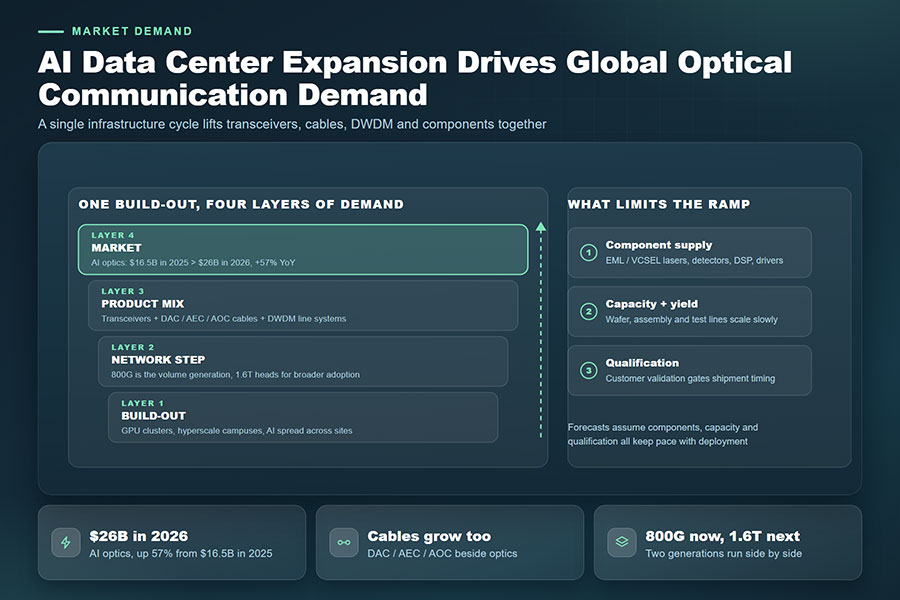
AI infrastructure: Distributed computing environments create additional demand for high-capacity connections between data centers.
Enterprise digitalization: Global businesses depend on reliable connectivity between offices, cloud platforms, and centralized applications.
Emerging market connectivity: Expanding internet access creates additional requirements for regional and international network capacity.
However, international traffic growth does not translate directly into an identical increase in long-distance fiber demand. Content caching, local data centers, private backbones, and regional traffic exchange can keep some data closer to end users. Network investment therefore depends on where traffic originates, where it is consumed, and how operators distribute their infrastructure.
3. Data Centers and AI Computing Create New Fiber Capacity Requirements
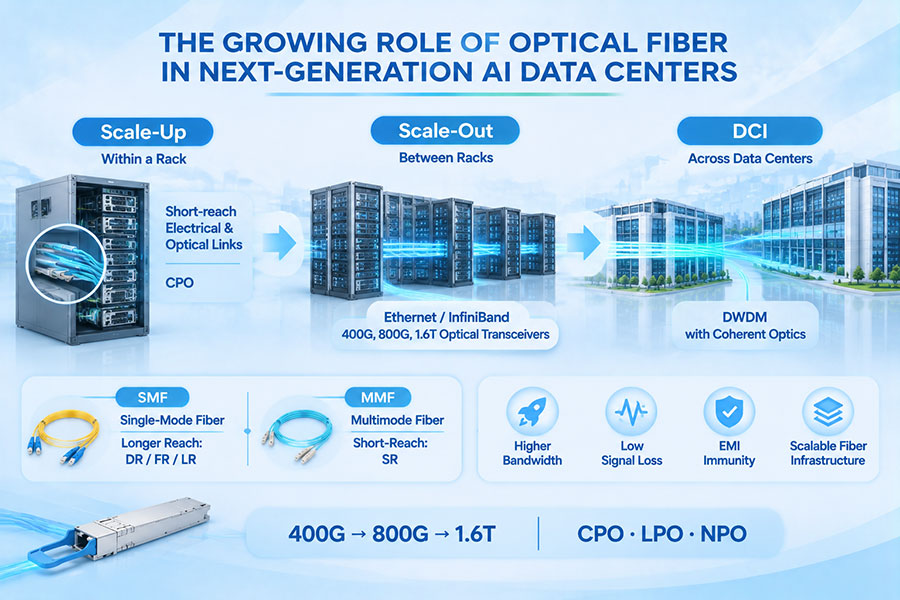
Large-scale AI computing is changing the way data centers are interconnected. Training clusters, inference platforms, high-performance computing systems, and cloud infrastructure require high-bandwidth connections both within individual facilities and between geographically distributed sites.
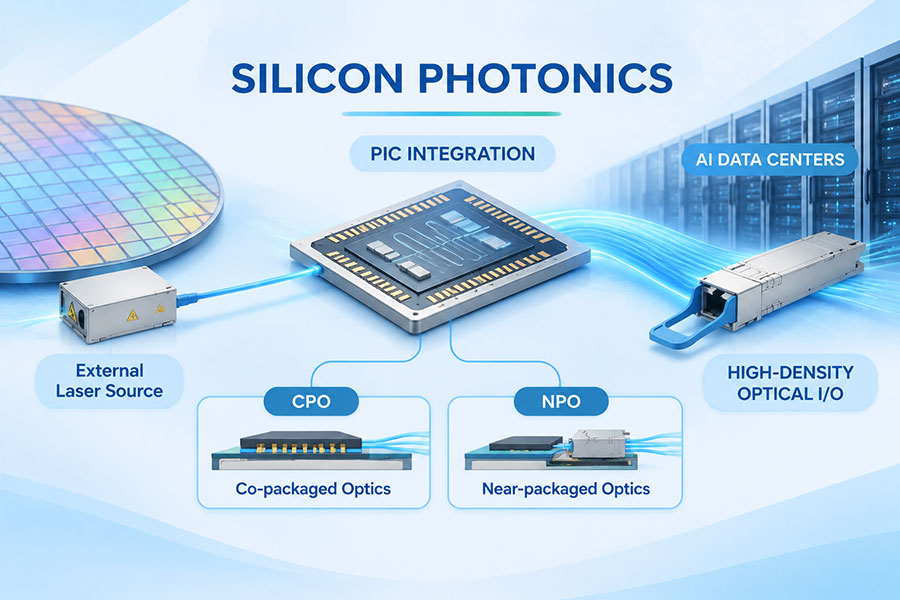
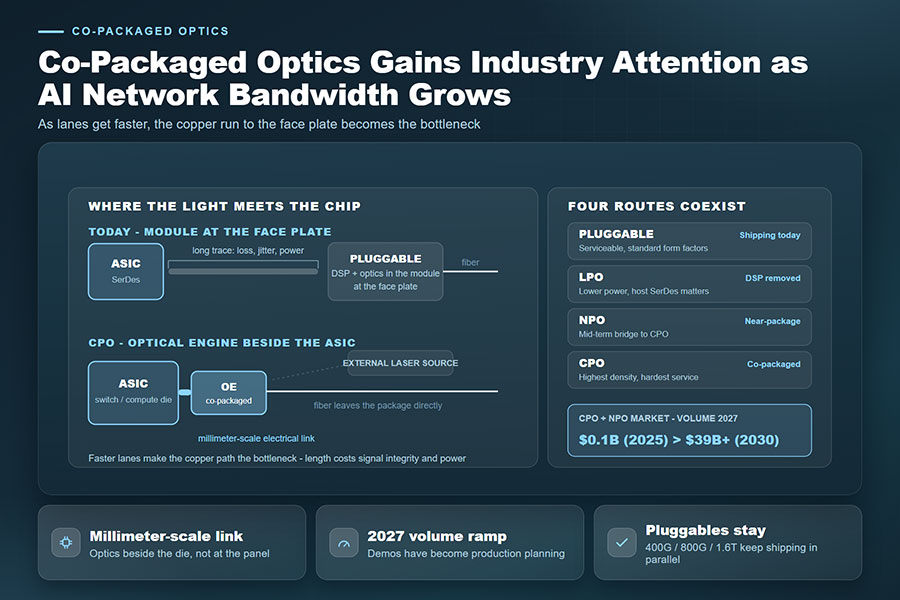
Inside data centers, optical transceivers connect servers, GPU systems, storage infrastructure, and network switches. As network speeds advance from 400G to 800G and 1.6T, operators need higher-capacity optical interfaces and denser fiber connectivity.
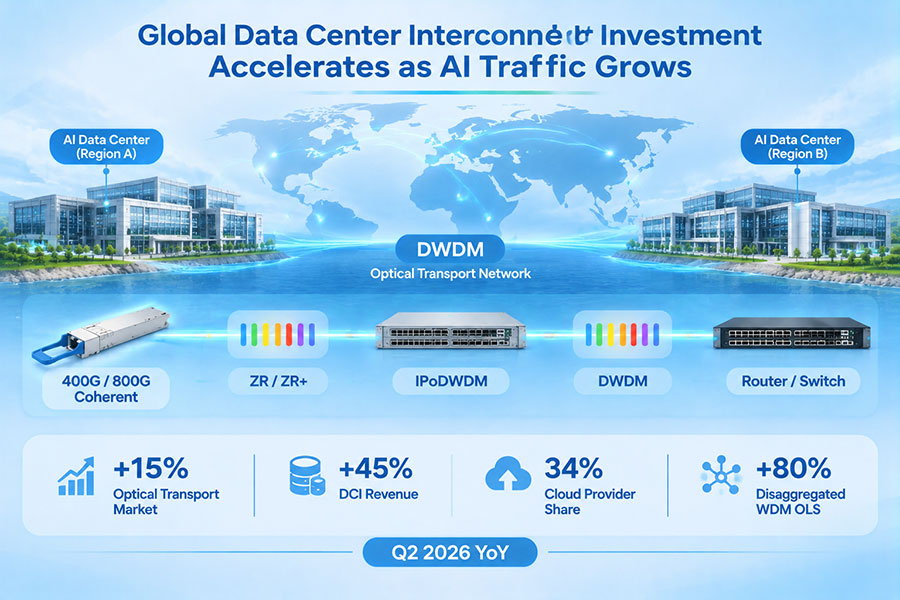
Between data centers, Data Center Interconnect (DCI) networks provide the transport capacity required to synchronize applications, replicate data, distribute workloads, and connect cloud regions.
These two environments have different optical requirements:
| Network Environment | Typical Optical Requirements | Primary Design Priorities |
|---|---|---|
| Server-to-switch connections | 400G, 800G and emerging 1.6T short-reach optics | Port density, power, latency, and thermal performance |
| Switch-to-switch connections | 400G and 800G SR, DR, FR and parallel optics | Bandwidth, reach, fiber type, and connectivity density |
| Data center interconnection | 400G and 800G coherent or high-speed optical solutions | Distance, optical spectrum, line-system compatibility, and capacity |
| Regional backbone networks | Coherent DWDM and OTN transmission | Long-distance performance, wavelength utilization, and scalability |
As AI infrastructure expands, optical connectivity becomes important at multiple levels. Short-reach transceivers support connections within computing facilities, while coherent optical systems and DWDM platforms provide the capacity required for longer-distance transport.
4. 400G, 800G, and 1.6T Optical Interfaces Increase Network Capacity
Higher-speed optical interfaces allow network operators to transport more data through individual connections. This is particularly important in environments where fiber routes, switch ports, equipment space, and network power are limited.
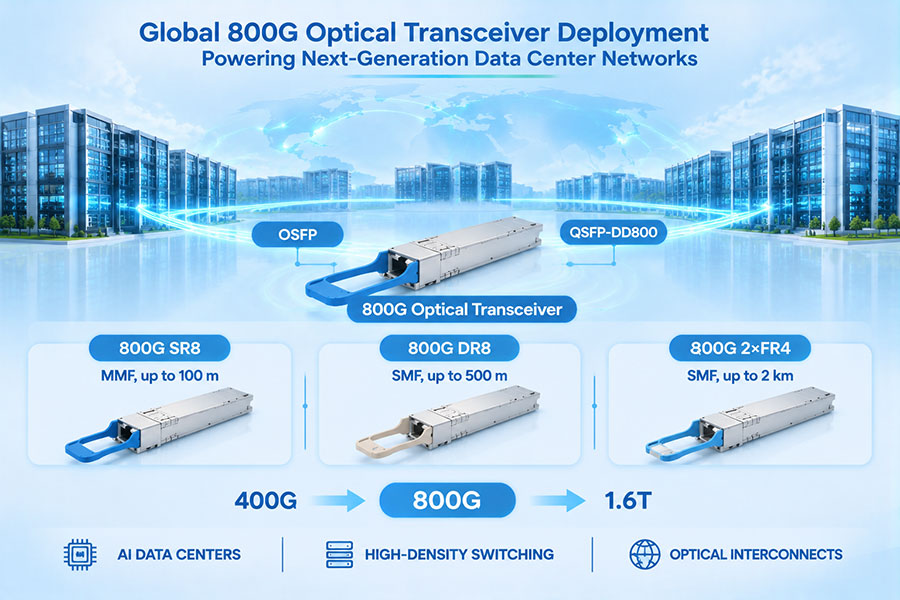
400G optical transceivers are widely used in high-capacity data center and transport networks. 800G modules provide additional bandwidth density for AI clusters and hyperscale infrastructure, while 1.6T optical interfaces are emerging as another step in high-speed network development.
| Optical Interface | Aggregate Data Rate | Common Applications |
|---|---|---|
| 100G | 100 Gbps | Enterprise networks, aggregation, and existing transport infrastructure |
| 400G | 400 Gbps | Data center switching, backbone networks, and DCI |
| 800G | 800 Gbps | AI clusters, hyperscale data centers, and high-capacity interconnection |
| 1.6T | 1.6 Tbps | Next-generation AI and high-density data center networks |
Higher interface speeds can increase the capacity of existing network infrastructure without requiring the number of physical connections to grow at the same rate. However, the benefits depend on fiber availability, optical reach, host equipment, port density, and thermal design.
Different optical configurations serve different distances. SR and DR modules are commonly used for shorter data center links, while FR and LR solutions support longer connections. Coherent modules are used in suitable high-capacity transport and DCI applications where advanced modulation and digital signal processing help extend transmission reach.
Operators should select optical interfaces based on the actual network topology rather than assuming that the highest available data rate is always the most economical option.
5. DWDM Helps Increase the Capacity of Existing Fiber Routes
Building new fiber infrastructure is not always practical. In dense metropolitan areas, international gateways, and established telecommunications corridors, obtaining new fiber routes can involve high construction costs, permitting requirements, and complex civil engineering work.
Dense Wavelength Division Multiplexing (DWDM) provides another way to expand network capacity. It allows multiple optical channels at different wavelengths to operate over the same fiber pair, increasing the amount of data that can be transported without requiring a separate fiber for every connection.
DWDM systems are widely used in backbone networks, metropolitan transport, data center interconnection, and long-distance telecommunications infrastructure.
Key components of a DWDM transmission system can include:
DWDM transceivers: Generate and receive optical signals at assigned wavelengths.
MUX/DEMUX equipment: Combines multiple wavelength channels onto a shared fiber and separates them at the receiving end.
Optical amplifiers: Compensate for accumulated signal attenuation along suitable transmission paths.
ROADM systems: Allow wavelength channels to be added, dropped, or redirected within flexible optical networks.
Optical monitoring equipment: Supports supervision of signal power, wavelength performance, and transmission conditions.
By using multiple wavelengths, operators can increase the capacity of existing fiber routes and improve infrastructure utilization. Actual capacity depends on channel spacing, modulation format, optical spectrum, fiber characteristics, amplifier performance, and system design.
6. Coherent Optical Technology Supports Long-Distance High-Capacity Transmission
As backbone and DCI bandwidth requirements increase, coherent optical transmission is becoming an important technology for high-capacity fiber networks.
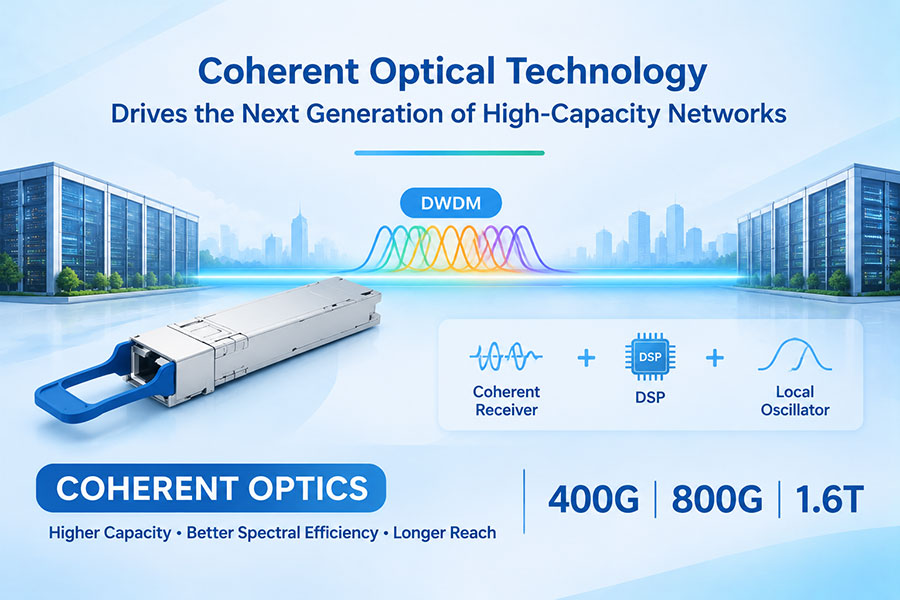
Unlike conventional direct-detection optical modules used in many short-reach applications, coherent transceivers use advanced modulation and digital signal processing to recover information encoded in the amplitude and phase of optical signals.
This approach can support higher spectral efficiency and transmission over longer distances, depending on the optical channel conditions and system configuration.
400G and 800G Coherent Transceivers
400G coherent modules are used in data center interconnection, metropolitan transport, and selected long-distance network applications. 800G coherent technology is extending the available capacity per wavelength for suitable high-performance optical transport systems.
Pluggable coherent modules can simplify selected network architectures by integrating optical transmission and digital signal processing into compact form factors. However, their reach depends on modulation, baud rate, optical power, fiber quality, amplifier configuration, and the overall link budget.
Coherent DWDM and OTN Integration
Coherent optics can operate within DWDM systems to provide high-capacity wavelength channels. OTN equipment can add transport-layer functions such as service mapping, multiplexing, monitoring, and protection.
The combination of coherent transceivers, DWDM line systems, and OTN transport creates flexible architectures for backbone operators and large-scale network providers.
7. Submarine Cables and Regional Fiber Backbones Support International Traffic
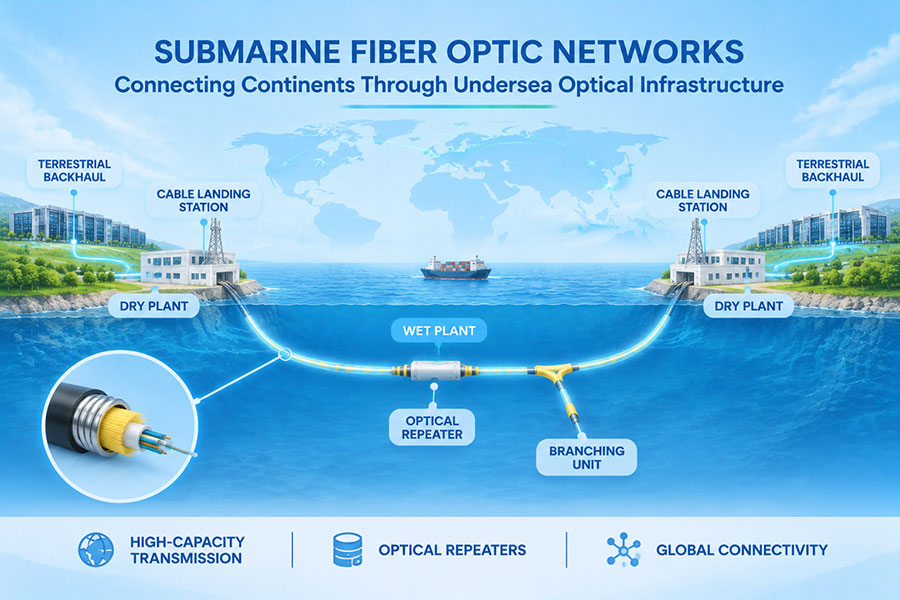
International internet connectivity depends heavily on submarine fiber optic cables. These systems connect continents, provide capacity between major telecommunications markets, and support data exchange between cloud regions and content delivery infrastructure.
As international bandwidth requirements grow, operators and infrastructure investors are developing new submarine cable systems, upgrading existing routes, and improving connections between cable landing stations and terrestrial backbone networks.
Submarine cable investment is only one part of the overall fiber infrastructure requirement. After international traffic reaches a landing station, it must be transported through terrestrial networks toward data centers, internet exchange points, cloud platforms, and local service providers.
This creates additional demand for:
High-capacity terrestrial fiber routes.
DWDM and coherent optical transport equipment.
Regional data center interconnection.
Optical amplification and wavelength management.
High-speed connections between cable landing stations and backbone hubs.
Redundant fiber routes for network resilience.
Route diversity is especially important for international and regional networks. Multiple geographically separated routes can help reduce the impact of cable faults, construction incidents, and other infrastructure disruptions.
8. Network Operators Face Challenges in Expanding Fiber Capacity
Increasing traffic creates opportunities for fiber infrastructure investment, but network expansion involves several technical and economic challenges. Operators must balance capacity requirements against construction costs, equipment investment, operating expenses, and long-term traffic forecasts.
Fiber availability: Existing fiber routes may not have sufficient spare capacity or may not reach the locations where new network connections are required.
Construction costs: Deploying new underground or aerial fiber can involve civil engineering, permits, right-of-way access, and coordination with local authorities.
Optical performance: Higher transmission speeds require careful evaluation of fiber attenuation, dispersion, optical signal-to-noise ratio, connector losses, and link margins.
Equipment interoperability: Optical modules and line systems must support compatible wavelengths, modulation formats, management interfaces, and transmission parameters.
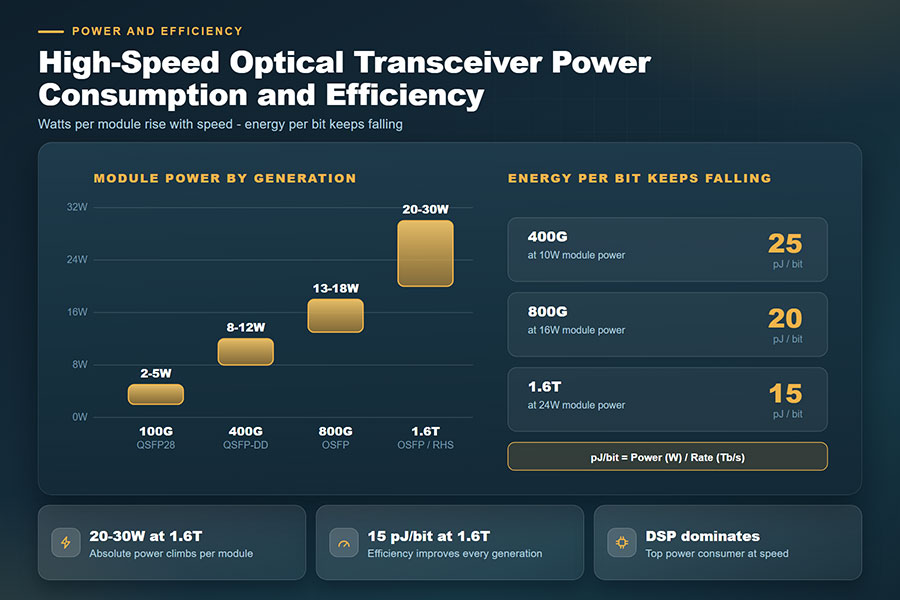
Power and thermal management: Higher-speed transceivers and denser network equipment increase the importance of energy efficiency and heat dissipation.
Network resilience: Backbone and data center networks require appropriate protection mechanisms, route diversity, monitoring, and recovery planning.
These factors make network planning increasingly complex. Operators need to evaluate the complete transmission system rather than focusing exclusively on individual transceiver specifications.
9. C-LIGHT Optical Products for High-Capacity Fiber Networks
High-capacity fiber infrastructure requires optical transceivers that support different transmission rates, distances, wavelengths, and network architectures. C-LIGHT provides optical connectivity products for data centers, telecommunications networks, cloud infrastructure, and optical transport applications.
400G QSFP-DD Optical Transceivers – A portfolio covering SR8, DR4, FR4, LR4, ER4, ZR, and coherent configurations. Selected models support transmission distances from short-reach data center links to extended transport applications.
800G OSFP Optical Transceivers – Supports multiple configurations including VR8 50m, SR8 100m, DR8 500m, and 2×FR4 2km. Suitable for AI data centers, high-performance computing, and high-capacity network connections.
1.6T OSFP-RHS Optical Transceivers – High-density 1.6T optical connectivity using an 8×200G PAM4 architecture with integrated DSP and FEC. Selected configurations support 500m DR4 and 2km 2×FR4 applications.
DWDM DCO Coherent Transceivers – Coherent optical solutions covering 100G, 200G, 400G, and 800G for high-capacity DWDM transport and data center interconnection applications.
Complete Optical Transceiver Portfolio – Includes 1.6T, 800G, 400G, 200G, 100G, DWDM, CWDM, DCO, and other optical connectivity products for different network requirements.
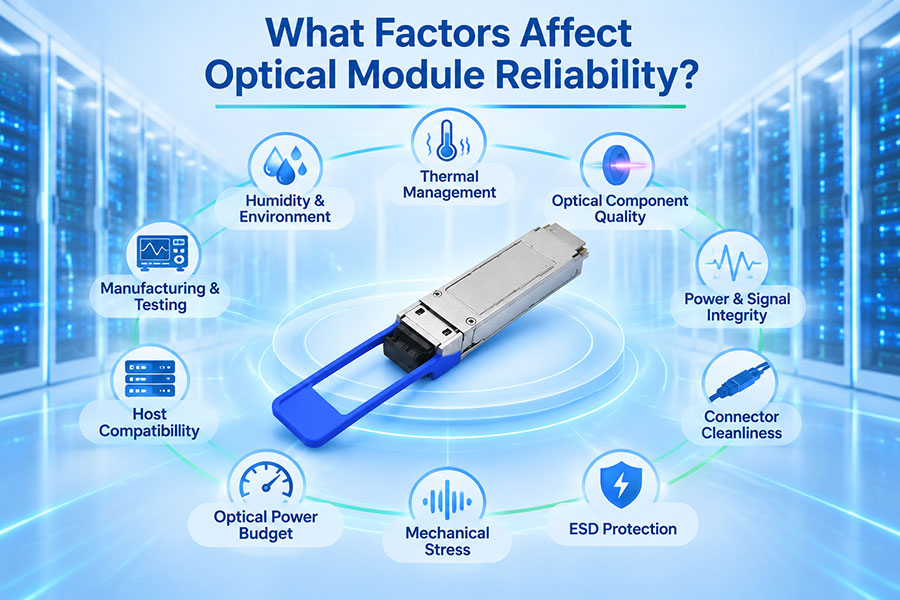
When selecting optical transceivers for backbone or data center applications, customers should evaluate data rate, transmission distance, fiber type, wavelength, optical power budget, host compatibility, and thermal requirements. Coherent modules also require compatibility with the target line system and supported operating modes.
10. Future Fiber Networks Will Focus on Capacity, Flexibility, and Efficiency
Global data traffic is expected to continue influencing investment in optical infrastructure. The next stage of network development will involve more than installing additional fiber. Operators will increasingly focus on improving the capacity and flexibility of existing networks while preparing for new traffic patterns.
Higher-speed optical interfaces: 400G and 800G deployments will continue to support high-capacity data center and transport networks, while 1.6T technology will expand the available bandwidth per interface.
Greater use of coherent optics: Coherent transmission will remain important for high-capacity metropolitan, regional, and long-distance networks.
Expanded DWDM deployment: Wavelength multiplexing will help operators improve fiber utilization and increase capacity along existing routes.
AI-driven infrastructure investment: Distributed AI computing and cloud services will create additional requirements for connections between data centers and network hubs.
More efficient optical systems: Power consumption, cooling, and energy per bit will become increasingly important as network capacity and port density rise.
Automated network management: Monitoring, optical performance analytics, and software-controlled network configuration will help operators manage increasingly complex fiber infrastructure.
These developments point toward optical networks that are not only faster but also more adaptable, easier to scale, and more efficient to operate.
11. Conclusion
Rising global data traffic is accelerating investment in high-capacity fiber networks across telecommunications, cloud computing, data centers, and international connectivity infrastructure. Fixed broadband growth, mobile traffic expansion, AI computing, and global content distribution are increasing the need for reliable and scalable optical transmission.
400G, 800G, and 1.6T optical interfaces provide higher bandwidth per connection, while DWDM and coherent transmission technologies help operators increase capacity across existing fiber routes and long-distance networks. Submarine cables and terrestrial backbone infrastructure also remain essential for supporting international data exchange.
As traffic requirements continue to evolve, successful network expansion will depend on a combination of fiber availability, optical performance, equipment compatibility, power efficiency, and intelligent network planning.
For 400G, 800G, 1.6T, DWDM, and coherent optical connectivity requirements, Contact C-LIGHT for product information, technical support, and customized optical networking solutions.
 >

 >
 >
 >
 >
 >
 >
 >