TEL:+86 132 6656 7067





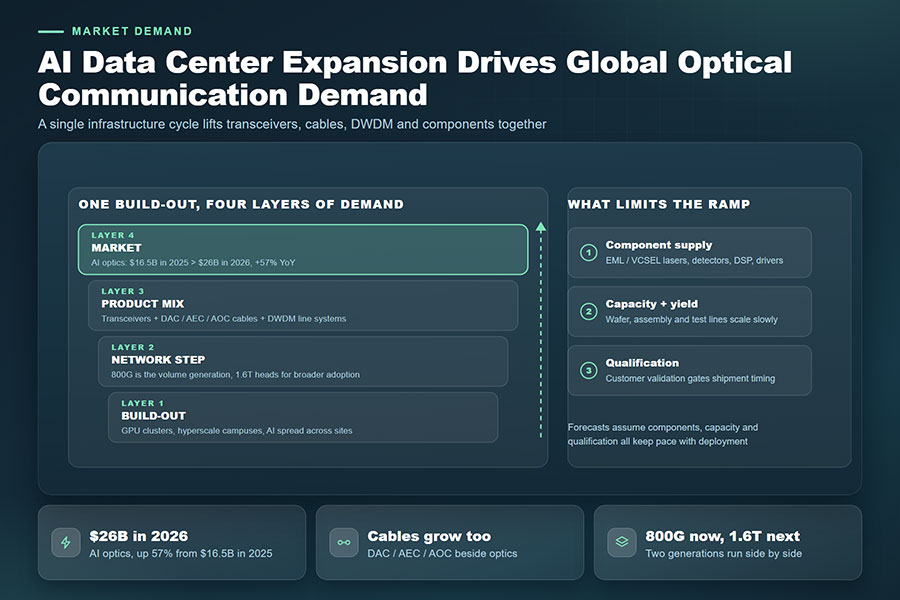
Artificial intelligence infrastructure is entering a new phase of network expansion. Large GPU clusters, distributed training systems, and increasingly complex AI workloads are placing greater demands on data center switching capacity and optical connectivity. As 800G networks continue to expand, the industry is preparing for the next bandwidth generation: 1.6T optical modules.
The transition to 1.6T is driven by more than the need for faster individual connections. AI data centers must move larger volumes of information between GPUs, servers, switches, and storage systems while managing power consumption, port density, signal integrity, and cooling requirements. Higher-capacity optical interfaces can help increase network bandwidth without requiring a proportional increase in physical port counts.
With 200G-per-lane signaling, advanced PAM4 modulation, improved DSP technology, and new optical packaging designs, 1.6T transceivers are becoming an important part of next-generation data center roadmaps. However, adoption depends on the readiness of switch platforms, optical components, manufacturing capacity, and customer qualification processes.
1. AI Infrastructure Creates New Demand for 1.6T Optical Modules
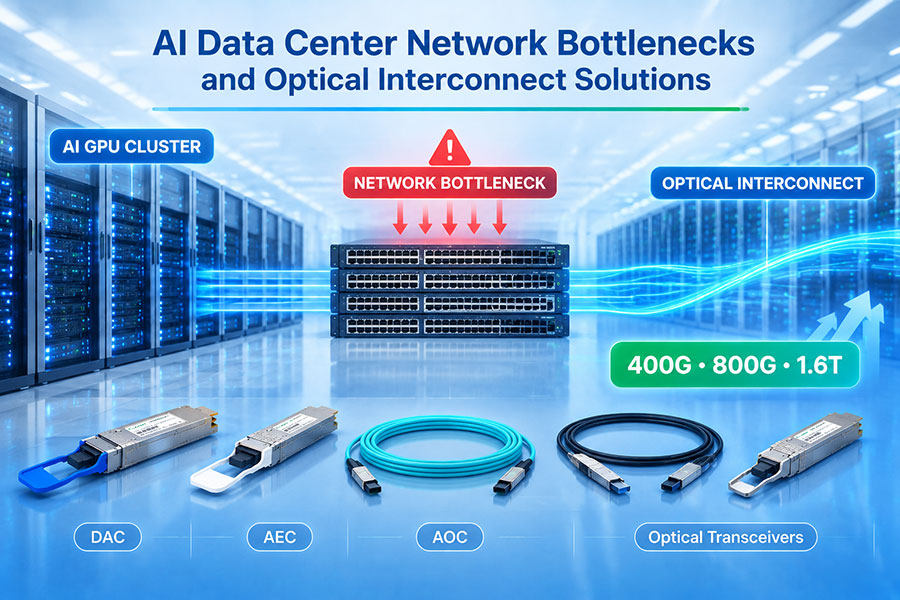
AI training and inference systems generate substantial traffic between computing resources. Distributed GPU clusters exchange model parameters, gradients, intermediate results, and other information across high-speed network fabrics. As clusters expand across multiple racks, the network must provide sufficient bandwidth to prevent communication from becoming a bottleneck.
Traditional data center architectures increasingly rely on 400G and 800G optical interfaces. These technologies provide substantial capacity, but the growth of AI infrastructure is creating demand for higher bandwidth per port and greater switching density.
Several developments are accelerating interest in 1.6T optical connectivity:
Larger GPU clusters: More accelerators create greater aggregate communication demand across the network.
Higher switch capacity: New switching platforms require faster interfaces to support increasing aggregate throughput.
Distributed AI training: Frequent synchronization and collective communication operations increase east-west network traffic.
Higher bandwidth density: More capacity per optical port can reduce the number of physical connections required for a given aggregate bandwidth.
Network scalability: Higher-speed interfaces provide additional capacity for expanding AI data center fabrics.
Power efficiency: The industry is seeking to improve energy consumption per transmitted bit as network bandwidth increases.
2. From 400G and 800G to 1.6T Network Architecture
The transition to 1.6T follows several generations of increasing data center interface capacity. Each generation raises the amount of information that can be transferred through an individual network connection.
Moving from 800G to 1.6T doubles the aggregate interface bandwidth. For large switching systems, this can increase the capacity available per port and support higher-density network architectures.
| Optical Generation | Aggregate Data Rate | Representative Lane Architecture | Development Focus |
|---|---|---|---|
| 400G | 400 Gb/s | 8 × 50G or other supported configurations | High-speed data center connectivity |
| 800G | 800 Gb/s | 8 × 100G or 4 × 200G | High-density AI and cloud networking |
| 1.6T | 1.6 Tb/s | 8 × 200G in common architectures | Next-generation switch and optical interfaces |
| 3.2T | 3.2 Tb/s | Future higher-speed lane architectures | Further increases in bandwidth density |
The move from 800G to 1.6T is not simply a matter of doubling the number of optical components. It requires improvements in electrical signaling, optical modulation, DSP performance, packaging, thermal management, and host interface design.
For network operators, the transition also involves infrastructure planning. Switches, network interface cards, optical modules, fiber cabling, and monitoring systems must all support the intended data rate and configuration.
3. 200G-per-Lane Signaling Enables 1.6T Connectivity
One of the most important technologies behind 1.6T optical modules is 200G-per-lane signaling. Common 1.6T architectures use eight high-speed lanes, each operating at approximately 200 Gb/s, to achieve an aggregate bandwidth of 1.6 Tb/s.
This approach increases lane speed compared with the 100G-per-lane architecture widely used in 800G interfaces.
Higher lane rates help increase aggregate bandwidth without proportionally increasing the number of electrical and optical channels. However, they also place greater demands on signal integrity, modulation accuracy, and component performance.
| Technical Factor | 800G Generation | 1.6T Generation |
|---|---|---|
| Common Electrical Lane Rate | 100G-class | 200G-class |
| Representative Lane Count | 8 × 100G | 8 × 200G |
| Modulation | PAM4 | PAM4 |
| Signal Processing | DSP and FEC depending on module architecture | Advanced DSP and FEC implementations |
| Engineering Focus | 100G-class lane signal integrity | Higher-speed electrical and optical channel performance |
At 200G per lane, the electrical channel becomes more sensitive to insertion loss, crosstalk, reflections, and other signal impairments. The design of the switch ASIC, package, PCB, connector, and optical module must therefore be coordinated.
For this reason, 1.6T adoption depends on the complete host-to-module electrical interface, not only the optical performance of the transceiver.
4. PAM4, DSP, and FEC Support Higher-Speed Optical Transmission
Pulse Amplitude Modulation with four levels, commonly known as PAM4, is a key signaling technology for high-speed optical communication. Unlike NRZ, which represents one bit per symbol using two signal levels, PAM4 represents two bits per symbol using four amplitude levels.
This increases the amount of information carried by each symbol and helps achieve higher data rates without requiring a proportional increase in symbol frequency.
However, PAM4 also reduces the voltage separation between adjacent signal levels. As a result, high-speed links become more sensitive to noise, distortion, and channel impairments.
Several technologies help maintain transmission performance:
DSP: Digital signal processing compensates for channel impairments and supports signal recovery.
FEC: Forward error correction detects and corrects supported transmission errors.
SerDes: Serializer/deserializer circuitry manages high-speed electrical data transmission between chips and interfaces.
Equalization: Signal conditioning helps compensate for frequency-dependent channel loss.
High-speed drivers and TIAs: Electronic components support optical transmit and receive functions.
In a 1.6T module, these components must operate at higher lane rates while meeting the power and thermal limits of the host platform. Their combined performance influences link reliability, error rates, and overall system efficiency.
5. OSFP Form Factor Supports High-Density 1.6T Deployment
Form factor design is another important part of the transition. A high-speed optical module must provide sufficient electrical connections, optical interfaces, mechanical stability, and thermal performance within the available system space.
OSFP is an important form factor in high-capacity data center networking. Its mechanical design and thermal provisions make it suitable for high-power optical applications, subject to the specific host implementation.
For 1.6T applications, OSFP-based designs are being developed to accommodate higher electrical lane rates and more demanding optical engine requirements.
Important design considerations include:
Electrical interface and lane mapping.
Optical connector configuration.
Transmitter and receiver architecture.
Module power consumption.
Heat dissipation and airflow requirements.
Host cage and mechanical compatibility.
Management interface and diagnostic functions.
OSFP-RHS is one approach to high-density thermal design. RHS stands for Reduced Height Sink and refers to a reduced-height heatsink structure intended for specific host cooling arrangements. It may support integration with compatible cooling systems, but actual cold-plate compatibility must be verified against the module and host platform specifications.
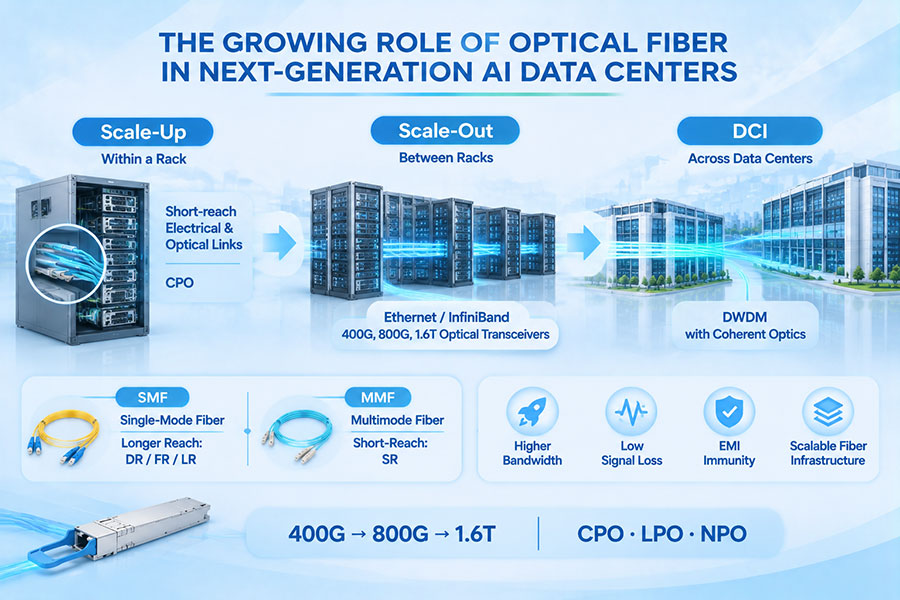
6. 1.6T Optical Module Configurations Address Different Distances
Not all AI data center connections require the same optical reach. Links between nearby switches may use short-reach multimode or single-mode interfaces, while connections across equipment rows or larger data center spaces may require longer-reach single-mode solutions.
Different optical configurations allow network designers to select a suitable combination of fiber type, connector arrangement, wavelength, and transmission distance.
| Optical Configuration | Fiber Type | Typical Application | Design Consideration |
|---|---|---|---|
| 1.6T SR8 | Multimode fiber | Short-distance data center connections | Multimode fiber grade and parallel optical interface |
| 1.6T DR8 | Single-mode fiber | High-density switch and rack connectivity | Parallel single-mode transmission and fiber management |
| 1.6T 2DR4 | Single-mode fiber | High-capacity short-reach links | Dual 800G optical interface architecture |
| 1.6T 2×FR4 | Single-mode fiber | Longer data center connections | Wavelength multiplexing and duplex fiber connectivity |
These configuration names describe different optical architectures, not interchangeable products. Actual reach depends on the specific module specification, optical budget, fiber characteristics, connector losses, and host implementation.
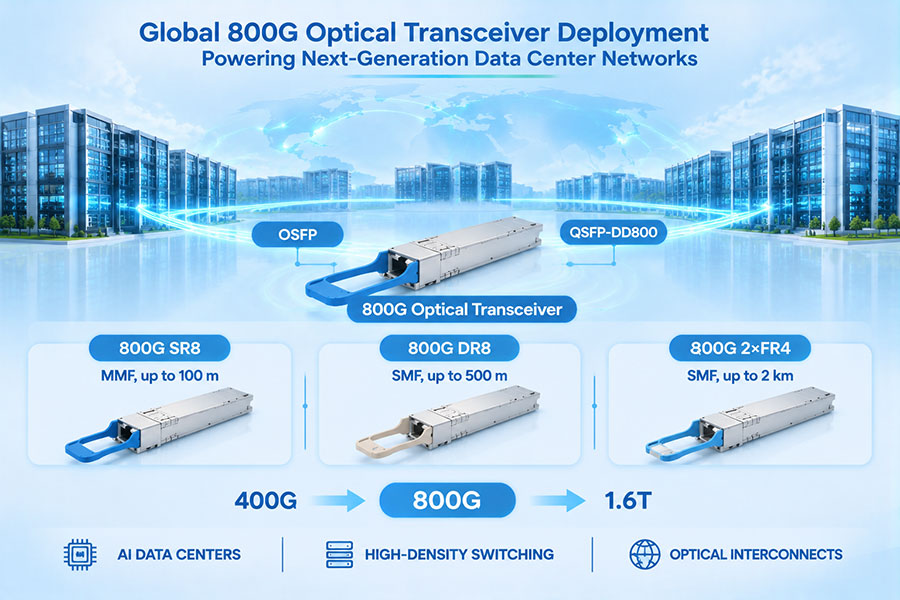
For example, C-LIGHT lists a 1.6T OSFP-RHS 2DR4 configuration supporting up to 500 m over single-mode fiber, while its 2×FR4 configuration supports up to 2 km. These are product-specific specifications rather than universal reach limits for all 1.6T modules.
7. Higher Bandwidth Density Improves AI Network Scalability
AI data centers require large numbers of high-speed connections between GPU servers, leaf switches, spine switches, and other network resources. As the number of accelerators increases, the total number of network ports and optical connections can become substantial.
Increasing bandwidth per port can help reduce the number of interfaces required to provide a given aggregate network capacity.
For example, a simplified bandwidth calculation illustrates the difference:
| Number of Ports | 800G Aggregate Capacity | 1.6T Aggregate Capacity |
|---|---|---|
| 16 | 12.8 Tb/s | 25.6 Tb/s |
| 32 | 25.6 Tb/s | 51.2 Tb/s |
| 64 | 51.2 Tb/s | 102.4 Tb/s |
| 128 | 102.4 Tb/s | 204.8 Tb/s |
These figures represent theoretical aggregate interface capacity, not guaranteed application throughput. Actual network performance depends on switching capacity, traffic distribution, oversubscription, protocol overhead, and link utilization.
Higher bandwidth per port can also reduce the number of physical interfaces needed for some network designs. This may simplify cabling and port planning, although the final result depends on switch architecture and the distribution of traffic across the network.
8. Power Consumption and Thermal Management Become More Important
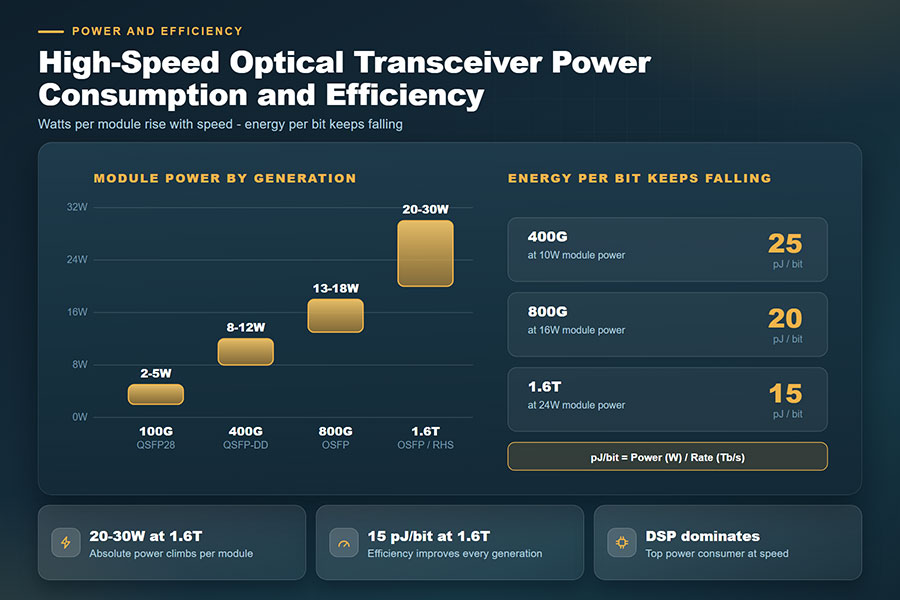
Higher data rates create additional power and thermal challenges. A 1.6T optical module contains high-speed electrical and optical components that must operate within defined power and temperature limits.
When thousands of optical connections are deployed across a large AI data center, even small differences in power consumption per port can influence the overall energy budget.
Several factors affect 1.6T module power and thermal performance:
DSP complexity: High-speed signal processing can contribute significantly to module power consumption.
Optical engine design: Laser, modulator, and receiver architectures influence electrical and optical efficiency.
Electrical channel quality: Host signal integrity affects the amount of equalization and processing required.
Thermal resistance: Package and heatsink design determine how effectively heat is transferred away from components.
Cooling architecture: Airflow and liquid-cooling solutions must match the actual module and host design.
Port density: Higher numbers of high-speed modules increase the thermal load within switches and racks.
OSFP-RHS designs address specific mechanical and thermal integration requirements through a reduced-height heatsink structure. However, an RHS module should not automatically be considered compatible with every liquid-cooling system. The host cage, cold plate, contact arrangement, and module thermal specifications must be checked together.
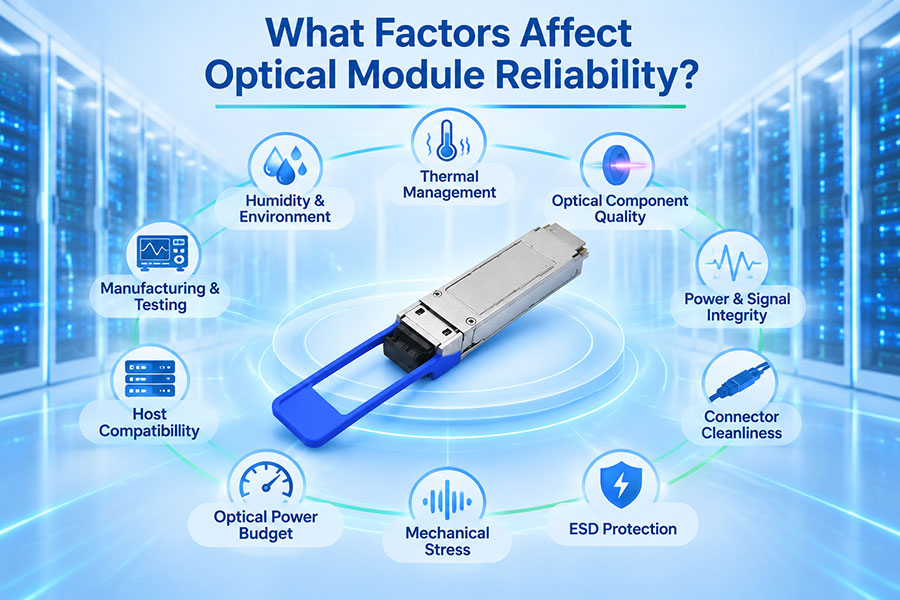
9. Optical Module Reliability and Interoperability Are Critical
Higher bandwidth does not remove the need for rigorous optical and electrical validation. In fact, the increased complexity of 1.6T interfaces makes compatibility testing even more important.
A module must operate correctly with the host switch, electrical interface, firmware, management system, fiber infrastructure, and cooling environment.
| Validation Area | Test Parameters | Purpose |
|---|---|---|
| Optical Performance | Transmit power, receiver sensitivity, wavelength, and optical budget | Confirms optical transmission performance |
| Electrical Performance | Lane rate, signal integrity, and electrical interface characteristics | Verifies host-to-module communication |
| BER and FEC | Pre-FEC and post-FEC error performance where applicable | Evaluates link reliability |
| Thermal Performance | Operating temperature, power consumption, and thermal behavior | Confirms operation within host cooling limits |
| Management Interface | CMIS, module identification, diagnostics, and alarms | Supports system monitoring and maintenance |
| Interoperability | Switch, NIC, HCA, firmware, and platform testing | Confirms practical deployment compatibility |
Physical insertion into an OSFP cage does not guarantee compatibility. The module must also match the host's electrical lane configuration, supported protocol, management implementation, thermal design, and optical interface.
For large AI networks, validation should include representative operating conditions and sustained data transmission rather than relying exclusively on basic module identification or initial link establishment.
10. The Transition From 800G to 1.6T Will Be Gradual
Although 1.6T is attracting significant industry attention, 800G will remain important during the transition. Data center operators must consider equipment availability, qualification cycles, network topology, power budgets, and the operational lifetime of existing infrastructure.
Different customers will adopt 1.6T according to their switch upgrade schedules and bandwidth requirements. Some high-density AI deployments may introduce 1.6T earlier, while other facilities may continue expanding 800G networks.
The transition can be divided into several practical stages:
Infrastructure evaluation: Operators assess the bandwidth requirements of future AI workloads and the capabilities of existing network platforms.
Platform qualification: Switches, optical modules, and high-speed electrical interfaces undergo compatibility testing.
Initial deployment: Selected network layers or new AI clusters introduce 1.6T connectivity.
Capacity expansion: Additional 1.6T links are deployed as equipment availability and workload requirements increase.
Mixed-generation operation: 400G, 800G, and 1.6T interfaces coexist across different network segments.
Marvell's March 2026 announcement of its 1.6T DSP platform highlighted the commercial development of 200G-per-lane optical connectivity and reported volume shipments to customers. This is evidence of supply-chain progress, but it does not mean that every 1.6T module design or network platform has reached the same level of commercial maturity.
For operators, the most practical migration strategy is to qualify new technology alongside existing infrastructure and deploy it where the bandwidth and system benefits justify the investment.
11. 1.6T Optical Modules and the Future of AI Data Center Connectivity
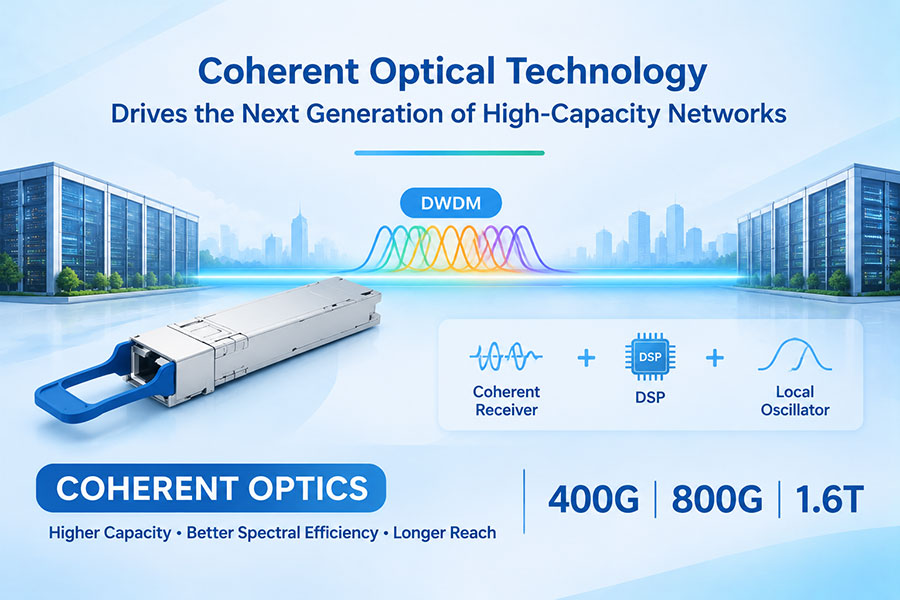
The development of 1.6T is part of a broader transformation in optical communication. As network capacity continues to increase, the industry is evaluating technologies that can improve bandwidth density while managing power, packaging, and thermal limitations.
Several technology directions are closely connected to the 1.6T transition:
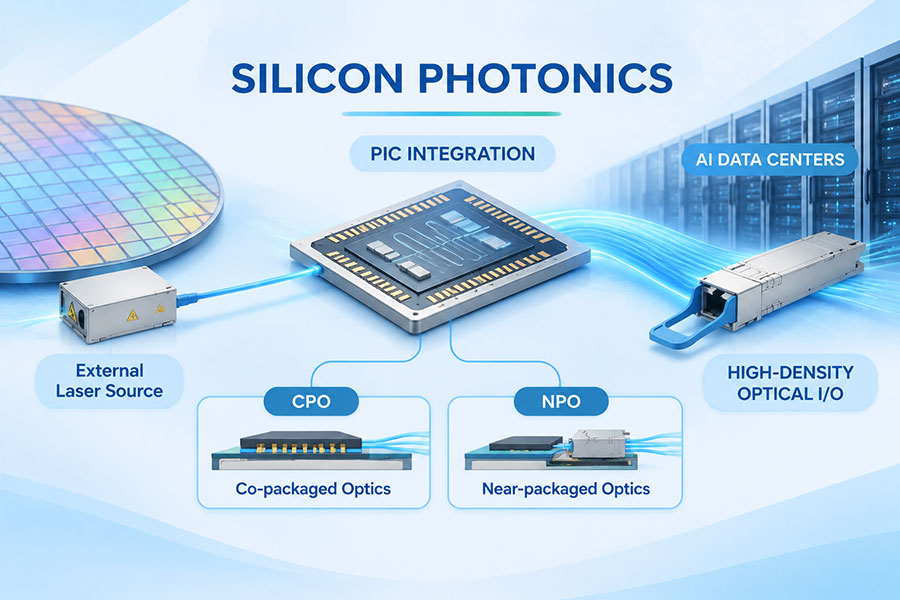
Silicon photonics: Supports higher levels of optical integration and compact multi-channel designs.
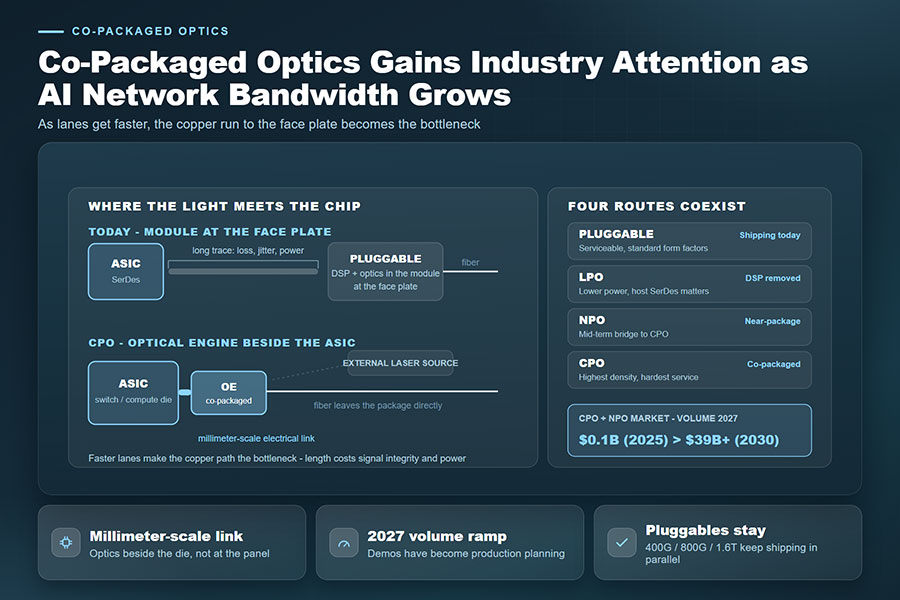
Linear and retimed optics: Provides different approaches to signal processing and power efficiency.
NPO: Places optical engines closer to switching silicon while retaining some physical separation.
CPO: Integrates optical engines more closely with switch ASIC packages.
Advanced DSP: Supports higher lane rates and improved link performance.
High-density fiber connectivity: Helps manage the growing number of optical channels in AI facilities.
Future 3.2T architectures: Continue the industry's development toward higher aggregate bandwidth and faster lane signaling.
These technologies do not all serve the same purpose. Pluggable 1.6T modules offer a familiar deployment model, while NPO and CPO address more tightly integrated optical architectures. The choice will depend on application distance, power requirements, serviceability, host design, and manufacturing maturity.
As AI infrastructure expands, optical networking will increasingly become a system-level design consideration involving processors, switching silicon, photonic components, fiber connectivity, and cooling technologies.
12. C-LIGHT 1.6T Optical Transceiver Solutions
C-LIGHT provides high-speed optical transceiver solutions for data centers, AI infrastructure, hyperscale networks, and high-performance computing applications. Its 1.6T OSFP-RHS product family is designed for next-generation high-bandwidth optical connectivity.
C-LIGHT 1.6T OSFP-RHS 2DR4 Optical Transceiver – Supports 1.6 Tb/s aggregate bandwidth using an 8 × 200G PAM4 architecture. The listed configuration supports up to 500 m over single-mode fiber with dual MPO-12 connectors.
C-LIGHT 1.6T OSFP-RHS 2×FR4 Optical Transceiver – Provides a 1.6T optical interface for longer data center connections, supporting up to 2 km over single-mode fiber with dual LC/APC connectors.
C-LIGHT 800G OSFP Optical Transceiver – Supports different optical configurations, including VR8, SR8, DR8, and 2×FR4, for current high-bandwidth data center networks.
C-LIGHT 800G AEC Cable – Provides active electrical connectivity for compatible short-distance high-speed network connections.
C-LIGHT 800G AOC Cable – Integrates optical transmission into a cable assembly for compatible high-speed server and switch connections.
C-LIGHT DAC, AEC, ACC, and AOC Solutions – Offers different electrical and optical cabling options for data center connectivity.
The 1.6T OSFP-RHS product family uses integrated DSP and FEC technology and an 8-channel 200G PAM4 architecture. Its reduced-height heatsink design is intended for compatible high-density thermal environments.
For customers evaluating a transition from 800G to 1.6T, the selection process should consider the target switch platform, host electrical interface, supported protocol, optical reach, fiber type, connector configuration, power consumption, and cooling requirements.
Product-specific compatibility and operating conditions should be confirmed against the applicable datasheet and host equipment before deployment.
13. Conclusion
Rising AI infrastructure demand is accelerating the development and commercial adoption of 1.6T optical modules. Larger GPU clusters, higher switching capacity, and increasing data movement requirements are creating demand for greater bandwidth density across data center networks.
With 200G-per-lane signaling, PAM4 modulation, advanced DSP, and improved optical packaging, 1.6T transceivers provide a new capacity level for next-generation AI connectivity. At the same time, higher lane speeds introduce additional challenges involving signal integrity, thermal management, interoperability, and manufacturing reliability.
The transition from 800G to 1.6T will take place gradually as switch platforms, optical components, and customer networks become ready. Both generations will continue to coexist, supporting different deployment requirements across AI data centers and hyperscale infrastructure.
As the industry advances toward 1.6T and future higher-speed optical interfaces, high-performance optical modules will remain an important part of scalable AI networking. C-LIGHT continues to provide high-speed optical transceiver and cable solutions for evolving data center connectivity requirements.
For 1.6T OSFP-RHS, 800G optical transceivers, and high-speed data center connectivity solutions, Contact C-LIGHT for product information, technical support, and customized connectivity requirements.
 >

 >
 >
 >
 >
 >
 >
 >