TEL:+86 132 6656 7067





Investment in AI data centers, hyperscale cloud facilities, and high-performance computing infrastructure is reshaping the optical communication manufacturing industry. As network architectures transition from 400G to 800G and 1.6T connectivity, optical transceiver manufacturers are expanding production capacity, upgrading manufacturing equipment, and strengthening relationships with upstream component suppliers.
This expansion involves more than adding assembly lines. High-speed optical modules require increasingly sophisticated laser technology, optical alignment, digital signal processing, packaging, thermal management, and automated testing. Manufacturers must scale these capabilities together to meet customer qualification requirements and maintain consistent product quality.
The result is a broader investment cycle across the optical communication supply chain, covering optical chips, passive components, module assembly, testing equipment, and global manufacturing facilities.
1. AI Data Center Investment Drives Optical Transceiver Capacity Expansion
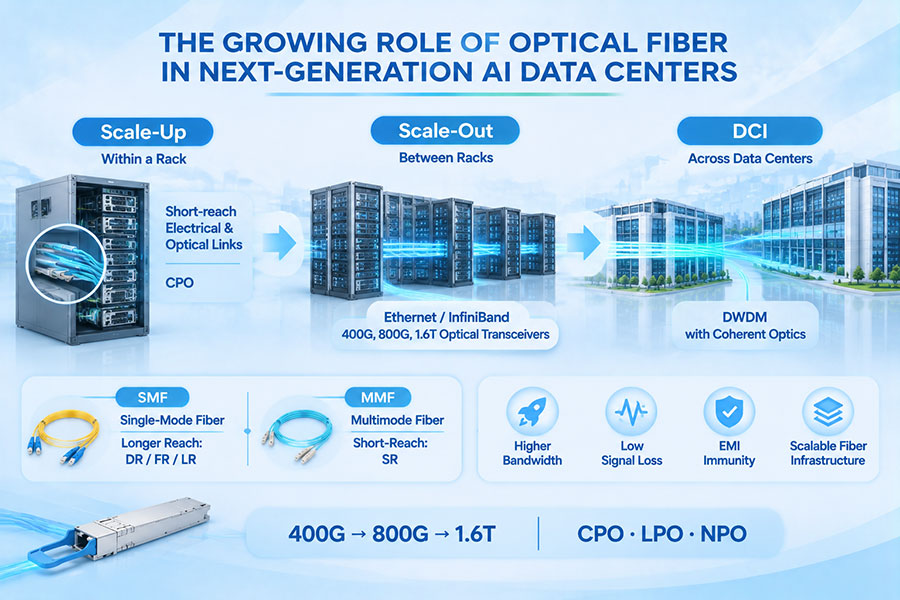
AI data centers require high-bandwidth connections between GPUs, accelerators, switches, storage systems, and other network infrastructure. As computing clusters grow, the number of high-speed optical links increases, creating additional demand for optical transceivers and active optical connectivity products.
Unlike traditional enterprise networks, large AI infrastructure projects can deploy substantial quantities of high-speed optical modules within relatively concentrated installation periods. Network operators must therefore secure production capacity that can support both initial equipment deployment and subsequent expansion.
Several factors are driving manufacturers to increase investment:
Expanding AI computing clusters: Larger GPU deployments require more high-bandwidth connections between servers and network switches.
Higher port speeds: The transition to 800G and 1.6T increases demand for advanced optical module designs.
Hyperscale construction: New data center facilities create demand for large-volume optical connectivity procurement.
Network architecture upgrades: Changes in Ethernet, InfiniBand, and DCI infrastructure create additional product requirements.
Long-term supply planning: Large customers increasingly need predictable production schedules and qualified manufacturing capacity.
For optical manufacturers, the opportunity is not limited to higher shipment volumes. It also includes the development of new products, manufacturing processes, and supply capabilities for next-generation data center networks.
2. The Transition From 400G to 800G and 1.6T Changes Manufacturing Requirements
Optical transceiver production is becoming more technically demanding as data rates increase. Higher-speed modules require advanced electrical interfaces, faster optical components, more sophisticated signal processing, and tighter control of manufacturing tolerances.
400G products established the foundation for large-scale high-speed optical deployment. The expansion of 800G is increasing manufacturing requirements further, while 1.6T introduces additional challenges in signal integrity, thermal design, optical integration, and final testing.
| Generation | Manufacturing Focus | Key Production Requirements |
|---|---|---|
| 400G | Large-scale high-speed module production | PAM4 signal processing, optical alignment, automated testing |
| 800G | Higher production density and precision | Advanced DSP, high-speed optical components, thermal control |
| 1.6T | Next-generation high-bandwidth manufacturing | 200G-per-lane technologies, advanced packaging, tighter electrical and optical validation |
| Future 3.2T | Further integration and manufacturing development | Advanced photonic integration, optical engines, and new packaging approaches |
The transition between generations does not mean that older products immediately disappear. Data centers continue to operate mixed-speed networks, and manufacturers often need to maintain production capability across multiple product generations.
Consequently, capacity planning must account for both current high-volume products and emerging technologies that are moving through customer qualification.
3. Optical Transceiver Production Capacity Is More Than Assembly Volume
A manufacturing facility's nominal production capacity does not necessarily represent the number of fully qualified modules it can deliver. Optical transceiver production includes several interconnected processes, each of which can constrain final output.
Typical manufacturing stages include:
Component preparation: Optical chips, DSPs, drivers, TIAs, connectors, and other electronic or optical components are prepared for assembly.
Optical subassembly: Laser, photodetector, and optical components are integrated into transmitter and receiver assemblies.
Optical alignment: Precision positioning is used to achieve the required optical coupling performance.
Module assembly: Optical and electronic subassemblies are integrated into the final transceiver package.
Firmware and calibration: Control functions, diagnostics, and operating parameters are configured and validated.
Final testing: Modules undergo electrical, optical, environmental, and reliability-related tests according to their specifications.
Increasing the number of assembly stations alone cannot guarantee a corresponding increase in qualified shipments. If optical alignment, component supply, calibration, or final testing becomes a bottleneck, completed output may remain below the facility's theoretical capacity.
4. Upstream Component Supply Becomes a Critical Capacity Constraint
As optical transceiver demand increases, manufacturers need reliable access to specialized components. Some optical and electronic components require advanced fabrication processes, long qualification cycles, or highly specialized production equipment.
Important upstream components include:
EML laser chips: Used in optical transmitters for supported high-speed applications.
Continuous-wave lasers: Provide optical sources for architectures that use external or integrated light sources.
Photodetectors: Convert received optical signals into electrical signals.
DSP chips: Perform signal processing, compensation, and other functions in supported module architectures.
Driver and TIA components: Support optical transmitter and receiver electrical interfaces.
Optical passive components: Include lenses, filters, isolators, multiplexers, and other optical elements.
Shortages in any critical component category can delay module production even when downstream assembly facilities have available capacity. This is particularly important for 800G and 1.6T products, where component specifications and performance requirements may differ from earlier generations.
Manufacturers are therefore strengthening supplier relationships, qualifying alternative sources where possible, and planning component procurement further in advance. Long-term supply agreements can improve visibility, although they do not eliminate manufacturing or logistics risks.
5. Automation and Precision Manufacturing Improve Production Scalability
High-speed optical transceivers require precise assembly and repeatable optical performance. As production volumes increase, manufacturers are investing in automation to reduce process variation and improve manufacturing consistency.
Automation can be applied to several stages:
Automated optical alignment: Helps position optical components with repeatable precision.
Automated assembly: Supports consistent handling and integration of module components.
Laser welding and bonding: Provides controlled joining processes for suitable optical and mechanical structures.
Automated calibration: Helps configure module operating parameters and diagnostic functions.
Production data collection: Tracks process conditions and test results across manufacturing batches.
Automated optical testing: Improves testing throughput and supports more consistent measurement procedures.
Automation is particularly valuable when a manufacturer needs to increase output without allowing defect rates or product variation to rise. However, production automation must be adapted to the specific module design. A process suitable for one optical package may not transfer directly to another.
6. Testing and Quality Control Become More Important at Higher Data Rates
Higher-speed optical modules operate with increasingly demanding electrical and optical performance requirements. Production testing must verify that each product meets its specified operating conditions before shipment.
Testing procedures may include:
| Test Category | Inspection Focus | Manufacturing Purpose |
|---|---|---|
| Optical output testing | Transmit power and wavelength | Verify transmitter performance |
| Receiver testing | Receiver sensitivity and overload characteristics | Validate signal detection performance |
| High-speed signal testing | Eye diagrams, modulation quality, and BER | Evaluate data transmission performance |
| Electrical testing | Host interface and power characteristics | Verify electrical compatibility and operating behavior |
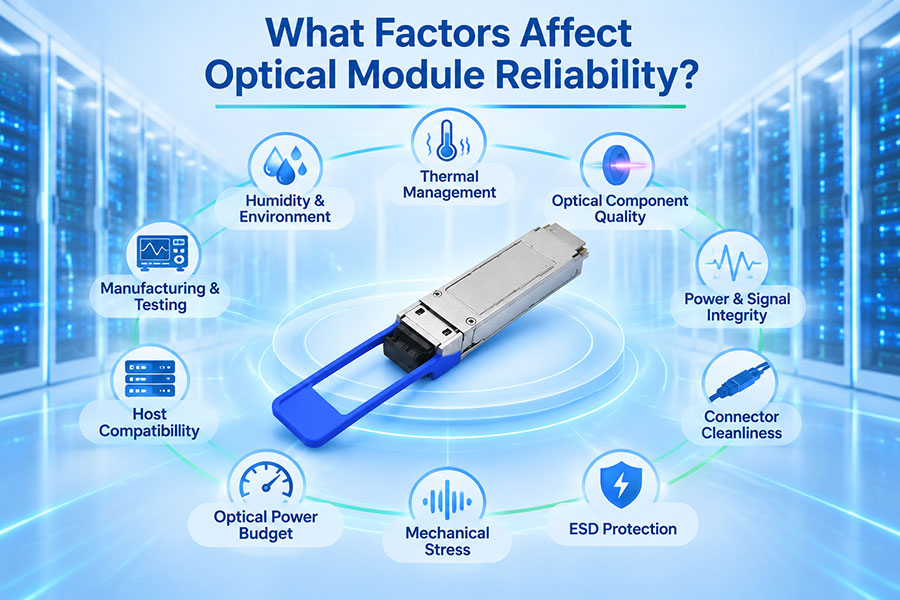
| Thermal testing | Operating temperature and power dissipation | Confirm thermal performance within specified conditions |
| Environmental testing | Temperature cycling and other specified conditions | Assess product stability and reliability |
| Firmware and diagnostics | Management interface and monitoring functions | Validate module control and reporting |
Testing capacity must expand alongside assembly capacity. High-speed test equipment can represent a significant investment, and test time per unit may vary between product generations and configurations.
Manufacturers that integrate process monitoring, automated testing, and traceable production records are better positioned to manage quality as output increases.
7. Global Manufacturing Expansion Strengthens Supply Flexibility
Optical transceiver manufacturers are evaluating production locations based on customer requirements, component availability, labor capabilities, logistics, infrastructure, and regional manufacturing strategies.
Expanding manufacturing operations across multiple regions can provide several advantages:
Production flexibility: Multiple facilities can provide additional options for allocating manufacturing workloads.
Regional customer support: Local operations may improve coordination with customers and equipment qualification teams.
Supply chain resilience: Geographically distributed production can reduce reliance on a single manufacturing location.
Market access: Regional facilities may help manufacturers respond to different procurement and delivery requirements.
Technology development: New facilities can incorporate updated production equipment and manufacturing processes.
However, global expansion also creates challenges. Manufacturing locations must maintain consistent quality standards, component traceability, process documentation, and engineering coordination. Moving production between facilities may require additional qualification and customer approval.
For this reason, geographic diversification is most effective when supported by standardized manufacturing procedures and coordinated quality management.
8. The Role of Silicon Photonics, LPO, and Advanced Packaging
Manufacturing investment is not limited to conventional DSP-based optical transceivers. Several technology directions are changing how future optical modules may be designed and produced.
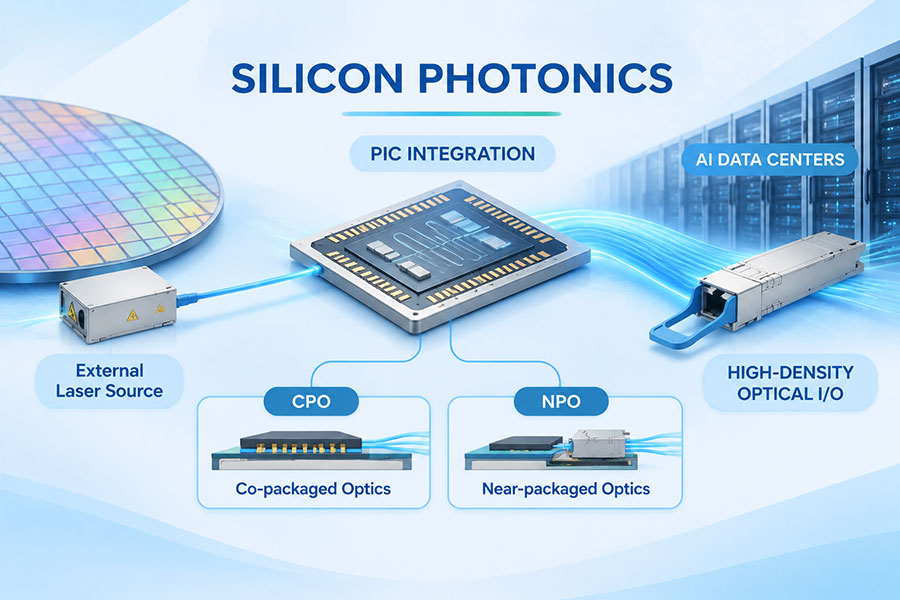
Silicon photonics integrates optical functions into photonic integrated circuits, potentially enabling compact optical architectures and different manufacturing approaches. Its adoption requires specialized photonic fabrication, packaging, optical coupling, and testing capabilities.
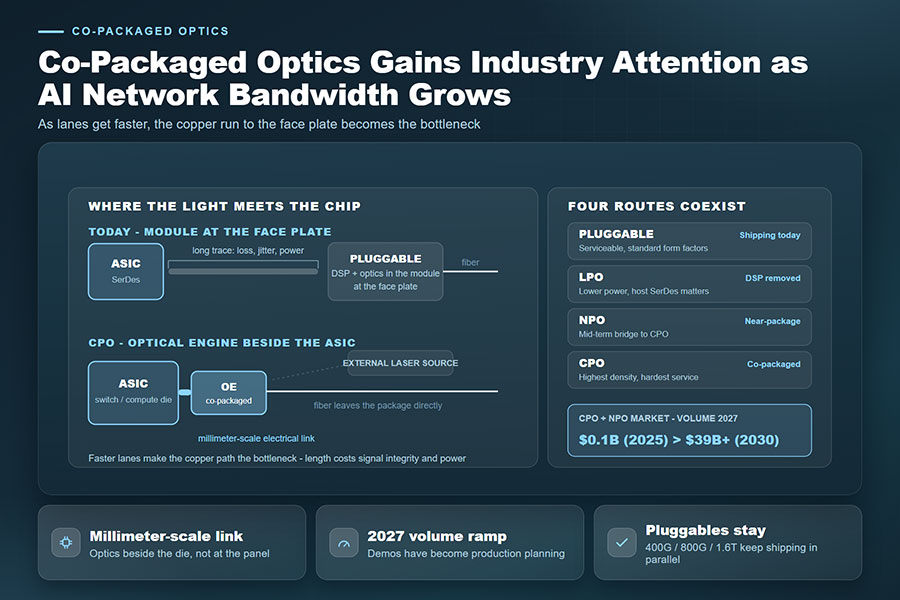
Linear-drive pluggable optics (LPO) reduces or removes certain DSP functions from the module signal path in supported architectures. This can change module power consumption and electrical design requirements, but it also places greater emphasis on host-side signal quality and system-level interoperability.
Advanced packaging brings optical and electronic components closer together. Technologies associated with optical engines, near-packaged optics, and co-packaged optics require additional expertise in thermal management, optical coupling, assembly, and system validation.
These technologies do not replace every existing optical transceiver design. Conventional pluggable modules remain important, while new architectures will develop according to application requirements, ecosystem readiness, and manufacturing economics.
9. Why 800G and 1.6T Capacity Expansion Requires Different Planning
Although 800G and 1.6T products share parts of the high-speed optical manufacturing ecosystem, they do not necessarily use identical components, assembly processes, or qualification procedures.
800G production is already an important part of current AI data center infrastructure expansion. 1.6T manufacturing introduces additional requirements associated with higher aggregate bandwidth and next-generation optical and electrical interfaces.
| Manufacturing Area | 800G Production | 1.6T Production |
|---|---|---|
| Product maturity | Established across multiple product categories | Developing through customer qualification and production ramp-up |
| Optical components | High-speed laser and receiver technologies | Advanced components and model-specific optical architectures |
| Signal processing | 800G-class DSP and electrical interfaces | Higher-bandwidth DSP and 200G-per-lane technology in relevant designs |
| Thermal management | Important for dense module deployment | Increasingly demanding at higher power and port density |
| Testing | High-volume automated optical and electrical testing | Additional validation for new interface and performance requirements |
| Capacity strategy | Volume expansion and process optimization | New product introduction and scalable production development |
Manufacturers must balance the need for near-term 800G volume with investment in 1.6T production readiness. Equipment flexibility, process compatibility, and product-specific testing requirements all influence how quickly new capacity can be brought online.
10. Data Center Investment Changes Optical Transceiver Procurement Strategies
Large data center operators increasingly view optical connectivity as a strategic part of infrastructure planning. Delays in optical module delivery can affect network commissioning and the deployment schedules of computing facilities.
Procurement strategies are therefore evolving beyond short-term price negotiations. Buyers may evaluate manufacturers according to several factors:
Production capability: Whether the supplier can support the required order volume and delivery schedule.
Product qualification: Whether modules have been validated for the intended network equipment and application.
Supply chain stability: Whether key components can be secured consistently.
Quality consistency: Whether manufacturing processes and test results remain stable across batches.
Product roadmap: Whether the supplier can support future 800G, 1.6T, and related connectivity requirements.
Technical support: Whether the supplier can assist with compatibility, diagnostics, and deployment issues.
Long-term procurement agreements and demand forecasts can help manufacturers plan capacity investments. At the same time, customers need to avoid relying exclusively on announced production figures without checking actual product qualification, delivery performance, and available supply.
11. Market Outlook: Capacity Investment Extends Beyond 2026
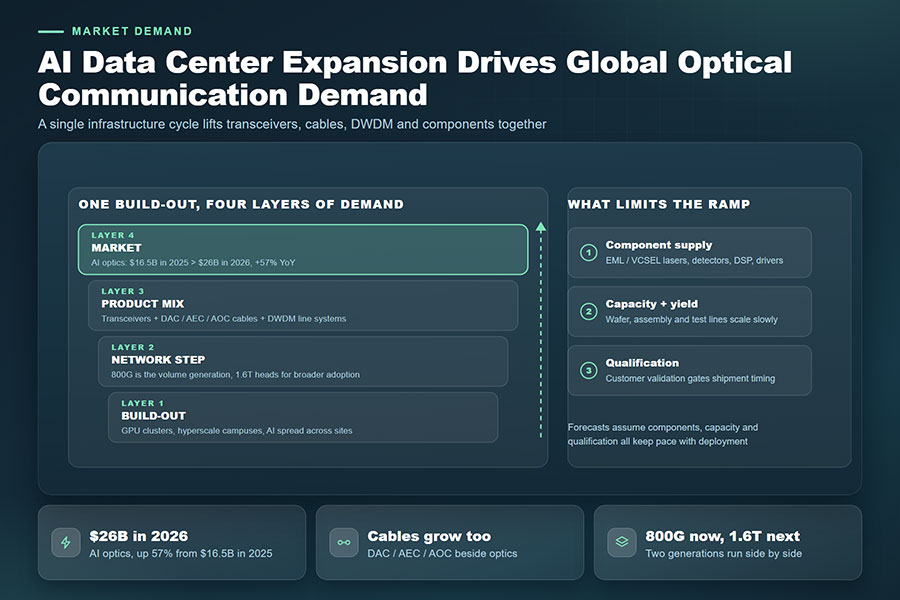
Industry research indicates that AI-related optical transceiver demand is growing rapidly. TrendForce projected that the global AI optical transceiver market would increase from approximately US$16.5 billion in 2025 to US$26 billion in 2026. Its analysis also identified tight supplies of key optoelectronic components and precision manufacturing constraints as important factors affecting capacity expansion.
These market developments suggest that manufacturers will continue investing in several areas:
Additional production lines for 800G and 1.6T optical modules.
Expanded laser and photonic component supply.
More automated optical alignment and testing equipment.
Advanced packaging and silicon photonics manufacturing capabilities.
Regional manufacturing facilities and supply chain diversification.
Engineering resources for new product development and customer qualification.
However, market growth forecasts should not be interpreted as guaranteed production or shipment volumes for individual manufacturers. Actual output depends on customer orders, component availability, yield rates, qualification progress, and the timing of new facility ramp-ups.
12. C-LIGHT High-Speed Optical Transceiver Product Portfolio
As data center investment increases demand for high-speed connectivity, product coverage across multiple data rates and form factors becomes important. C-LIGHT provides optical transceiver solutions for data centers, AI infrastructure, high-performance computing, Ethernet networks, and optical transport applications.
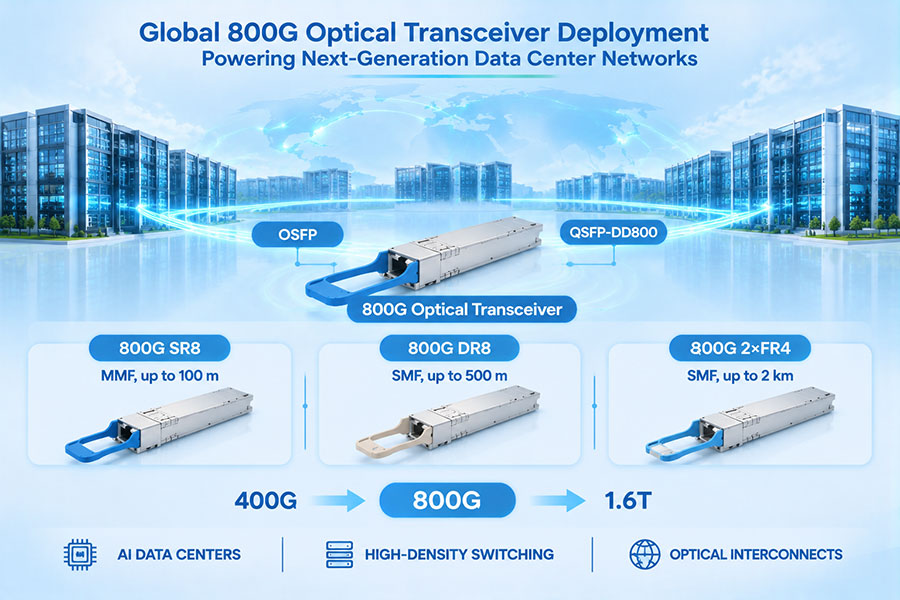
C-LIGHT's 800G OSFP portfolio includes multiple optical configurations, such as VR8, SR8, DR8, and 2×FR4. Listed transmission distances include 50m, 100m, 500m, and 2km, depending on the specific model. The product range supports high-bandwidth applications in AI clusters, hyperscale data centers, and high-performance computing networks.
Product details: C-LIGHT 800G OSFP Optical Transceivers
C-LIGHT 800G QSFP-DD modules provide another form-factor option for compatible high-speed switching platforms. The portfolio covers SR8, DR8, and FR4 configurations for different transmission distances and fiber architectures.
Product details: C-LIGHT 800G QSFP-DD Optical Transceivers
C-LIGHT's 1.6T OSFP-RHS product family addresses next-generation high-bandwidth network platforms. Listed configurations include 2×800G optical architectures, with model-specific DR4 and FR4 options. These products are relevant to network operators preparing for higher-capacity AI data center infrastructure.
Product details: C-LIGHT 1.6T OSFP-RHS Optical Transceivers
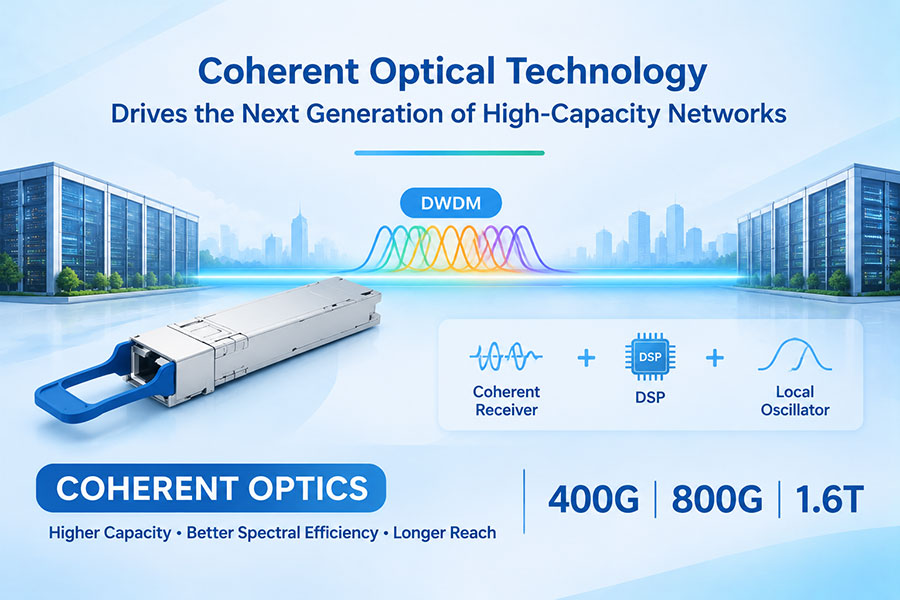
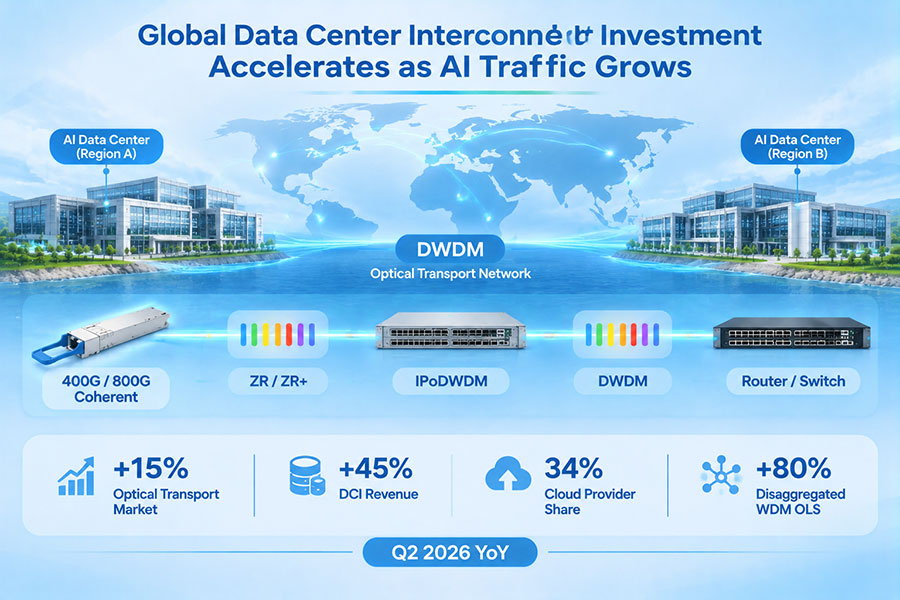
C-LIGHT's DWDM DCO portfolio includes coherent optical transceiver options for high-capacity data center interconnect and optical transport applications. The product family covers multiple data rates and form factors, supporting different network reach and transmission requirements according to the selected model.
Product details: C-LIGHT DWDM DCO Coherent Transceivers
Product availability, production lead times, and technical specifications should be confirmed for each model and order requirement. C-LIGHT's broader portfolio can be viewed through its optical transceiver product range.
13. Conclusion
Growing investment in AI data centers and hyperscale cloud infrastructure is accelerating optical transceiver production capacity expansion. The transition to 800G and 1.6T connectivity is encouraging manufacturers to invest in new facilities, advanced optical components, automated assembly, and higher-capacity testing systems.
At the same time, production scalability depends on more than factory size. Component availability, optical alignment precision, manufacturing yield, product qualification, and supply chain coordination all influence the number of modules that can be delivered reliably.
As data center construction continues, manufacturers with flexible production systems, stable component sourcing, and strong engineering capabilities will be better positioned to support the next generation of optical networking. Capacity expansion will remain an important part of the industry's response to rising demand for high-speed data center connectivity.
C-LIGHT provides 400G, 800G, and 1.6T optical transceiver solutions for data centers, AI infrastructure, and high-performance computing networks. Contact our team for product specifications, compatibility information, and project-based supply requirements.
 >

 >
 >
 >
 >
 >
 >
 >