TEL:+86 132 6656 7067





The rapid expansion of AI computing, hyperscale data centers, and high-capacity telecommunications infrastructure is making power efficiency a major consideration in optical network design. As data rates advance from 400G and 800G toward 1.6T and beyond, network operators must deliver significantly more bandwidth while managing electricity consumption, heat dissipation, and equipment density.
Optical transceivers are an important part of this challenge. Higher-speed modules require advanced signal processing, optical components, electrical interfaces, and thermal management. At the same time, the power consumed by switch ASICs, SerDes interfaces, optical links, and cooling systems contributes to the overall energy requirements of network infrastructure.
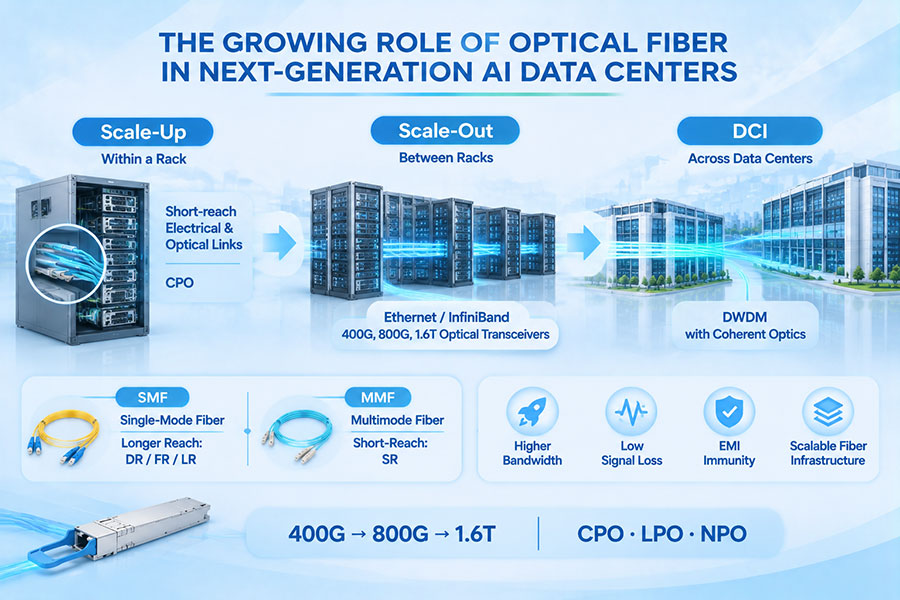
This is driving the development of more efficient optical architectures, including Linear Pluggable Optics (LPO), Linear Receive Optics (LRO), Near-Packaged Optics (NPO), and Co-Packaged Optics (CPO). Improvements in silicon photonics, laser integration, thermal design, and system-level optimization are also becoming important as optical networks move toward higher bandwidth and greater port density.
1. Power Efficiency Becomes a Critical Network Design Requirement
Traditional network upgrades often focused primarily on increasing transmission speed, port density, and total switching capacity. However, the power requirements associated with higher-speed networking are becoming more difficult to ignore, particularly in large AI data centers containing thousands of high-speed optical connections.
Every optical link contributes to the energy consumption of a network. A large deployment may contain optical transceivers connecting GPU servers, top-of-rack switches, leaf-spine switches, storage systems, and data center interconnection equipment. Even relatively small differences in module power can become significant when multiplied across thousands of ports.
Several factors are increasing the importance of optical network efficiency:
Higher transmission speeds: 800G and 1.6T optical interfaces require more advanced electrical and optical components.
Increasing port density: More high-speed connections are being installed within individual switches and server racks.
Signal processing requirements: DSP, retiming, equalization, and clock recovery contribute to module and host-system power consumption.
Thermal limitations: Higher power density increases cooling requirements and can affect equipment reliability.
Data center electricity constraints: Operators must manage network energy consumption alongside the growing power requirements of computing equipment.
Operating costs: Electricity and cooling expenses influence the long-term economics of large-scale network deployments.
As a result, network efficiency is increasingly evaluated alongside bandwidth, latency, reliability, and scalability when selecting optical interconnect technologies.
2. Optical Transceiver Power Consumption Increases With Higher Data Rates
Optical transceivers convert electrical signals into optical signals and perform the reverse conversion at the receiving end. Their power consumption depends on multiple components, including the laser, modulator, photodetector, driver, transimpedance amplifier (TIA), DSP, microcontroller, and thermal control circuitry.
In conventional high-speed pluggable transceivers, DSP functionality can account for a substantial portion of total module power. The DSP performs signal conditioning and compensation functions that help maintain transmission performance across different electrical and optical conditions.
As data rates increase, the signal processing architecture becomes more demanding. Higher-speed electrical lanes, advanced modulation formats, and stricter signal integrity requirements place additional pressure on module design and thermal management.
| Optical Module Generation | Typical Architecture | Power Efficiency Consideration |
|---|---|---|
| 400G | 4 × 100G or 8 × 50G electrical/optical lanes, depending on implementation | DSP architecture and optical reach influence total module power |
| 800G | 8 × 100G PAM4 or other supported configurations | Higher electrical bandwidth increases signal processing and thermal requirements |
| 1.6T | 8 × 200G PAM4 architecture | Higher aggregate throughput requires advanced electrical, optical, and thermal integration |
| 3.2T and Beyond | Emerging multi-lane optical interconnect architectures | Energy per bit, packaging, and system-level integration become increasingly important |
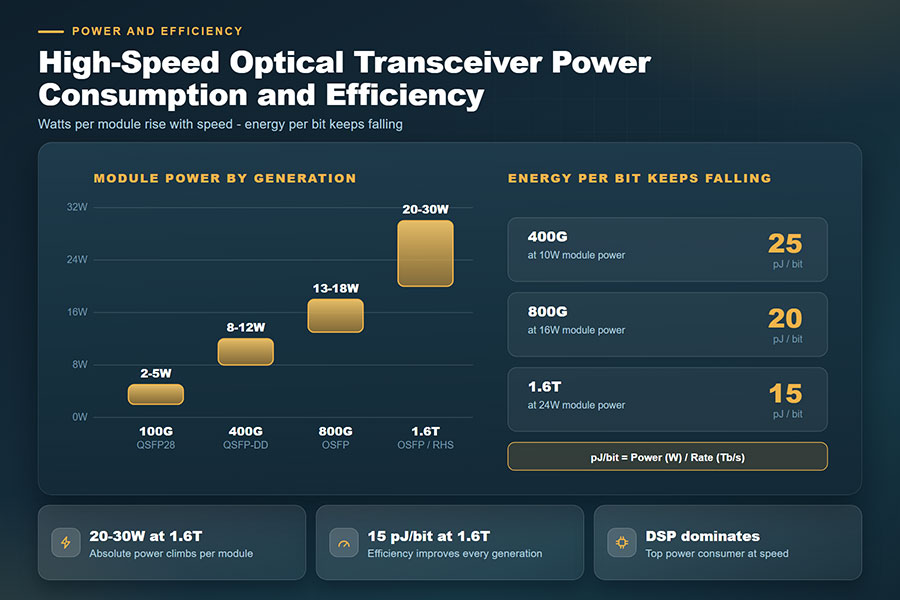
Higher data rates do not necessarily mean that energy consumption per transmitted bit must increase. A module may consume more total watts while delivering substantially more bandwidth, resulting in improved energy efficiency per bit.
Energy per bit (pJ/bit) = Module Power (W) ÷ Data Rate (Tb/s)
For example, an 800G module consuming 16W provides approximately 20 pJ/bit at the module level. A hypothetical 1.6T module consuming 25W provides approximately 15.6 pJ/bit. The second module consumes more absolute power but delivers better energy efficiency per bit.
This distinction is important when evaluating optical products. Absolute power consumption and energy efficiency are related but different measurements. Both should be considered when planning high-density optical networks.
3. DSP, LPO, and LRO Architectures Target Lower Optical Link Power
One of the main approaches to reducing optical interconnect power is changing how electrical signal processing is distributed between the switch ASIC and the optical module.
Traditional DSP-based pluggable transceivers perform substantial signal processing within the module. LPO and LRO architectures reduce or relocate selected processing functions to lower module power consumption and reduce latency.
| Architecture | Signal Processing | Potential Advantages | Engineering Considerations |
|---|---|---|---|
| DSP Pluggable | DSP-based processing inside the optical module | Signal conditioning flexibility and established interoperability models | Higher module power and additional heat generation |
| LPO | Removes module DSP and relies on linear signal paths and host-side equalization | Lower module power and reduced latency | Requires capable host ASICs and carefully controlled signal integrity |
| LRO | Uses a linear receive path while retaining selected transmit-side retiming functions | Reduces receiver-side processing requirements while retaining some signal conditioning | Requires compatible host and module interfaces |
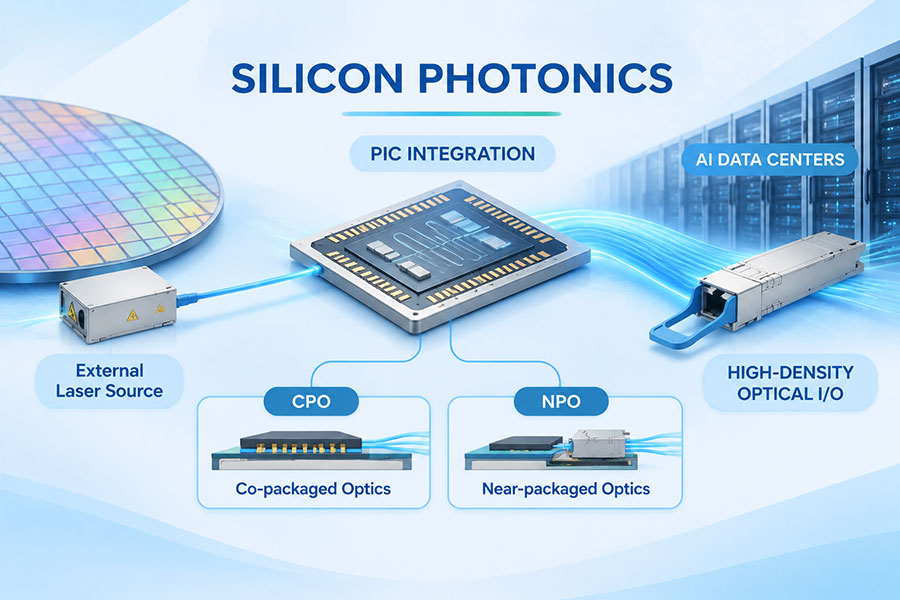
| NPO | Places optical engines closer to the host ASIC | Shorter electrical paths and improved integration potential | More complex packaging, servicing, and thermal design |
| CPO | Integrates optical engines closely with the switch or computing ASIC | Reduced electrical interconnect losses and potential improvements in energy per bit | Advanced packaging, laser management, and maintenance complexity |
LPO is particularly relevant for short-reach data center links where the host ASIC can provide the required equalization and signal recovery capabilities. Removing the module DSP can reduce power consumption and latency, but the architecture also places greater responsibility on host-side electrical design.
LRO represents an intermediate approach. By retaining selected retiming functions while simplifying the receive path, it provides a different balance between power reduction and signal integrity.
Neither architecture is suitable for every link. Transmission distance, fiber type, host SerDes performance, channel quality, and interoperability requirements must be evaluated before deployment.
4. CPO and NPO Move Optical Integration Closer to Computing Chips
As switch bandwidth increases, electrical signals must travel between the switch ASIC and optical interfaces at increasingly high data rates. Longer electrical paths can introduce insertion loss, signal degradation, and additional power requirements.
NPO and CPO address this challenge by moving optical engines closer to the host computing or switching silicon.
Near-Packaged Optics
NPO places optical engines close to the switch ASIC, typically within the same system package or a nearby packaging structure. Shortening the electrical connection can reduce signal loss and improve the efficiency of high-speed interfaces.
Because the optical engine is not necessarily integrated into the same package as the switch ASIC, NPO can offer a different balance between integration density, manufacturing complexity, and serviceability.
Co-Packaged Optics
CPO integrates optical engines much closer to the switch ASIC, often within the same advanced package or substrate assembly. This reduces the length of high-speed electrical connections between the switching silicon and optical conversion components.
By reducing electrical signal travel distance and associated SerDes requirements, CPO can improve link energy efficiency and support higher aggregate bandwidth density. It is receiving significant attention for AI scale-up networks and high-capacity data center switching systems.
However, CPO also introduces new design considerations. Laser source management, optical engine replacement, package reliability, thermal interactions, and manufacturing yield must be addressed at the system level.
These architectures are not simply replacements for all pluggable modules. Pluggable optics remain valuable for flexible deployment, front-panel servicing, and applications requiring different transmission distances. The most suitable architecture depends on the network topology and operating requirements.
5. System-Level Energy Efficiency Matters More Than Module Power Alone
Evaluating optical network efficiency requires looking beyond the power consumption of an individual transceiver. Switch ASICs, electrical SerDes, optical modules, power supplies, and cooling infrastructure all contribute to the total system energy requirement.
A 2026 study published in the Journal of Lightwave Technology examined power consumption in a 102.4 Tbps switch using DSP-based pluggable optics, LPO, and CPO architectures. Under the study's modeled assumptions, estimated total switch power was approximately 6,400W for the DSP-based design, 4,983W for LPO, and 4,093W for CPO.
| Modeled Switch Configuration | Estimated Total Power | Reduction vs. DSP Design |
|---|---|---|
| DSP-based pluggable optics | 6,400W | Baseline |
| LPO-based design | 4,983W | Approximately 22% |
| CPO-based design | 4,093W | Approximately 36% |
These figures are specific to the study's modeled system and assumptions, not universal measurements for every commercial switch. The results illustrate why power efficiency should be evaluated across the complete network system rather than by comparing optical module specifications alone.
Cooling also plays an important role. Reducing optical and electrical power can lower the amount of heat that must be removed from a switch enclosure or rack. However, actual cooling savings depend on the cooling architecture, airflow design, facility temperature, and thermal distribution.
6. Advanced Cooling Becomes Essential for High-Density Optical Networks
Higher-speed optical modules generate heat that must be managed within increasingly dense networking equipment. As 800G and 1.6T modules become more common, thermal design is becoming an important part of optical transceiver development.
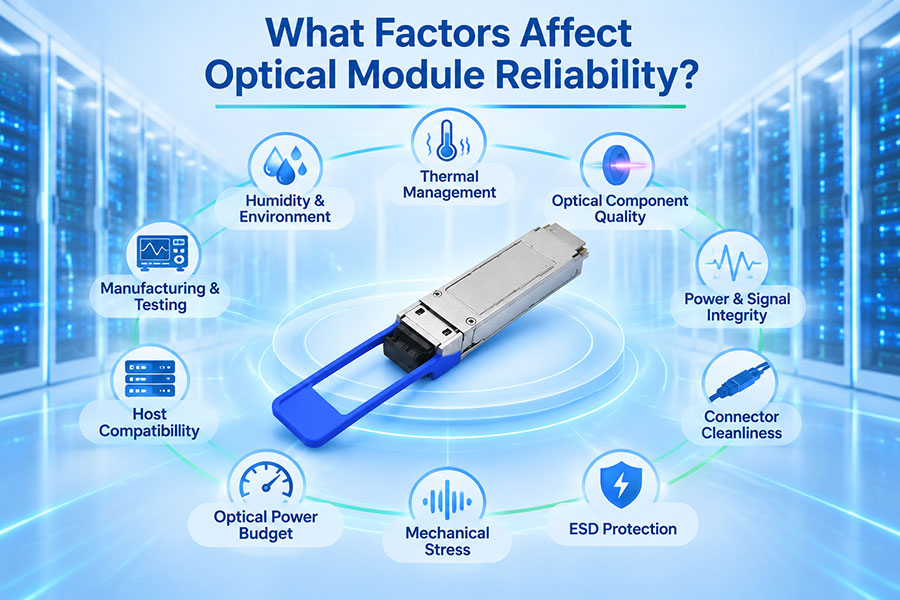
Excessive operating temperature can affect component performance, optical stability, and long-term reliability. Thermal management therefore needs to be considered alongside power consumption and transmission performance.
Improved Heat Sink Design
Heat sinks and optimized module housings help transfer heat away from internal components. Their effectiveness depends on the module structure, host cage design, airflow direction, contact surfaces, and available cooling capacity.
Airflow Optimization
High-density switches require carefully designed airflow paths to prevent localized hot spots. The arrangement of optical modules, fan performance, chassis layout, and front-to-back or back-to-front airflow all influence thermal conditions.
Liquid Cooling Integration
Liquid cooling is gaining importance in high-density AI infrastructure. Cold plates and other liquid cooling components can remove heat from selected system components more efficiently than relying entirely on conventional air cooling.
Some optical module designs are developed with thermal integration in mind. For example, reduced-height heat sink structures can support specific host-system and cold-plate configurations. However, mechanical and thermal compatibility must be verified with the actual switch platform.
It is also important to distinguish between reducing power consumption and improving heat removal. Cooling solutions help manage heat, but they do not automatically reduce the electrical power consumed by the optical module.
7. Silicon Photonics and Optical Integration Support Future Efficiency Improvements
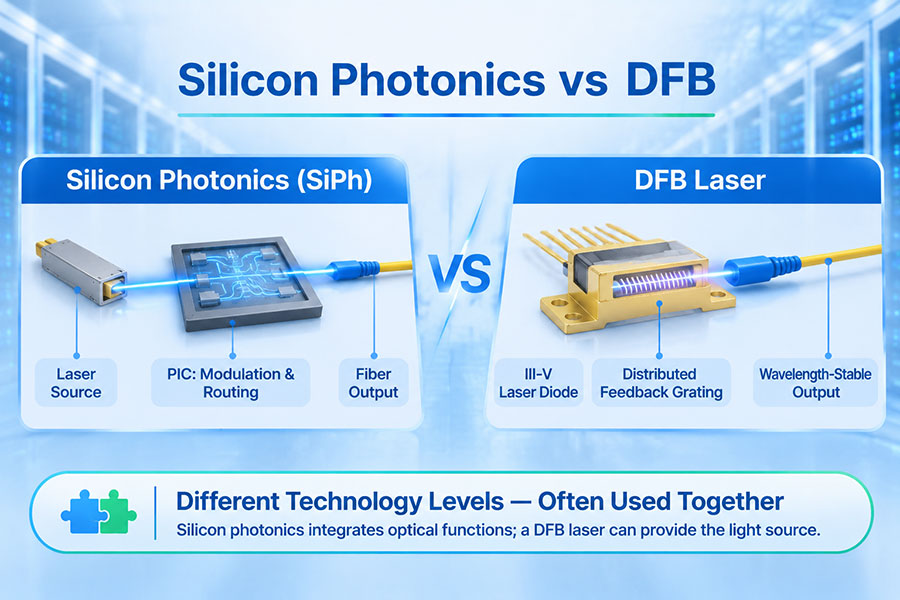
Silicon photonics is an important technology direction for increasing optical integration and supporting higher-density interconnects. It uses silicon-based photonic circuits to integrate optical functions such as modulation, waveguide routing, and signal processing interfaces.
By integrating multiple optical functions into compact photonic components, silicon photonics can support higher manufacturing integration and potentially reduce the size and power requirements of certain optical subsystems.
Its development is closely connected with several next-generation optical technologies:
Integrated photonic circuits: Combine multiple optical functions within compact photonic platforms.
External laser sources: Separate laser generation from optical engines in architectures where centralized or external laser arrangements are appropriate.
Advanced packaging: Integrate optical engines, electrical components, and switching silicon more closely.
Higher-speed modulation: Support increasing data rates through advanced optical and electrical interfaces.
Optical I/O: Bring optical connectivity closer to processors and accelerators to support high-bandwidth computing architectures.
Silicon photonics does not guarantee lower power in every implementation. Total efficiency depends on the laser source, modulator, driver, receiver, DSP requirements, packaging, and host platform. The technology's value comes from its potential for integration, scalability, and improved system-level design.
8. 800G and 1.6T Optical Transceivers Must Balance Bandwidth and Thermal Performance
The transition to 800G and 1.6T optical connectivity is increasing the importance of power and thermal optimization in AI data center networks.
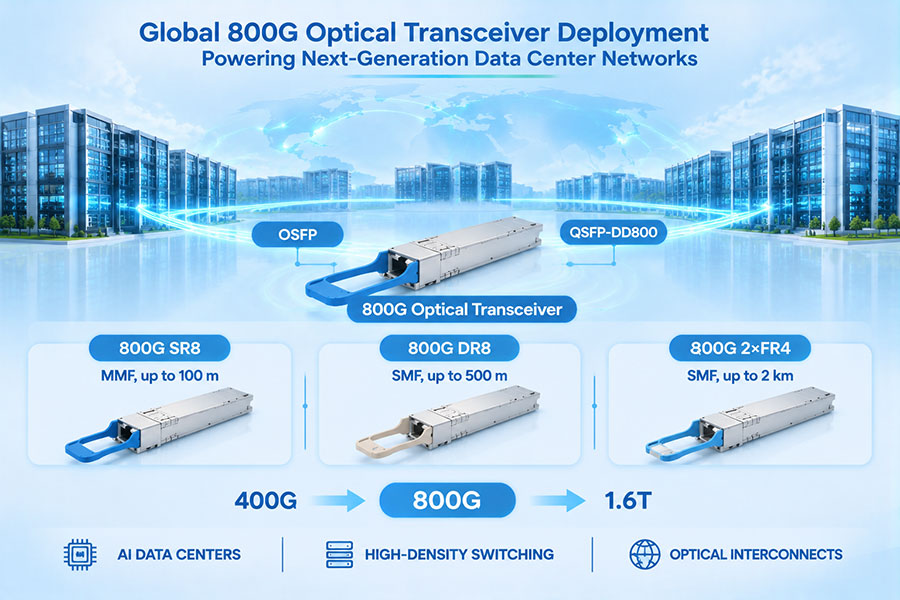
800G modules are already available in multiple configurations, including SR8, DR8, and 2×FR4. Different optical architectures have different power profiles because of their reach, transmitter technology, receiver design, DSP implementation, and packaging.
For example, C-LIGHT's 800G OSFP product family includes SR8, DR8, 2×FR4, and selected coherent configurations. Its 800G OSFP SR8 product specification lists power consumption below 16W for the referenced configuration. This figure applies to that specific product and should not be generalized to all 800G OSFP modules.
At 1.6T, the OSFP-RHS form factor introduces a reduced-height heat sink design intended for high thermal dissipation requirements. It supports integration with selected cold-plate liquid cooling systems, subject to host-platform mechanical and thermal compatibility.
As module bandwidth increases, engineers must evaluate several parameters together:
| Design Parameter | Why It Matters |
|---|---|
| Power consumption | Determines the electrical power required by each optical module |
| Energy per bit | Normalizes power against delivered data throughput |
| Operating temperature | Influences component performance and reliability |
| Optical reach | Affects transmitter, receiver, and signal processing requirements |
| DSP architecture | Influences power, latency, and signal compensation capabilities |
| Cooling compatibility | Determines whether the module can operate within the host system's thermal design |
| Host compatibility | Ensures electrical, mechanical, management, and thermal requirements are satisfied |
For network operators, the most efficient optical solution is not necessarily the module with the lowest standalone power consumption. It is the solution that meets the required transmission performance while minimizing total network energy and maintaining reliable operation.
9. C-LIGHT High-Speed Optical Products for Next-Generation Networks
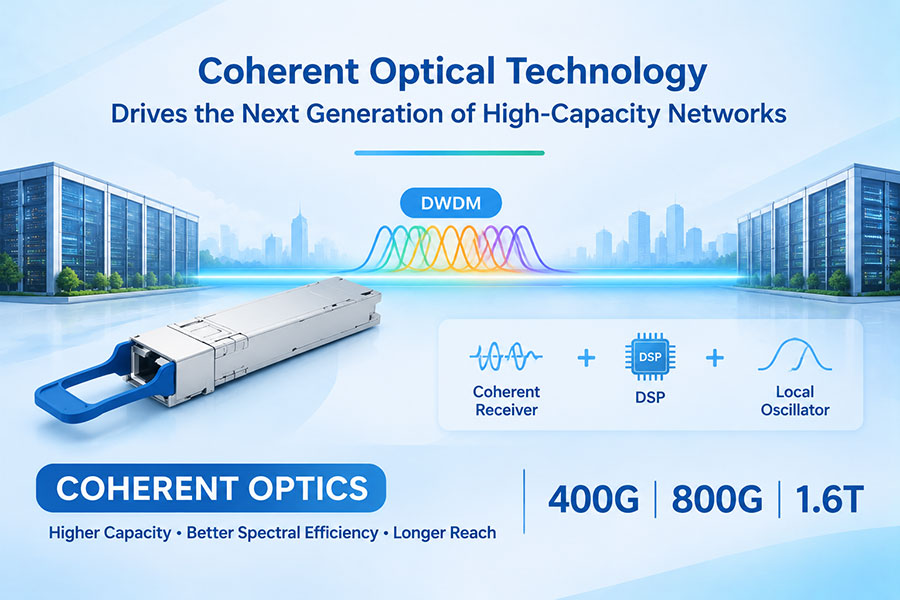
C-LIGHT provides high-speed optical transceivers for AI data centers, hyperscale networks, high-performance computing, and telecommunications infrastructure. Its product portfolio includes 800G and 1.6T optical modules, coherent transceivers, and specialized thermal designs.
800G OSFP Optical Transceivers – A range of 800G OSFP configurations including SR8, DR8, 2×FR4, and selected coherent options. The product family supports different optical reaches and network applications. Specific power and thermal characteristics should be checked against the relevant datasheet.
1.6T OSFP-RHS Optical Transceivers – High-density 1.6T optical connectivity using an 8×200G PAM4 architecture with integrated DSP and FEC. The reduced-height heat sink design supports thermal integration with compatible high-density host platforms and selected liquid cooling systems.
800G Active Optical Cables – Integrated optical connectivity for short-distance, high-bandwidth connections within data center and AI infrastructure.
800G Active Electrical Cables – High-speed electrical interconnect solutions for suitable short-reach connections in high-density networking environments.
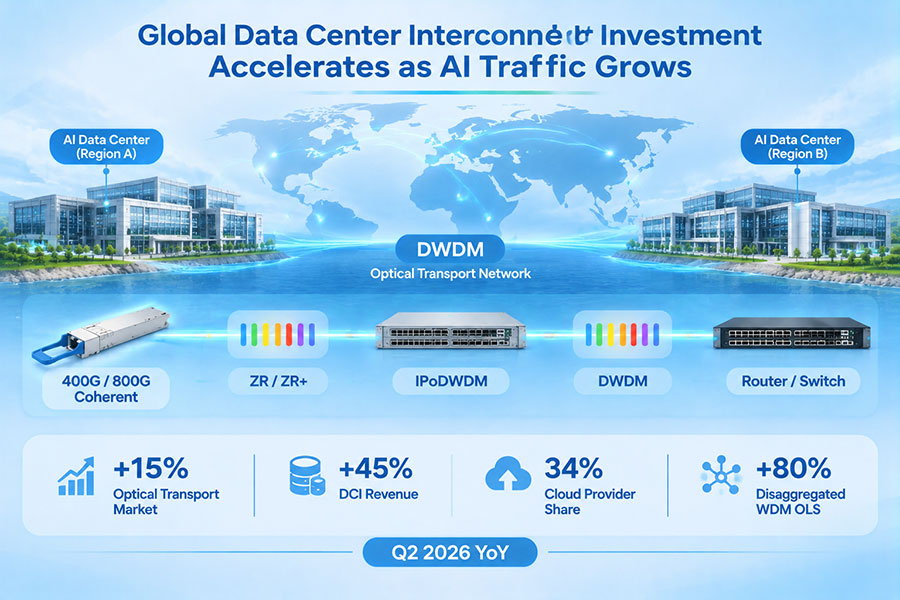
C-LIGHT Optical Transceiver Portfolio – Optical transceivers covering 1.6T, 800G, 400G, 200G, DCO, DWDM, CWDM, and other network applications.
When selecting high-speed optical products, customers should consider the complete operating environment rather than relying only on a nominal power figure. Transmission distance, optical interface, host platform, airflow, operating temperature, and cooling compatibility all influence the final deployment result.
10. Future Optical Networks Will Focus on Performance Per Watt
The next generation of optical networks will be designed around a broader set of efficiency indicators. Higher aggregate bandwidth will remain important, but operators will increasingly consider how much energy is required to deliver each bit of data across the network.
Several developments are expected to shape this transition.
More efficient pluggable optics: Improvements in DSP integration, silicon photonics, laser efficiency, and module packaging will help optimize power consumption while maintaining transmission performance.
Broader LPO and LRO adoption: Linear optical architectures may expand in suitable short-reach applications where host ASICs can provide the required signal processing and interoperability.
Growth of NPO and CPO: Bringing optical engines closer to switching and computing silicon can reduce electrical path losses and support higher bandwidth density.
Advanced thermal integration: Air cooling, cold plates, and liquid cooling will become increasingly important for managing high-density networking equipment.
System-level energy optimization: Network designers will evaluate optical modules, switch ASICs, SerDes, power supplies, and cooling systems as interconnected parts of a complete energy budget.
Higher bandwidth with improved energy efficiency: Future 1.6T and 3.2T optical platforms will need to increase aggregate throughput without allowing power consumption and thermal requirements to grow at the same rate.
These developments indicate that power efficiency is becoming a fundamental design consideration rather than a secondary specification in high-speed optical networking.
11. Conclusion
Power efficiency is becoming a major priority as optical networks evolve toward 800G, 1.6T, and higher transmission capacities. AI computing, hyperscale data centers, and high-density switching infrastructure are increasing the need for optical interconnects that deliver more bandwidth while controlling energy consumption and heat generation.
LPO, LRO, NPO, CPO, silicon photonics, and advanced thermal management represent different approaches to improving optical network efficiency. Each technology addresses specific challenges involving signal processing, electrical interconnect losses, packaging density, and cooling requirements.
For network operators, the key objective is to optimize the complete system rather than focus exclusively on individual transceiver power specifications. Evaluating energy per bit, link performance, thermal compatibility, host requirements, and long-term reliability provides a more accurate basis for selecting next-generation optical solutions.
As optical connectivity becomes increasingly important to AI infrastructure and high-capacity communication networks, efficient optical transceivers and integrated photonic technologies will play a central role in building scalable and sustainable network architectures.
For 800G, 1.6T, and other high-speed optical connectivity requirements, Contact C-LIGHT for product information, technical support, and optical module compatibility evaluation.
 >

 >
 >
 >
 >
 >
 >
 >