TEL:+86 132 6656 7067





As artificial intelligence models grow in complexity, the computing industry faces increasing pressure to improve processing throughput, energy efficiency, and data movement. Conventional electronic processors remain central to modern computing, but moving large volumes of data between memory, processors, and accelerator devices consumes significant power and creates performance constraints. These challenges have encouraged researchers to investigate a different way of processing information: using light.
Optical computing, also known as photonic computing, uses the physical properties of light to perform selected computational operations. Photons can propagate through optical waveguides, interfere with one another, and be manipulated through phase, amplitude, wavelength, and polarization. By arranging photonic components into carefully designed circuits, researchers can implement parallel mathematical operations and specialized information-processing functions.
Research in silicon photonics, optical neural networks, integrated modulators, and photonic signal processing is opening new possibilities for future computing architectures. Although optical computing is not expected to replace general-purpose electronic processors in the near term, it may become an important accelerator technology for AI, scientific computing, signal processing, and other data-intensive applications.
1. What Is Optical Computing?
Optical computing is a computing approach that uses photons and optical components to perform information-processing operations. Instead of relying exclusively on electronic currents moving through semiconductor logic circuits, optical systems manipulate light signals to represent and process data.
Depending on the architecture, optical computing can use interference, diffraction, wavelength multiplexing, optical modulation, and photodetection to implement specific computational functions.
Common photonic components include:
Optical waveguides: Guide light through integrated photonic circuits and connect different processing elements.
Optical modulators: Encode information onto an optical carrier by changing its amplitude, phase, or other properties.
Mach–Zehnder interferometers: Split, manipulate, and recombine optical signals to implement programmable transformations.
Microring resonators: Provide wavelength-selective filtering, routing, and processing functions in compact photonic circuits.
Photodetectors: Convert optical signals into electrical signals for measurement or subsequent electronic processing.
Optical amplifiers and lasers: Supply or amplify optical signals within suitable system architectures.
Optical computing is a broad research field rather than a single processor design. Some systems perform analog mathematical operations directly in the optical domain, while others combine photonic processing with electronic control, memory, and digital computation.
2. Why Researchers Are Exploring Light-Based Computing
Electronic processors have benefited from decades of semiconductor scaling and architectural improvements. However, the increasing complexity of AI workloads has made data movement, power consumption, and interconnect bandwidth important constraints alongside raw processing capability.
Photonic systems offer several physical characteristics that make them attractive for selected computing tasks.
| Photonic Characteristic | Potential Computing Benefit | Engineering Consideration |
|---|---|---|
| High optical bandwidth | Supports high-speed information transfer and parallel signal processing | Modulator, detector, and electronic interface bandwidth must also be sufficient |
| Wavelength multiplexing | Allows multiple optical channels to share a waveguide or optical path | Requires wavelength control, filtering, and channel management |
| Optical interference | Enables matrix transformations and other analog computational operations | Phase stability and calibration affect computational accuracy |
| Low-latency propagation | Can support fast signal processing in suitable architectures | Total system latency includes conversion, control, and electronic processing |
| Photonic integration | Combines optical functions on compact chips | Fabrication tolerances, optical losses, and thermal behavior influence scalability |
These properties do not mean that every optical processor will automatically outperform an electronic processor. The actual advantage depends on the computational operation, data representation, optical-to-electrical conversion requirements, and the complete system architecture.
3. How Optical Computing Processes Information
Optical computing architectures encode information into light and use photonic components to transform that information. The exact process varies, but many systems follow a sequence involving data encoding, optical processing, detection, and output interpretation.
Optical Data Encoding
Input data is converted into optical signals through modulators or other electro-optic devices. Information may be represented through optical amplitude, phase, wavelength, polarization, or spatial distribution.
Photonic Signal Processing
Once encoded, light travels through optical components that perform the intended transformation. Interference networks, waveguide structures, resonators, and diffractive elements can manipulate the optical field according to the circuit design.
Optical Detection and Output
Photodetectors convert the resulting optical signals into electrical measurements. Electronic circuits can then perform further calculations, apply nonlinear functions, store intermediate results, or pass the output to another computing stage.
This hybrid structure is important because many practical optical computing systems still depend on electronic components for data preparation, control, memory, and final processing.
4. Optical Neural Networks and AI Acceleration
One of the most active areas of optical computing research is the photonic neural network. AI models frequently perform large numbers of matrix multiplications and multiply-accumulate operations. These operations are computationally intensive and appear throughout neural network inference and training workloads.
Photonic circuits can implement selected linear transformations through optical interference and parallel signal propagation. This makes them attractive candidates for specialized AI accelerators.
Several architectures are under investigation:
Mach–Zehnder interferometer networks: Use interconnected interferometers to implement programmable matrix transformations through controlled optical phase shifts.
Microring resonator networks: Use wavelength-selective resonant structures to support filtering, weighting, and parallel optical processing.
Diffractive optical neural networks: Use light propagation and diffraction through structured optical elements to perform transformations on spatial information.
Wavelength-division multiplexed photonic networks: Use multiple wavelengths to increase parallelism and computational throughput within integrated optical systems.
Photonic reservoir computing: Uses the dynamics of optical systems to process time-dependent signals and support tasks such as classification and signal prediction.
These architectures have different strengths. Interferometer networks offer programmable transformations, while diffractive systems can exploit spatial optical processing. Wavelength-multiplexed systems use multiple spectral channels to increase the amount of information processed in parallel.
For AI applications, the objective is not necessarily to execute every part of a neural network optically. A more practical approach may assign computationally intensive linear operations to photonic hardware while using electronic processors for nonlinear functions, memory access, model control, and other operations.
5. Silicon Photonics Makes Integrated Optical Computing More Practical
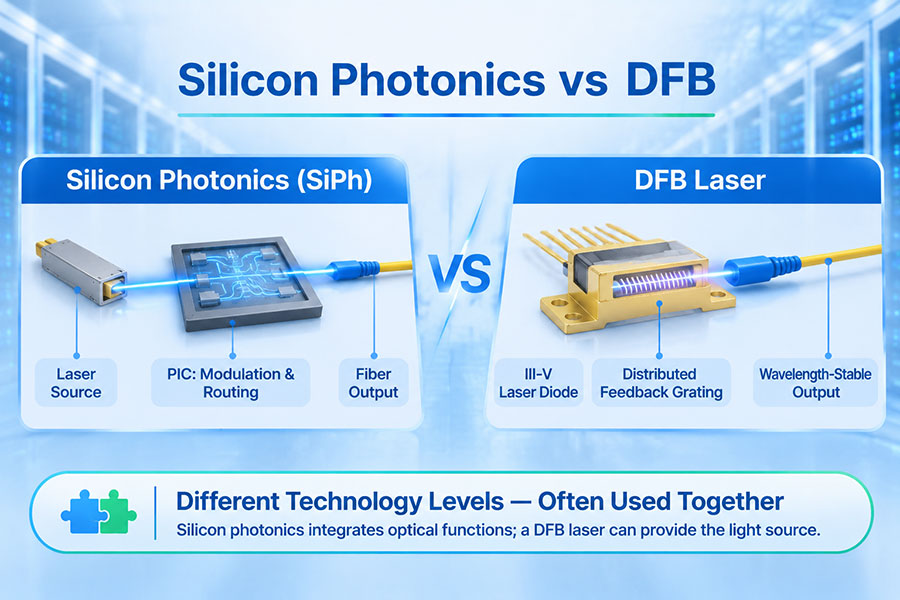
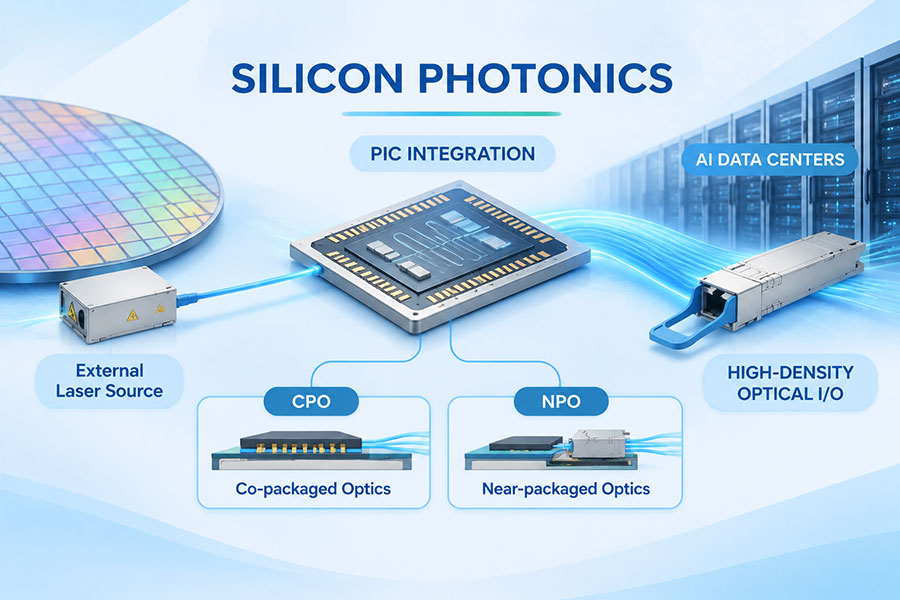
Silicon photonics is a major enabling technology for integrated optical computing. It uses semiconductor fabrication techniques to manufacture optical components and waveguides on silicon-based platforms. This approach can support compact photonic circuits and potentially enable more repeatable, scalable manufacturing.
Silicon photonic integration can combine multiple optical functions on a single chip, reducing the need for separate optical components and complex external connections.
Important building blocks include:
| Component | Function | Role in Integrated Photonics |
|---|---|---|
| Waveguide | Guides optical signals | Connects optical processing elements |
| Modulator | Changes optical signal properties | Encodes data and controls optical fields |
| Photodetector | Converts light into electrical current | Reads processed optical information |
| Microring resonator | Provides wavelength-selective response | Supports filtering and optical weighting |
| Phase shifter | Controls optical phase | Enables programmable interference |
| Laser source | Generates optical signals | Supplies light to the photonic circuit |
Silicon photonics is also relevant to optical communication, where integrated optical components support high-speed data transmission. However, a photonic computing chip and an optical transceiver are different devices. A computing chip performs selected information-processing operations, while a transceiver converts electrical data into optical signals and converts received light back into electrical data for communication.
6. Optical Computing Research: Recent Technical Directions
Recent research has moved beyond demonstrating individual photonic components toward investigating complete optical processing systems. Researchers are studying how optical neural networks can become more programmable, compact, stable, and suitable for practical workloads.
Several developments illustrate the direction of the field.
Integrated optical neural networks: Research published in 2026 has demonstrated silicon photonic neural network systems integrating multiple processing stages, including convolutional and fully connected layers with optoelectronic nonlinear activation.
Compact nanophotonic accelerators: Inverse-designed photonic structures are being investigated to increase computational density and reduce the physical footprint of optical processing devices.
Scalable photonic network architectures: Research is exploring spatial, temporal, and spectral scaling strategies to increase the computational capacity of photonic neural networks.
Optical signal equalization: Silicon photonic reservoir computing has been experimentally investigated for real-time processing of optical fiber communication impairments.
Hybrid photonic-electronic processing: Researchers are developing architectures that combine optical parallelism with electronic control and computation to address practical system requirements.
These developments show that optical computing is progressing across several research areas. However, experimental demonstrations on benchmark datasets or specific signals do not automatically establish commercial readiness for large-scale general-purpose computing.
7. Optical Computing vs. Electronic Computing
Optical and electronic computing use different physical mechanisms to process information. Electronic processors rely on semiconductor transistors and electrical signals, while optical computing architectures use light propagation and photonic components for selected operations.
The two approaches are more likely to complement each other than to compete as direct replacements across every computing application.
| Evaluation Factor | Electronic Computing | Optical Computing |
|---|---|---|
| Signal medium | Electrical signals | Optical signals |
| Core components | Transistors, logic gates, memory circuits | Waveguides, modulators, resonators, photodetectors |
| Computational approach | Digital logic and numerical processing | Optical analog processing, photonic transformations, or hybrid processing |
| Parallel processing | Supported by processor cores, vector units, and parallel architectures | Can exploit wavelength, spatial, and interference-based parallelism |
| Memory ecosystem | Mature semiconductor memory technologies | Often relies on electronic memory and control systems |
| Precision | High digital precision is widely available | Analog optical precision is affected by noise, drift, and component variation |
| Commercial maturity | Widely deployed across general-purpose computing | Specialized research and emerging application-specific deployments |
Electronic processors remain more versatile for general-purpose logic, memory management, and precise digital computation. Optical systems may provide advantages for selected high-throughput operations, particularly where large numbers of parallel linear transformations are required.
8. The Main Technical Challenges Facing Optical Computing
Despite its potential, optical computing still faces significant engineering challenges. Moving from a laboratory demonstration to a reliable commercial platform requires more than increasing optical processing speed. The complete system must provide sufficient precision, stability, programmability, manufacturability, and energy efficiency.
Optical-to-Electrical Conversion
Many practical systems require electronic input and output. Converting electrical data into optical signals and converting processed light back into electrical information can consume power and introduce latency. If these interfaces dominate the system, they can reduce the benefits of photonic processing.
Precision and Signal Noise
Analog optical computation can be affected by optical noise, phase errors, component variation, and signal loss. Small deviations may accumulate across multiple processing stages and influence the final numerical result.
Nonlinear Operations
Many neural network architectures rely on nonlinear activation functions. Optical systems can perform linear transformations naturally through interference and propagation, but implementing efficient and scalable nonlinear operations remains a major challenge.
Thermal Stability and Calibration
Temperature changes can influence the refractive index and optical phase of photonic components. Programmable photonic circuits may require calibration and control mechanisms to maintain stable operation.
Manufacturing and Integration
Large-scale photonic processors require consistent fabrication of waveguides, resonators, modulators, and other components. Integrating these optical structures with electronic control circuits and memory systems adds further manufacturing complexity.
| Technical Challenge | Potential Effect | Research Direction |
|---|---|---|
| Conversion overhead | Higher system power and additional latency | More efficient electro-optic interfaces |
| Analog precision | Computational errors and reduced accuracy | Calibration, error compensation, and improved component design |
| Optical nonlinearity | Limits fully optical neural network operations | Hybrid optoelectronic activation and new nonlinear materials |
| Thermal drift | Changes in phase and circuit response | Thermal control and feedback systems |
| Photonic integration | Manufacturing complexity and yield constraints | Advanced fabrication and heterogeneous integration |
| Memory access | Data movement can limit overall throughput | Closer integration of photonic processing and electronic memory |
9. Applications That Could Benefit from Optical Computing
Optical computing is unlikely to be equally useful for every type of data processing. Its strongest potential lies in applications where parallel signal transformation, high data throughput, or specialized mathematical operations are important.
Artificial intelligence inference: Photonic accelerators may support selected matrix operations and neural network processing tasks, particularly in workloads with large amounts of parallel computation.
Scientific computing: Specialized photonic systems could accelerate certain numerical transformations, optimization tasks, and simulation-related operations.
Computer vision: Optical processing can operate directly on spatial information, making it relevant to image recognition, optical sensing, and selected edge-processing applications.
Telecommunications: Photonic processing may help handle optical signal equalization, filtering, and other communication-related functions.
Signal processing: Optical systems can support high-speed processing of selected analog and time-dependent signals.
Edge AI: Application-specific photonic processors may become useful where low latency, high parallelism, and power constraints are important.
The most realistic early applications are likely to be specialized rather than universal. A photonic accelerator designed for a particular matrix operation or signal-processing task may deliver useful advantages without replacing the broader electronic computing platform.
10. Optical Computing and the Evolution of AI Data Center Infrastructure
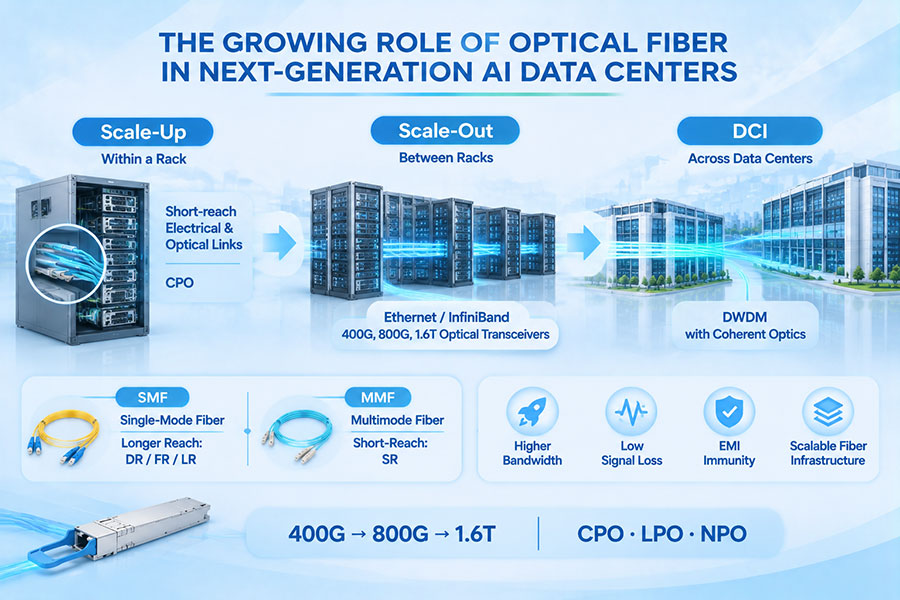
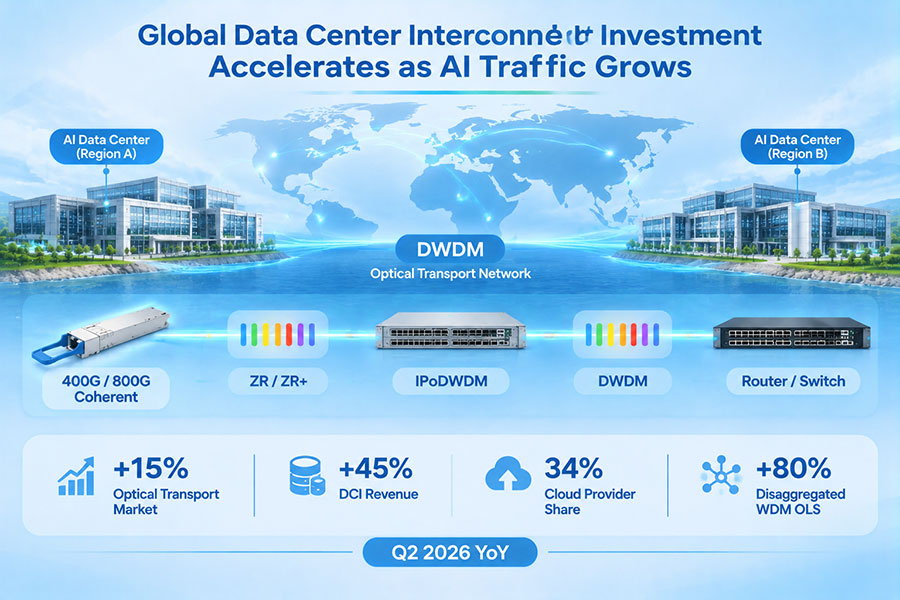
As photonic computing research advances, AI infrastructure will need to support increasingly complex interactions between electronic processors, optical accelerators, memory systems, and high-speed networks. Even if optical computing performs selected calculations on-chip, the surrounding infrastructure must still move data efficiently between computing devices and facilities.
This creates two related but distinct development paths:
Photonic computation: Uses light to perform selected mathematical or information-processing operations within a computing device.
Optical interconnect: Uses optical signals to transmit data between processors, accelerators, switches, storage systems, and data centers.
These technologies can complement each other. A photonic accelerator may require high-bandwidth connections to electronic processors and memory systems. Optical interconnects can support these connections by providing high-capacity data transmission across chip, board, rack, and data center network boundaries.
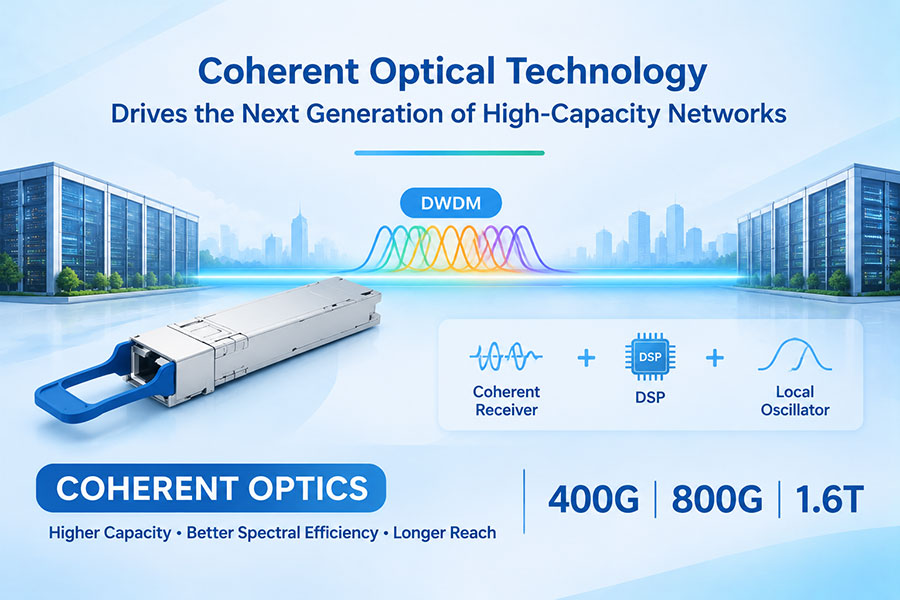
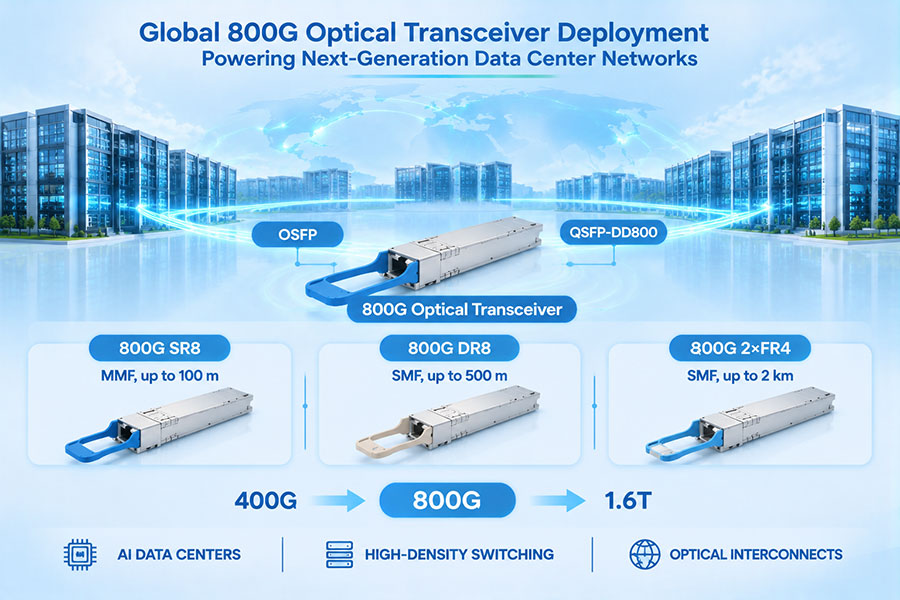
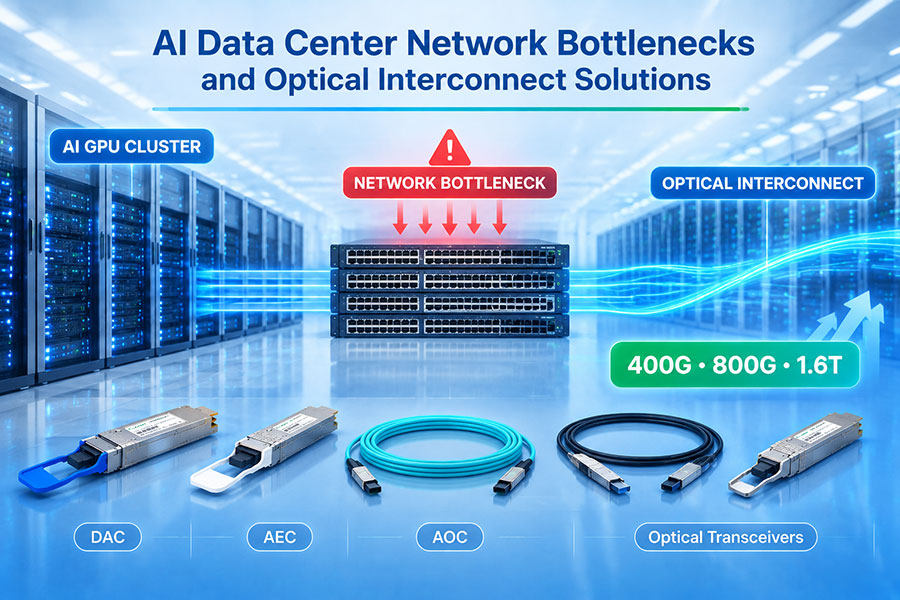
As AI systems scale, optical connectivity technologies such as 800G and 1.6T transceivers, AOC, AEC, and advanced optical integration are becoming increasingly relevant to the wider computing ecosystem. They do not themselves perform optical computing, but they help move the data required by modern AI infrastructure.
11. High-Speed Optical Connectivity from C-LIGHT
Although optical computing and optical communication serve different purposes, both depend on advances in photonic technology. Optical computing focuses on processing information with light, while optical connectivity provides the high-speed data transmission required by distributed computing systems.
C-LIGHT provides optical connectivity products for high-bandwidth data center and AI infrastructure applications. Relevant product families include:
1.6T OSFP-RHS optical transceivers: The C-LIGHT 1.6T OSFP-RHS series supports next-generation high-bandwidth optical interconnect applications. The listed configurations include 2DR4 and 2FR4 variants for different reach requirements.
800G OSFP optical transceivers: The 800G OSFP portfolio includes SR8, DR8, and 2×FR4 configurations for high-speed data center connectivity.
800G AOC cables: The 800G AOC series provides integrated optical cable connectivity for suitable short- and medium-distance data center links.
800G AEC cables: The 800G AEC series provides active copper connectivity for qualified short-distance, high-bandwidth connections.
Optical transceiver portfolio: The C-LIGHT optical transceiver range covers multiple data rates, form factors, and optical transmission applications.
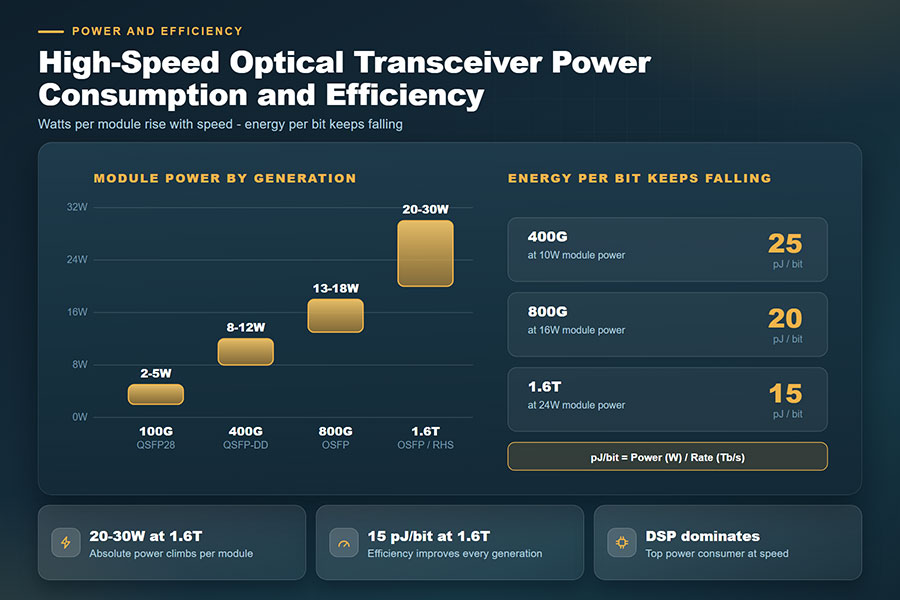
For AI infrastructure developers, the selection of optical connectivity should consider data rate, transmission distance, host compatibility, power consumption, thermal conditions, and network architecture. As photonic computing evolves, reliable optical interconnects will remain an important part of the systems that connect processors, accelerators, and distributed computing resources.
12. Future Development of Optical Computing
The next stage of optical computing research will focus on making photonic systems more scalable, programmable, accurate, and energy-efficient at the complete system level.
Several development directions are attracting attention:
Higher-density photonic integration: More optical processing elements will be integrated into compact chips to increase computational capacity and reduce interconnection complexity.
Improved electro-optic conversion: More efficient modulators and photodetectors will help reduce the energy and latency overhead associated with optical input and output.
Advanced photonic materials: Silicon, silicon nitride, thin-film lithium niobate, and other photonic platforms offer different advantages for integration, modulation, and optical processing.
Hybrid computing architectures: Combining electronic logic, digital memory, and photonic processing may provide a practical path toward specialized accelerators.
More stable programmable circuits: Better phase control, calibration, and thermal management will improve the reliability of large photonic processing networks.
Application-specific processors: Specialized optical processors may emerge for inference, signal processing, sensing, and selected scientific workloads.
Commercial adoption will depend on more than peak optical throughput. Developers must demonstrate consistent accuracy, system-level energy savings, competitive cost, manufacturability, and reliable operation under real workloads.
13. Conclusion
Optical computing is opening a new direction in the development of future data processing technologies. By using light for selected computational operations, photonic systems offer opportunities for high-speed parallel processing, compact integration, and specialized AI acceleration.
Research in silicon photonics, optical neural networks, nanophotonic structures, and hybrid photonic-electronic architectures is steadily expanding the capabilities of light-based processing. At the same time, challenges involving conversion efficiency, analog precision, nonlinear operations, thermal stability, and manufacturing scalability remain important barriers to widespread deployment.
The most likely near-term outcome is not the complete replacement of electronic processors, but the integration of photonic accelerators into specialized computing systems. Combined with high-speed optical interconnects, these technologies could support a more efficient and scalable infrastructure for AI, scientific computing, telecommunications, and other data-intensive applications.
Building high-bandwidth optical infrastructure for next-generation computing?
C-LIGHT provides optical transceivers and high-speed interconnect solutions for AI data centers, HPC systems, and advanced networking environments. Contact our team to discuss optical connectivity requirements, product specifications, and compatibility.
 >

 >
 >
 >
 >
 >
 >
 >